OrthoVellum
Knowledge Hub

Study

  • Topics
  • MCQs
  • ISAWE
  • Operative Surgery
  • Flashcards

Company

  • About Us
  • Editorial Policy
  • Contact
  • FAQ
  • Blog

Legal

  • Terms of Service
  • Privacy Policy
  • Cookie Policy
  • Medical Disclaimer
  • Copyright & DMCA
  • Refund Policy

Support

  • Help Center
  • Accessibility
  • Report an Issue
OrthoVellum

© 2026 OrthoVellum. For educational purposes only.

Not affiliated with the Royal Australasian College of Surgeons.

Back to ISAWE Scenarios
Contents
0%
spine

Atlas Fracture (C1 Fracture)
advanced
6 min
28 marks
6 questions
Clinical Scenario
A 28-year-old man presents after diving into a shallow pool and striking his head on the bottom. He has severe upper neck pain and is holding his head with his hands. He is neurologically intact. CT scan shows a burst fracture of C1 with bilateral lateral mass displacement. Open-mouth odontoid view shows combined lateral mass displacement of 8mm.
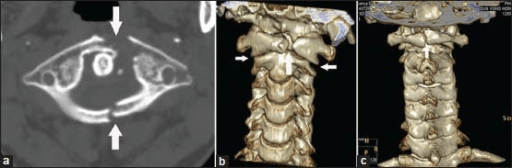
Axial and coronal CT images demonstrating a Jefferson burst fracture of C1 with bilateral anterior and posterior arch fractures. There is lateral displacement of the C1 lateral masses with a combined lateral mass displacement (LMD) of 8mm measured on open-mouth odontoid view. The transverse ligament status is concerning. This represents an unstable C1 ring fracture.
Open Full Size

Axial and coronal CT images demonstrating a Jefferson burst fracture of C1 with bilateral anterior and posterior arch fractures. There is lateral displacement of the C1 lateral masses with a combined lateral mass displacement (LMD) of 8mm measured on open-mouth odontoid view. The transverse ligament status is concerning. This represents an unstable C1 ring fracture.

Image source: Open Access medical literature (NIH/PubMed Central) • CC-BY License

Questions

Question 1 (4 marks)

Describe the CT findings and classify this fracture.

Question 2 (5 marks)

What is the transverse ligament and why is its integrity critical?

Question 3 (6 marks)

How do you assess transverse ligament integrity and what is the Rule of Spence?

Question 4 (5 marks)

What are the treatment options based on stability assessment?

Question 5 (4 marks)

Describe the surgical options when surgery is indicated.

Question 6 (4 marks)

What are the expected outcomes and potential complications?

Exam Day Cheat Sheet

Must Mention

  • •Jefferson = 4-part burst fracture (anterior + posterior arches bilateral)
  • •Transverse ligament integrity = KEY
  • •Rule of Spence: LMD >6.9mm (limited by magnification)
  • •MRI = gold standard for TL assessment
  • •TL intact = collar/halo (8-12 weeks)
  • •TL ruptured = C1-C2 posterior fusion
  • •Usually neurologically intact (wide canal)

Common Pitfalls

  • •Ignoring TL status
  • •Rule of Spence only
  • •No MRI
  • •Surgery for all
  • •Missing vertebral artery
  • •Wrong fusion levels
Scenario Info
Answers Revealed0/6
Difficulty
advanced
Time Allowed6 min
Total Marks28
Questions6
Related Scenarios

Acute Spinal Cord Injury

spine•28 marks

Adolescent Idiopathic Scoliosis

spine•28 marks

Cauda Equina Syndrome

spine•28 marks

Central Cord Syndrome

spine•28 marks

Cervical Facet Dislocation

spine•28 marks