OrthoVellum
Knowledge Hub

Study

  • Topics
  • MCQs
  • ISAWE
  • Operative Surgery
  • Flashcards

Company

  • About Us
  • Editorial Policy
  • Contact
  • FAQ
  • Blog

Legal

  • Terms of Service
  • Privacy Policy
  • Cookie Policy
  • Medical Disclaimer
  • Copyright & DMCA
  • Refund Policy

Support

  • Help Center
  • Accessibility
  • Report an Issue
OrthoVellum

© 2026 OrthoVellum. For educational purposes only.

Not affiliated with the Royal Australasian College of Surgeons.

Back to ISAWE Scenarios
Contents
0%
spine

Acute Spinal Cord Injury
advanced
6 min
28 marks
6 questions
Clinical Scenario
A 28-year-old male motorcyclist is brought to the emergency department after a high-speed collision. He was found with no movement in all four limbs at the scene. On arrival, he is conscious with BP 70/40, HR 55. He has complete loss of motor and sensory function below the clavicles. He has priapism and absent anal tone. His C-spine is immobilized.
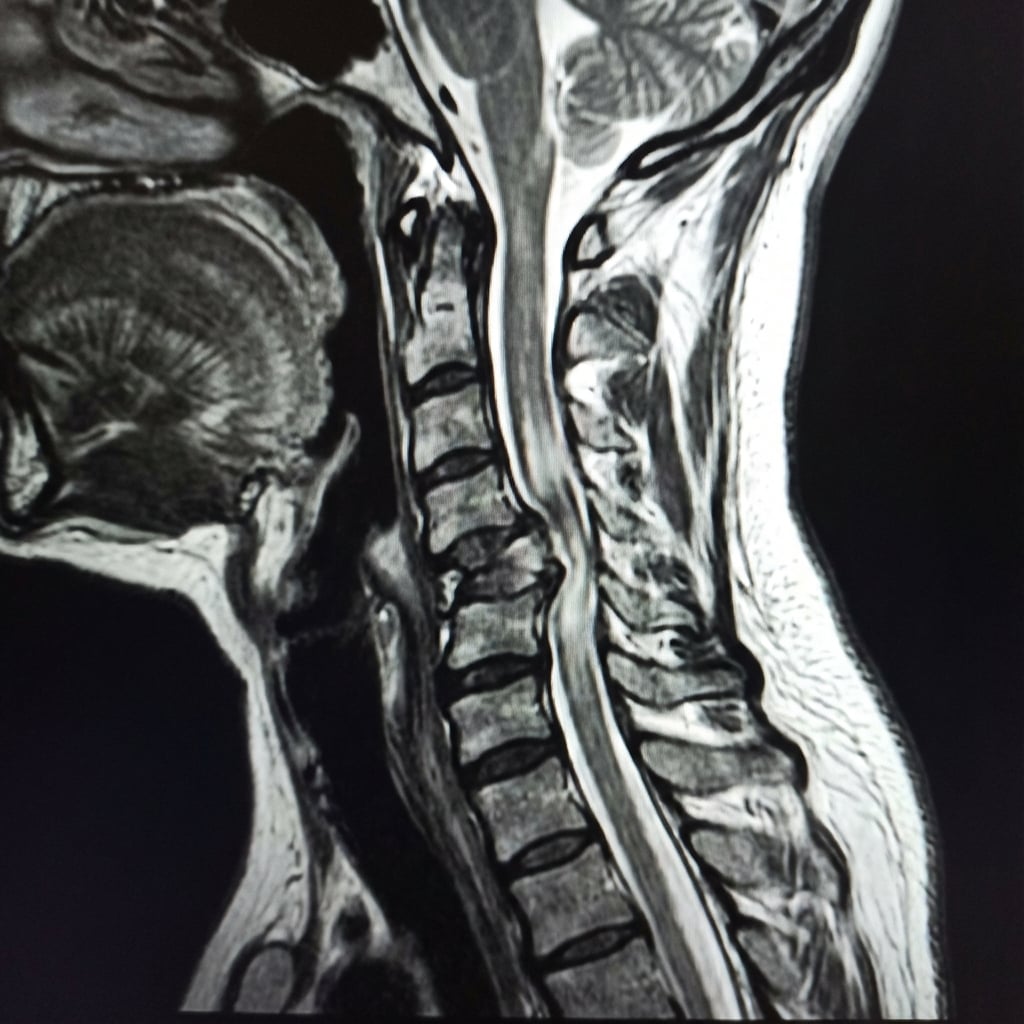
Sagittal T2-weighted MRI demonstrating C5-6 fracture-dislocation with anterior translation of C5 on C6. There is severe spinal cord compression with intramedullary T2 hyperintensity extending from C4 to C7 consistent with cord edema and contusion. The posterior ligamentous complex is disrupted. This represents complete spinal cord injury at C5 level.
Open Full Size

Sagittal T2-weighted MRI demonstrating C5-6 fracture-dislocation with anterior translation of C5 on C6. There is severe spinal cord compression with intramedullary T2 hyperintensity extending from C4 to C7 consistent with cord edema and contusion. The posterior ligamentous complex is disrupted. This represents complete spinal cord injury at C5 level.

Image source: Open Access medical literature (NIH/PubMed Central) • CC-BY License

Questions

Question 1 (4 marks)

Describe the imaging findings and classify this injury.

Question 2 (5 marks)

Explain the ASIA classification and what is the neurological level?

Question 3 (6 marks)

How do you manage neurogenic shock and what is the initial resuscitation?

Question 4 (5 marks)

What is the evidence for timing of surgery and role of steroids?

Question 5 (4 marks)

What are the acute complications and how do you prevent them?

Question 6 (4 marks)

What are the expected outcomes and rehabilitation considerations?

Exam Day Cheat Sheet

Must Mention

  • •ASIA classification (A = complete, B-D = incomplete)
  • •Sacral sparing = incomplete (check S4-5 sensation, anal tone)
  • •Neurogenic shock = hypotension + bradycardia
  • •MAP ≥85 mmHg for 5-7 days
  • •STASCIS: early surgery (<24h) = better outcomes
  • •Steroids NOT standard of care
  • •DVT prophylaxis mandatory

Common Pitfalls

  • •Confusing shock types
  • •Wrong ASIA classification
  • •Steroids as standard
  • •Delayed surgery
  • •Missing respiratory monitoring
  • •Forgetting DVT prophylaxis
Scenario Info
Answers Revealed0/6
Difficulty
advanced
Time Allowed6 min
Total Marks28
Questions6
Related Scenarios

Adolescent Idiopathic Scoliosis

spine•28 marks

Atlas Fracture (C1 Fracture)

spine•28 marks

Cauda Equina Syndrome

spine•28 marks

Central Cord Syndrome

spine•28 marks

Cervical Facet Dislocation

spine•28 marks