OrthoVellum
Knowledge Hub

Study

  • Topics
  • MCQs
  • ISAWE
  • Operative Surgery
  • Flashcards

Company

  • About Us
  • Editorial Policy
  • Contact
  • FAQ
  • Blog

Legal

  • Terms of Service
  • Privacy Policy
  • Cookie Policy
  • Medical Disclaimer
  • Copyright & DMCA
  • Refund Policy

Support

  • Help Center
  • Accessibility
  • Report an Issue
OrthoVellum

Β© 2026 OrthoVellum. For educational purposes only.

Not affiliated with the Royal Australasian College of Surgeons.

Back to ISAWE Scenarios
Contents
0%
spine

Central Cord Syndrome
advanced
6 min
28 marks
6 questions
Clinical Scenario
A 72-year-old man presents after falling forward onto his forehead. He has disproportionate weakness in his arms compared to his legs. He can wiggle his toes but cannot grip or extend his fingers. He has a band of numbness across both arms and reports burning pain in his hands. He has a history of neck stiffness for years. Examination shows 2/5 power in upper limbs, 4/5 in lower limbs, and intact bladder function.
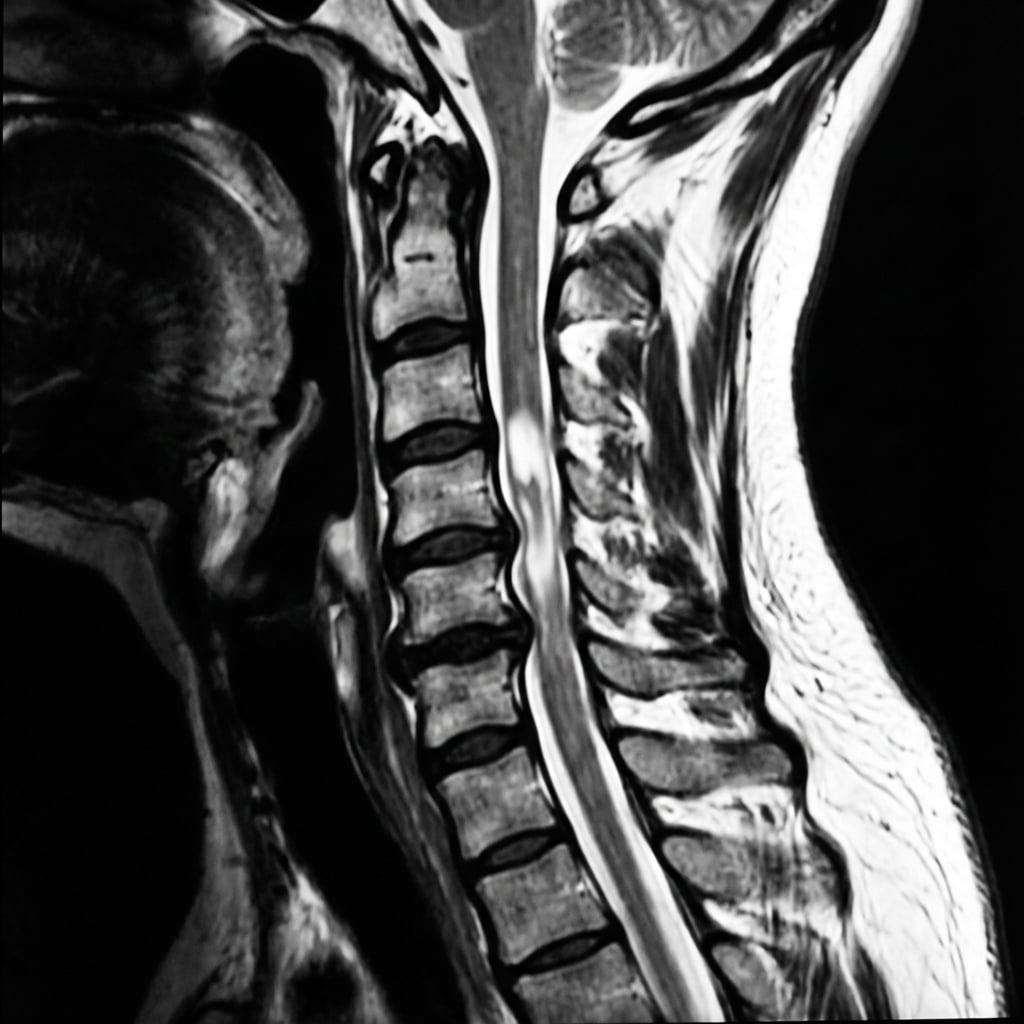
Sagittal T2-weighted MRI demonstrating multilevel cervical spondylosis with stenosis from C3-6. There is central cord T2 hyperintensity at C4-5 level indicating cord edema/contusion. There is no fracture or dislocation. This represents central cord syndrome from hyperextension injury in a patient with pre-existing cervical stenosis.
Open Full Size

Sagittal T2-weighted MRI demonstrating multilevel cervical spondylosis with stenosis from C3-6. There is central cord T2 hyperintensity at C4-5 level indicating cord edema/contusion. There is no fracture or dislocation. This represents central cord syndrome from hyperextension injury in a patient with pre-existing cervical stenosis.

Image source: Open Access medical literature (NIH/PubMed Central) β€’ CC-BY License

Questions

Question 1 (4 marks)

Describe the MRI findings and explain the pathophysiology.

Question 2 (5 marks)

What are the clinical features and how does this differ from other incomplete SCI syndromes?

Question 3 (6 marks)

How do you investigate and what is the initial management?

Question 4 (5 marks)

What is the evidence regarding surgical timing?

Question 5 (4 marks)

What are the expected outcomes and recovery pattern?

Question 6 (4 marks)

Describe your surgical approach if surgery is indicated.

Exam Day Cheat Sheet

Must Mention

  • β€’Upper limbs weaker than lower limbs
  • β€’Hyperextension in spondylotic/elderly spine
  • β€’No fracture typically (soft tissue mechanism)
  • β€’Recovery: legs β†’ bladder β†’ proximal arms β†’ hands
  • β€’Surgical timing debated (trend toward early)
  • β€’Approach based on pathology location

Common Pitfalls

  • β€’Confusing syndromes
  • β€’Wrong recovery order
  • β€’Emergency surgery for all
  • β€’Missing stenosis
  • β€’Wrong surgical approach
  • β€’Laminoplasty in kyphosis
Scenario Info
Answers Revealed0/6
Difficulty
advanced
Time Allowed6 min
Total Marks28
Questions6
Related Scenarios

Acute Spinal Cord Injury

spineβ€’28 marks

Adolescent Idiopathic Scoliosis

spineβ€’28 marks

Atlas Fracture (C1 Fracture)

spineβ€’28 marks

Cauda Equina Syndrome

spineβ€’28 marks

Cervical Facet Dislocation

spineβ€’28 marks