OrthoVellum
Knowledge Hub

Study

  • Topics
  • MCQs
  • ISAWE
  • Operative Surgery
  • Flashcards

Company

  • About Us
  • Editorial Policy
  • Contact
  • FAQ
  • Blog

Legal

  • Terms of Service
  • Privacy Policy
  • Cookie Policy
  • Medical Disclaimer
  • Copyright & DMCA
  • Refund Policy

Support

  • Help Center
  • Accessibility
  • Report an Issue
OrthoVellum

© 2026 OrthoVellum. For educational purposes only.

Not affiliated with the Royal Australasian College of Surgeons.

Back to ISAWE Scenarios
Contents
0%
spine

Cauda Equina Syndrome
advanced
6 min
28 marks
6 questions
Clinical Scenario
A 45-year-old woman presents to the emergency department with a 2-day history of worsening low back pain and bilateral leg pain. She now reports difficulty passing urine and has not opened her bowels for 24 hours. On examination, she has reduced perianal sensation bilaterally and a post-void residual of 350mL.
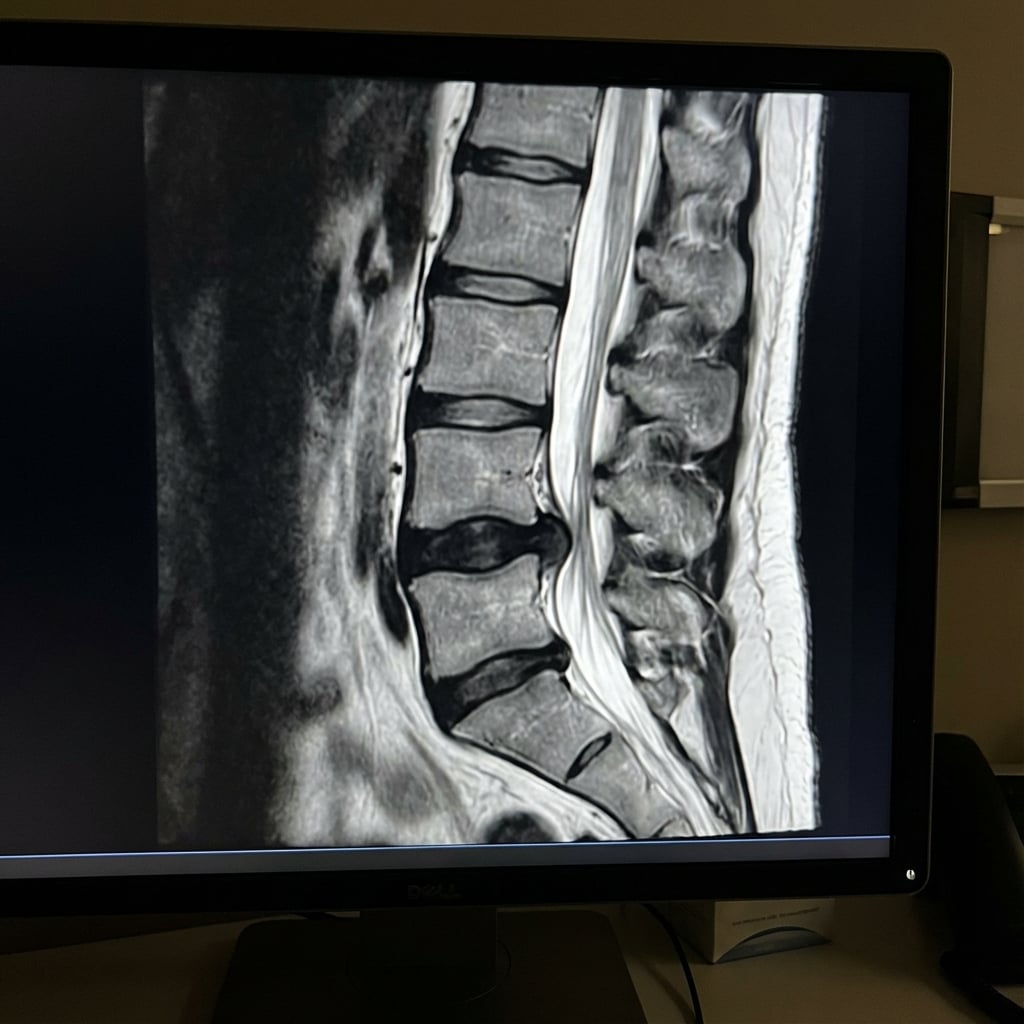
Sagittal T2-weighted MRI demonstrating large L4-5 disc herniation with severe canal stenosis. Axial image shows the disc occupying >50% of the canal with compression of the cauda equina nerve roots. There is obliteration of CSF signal around the roots. This represents cauda equina syndrome requiring emergency surgical decompression.
Open Full Size

Sagittal T2-weighted MRI demonstrating large L4-5 disc herniation with severe canal stenosis. Axial image shows the disc occupying >50% of the canal with compression of the cauda equina nerve roots. There is obliteration of CSF signal around the roots. This represents cauda equina syndrome requiring emergency surgical decompression.

Image source: Open Access medical literature (NIH/PubMed Central) • CC-BY License

Questions

Question 1 (4 marks)

Describe the MRI findings and define cauda equina syndrome.

Question 2 (5 marks)

What are the clinical features and how do you classify the severity?

Question 3 (6 marks)

What is the optimal timing of surgery and what does the evidence show?

Question 4 (5 marks)

Describe your surgical technique for emergency decompression.

Question 5 (4 marks)

What are the expected outcomes and prognostic factors?

Question 6 (4 marks)

What documentation and consent issues are specific to this condition?

Exam Day Cheat Sheet

Must Mention

  • •CES-I (incomplete) vs CES-R (retention) classification
  • •Bladder dysfunction is the DEFINING feature
  • •Post-void residual >200mL significant
  • •Operate ASAP - earlier is better
  • •CES-I → CES-R conversion = worse outcome
  • •Prognosis depends on pre-op bladder status
  • •Document everything (medicolegal)

Common Pitfalls

  • •Missing the diagnosis (not checking red flags)
  • •Not measuring PVR
  • •Delaying surgery
  • •Poor documentation
  • •Not discussing prognosis realistically
  • •Back pain alone is NOT CES
Scenario Info
Answers Revealed0/6
Difficulty
advanced
Time Allowed6 min
Total Marks28
Questions6
Related Scenarios

Acute Spinal Cord Injury

spine•28 marks

Adolescent Idiopathic Scoliosis

spine•28 marks

Atlas Fracture (C1 Fracture)

spine•28 marks

Central Cord Syndrome

spine•28 marks

Cervical Facet Dislocation

spine•28 marks