OrthoVellum
Knowledge Hub

Study

  • Topics
  • MCQs
  • ISAWE
  • Operative Surgery
  • Flashcards

Company

  • About Us
  • Editorial Policy
  • Contact
  • FAQ
  • Blog

Legal

  • Terms of Service
  • Privacy Policy
  • Cookie Policy
  • Medical Disclaimer
  • Copyright & DMCA
  • Refund Policy

Support

  • Help Center
  • Accessibility
  • Report an Issue
OrthoVellum

© 2026 OrthoVellum. For educational purposes only.

Not affiliated with the Royal Australasian College of Surgeons.

Back to ISAWE Scenarios
Contents
0%
spine

Spine Fracture in Ankylosing Spondylitis
advanced
6 min
28 marks
6 questions
Clinical Scenario
A 62-year-old man with known ankylosing spondylitis presents after a fall from standing height. He has severe neck pain and is unable to move his head. He has progressive weakness in all four limbs over the past 2 hours. He has a long-standing rigid kyphotic spine. On examination, he has 2/5 power in upper limbs and 3/5 in lower limbs with hyperreflexia.
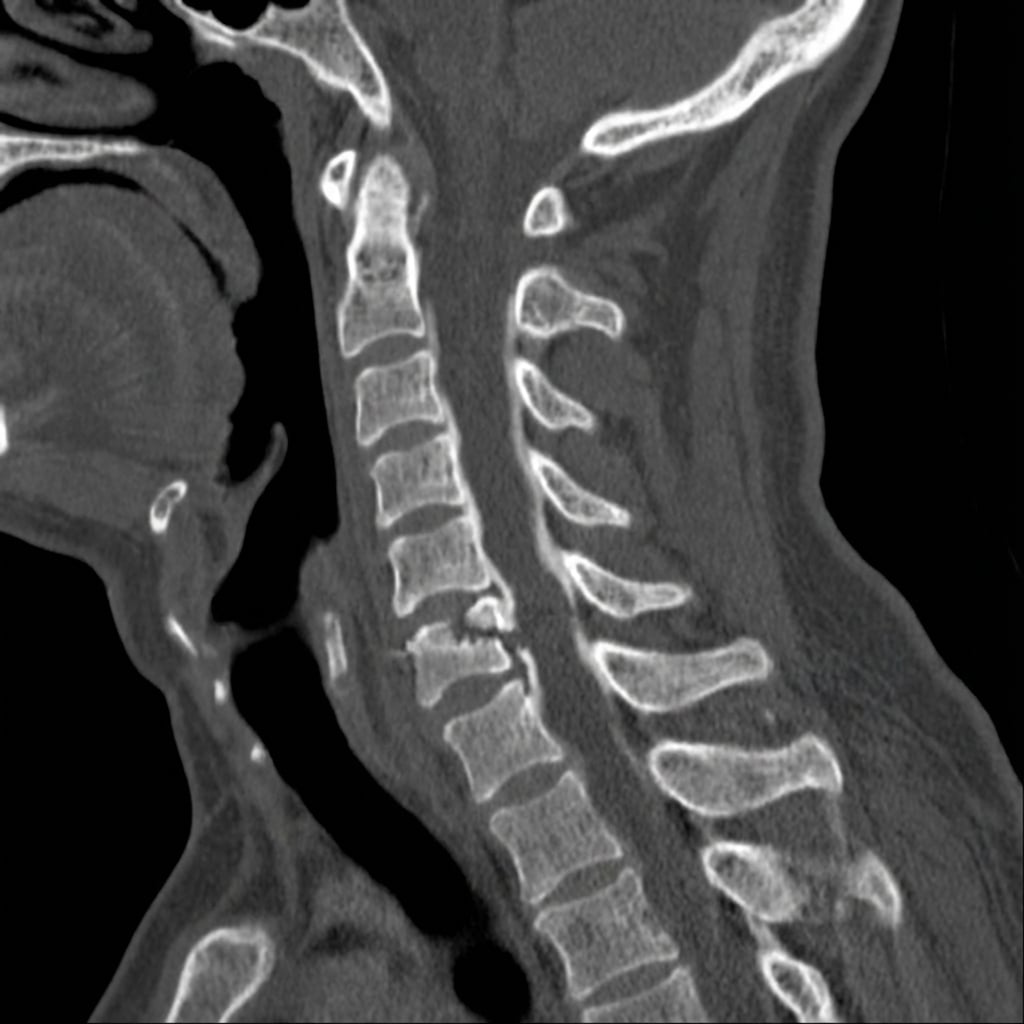
Sagittal CT demonstrating a hyperextension fracture-dislocation through a completely ankylosed cervical spine at C6-7 in a patient with ankylosing spondylitis. The fracture extends through the fused disc space and facets (three-column injury). There is posterior displacement with likely epidural hematoma. The remainder of the spine shows complete ankylosis with bridging syndesmophytes.
Open Full Size

Sagittal CT demonstrating a hyperextension fracture-dislocation through a completely ankylosed cervical spine at C6-7 in a patient with ankylosing spondylitis. The fracture extends through the fused disc space and facets (three-column injury). There is posterior displacement with likely epidural hematoma. The remainder of the spine shows complete ankylosis with bridging syndesmophytes.

Image source: Open Access medical literature (NIH/PubMed Central) • CC-BY License

Questions

Question 1 (4 marks)

Describe the imaging findings and why is this injury pattern unique?

Question 2 (5 marks)

What are the special considerations in managing AS spine fractures?

Question 3 (6 marks)

What investigations are required and what are you looking for?

Question 4 (5 marks)

Describe your management algorithm and surgical approach.

Question 5 (4 marks)

What are the technical considerations for surgical fixation?

Question 6 (4 marks)

What are the expected outcomes and complications?

Exam Day Cheat Sheet

Must Mention

  • •Three-column injury (long bone analogy)
  • •Low-energy mechanism
  • •CT entire spine (5-10% have second fracture)
  • •MRI for epidural hematoma (30-40%)
  • •Surgical stabilization preferred
  • •Long constructs (3-4 levels each side)
  • •Careful handling (fragile spine)
  • •Awake fiberoptic intubation if cervical

Common Pitfalls

  • •Underestimate severity
  • •Miss second fracture
  • •Miss epidural hematoma
  • •Short constructs
  • •Rough handling
  • •Delayed surgery
  • •Forced positioning
Scenario Info
Answers Revealed0/6
Difficulty
advanced
Time Allowed6 min
Total Marks28
Questions6
Related Scenarios

Acute Spinal Cord Injury

spine•28 marks

Adolescent Idiopathic Scoliosis

spine•28 marks

Atlas Fracture (C1 Fracture)

spine•28 marks

Cauda Equina Syndrome

spine•28 marks

Central Cord Syndrome

spine•28 marks