OrthoVellum
Knowledge Hub

Study

  • Topics
  • MCQs
  • ISAWE
  • Operative Surgery
  • Flashcards

Company

  • About Us
  • Editorial Policy
  • Contact
  • FAQ
  • Blog

Legal

  • Terms of Service
  • Privacy Policy
  • Cookie Policy
  • Medical Disclaimer
  • Copyright & DMCA
  • Refund Policy

Support

  • Help Center
  • Accessibility
  • Report an Issue
OrthoVellum

© 2026 OrthoVellum. For educational purposes only.

Not affiliated with the Royal Australasian College of Surgeons.

Back to ISAWE Scenarios
Contents
0%
spine

Cervical Myelopathy

advanced
6 min
28 marks
6 questions
Clinical Scenario
A 62-year-old man presents with a 12-month history of progressive difficulty walking and hand clumsiness. He reports difficulty buttoning shirts and notices his handwriting has deteriorated. He also describes intermittent electric shock sensations down his spine with neck flexion. He has mild neck pain but his main complaints are functional limitations.
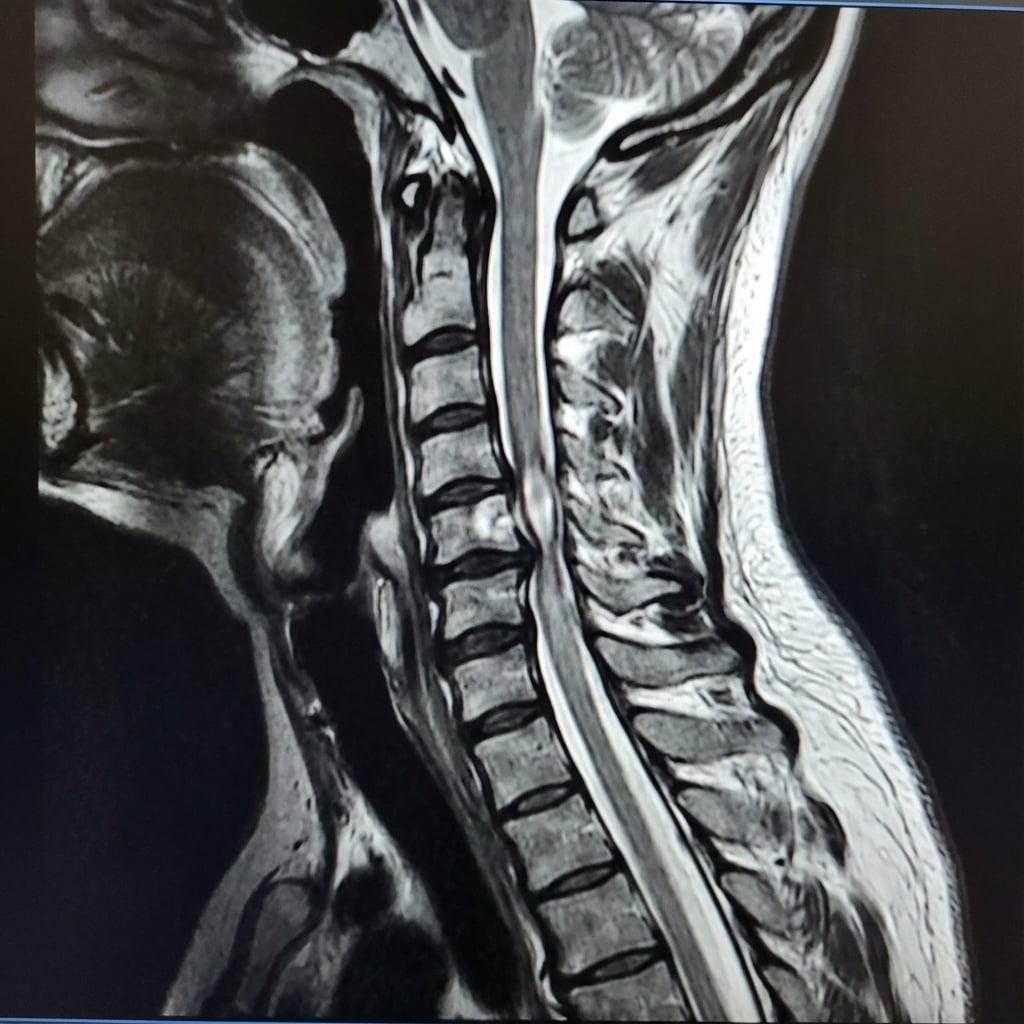
Sagittal T2-weighted MRI demonstrating multi-level cervical stenosis at C3-4, C4-5, and C5-6. There is cord compression with intramedullary T2 hyperintensity at C4-5 level indicating myelomalacia. The cord appears flattened and draped over disc-osteophyte complexes. Ligamentum flavum hypertrophy contributes posteriorly. This represents degenerative cervical myelopathy (DCM) requiring surgical decompression.
Open Full Size

Sagittal T2-weighted MRI demonstrating multi-level cervical stenosis at C3-4, C4-5, and C5-6. There is cord compression with intramedullary T2 hyperintensity at C4-5 level indicating myelomalacia. The cord appears flattened and draped over disc-osteophyte complexes. Ligamentum flavum hypertrophy contributes posteriorly. This represents degenerative cervical myelopathy (DCM) requiring surgical decompression.

Image source: Open Access medical literature (NIH/PubMed Central) • CC-BY License

Questions

Question 1 (4 marks)

Describe the MRI findings and explain the clinical significance of myelomalacia.

Question 2 (5 marks)

What are the clinical features of cervical myelopathy and how do you assess severity?

Question 3 (6 marks)

What factors determine your choice between anterior and posterior surgical approaches?

Question 4 (5 marks)

Describe your technique for anterior cervical decompression and fusion (ACDF).

Question 5 (4 marks)

What are the indications and technique for cervical laminoplasty?

Question 6 (4 marks)

What is the natural history and expected outcomes after surgical treatment?

Exam Day Cheat Sheet

Must Mention

  • •Myelomalacia = T2 cord signal = chronic damage = poorer recovery
  • •UMN signs: Hoffman's, hyperreflexia, clonus, Babinski
  • •JOA score 17 max (severity: <9 severe, 9-12 moderate, 13-17 mild)
  • •Anterior for 1-2 levels, posterior for ≥3 levels
  • •K-line negative = posterior less effective
  • •Laminoplasty requires lordosis
  • •Surgery arrests progression, 50-75% recovery rate

Common Pitfalls

  • •Confusing myelopathy (UMN) with radiculopathy (LMN)
  • •Laminoplasty in kyphosis (won't work)
  • •Ignoring K-line in posterior planning
  • •Not assessing dynamic instability
  • •Overestimating recovery with myelomalacia
Scenario Info
Answers Revealed0/6
Difficulty
advanced
Time Allowed6 min
Total Marks28
Questions6
Related Scenarios

Acute Spinal Cord Injury

spine•28 marks

Adolescent Idiopathic Scoliosis

spine•28 marks

Atlas Fracture (C1 Fracture)

spine•28 marks

Cauda Equina Syndrome

spine•28 marks

Central Cord Syndrome

spine•28 marks