OrthoVellum
Knowledge Hub

Study

  • Topics
  • MCQs
  • ISAWE
  • Operative Surgery
  • Flashcards

Company

  • About Us
  • Editorial Policy
  • Contact
  • FAQ
  • Blog

Legal

  • Terms of Service
  • Privacy Policy
  • Cookie Policy
  • Medical Disclaimer
  • Copyright & DMCA
  • Refund Policy

Support

  • Help Center
  • Accessibility
  • Report an Issue
OrthoVellum

© 2026 OrthoVellum. For educational purposes only.

Not affiliated with the Royal Australasian College of Surgeons.

Back to ISAWE Scenarios
Contents
0%
spine

Degenerative Lumbar Spondylolisthesis
advanced
6 min
28 marks
6 questions
Clinical Scenario
A 68-year-old woman presents with a 2-year history of bilateral leg pain and heaviness when walking. She can walk approximately 200 meters before needing to stop and sit or lean forward. Standing and walking uphill are particularly difficult. Her symptoms are relieved by sitting or leaning on a shopping trolley. She has tried physiotherapy and epidural injections with limited relief.
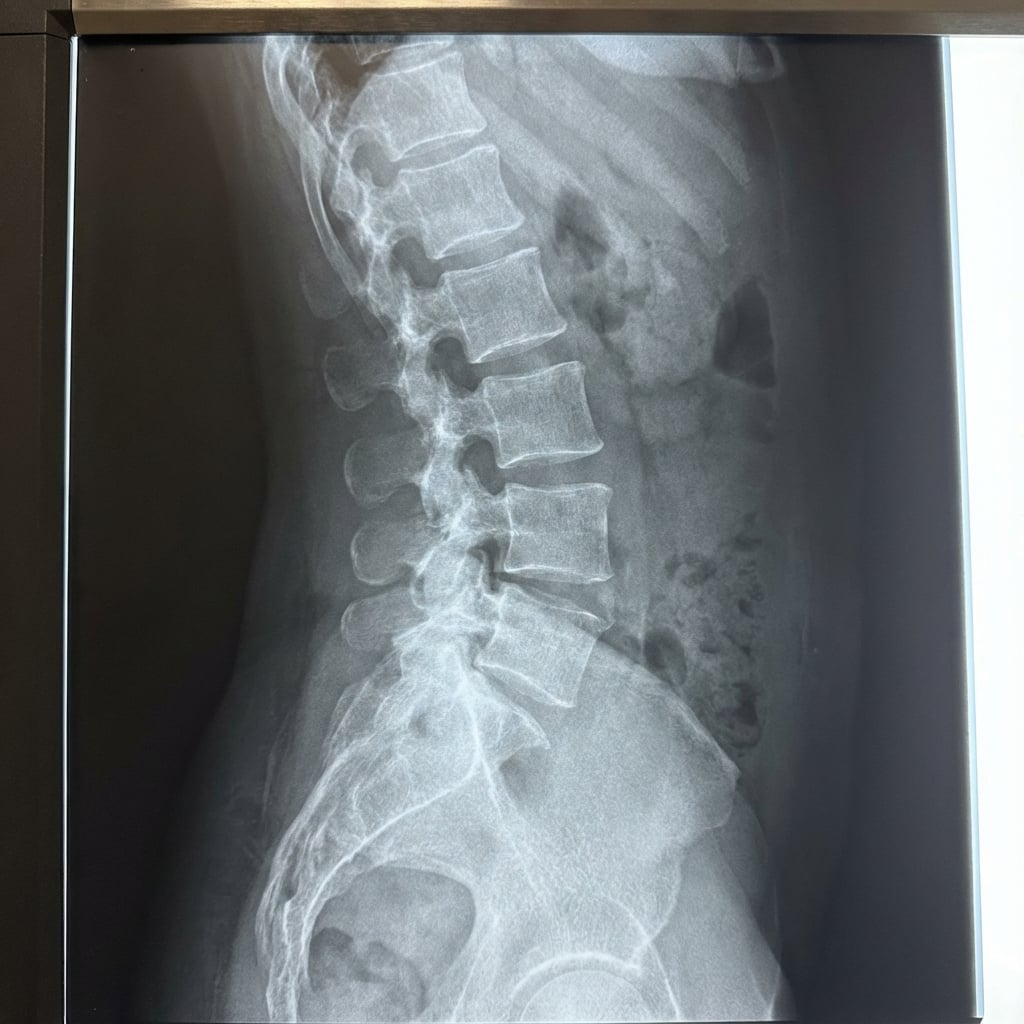
Lateral standing radiograph demonstrating Grade I (Meyerding) anterior spondylolisthesis of L4 on L5. There is disc space narrowing at L4-5 and facet hypertrophy. MRI shows central and lateral recess stenosis at L4-5 with compression of the traversing L5 nerve roots. The pars is intact. This represents degenerative spondylolisthesis causing neurogenic claudication.
Open Full Size

Lateral standing radiograph demonstrating Grade I (Meyerding) anterior spondylolisthesis of L4 on L5. There is disc space narrowing at L4-5 and facet hypertrophy. MRI shows central and lateral recess stenosis at L4-5 with compression of the traversing L5 nerve roots. The pars is intact. This represents degenerative spondylolisthesis causing neurogenic claudication.

Image source: Open Access medical literature (NIH/PubMed Central) • CC-BY License

Questions

Question 1 (4 marks)

Describe the imaging findings and differentiate from isthmic spondylolisthesis.

Question 2 (5 marks)

What is the clinical presentation and how do you differentiate from vascular claudication?

Question 3 (6 marks)

What is the evidence for treatment options?

Question 4 (5 marks)

Describe your surgical technique for decompression and fusion.

Question 5 (4 marks)

What are the indications for interbody fusion and what options exist?

Question 6 (4 marks)

What are the expected outcomes and potential complications?

Exam Day Cheat Sheet

Must Mention

  • •Degenerative = intact pars, L4-5 most common
  • •Isthmic = pars defect, L5-S1 most common
  • •SPORT trial: surgery superior for degenerative spondylolisthesis
  • •Neurogenic claudication: relieved by flexion (shopping cart sign)
  • •Vascular claudication: relieved by standing still
  • •Decompression + fusion: lower reoperation than decompression alone

Common Pitfalls

  • •Confusing degenerative with isthmic
  • •Missing vascular claudication
  • •Decompression alone with instability
  • •Not mentioning SPORT trial
  • •Forgetting adjacent segment disease
  • •Wrong level (L4-5 not L5-S1)
Scenario Info
Answers Revealed0/6
Difficulty
advanced
Time Allowed6 min
Total Marks28
Questions6
Related Scenarios

Acute Spinal Cord Injury

spine•28 marks

Adolescent Idiopathic Scoliosis

spine•28 marks

Atlas Fracture (C1 Fracture)

spine•28 marks

Cauda Equina Syndrome

spine•28 marks

Central Cord Syndrome

spine•28 marks