OrthoVellum
Knowledge Hub

Study

  • Topics
  • MCQs
  • ISAWE
  • Operative Surgery
  • Flashcards

Company

  • About Us
  • Editorial Policy
  • Contact
  • FAQ
  • Blog

Legal

  • Terms of Service
  • Privacy Policy
  • Cookie Policy
  • Medical Disclaimer
  • Copyright & DMCA
  • Refund Policy

Support

  • Help Center
  • Accessibility
  • Report an Issue
OrthoVellum

© 2026 OrthoVellum. For educational purposes only.

Not affiliated with the Royal Australasian College of Surgeons.

Back to ISAWE Scenarios
Contents
0%
spine

Hangman's Fracture (C2 Pars Fracture)
advanced
6 min
28 marks
6 questions
Clinical Scenario
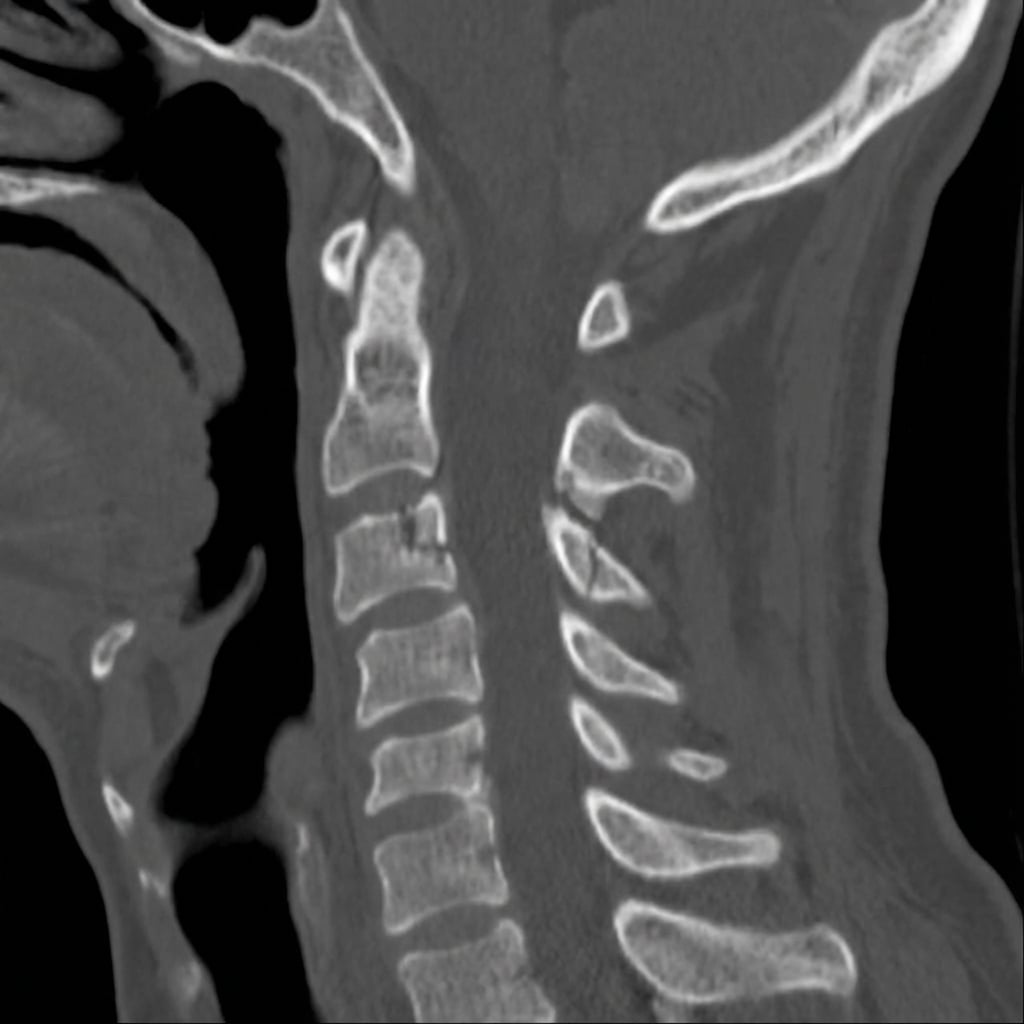
A 32-year-old man is brought in after a high-speed motor vehicle accident. He was an unrestrained driver who hit the steering wheel with his face. He complains of severe neck pain and holds his neck in his hands. He is neurologically intact. CT cervical spine shows bilateral C2 pars fractures with anterior translation of C2 on C3.
Sagittal and axial CT images demonstrating bilateral fractures through the pars interarticularis of C2 (hangman's fracture). There is anterior displacement of C2 on C3 with disruption of the C2-3 disc space. The fracture lines extend through the pars bilaterally. This represents a Type II hangman's fracture requiring consideration of surgical stabilization.
Open Full Size

Sagittal and axial CT images demonstrating bilateral fractures through the pars interarticularis of C2 (hangman's fracture). There is anterior displacement of C2 on C3 with disruption of the C2-3 disc space. The fracture lines extend through the pars bilaterally. This represents a Type II hangman's fracture requiring consideration of surgical stabilization.

Image source: Open Access medical literature (NIH/PubMed Central) • CC-BY License

Questions

Question 1 (4 marks)

Describe the CT findings and classify this fracture.

Question 2 (5 marks)

Explain the mechanism and why patients are often neurologically intact.

Question 3 (6 marks)

What is the Levine-Edwards classification and how does it guide treatment?

Question 4 (5 marks)

Describe the treatment options for each fracture type.

Question 5 (4 marks)

When is surgery indicated and what are the surgical options?

Question 6 (4 marks)

What are the expected outcomes and potential complications?

Exam Day Cheat Sheet

Must Mention

  • •Levine-Edwards classification
  • •Type IIA = NO TRACTION (flexion-distraction)
  • •Auto-decompression = usually neurologically intact
  • •Type I/II: collar/halo
  • •Type III: surgery
  • •Fusion at C2-3 (NOT C1-2)

Common Pitfalls

  • •Traction for Type IIA
  • •C1-C2 fusion (wrong level)
  • •Not knowing classification
  • •Surgery for Type I
  • •Missing auto-decompression concept
  • •Confusing II and IIA
Scenario Info
Answers Revealed0/6
Difficulty
advanced
Time Allowed6 min
Total Marks28
Questions6
Related Scenarios

Acute Spinal Cord Injury

spine•28 marks

Adolescent Idiopathic Scoliosis

spine•28 marks

Atlas Fracture (C1 Fracture)

spine•28 marks

Cauda Equina Syndrome

spine•28 marks

Central Cord Syndrome

spine•28 marks