OrthoVellum
Knowledge Hub

Study

  • Topics
  • MCQs
  • ISAWE
  • Operative Surgery
  • Flashcards

Company

  • About Us
  • Editorial Policy
  • Contact
  • FAQ
  • Blog

Legal

  • Terms of Service
  • Privacy Policy
  • Cookie Policy
  • Medical Disclaimer
  • Copyright & DMCA
  • Refund Policy

Support

  • Help Center
  • Accessibility
  • Report an Issue
OrthoVellum

© 2026 OrthoVellum. For educational purposes only.

Not affiliated with the Royal Australasian College of Surgeons.

Back to ISAWE Scenarios
Contents
0%
spine

Lumbar Disc Herniation
intermediate
6 min
28 marks
6 questions
Clinical Scenario
A 42-year-old office worker presents with a 6-week history of left leg pain radiating from the buttock to the calf and foot. The pain is worse with sitting and coughing. He has tried physiotherapy and NSAIDs with limited relief. On examination, SLR is positive at 30 degrees on the left, he has weakness of left ankle plantar flexion (4/5), and absent left ankle jerk.
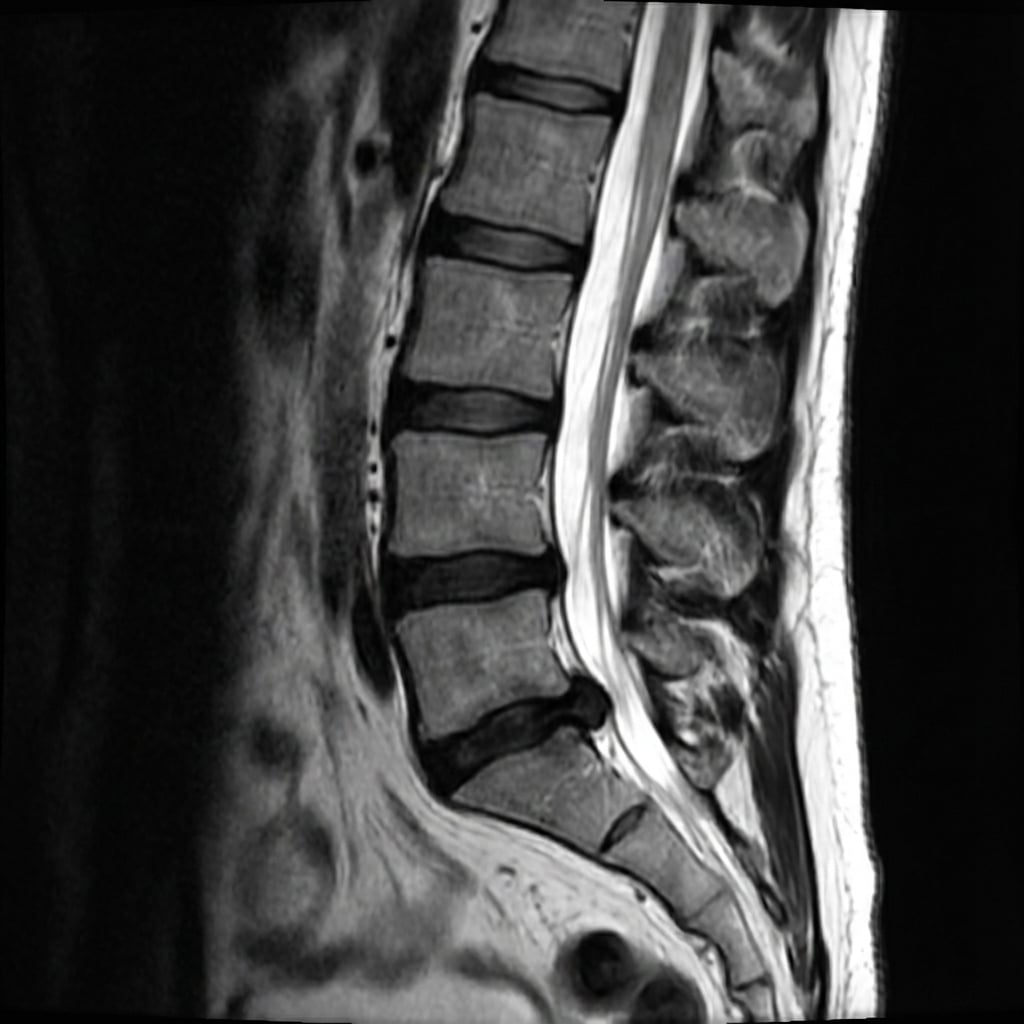
Sagittal and axial T2-weighted MRI demonstrating large left paracentral disc herniation at L5-S1. The disc fragment is extruded and extends inferiorly, compressing the left S1 nerve root in the lateral recess. There is loss of disc height and disc desiccation. The patient has left S1 radiculopathy with calf pain and absent ankle jerk.
Open Full Size

Sagittal and axial T2-weighted MRI demonstrating large left paracentral disc herniation at L5-S1. The disc fragment is extruded and extends inferiorly, compressing the left S1 nerve root in the lateral recess. There is loss of disc height and disc desiccation. The patient has left S1 radiculopathy with calf pain and absent ankle jerk.

Image source: Open Access medical literature (NIH/PubMed Central) • CC-BY License

Questions

Question 1 (4 marks)

Describe the MRI findings and correlate with the clinical presentation.

Question 2 (5 marks)

What is the natural history and what are the indications for surgery?

Question 3 (6 marks)

Describe your surgical technique for microdiscectomy.

Question 4 (5 marks)

What are the potential complications and how do you prevent them?

Question 5 (4 marks)

What clinical features would suggest a different level of herniation?

Question 6 (4 marks)

What alternative surgical techniques exist and what is the evidence?

Exam Day Cheat Sheet

Must Mention

  • •L5-S1 paracentral = S1 root (traversing)
  • •Natural history: 90% improve without surgery
  • •Conservative trial: 6-12 weeks
  • •Absolute indications: CES, progressive motor deficit
  • •Confirm level intraoperatively
  • •Recurrence rate: 5-10%
  • •Preserve >50% facet to prevent instability

Common Pitfalls

  • •Wrong root correlation
  • •Operating too early
  • •Wrong level surgery
  • •Excessive facet removal
  • •Missing CES indications
  • •Not recognizing natural history
Scenario Info
Answers Revealed0/6
Difficulty
intermediate
Time Allowed6 min
Total Marks28
Questions6
Related Scenarios

Acute Spinal Cord Injury

spine•28 marks

Adolescent Idiopathic Scoliosis

spine•28 marks

Atlas Fracture (C1 Fracture)

spine•28 marks

Cauda Equina Syndrome

spine•28 marks

Central Cord Syndrome

spine•28 marks