OrthoVellum
Knowledge Hub

Study

  • Topics
  • MCQs
  • ISAWE
  • Operative Surgery
  • Flashcards

Company

  • About Us
  • Editorial Policy
  • Contact
  • FAQ
  • Blog

Legal

  • Terms of Service
  • Privacy Policy
  • Cookie Policy
  • Medical Disclaimer
  • Copyright & DMCA
  • Refund Policy

Support

  • Help Center
  • Accessibility
  • Report an Issue
OrthoVellum

© 2026 OrthoVellum. For educational purposes only.

Not affiliated with the Royal Australasian College of Surgeons.

Back to ISAWE Scenarios
Contents
0%
spine

Lumbar Spinal Stenosis
intermediate
6 min
28 marks
6 questions
Clinical Scenario
A 70-year-old retired farmer presents with a 3-year history of bilateral leg heaviness and pain when walking. He can manage approximately 100 meters before needing to stop and lean forward or sit down. He finds walking uphill harder than downhill, and can cycle without problems. His symptoms are relieved within minutes of sitting. He has tried physiotherapy and two epidural injections with temporary relief.
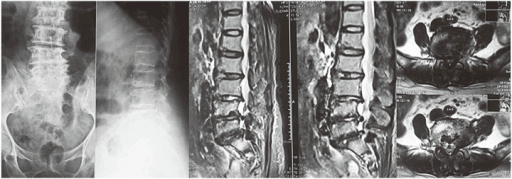
Axial and sagittal T2-weighted MRI demonstrating severe central canal stenosis at L4-5 with trefoil-shaped canal. There is bilateral ligamentum flavum hypertrophy, facet joint hypertrophy, and disc bulge causing circumferential compression of the cauda equina. Multiple levels show degenerative changes. This represents degenerative lumbar spinal stenosis causing neurogenic claudication.
Open Full Size

Axial and sagittal T2-weighted MRI demonstrating severe central canal stenosis at L4-5 with trefoil-shaped canal. There is bilateral ligamentum flavum hypertrophy, facet joint hypertrophy, and disc bulge causing circumferential compression of the cauda equina. Multiple levels show degenerative changes. This represents degenerative lumbar spinal stenosis causing neurogenic claudication.

Source: Sacral Insufficiency Fractures Mimicking Lumbar Spine Pathology • PMC4917777 • CC-BY

Questions

Question 1 (4 marks)

Describe the MRI findings and classify this stenosis.

Question 2 (5 marks)

What are the clinical features and how do you differentiate from vascular claudication?

Question 3 (6 marks)

What is the evidence for treatment and when do you recommend surgery?

Question 4 (5 marks)

Describe your surgical technique for decompression.

Question 5 (4 marks)

When is fusion indicated and what are the fusion options?

Question 6 (4 marks)

What are the expected outcomes and complications?

Exam Day Cheat Sheet

Must Mention

  • •Neurogenic claudication: positional, bicycle test positive
  • •Vascular: cramping, relieved by standing still
  • •SPORT trial: surgery superior for stenosis
  • •Decompression alone if no spondylolisthesis
  • •Fusion if spondylolisthesis or instability
  • •Preserve facets (<50%) to prevent instability

Common Pitfalls

  • •Missing vascular claudication
  • •Not knowing SPORT
  • •Unnecessary fusion
  • •Excessive facet removal
  • •Incomplete lateral decompression
  • •Missing instability
Scenario Info
Answers Revealed0/6
Difficulty
intermediate
Time Allowed6 min
Total Marks28
Questions6
Related Scenarios

Acute Spinal Cord Injury

spine•28 marks

Adolescent Idiopathic Scoliosis

spine•28 marks

Atlas Fracture (C1 Fracture)

spine•28 marks

Cauda Equina Syndrome

spine•28 marks

Central Cord Syndrome

spine•28 marks