OrthoVellum
Knowledge Hub

Study

  • Topics
  • MCQs
  • ISAWE
  • Operative Surgery
  • Flashcards

Company

  • About Us
  • Editorial Policy
  • Contact
  • FAQ
  • Blog

Legal

  • Terms of Service
  • Privacy Policy
  • Cookie Policy
  • Medical Disclaimer
  • Copyright & DMCA
  • Refund Policy

Support

  • Help Center
  • Accessibility
  • Report an Issue
OrthoVellum

© 2026 OrthoVellum. For educational purposes only.

Not affiliated with the Royal Australasian College of Surgeons.

Back to ISAWE Scenarios
Contents
0%
spine

Odontoid Fracture in the Elderly
advanced
6 min
28 marks
6 questions
Clinical Scenario
An 82-year-old woman presents after a fall at home. She has neck pain and restricted movement. She has a history of hypertension, osteoporosis, and atrial fibrillation on warfarin. She is neurologically intact. Her INR is 3.2 on presentation.
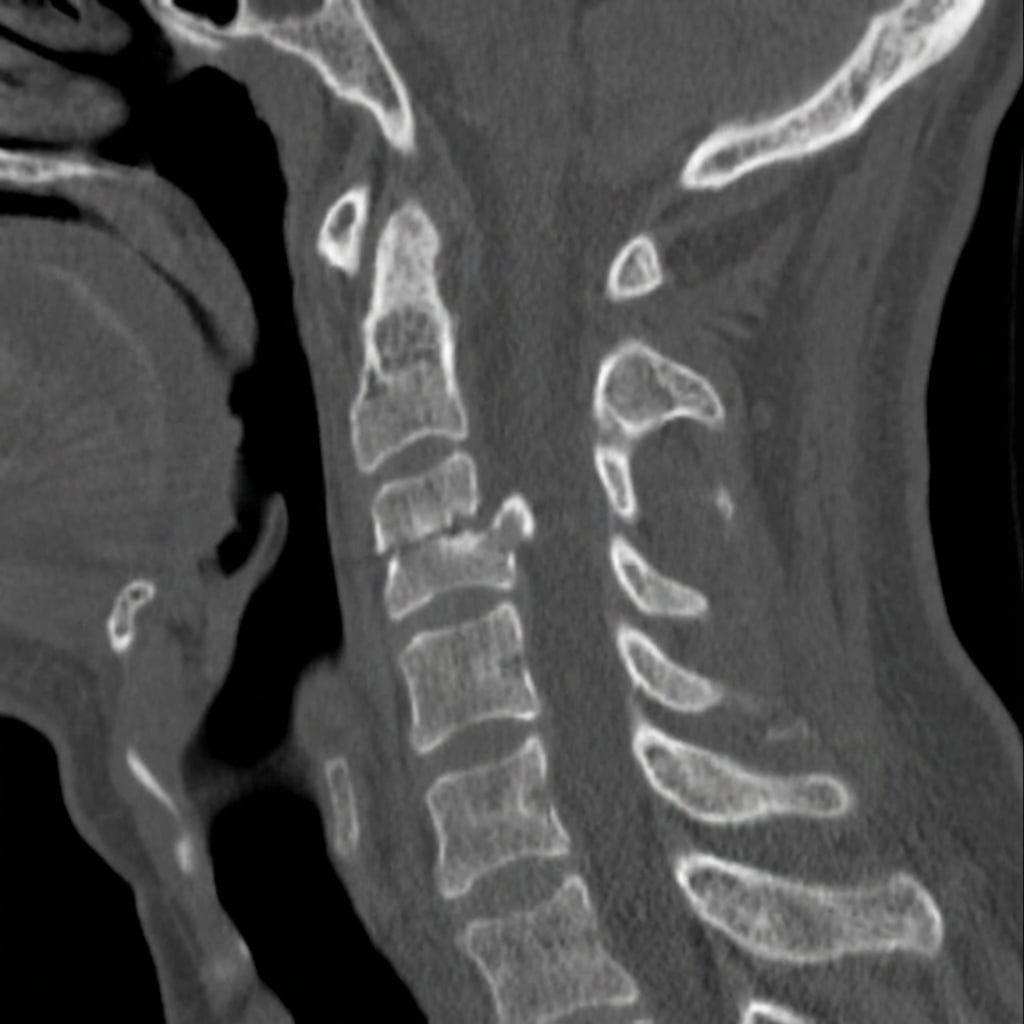
Sagittal and coronal CT images demonstrating Type II odontoid fracture at the base of the dens with 4mm posterior displacement of the dens relative to the C2 body. The fracture line is at the junction of the odontoid process and C2 body - the watershed zone for blood supply. This represents a Type II odontoid fracture in an elderly patient with high non-union risk requiring surgical stabilization.
Open Full Size

Sagittal and coronal CT images demonstrating Type II odontoid fracture at the base of the dens with 4mm posterior displacement of the dens relative to the C2 body. The fracture line is at the junction of the odontoid process and C2 body - the watershed zone for blood supply. This represents a Type II odontoid fracture in an elderly patient with high non-union risk requiring surgical stabilization.

Image source: Open Access medical literature (NIH/PubMed Central) • CC-BY License

Questions

Question 1 (4 marks)

Describe the CT findings and classify this fracture.

Question 2 (5 marks)

Why are elderly patients with Type II fractures particularly challenging?

Question 3 (6 marks)

What are the treatment options and how do you decide between them?

Question 4 (5 marks)

Describe the surgical technique for C1-C2 posterior fusion.

Question 5 (4 marks)

When is anterior odontoid screw fixation appropriate and what is the technique?

Question 6 (4 marks)

What are the outcomes and complications of treatment?

Exam Day Cheat Sheet

Must Mention

  • •Type II = base of dens = highest non-union (40-60%)
  • •Elderly Type II = surgery generally preferred
  • •Halo contraindicated in elderly
  • •Collar complications: dysphagia, skin, deconditioning
  • •Anterior screw: horizontal fracture, reducible, intact TL
  • •Posterior fusion: Goel-Harms (C1 lateral mass, C2 pedicle)
  • •Reverse anticoagulation before surgery

Common Pitfalls

  • •Collar for elderly Type II (high non-union)
  • •Halo in elderly (high complications)
  • •Anterior screw with reverse oblique fracture
  • •Missing transverse ligament injury
  • •Not reversing anticoagulation
  • •Not planning for vertebral artery
Scenario Info
Answers Revealed0/6
Difficulty
advanced
Time Allowed6 min
Total Marks28
Questions6
Related Scenarios

Acute Spinal Cord Injury

spine•28 marks

Adolescent Idiopathic Scoliosis

spine•28 marks

Atlas Fracture (C1 Fracture)

spine•28 marks

Cauda Equina Syndrome

spine•28 marks

Central Cord Syndrome

spine•28 marks