OrthoVellum
Knowledge Hub

Study

  • Topics
  • MCQs
  • ISAWE
  • Operative Surgery
  • Flashcards

Company

  • About Us
  • Editorial Policy
  • Contact
  • FAQ
  • Blog

Legal

  • Terms of Service
  • Privacy Policy
  • Cookie Policy
  • Medical Disclaimer
  • Copyright & DMCA
  • Refund Policy

Support

  • Help Center
  • Accessibility
  • Report an Issue
OrthoVellum

© 2026 OrthoVellum. For educational purposes only.

Not affiliated with the Royal Australasian College of Surgeons.

Back to ISAWE Scenarios
Contents
0%
spine

Pyogenic Spinal Infection
advanced
6 min
28 marks
6 questions
Clinical Scenario
A 55-year-old male with type 2 diabetes presents with 3 weeks of progressive back pain, fever, and malaise. He has been treated for a urinary tract infection recently. His temperature is 38.5°C, WBC 18,000, CRP 180. On examination, he has severe tenderness over the lumbar spine and has developed leg weakness over the past 48 hours.
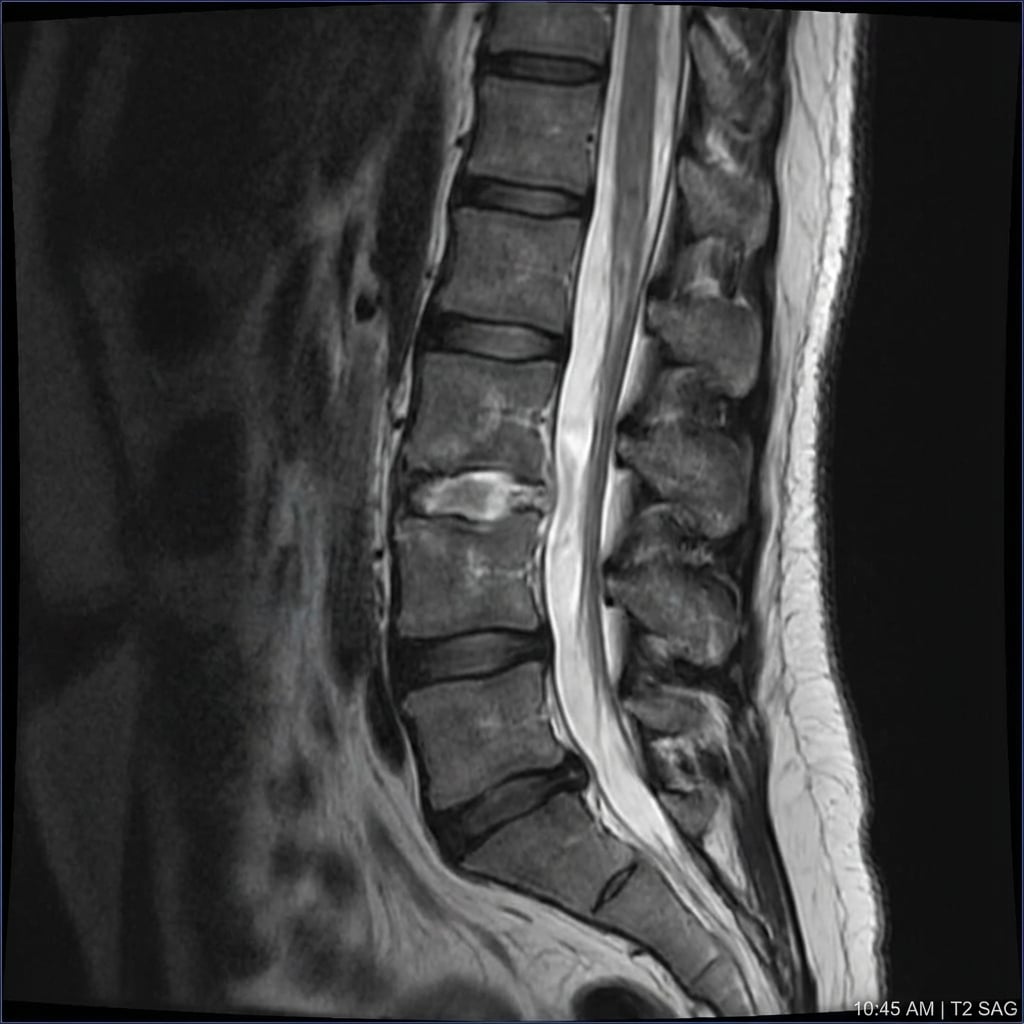
Sagittal T2-weighted MRI demonstrating L3-4 disc space infection with high signal in the disc and adjacent vertebral endplates. There is destruction of the L3 and L4 endplates with collapse. A posterior epidural abscess extends from L2 to L5 with cord/cauda compression. Paravertebral collection is visible anteriorly. This represents pyogenic spondylodiscitis with epidural abscess requiring urgent surgical debridement.
Open Full Size

Sagittal T2-weighted MRI demonstrating L3-4 disc space infection with high signal in the disc and adjacent vertebral endplates. There is destruction of the L3 and L4 endplates with collapse. A posterior epidural abscess extends from L2 to L5 with cord/cauda compression. Paravertebral collection is visible anteriorly. This represents pyogenic spondylodiscitis with epidural abscess requiring urgent surgical debridement.

Image source: Open Access medical literature (NIH/PubMed Central) • CC-BY License

Questions

Question 1 (4 marks)

Describe the MRI findings and what is the most likely diagnosis?

Question 2 (5 marks)

What are the risk factors and common causative organisms?

Question 3 (6 marks)

How do you investigate this patient and what are the indications for surgery?

Question 4 (5 marks)

Describe your surgical approach for debridement and stabilization.

Question 5 (4 marks)

What is the antibiotic management strategy?

Question 6 (4 marks)

What are the expected outcomes and prognostic factors?

Exam Day Cheat Sheet

Must Mention

  • •S. aureus most common (50-60%)
  • •Blood cultures x2 BEFORE antibiotics
  • •MRI = investigation of choice
  • •Epidural abscess + neuro deficit = urgent surgery
  • •6 weeks IV minimum, 6-12 weeks total
  • •Titanium instrumentation OK with debridement
  • •CRP to monitor response

Common Pitfalls

  • •Antibiotics before cultures
  • •Missing epidural abscess urgency
  • •Short antibiotic course
  • •Not checking echo for endocarditis
  • •Avoiding needed instrumentation
  • •Missing TB in appropriate populations
Scenario Info
Answers Revealed0/6
Difficulty
advanced
Time Allowed6 min
Total Marks28
Questions6
Related Scenarios

Acute Spinal Cord Injury

spine•28 marks

Adolescent Idiopathic Scoliosis

spine•28 marks

Atlas Fracture (C1 Fracture)

spine•28 marks

Cauda Equina Syndrome

spine•28 marks

Central Cord Syndrome

spine•28 marks