OrthoVellum
Knowledge Hub

Study

  • Topics
  • MCQs
  • ISAWE
  • Operative Surgery
  • Flashcards

Company

  • About Us
  • Editorial Policy
  • Contact
  • FAQ
  • Blog

Legal

  • Terms of Service
  • Privacy Policy
  • Cookie Policy
  • Medical Disclaimer
  • Copyright & DMCA
  • Refund Policy

Support

  • Help Center
  • Accessibility
  • Report an Issue
OrthoVellum

© 2026 OrthoVellum. For educational purposes only.

Not affiliated with the Royal Australasian College of Surgeons.

Back to ISAWE Scenarios
Contents
0%
spine

Scheuermann's Kyphosis
intermediate
6 min
28 marks
6 questions
Clinical Scenario
A 14-year-old boy is referred with progressive "round back" deformity noticed by his parents over the past 2 years. He has occasional mid-back aching that worsens with activity. He is otherwise healthy and has no neurological symptoms. On examination, he has a fixed thoracic kyphosis that does not correct with hyperextension. His Adams forward bend test shows a smooth thoracic roundback. He is Tanner stage 3.
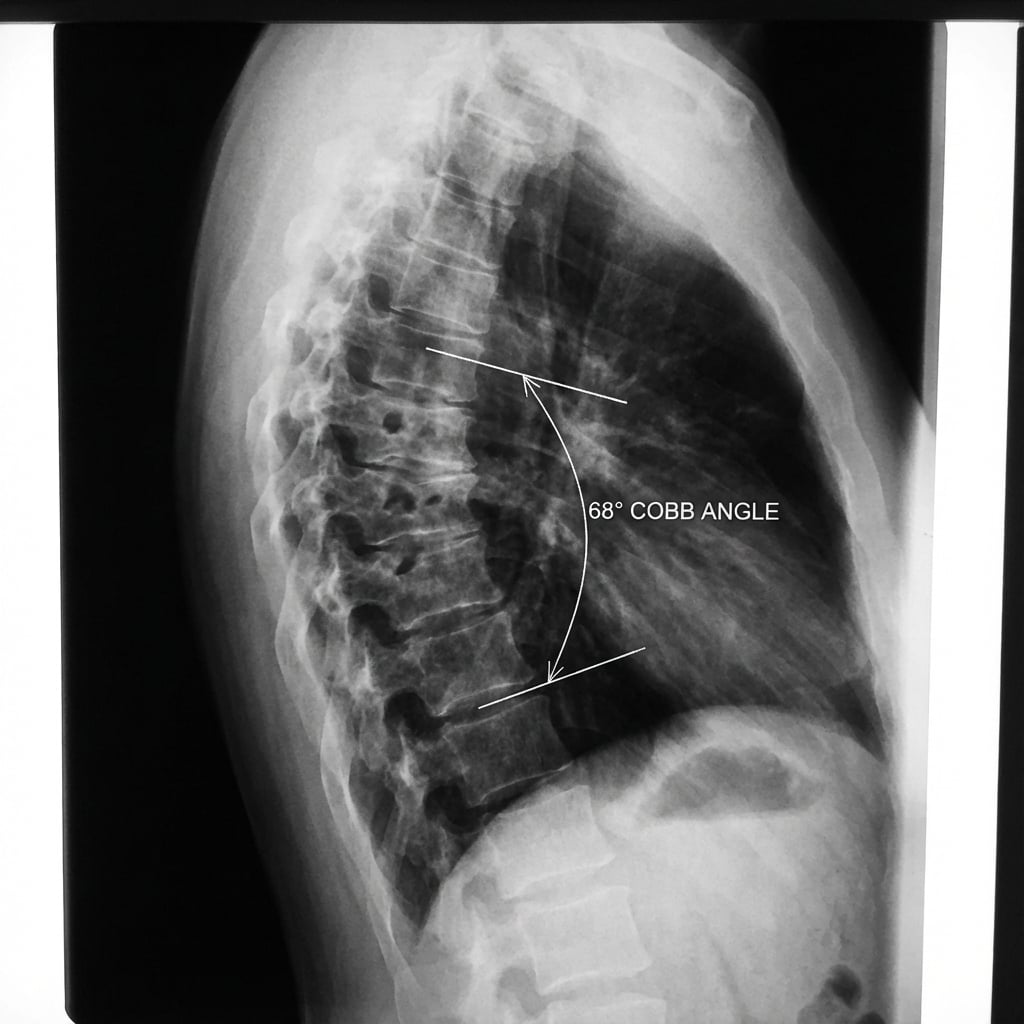
Standing lateral radiograph demonstrating thoracic kyphosis measuring 68 degrees (Cobb T5-T12). There is anterior wedging >5 degrees at T7, T8, and T9 with irregularity of the vertebral endplates and multiple Schmorl's nodes. The apex is at T8. This represents classic Scheuermann's disease with structural thoracic kyphosis.
Open Full Size

Standing lateral radiograph demonstrating thoracic kyphosis measuring 68 degrees (Cobb T5-T12). There is anterior wedging >5 degrees at T7, T8, and T9 with irregularity of the vertebral endplates and multiple Schmorl's nodes. The apex is at T8. This represents classic Scheuermann's disease with structural thoracic kyphosis.

Image source: Open Access medical literature (NIH/PubMed Central) • CC-BY License

Questions

Question 1 (4 marks)

Describe the radiographic findings and what criteria define Scheuermann's disease?

Question 2 (5 marks)

How do you differentiate from postural kyphosis and what is the clinical assessment?

Question 3 (6 marks)

What are the treatment options and indications for each?

Question 4 (5 marks)

Describe the surgical technique for posterior spinal fusion.

Question 5 (4 marks)

What are the expected outcomes and potential complications?

Question 6 (4 marks)

What is the natural history if left untreated?

Exam Day Cheat Sheet

Must Mention

  • •Sorensen: ≥3 vertebrae wedged ≥5 degrees
  • •Rigid = Scheuermann's, Flexible = postural
  • •Hyperextension test: does not correct
  • •Brace: 45-65° in immature patient
  • •Surgery: >75° or failed brace
  • •Ponte osteotomies for correction
  • •Watch for PJK

Common Pitfalls

  • •Missing Sorensen criteria
  • •Confusing with postural
  • •Wrong brace threshold
  • •Wrong surgery threshold
  • •Forgetting Pontes
  • •Missing PJK risk
Scenario Info
Answers Revealed0/6
Difficulty
intermediate
Time Allowed6 min
Total Marks28
Questions6
Related Scenarios

Acute Spinal Cord Injury

spine•28 marks

Adolescent Idiopathic Scoliosis

spine•28 marks

Atlas Fracture (C1 Fracture)

spine•28 marks

Cauda Equina Syndrome

spine•28 marks

Central Cord Syndrome

spine•28 marks