OrthoVellum
Knowledge Hub

Study

  • Topics
  • MCQs
  • ISAWE
  • Operative Surgery
  • Flashcards

Company

  • About Us
  • Editorial Policy
  • Contact
  • FAQ
  • Blog

Legal

  • Terms of Service
  • Privacy Policy
  • Cookie Policy
  • Medical Disclaimer
  • Copyright & DMCA
  • Refund Policy

Support

  • Help Center
  • Accessibility
  • Report an Issue
OrthoVellum

© 2026 OrthoVellum. For educational purposes only.

Not affiliated with the Royal Australasian College of Surgeons.

Back to ISAWE Scenarios
Contents
0%
spine

Subaxial Cervical Spine Trauma
advanced
6 min
28 marks
6 questions
Clinical Scenario
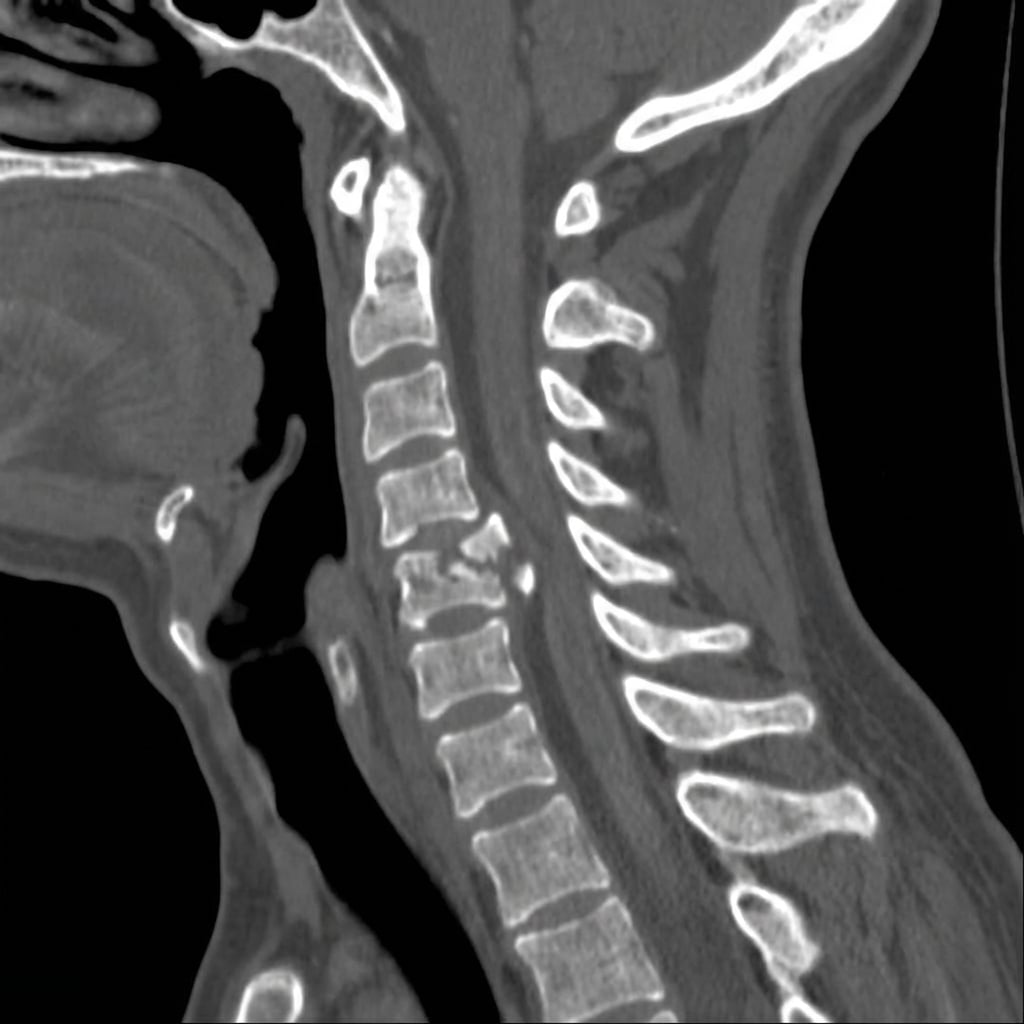
A 35-year-old man is brought in after diving into shallow water. He has neck pain and weakness in both arms worse than his legs. He has numbness in a cape distribution. CT shows a C5 burst fracture with 50% canal compromise. His motor exam shows 3/5 power in biceps and deltoids bilaterally, 4/5 in triceps, and 4/5 in lower extremities.
Sagittal and axial CT images demonstrating a C5 burst fracture with loss of vertebral body height, retropulsed posterior wall fragment causing canal compromise of approximately 50%. The posterior ligamentous complex appears intact on CT. MRI shows cord compression with edema. This represents a subaxial cervical injury requiring SLIC scoring for treatment decision.
Open Full Size

Sagittal and axial CT images demonstrating a C5 burst fracture with loss of vertebral body height, retropulsed posterior wall fragment causing canal compromise of approximately 50%. The posterior ligamentous complex appears intact on CT. MRI shows cord compression with edema. This represents a subaxial cervical injury requiring SLIC scoring for treatment decision.

Image source: Open Access medical literature (NIH/PubMed Central) • CC-BY License

Questions

Question 1 (4 marks)

Describe the imaging findings and apply the SLIC classification.

Question 2 (5 marks)

Explain the SLIC scoring system and how it guides treatment.

Question 3 (6 marks)

What is the role of MRI and how do you assess the PLC?

Question 4 (5 marks)

What are the surgical options and approach selection?

Question 5 (4 marks)

Describe the technique for anterior corpectomy and fusion.

Question 6 (4 marks)

What are the expected outcomes and complications?

Exam Day Cheat Sheet

Must Mention

  • •SLIC score (Morphology + DLC + Neurology)
  • •≥5 = surgery, ≤3 = non-op
  • •PLC assessment with MRI
  • •Anterior for burst/retropulsion
  • •Posterior for PLC disruption
  • •STASCIS: early surgery (<24h)
  • •Corpectomy for significant retropulsion

Common Pitfalls

  • •Not using SLIC
  • •Missing PLC injury
  • •Wrong approach
  • •Delayed surgery
  • •Incomplete decompression
  • •Missing posterior wall
Scenario Info
Answers Revealed0/6
Difficulty
advanced
Time Allowed6 min
Total Marks28
Questions6
Related Scenarios

Acute Spinal Cord Injury

spine•28 marks

Adolescent Idiopathic Scoliosis

spine•28 marks

Atlas Fracture (C1 Fracture)

spine•28 marks

Cauda Equina Syndrome

spine•28 marks

Central Cord Syndrome

spine•28 marks