OrthoVellum
Knowledge Hub

Study

  • Topics
  • MCQs
  • ISAWE
  • Operative Surgery
  • Flashcards

Company

  • About Us
  • Editorial Policy
  • Contact
  • FAQ
  • Blog

Legal

  • Terms of Service
  • Privacy Policy
  • Cookie Policy
  • Medical Disclaimer
  • Copyright & DMCA
  • Refund Policy

Support

  • Help Center
  • Accessibility
  • Report an Issue
OrthoVellum

© 2026 OrthoVellum. For educational purposes only.

Not affiliated with the Royal Australasian College of Surgeons.

Back to ISAWE Scenarios
Contents
0%
spine

Thoracolumbar Burst Fracture
advanced
6 min
28 marks
6 questions
Clinical Scenario
A 28-year-old construction worker fell from scaffolding approximately 4 meters. He has severe back pain and weakness in both legs. On examination, he has 3/5 power in hip flexors bilaterally, reduced sensation below L1, and intact perianal sensation with voluntary anal contraction. He has no other injuries.
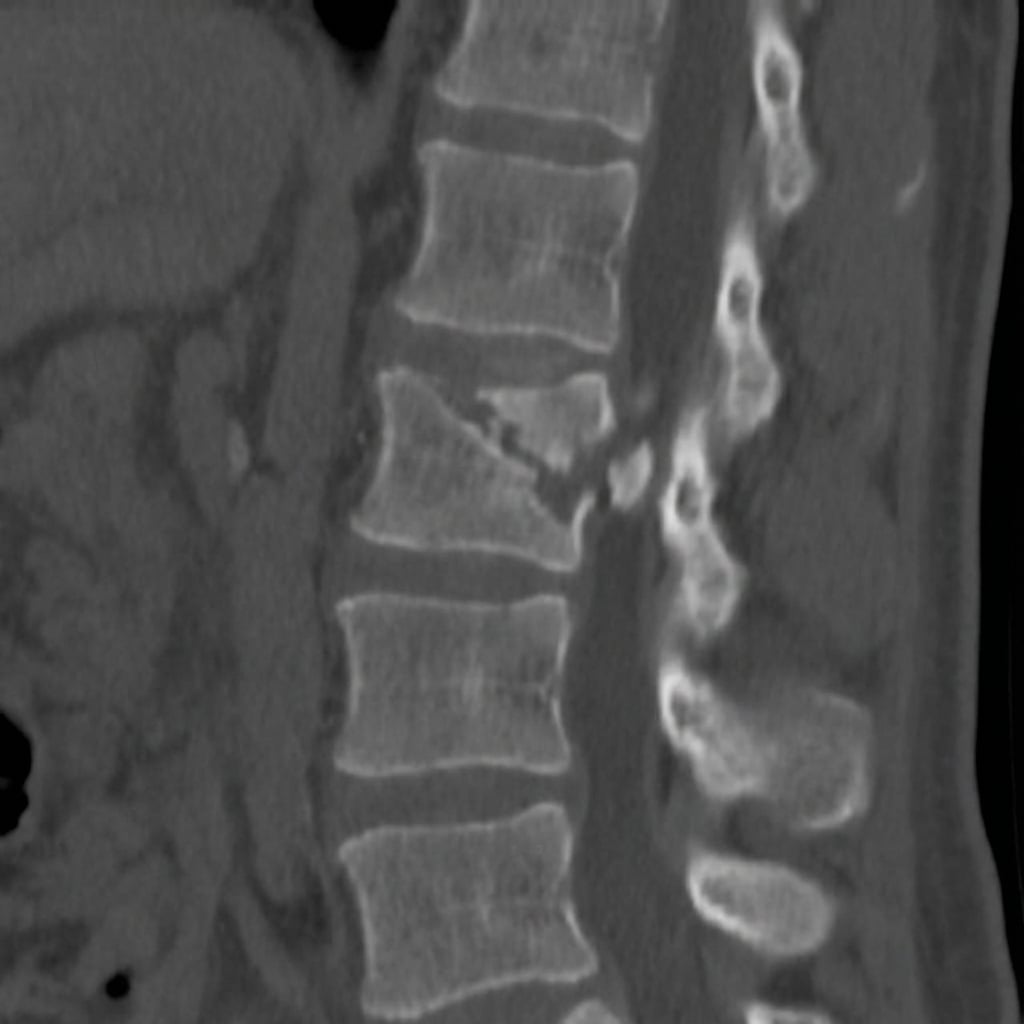
Sagittal and axial CT images demonstrating L1 burst fracture with loss of anterior vertebral body height, retropulsion of a posterior wall fragment causing 50% canal compromise, and widening of the interpedicular distance. The patient has an incomplete neurological deficit. This represents an unstable thoracolumbar junction injury requiring surgical stabilization.
Open Full Size

Sagittal and axial CT images demonstrating L1 burst fracture with loss of anterior vertebral body height, retropulsion of a posterior wall fragment causing 50% canal compromise, and widening of the interpedicular distance. The patient has an incomplete neurological deficit. This represents an unstable thoracolumbar junction injury requiring surgical stabilization.

Image source: Open Access medical literature (NIH/PubMed Central) • CC-BY License

Questions

Question 1 (4 marks)

Describe the CT findings and classify this injury using TLICS.

Question 2 (5 marks)

What determines stability and how do you assess the posterior ligamentous complex?

Question 3 (6 marks)

What are the indications for surgery and what approach would you choose?

Question 4 (5 marks)

Describe your surgical technique for posterior instrumented fusion.

Question 5 (4 marks)

When is anterior surgery indicated and what is the technique?

Question 6 (4 marks)

What are the expected outcomes and rehabilitation considerations?

Exam Day Cheat Sheet

Must Mention

  • •TLICS = Morphology + PLC + Neurology
  • •TLICS ≥5 = surgical
  • •PLC integrity - assess with MRI
  • •Ligamentotaxis = distraction + lordosis
  • •Posterior approach for most cases
  • •Incomplete SCI = best recovery prognosis
  • •2 above, 2 below for instrumentation

Common Pitfalls

  • •Miscalculating TLICS
  • •Missing PLC injury
  • •Operating when non-op appropriate
  • •Not using ligamentotaxis properly
  • •Delayed surgery with neurological deficit
  • •Inadequate follow-up imaging
Scenario Info
Answers Revealed0/6
Difficulty
advanced
Time Allowed6 min
Total Marks28
Questions6
Related Scenarios

Acute Spinal Cord Injury

spine•28 marks

Adolescent Idiopathic Scoliosis

spine•28 marks

Atlas Fracture (C1 Fracture)

spine•28 marks

Cauda Equina Syndrome

spine•28 marks

Central Cord Syndrome

spine•28 marks