OrthoVellum
Knowledge Hub

Study

  • Topics
  • MCQs
  • ISAWE
  • Operative Surgery
  • Flashcards

Company

  • About Us
  • Editorial Policy
  • Contact
  • FAQ
  • Blog

Legal

  • Terms of Service
  • Privacy Policy
  • Cookie Policy
  • Medical Disclaimer
  • Copyright & DMCA
  • Refund Policy

Support

  • Help Center
  • Accessibility
  • Report an Issue
OrthoVellum

© 2026 OrthoVellum. For educational purposes only.

Not affiliated with the Royal Australasian College of Surgeons.

Back to ISAWE Scenarios
Contents
0%
spine

Tuberculosis of the Spine (Pott's Disease)
advanced
6 min
28 marks
6 questions
Clinical Scenario
A 45-year-old man from India presents with 4 months of progressive back pain, weight loss, and night sweats. He has developed weakness in both legs over the past 2 weeks and difficulty walking. He has a history of treated pulmonary TB 10 years ago. On examination, he has a thoracic kyphotic deformity, spasticity in both legs, and hyperreflexia with upgoing plantars. He has 3/5 power in hip flexors bilaterally.
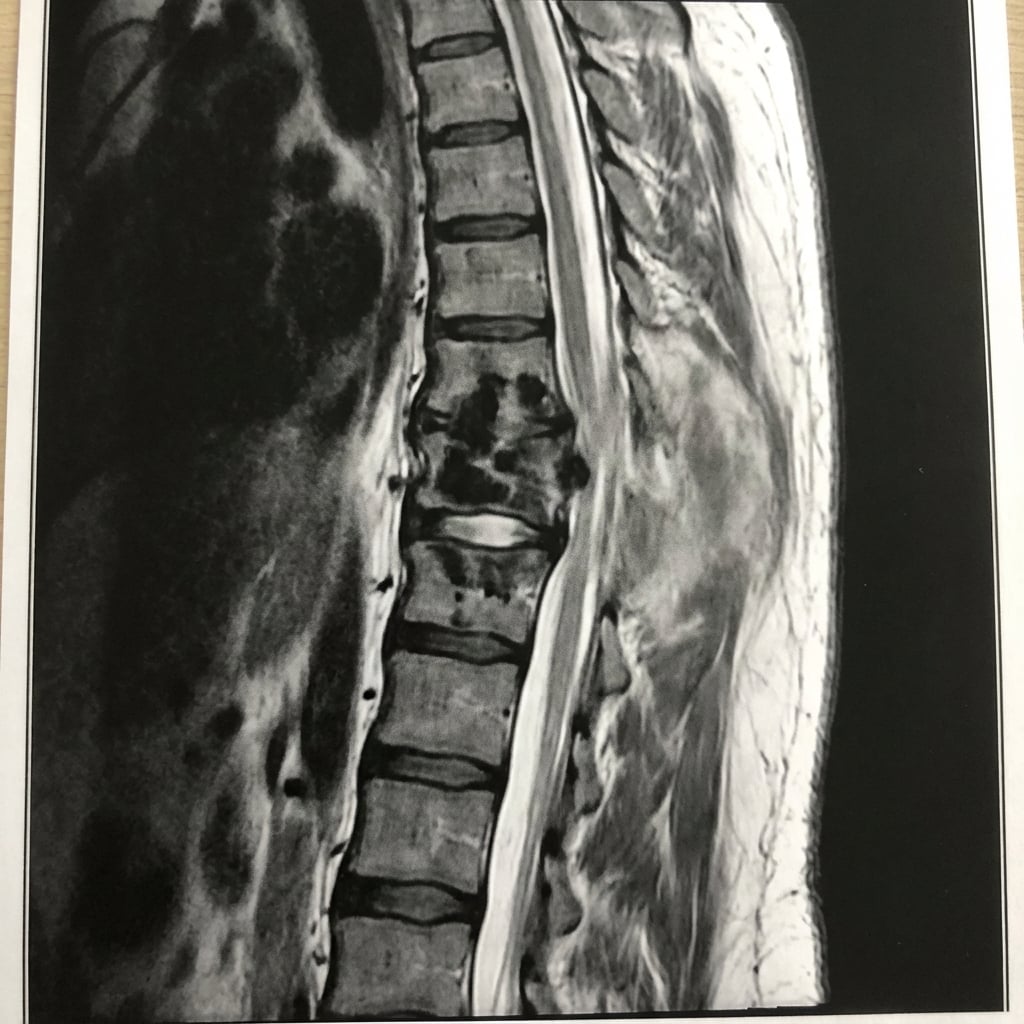
Sagittal and axial T2-weighted MRI demonstrating destruction of T10 and T11 vertebral bodies with relative preservation of the disc spaces (characteristic). Large paravertebral abscess extends anterolaterally. There is gibbus kyphotic deformity and spinal cord compression. This represents spinal tuberculosis (Pott's disease) requiring antitubercular chemotherapy and surgical consideration.
Open Full Size

Sagittal and axial T2-weighted MRI demonstrating destruction of T10 and T11 vertebral bodies with relative preservation of the disc spaces (characteristic). Large paravertebral abscess extends anterolaterally. There is gibbus kyphotic deformity and spinal cord compression. This represents spinal tuberculosis (Pott's disease) requiring antitubercular chemotherapy and surgical consideration.

Image source: Open Access medical literature (NIH/PubMed Central) • CC-BY License

Questions

Question 1 (4 marks)

Describe the MRI findings and how do they differ from pyogenic infection?

Question 2 (5 marks)

What investigations confirm the diagnosis and what is the differential?

Question 3 (6 marks)

What is the evidence for treatment and indications for surgery?

Question 4 (5 marks)

Describe the surgical options and the Hong Kong technique.

Question 5 (4 marks)

What is the antitubercular chemotherapy regimen?

Question 6 (4 marks)

What are the expected outcomes and potential complications?

Exam Day Cheat Sheet

Must Mention

  • •Disc PRESERVED in TB (destroyed in pyogenic)
  • •MRC trial: chemotherapy effective for most
  • •Surgery for neuro deficit, failure ATT, kyphosis
  • •Hong Kong technique: anterior radical debridement
  • •ATT: RHZE 2 months + RH 4-10 months (total 9-12 months)
  • •Monitor LFTs and vision

Common Pitfalls

  • •Missing disc preservation
  • •Surgery for all cases
  • •Short ATT duration
  • •Not monitoring drug toxicity
  • •Forgetting late complications
  • •Missing skip lesions
Scenario Info
Answers Revealed0/6
Difficulty
advanced
Time Allowed6 min
Total Marks28
Questions6
Related Scenarios

Acute Spinal Cord Injury

spine•28 marks

Adolescent Idiopathic Scoliosis

spine•28 marks

Atlas Fracture (C1 Fracture)

spine•28 marks

Cauda Equina Syndrome

spine•28 marks

Central Cord Syndrome

spine•28 marks