OrthoVellum
Knowledge Hub

Study

  • Topics
  • MCQs
  • ISAWE
  • Operative Surgery
  • Flashcards

Company

  • About Us
  • Editorial Policy
  • Contact
  • FAQ
  • Blog

Legal

  • Terms of Service
  • Privacy Policy
  • Cookie Policy
  • Medical Disclaimer
  • Copyright & DMCA
  • Refund Policy

Support

  • Help Center
  • Accessibility
  • Report an Issue
OrthoVellum

© 2026 OrthoVellum. For educational purposes only.

Not affiliated with the Royal Australasian College of Surgeons.

Back to ISAWE Scenarios
Contents
0%
trauma

Acetabular Fracture

advanced
6 min
26 marks
6 questions
Clinical Scenario
A 45-year-old man presents following a high-speed motor vehicle accident as a restrained driver. He reports severe right hip pain and is unable to move his leg. On examination, his right leg is shortened, internally rotated, and adducted. Dorsalis pedis and posterior tibial pulses are palpable. He has decreased sensation in the first dorsal web space and weakness of ankle dorsiflexion.
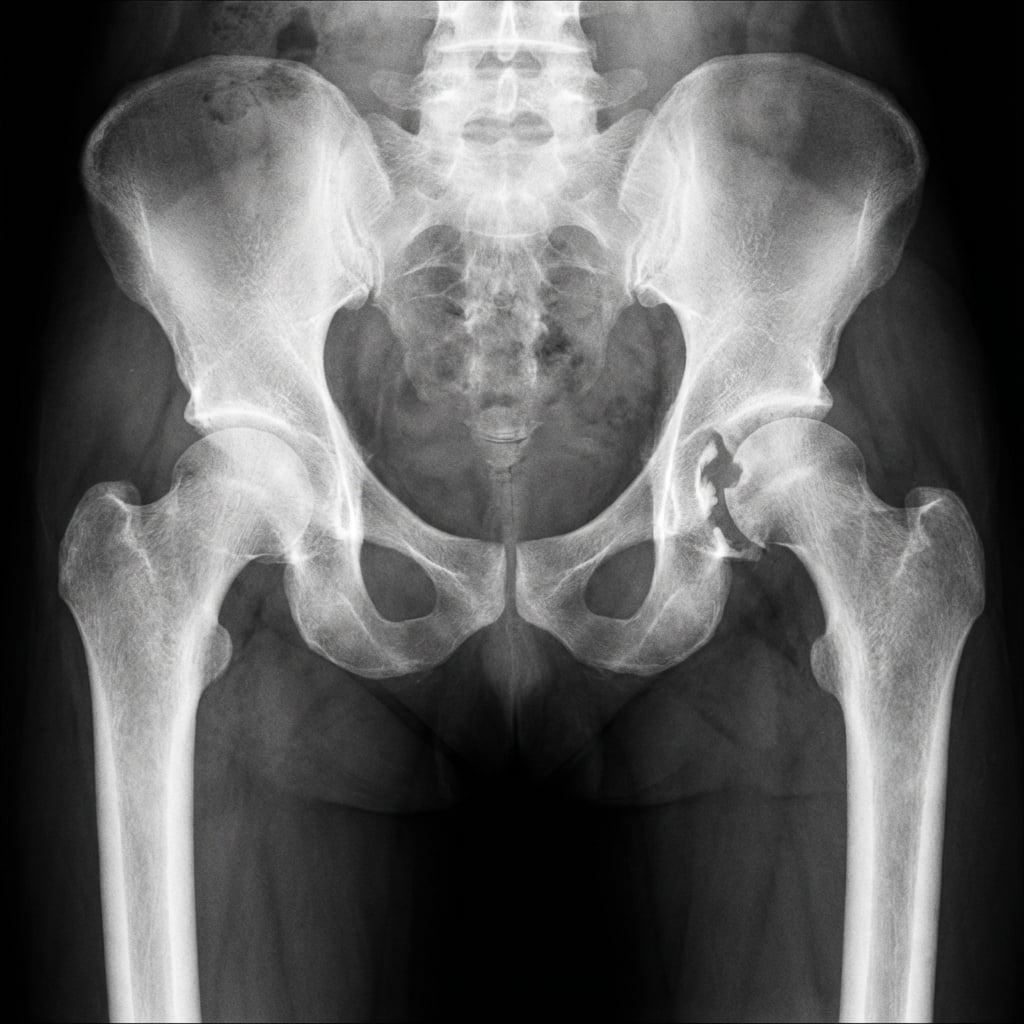
AP pelvis showing posterior wall acetabular fracture with associated posterior hip dislocation. The femoral head is displaced posteriorly with loss of Shenton's line. Obturator oblique view demonstrates posterior wall fragment size. CT shows >40% wall involvement with marginal impaction.
Open Full Size

AP pelvis showing posterior wall acetabular fracture with associated posterior hip dislocation. The femoral head is displaced posteriorly with loss of Shenton's line. Obturator oblique view demonstrates posterior wall fragment size. CT shows >40% wall involvement with marginal impaction.

Image source: Open Access medical literature (NIH/PubMed Central) • CC-BY License

Questions

Question 1 (4 marks)

Describe the clinical picture and your immediate priorities in the first 6 hours.

Question 2 (5 marks)

Describe the Letournel classification and classify this injury.

Question 3 (4 marks)

What imaging would you obtain and what are the indications for operative management?

Question 4 (6 marks)

Describe the surgical approaches for acetabular fractures and their indications.

Question 5 (4 marks)

What are the complications and prognostic factors for acetabular fractures?

Question 6 (3 marks)

Describe the concept of secondary congruence and its clinical significance.

Exam Day Cheat Sheet

Must Mention

  • •Reduce posterior dislocation within 6 HOURS (AVN risk)
  • •Document sciatic nerve BEFORE and AFTER reduction (10-20% injury)
  • •Letournel: 5 elementary + 5 associated = 10 types
  • •Spur sign = pathognomonic for both-column fracture
  • •Posterior wall: Kocher-Langenbeck
  • •Anterior column/both-column: Ilioinguinal or Modified Stoppa
  • •Anatomic reduction (<1-2mm) = most important prognostic factor

Common Pitfalls

  • •Delayed reduction of dislocation (>6 hours)
  • •Not documenting sciatic nerve pre/post reduction
  • •Missing marginal impaction on CT (important prognostic factor)
  • •Wrong surgical approach for fracture pattern
  • •Operating too late (>3 weeks - difficult reduction)
  • •Missing associated femoral head injury (Pipkin)
Scenario Info
Answers Revealed0/6
Difficulty
advanced
Time Allowed6 min
Total Marks26
Questions6
Related Scenarios

Atypical Femoral Fracture

trauma•26 marks

Calcaneal Fracture

trauma•24 marks

Chronic Elbow Dislocation

trauma•28 marks

Compartment Syndrome - Leg

trauma•26 marks

Distal Femur Fracture

trauma•30 marks