OrthoVellum
Knowledge Hub

Study

  • Topics
  • MCQs
  • ISAWE
  • Operative Surgery
  • Flashcards

Company

  • About Us
  • Editorial Policy
  • Contact
  • FAQ
  • Blog

Legal

  • Terms of Service
  • Privacy Policy
  • Cookie Policy
  • Medical Disclaimer
  • Copyright & DMCA
  • Refund Policy

Support

  • Help Center
  • Accessibility
  • Report an Issue
OrthoVellum

© 2026 OrthoVellum. For educational purposes only.

Not affiliated with the Royal Australasian College of Surgeons.

Back to ISAWE Scenarios
Contents
0%
trauma

Compartment Syndrome - Leg
advanced
6 min
26 marks
6 questions
Clinical Scenario
A 22-year-old male is reviewed 8 hours after sustaining a closed tibial shaft fracture in a soccer match. He has had an intramedullary nail inserted and is in a below-knee backslab. Nursing staff report he is requiring escalating opioid analgesia and the pain seems disproportionate to his injury. He reports tingling in his toes. On examination, the calf is tense and he has severe pain with passive toe extension.
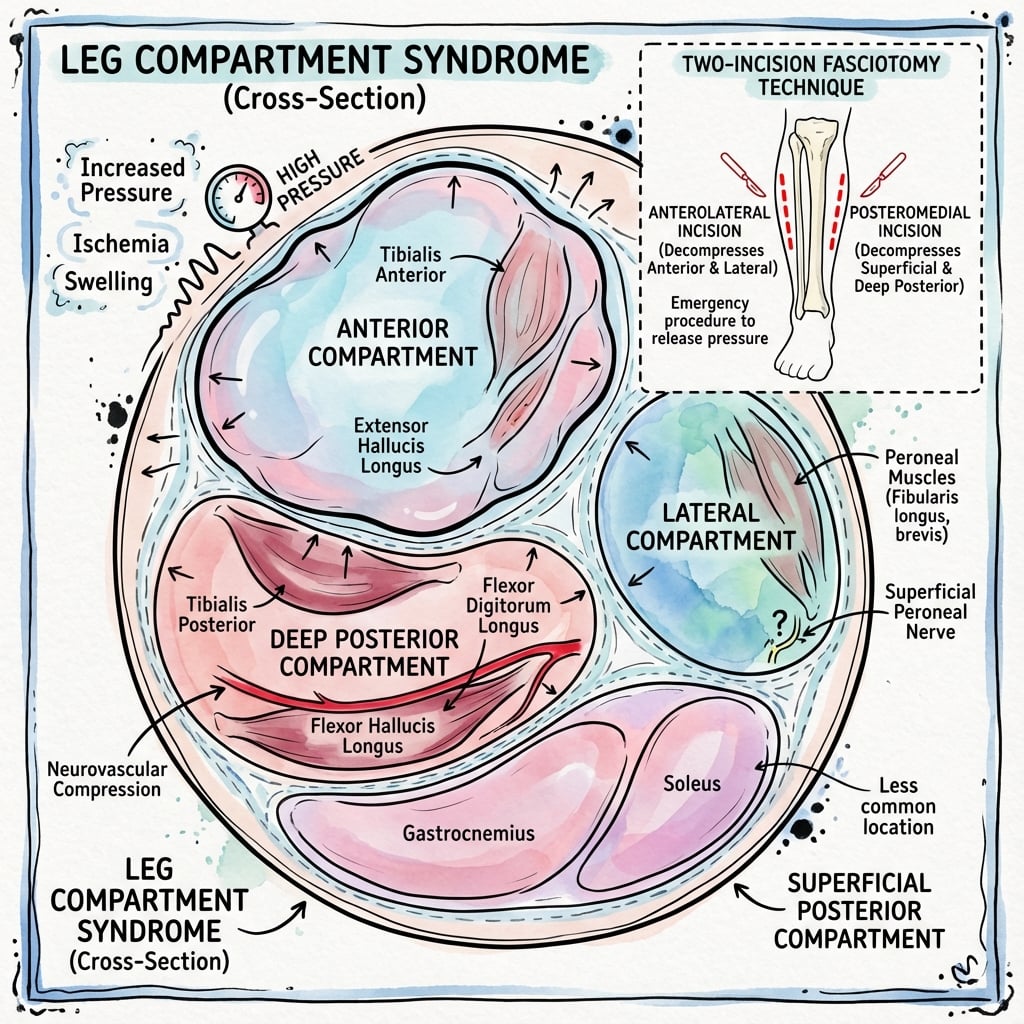
Cross-section of leg showing four compartments (anterior, lateral, superficial posterior, deep posterior) with neurovascular structures. Inset shows two-incision fasciotomy technique with anterolateral and posteromedial incisions.
Open Full Size

Cross-section of leg showing four compartments (anterior, lateral, superficial posterior, deep posterior) with neurovascular structures. Inset shows two-incision fasciotomy technique with anterolateral and posteromedial incisions.

Image source: Open Access medical literature (NIH/PubMed Central) • CC-BY License

Questions

Question 1 (4 marks)

Describe the clinical features of compartment syndrome and identify which features are present in this case.

Question 2 (4 marks)

What are the risk factors for leg compartment syndrome? Which are present in this patient?

Question 3 (5 marks)

How would you confirm the diagnosis and what are your immediate management steps?

Question 4 (6 marks)

Describe the surgical technique for four-compartment fasciotomy of the leg.

Question 5 (4 marks)

What are the consequences of delayed or missed compartment syndrome?

Question 6 (3 marks)

Discuss the medicolegal considerations in compartment syndrome management.

Exam Day Cheat Sheet

Must Mention

  • •Pain out of proportion + pain with passive stretch = most reliable EARLY signs
  • •Pulses usually PRESERVED - do NOT wait for pulselessness
  • •Delta P <30mmHg = fasciotomy (diastolic - compartment pressure)
  • •Do NOT elevate limb (reduces perfusion pressure)
  • •Two-incision, four-compartment fasciotomy
  • •Irreversible damage at 6-8 hours
  • •Leave wounds OPEN

Common Pitfalls

  • •Waiting for pulselessness (pulses usually preserved)
  • •Elevating the limb (reduces perfusion pressure - keep at heart level)
  • •Delaying for pressure measurement when clinical diagnosis clear
  • •Single incision release (must do two incisions, four compartments)
  • •Incomplete release (must be full length)
  • •Primary wound closure (always leave open)
  • •Not documenting serial examinations (medicolegal risk)
  • •Missing deep posterior compartment (most commonly missed)
Scenario Info
Answers Revealed0/6
Difficulty
advanced
Time Allowed6 min
Total Marks26
Questions6
Related Scenarios

Acetabular Fracture

trauma•26 marks

Atypical Femoral Fracture

trauma•26 marks

Calcaneal Fracture

trauma•24 marks

Chronic Elbow Dislocation

trauma•28 marks

Distal Femur Fracture

trauma•30 marks