OrthoVellum
Knowledge Hub

Study

  • Topics
  • MCQs
  • ISAWE
  • Operative Surgery
  • Flashcards

Company

  • About Us
  • Editorial Policy
  • Contact
  • FAQ
  • Blog

Legal

  • Terms of Service
  • Privacy Policy
  • Cookie Policy
  • Medical Disclaimer
  • Copyright & DMCA
  • Refund Policy

Support

  • Help Center
  • Accessibility
  • Report an Issue
OrthoVellum

© 2026 OrthoVellum. For educational purposes only.

Not affiliated with the Royal Australasian College of Surgeons.

Back to ISAWE Scenarios
Contents
0%
trauma

Calcaneal Fracture

advanced
6 min
24 marks
6 questions
Clinical Scenario
A 38-year-old roofer presents after falling 3 metres from scaffolding, landing on his feet. He has severe bilateral heel pain and swelling and is unable to weight bear. He also reports low back pain. Examination reveals bilateral heel ecchymosis extending to the plantar arch (Mondor's sign), tense swelling, and tenderness over the calcanei. The right heel has posterior skin tenting with blanching.
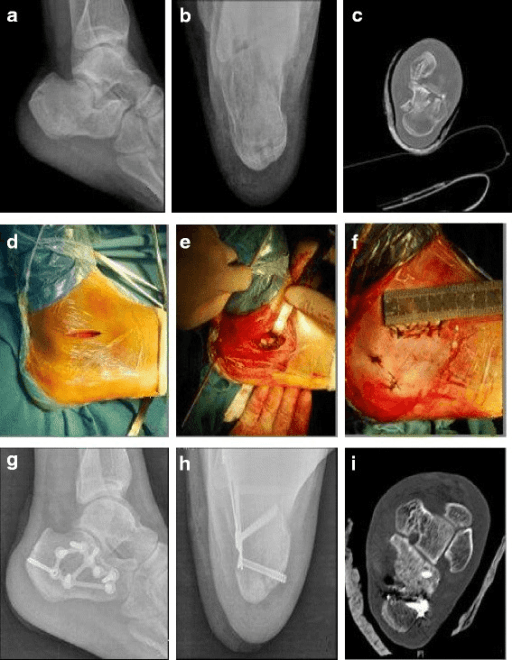
Lateral radiograph showing calcaneal fracture with decreased Bohler's angle (<10°) and loss of calcaneal height. CT coronal images demonstrate Sanders Type III fracture with 3 fragments of the posterior facet. Note widening of the calcaneal body and lateral wall blowout.
Open Full Size

Lateral radiograph showing calcaneal fracture with decreased Bohler's angle (<10°) and loss of calcaneal height. CT coronal images demonstrate Sanders Type III fracture with 3 fragments of the posterior facet. Note widening of the calcaneal body and lateral wall blowout.

Source: Percutaneous cannulated screw fixation vs sinus tarsi approach for displaced intra-articular calcaneal fractures • Feng Y, Shui X, Wang J, et al. • PMC4946135 • CC-BY

Questions

Question 1 (4 marks)

What associated injuries must you assess for and why?

Question 2 (4 marks)

Describe the radiographic assessment including the Sanders classification.

Question 3 (5 marks)

The right heel has skin tenting posteriorly. How does this change your immediate management?

Question 4 (5 marks)

Discuss the evidence for operative versus non-operative treatment of calcaneal fractures.

Question 5 (4 marks)

Describe the surgical approach and key intraoperative steps.

Question 6 (2 marks)

What complications would you discuss with this patient?

Exam Day Cheat Sheet

Must Mention

  • •10-15% spine fracture association - CHECK SPINE
  • •Sanders classification (coronal CT, posterior facet fragments)
  • •Bohler's angle: normal 20-40°, <20° = significant
  • •Wrinkle test before ORIF (7-14 days)
  • •Skin tenting = URGENT reduction
  • •UK Heel Fracture Trial: no difference at 2 years

Common Pitfalls

  • •Not checking spine (10-15% association)
  • •ORIF before soft tissue recovery (wound complications)
  • •Missing skin tenting as urgent
  • •Operating on Sanders IV (consider primary fusion)
  • •Missing foot compartment syndrome
  • •Not discussing UK Heel Fracture Trial in counselling
Scenario Info
Answers Revealed0/6
Difficulty
advanced
Time Allowed6 min
Total Marks24
Questions6
Related Scenarios

Acetabular Fracture

trauma•26 marks

Atypical Femoral Fracture

trauma•26 marks

Chronic Elbow Dislocation

trauma•28 marks

Compartment Syndrome - Leg

trauma•26 marks

Distal Femur Fracture

trauma•30 marks