OrthoVellum
Knowledge Hub

Study

  • Topics
  • MCQs
  • ISAWE
  • Operative Surgery
  • Flashcards

Company

  • About Us
  • Editorial Policy
  • Contact
  • FAQ
  • Blog

Legal

  • Terms of Service
  • Privacy Policy
  • Cookie Policy
  • Medical Disclaimer
  • Copyright & DMCA
  • Refund Policy

Support

  • Help Center
  • Accessibility
  • Report an Issue
OrthoVellum

© 2026 OrthoVellum. For educational purposes only.

Not affiliated with the Royal Australasian College of Surgeons.

Back to ISAWE Scenarios
Contents
0%
trauma

Atypical Femoral Fracture
advanced
6 min
26 marks
6 questions
Clinical Scenario
A 76-year-old woman presents after sudden onset of left thigh pain while walking across her living room. She has been on alendronate for 9 years for osteoporosis. She reports prodromal left thigh pain for 4 months. Examination reveals a shortened, externally rotated left leg with proximal thigh tenderness. She also mentions occasional right thigh discomfort.
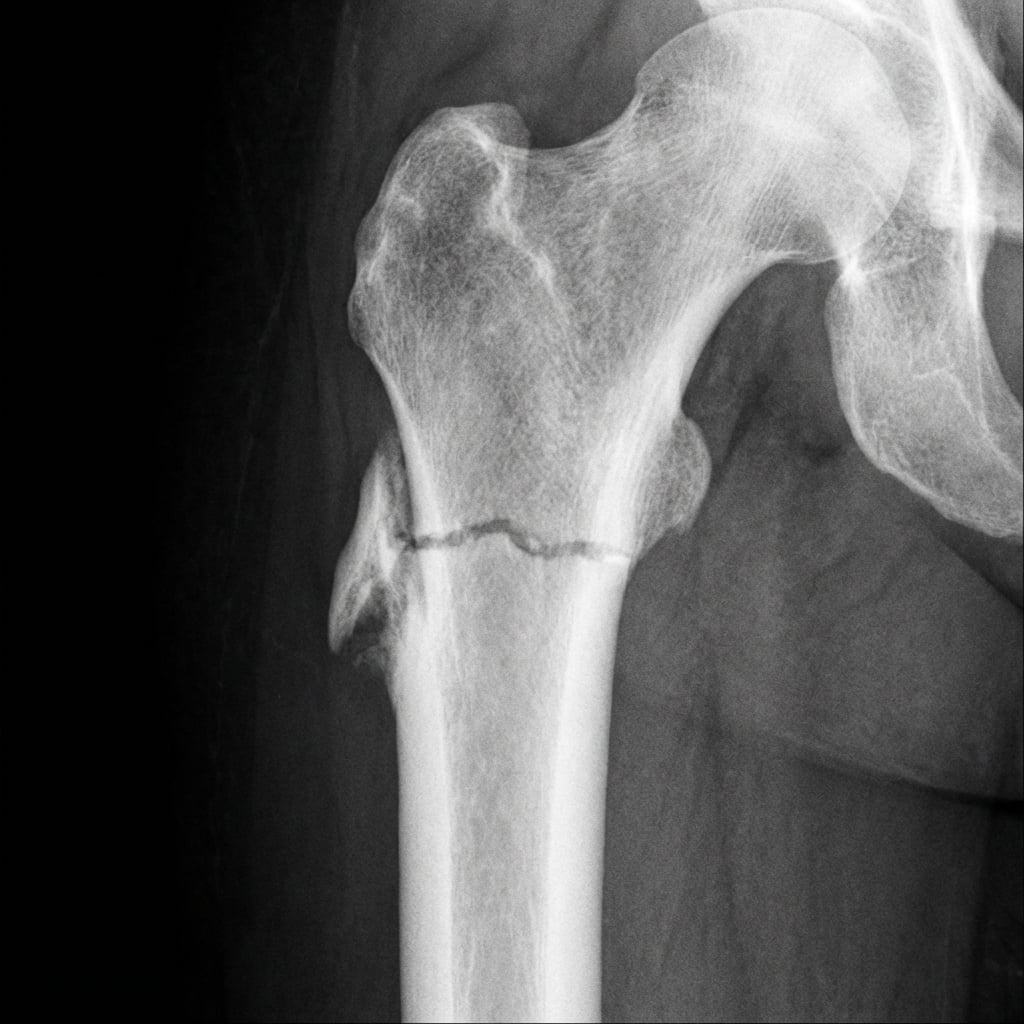
AP radiograph of the proximal femur showing transverse subtrochanteric fracture with classic atypical features: lateral cortical beaking (spike), localized periosteal/endosteal thickening, minimal comminution, and transverse orientation. Note the medial cortical thickening representing stress reaction.
Open Full Size

AP radiograph of the proximal femur showing transverse subtrochanteric fracture with classic atypical features: lateral cortical beaking (spike), localized periosteal/endosteal thickening, minimal comminution, and transverse orientation. Note the medial cortical thickening representing stress reaction.

Image source: Open Access medical literature (NIH/PubMed Central) • CC-BY License

Questions

Question 1 (4 marks)

What is the diagnosis and describe the ASBMR criteria that define this condition.

Question 2 (4 marks)

Explain the pathophysiology of atypical femoral fractures and the role of bisphosphonates.

Question 3 (5 marks)

What are the challenges in surgical management and how do you address them?

Question 4 (6 marks)

Describe your surgical technique for fixation of this fracture.

Question 5 (4 marks)

What medical management and investigations are required post-operatively?

Question 6 (3 marks)

The patient mentions right thigh discomfort. How do you evaluate and manage this?

Exam Day Cheat Sheet

Must Mention

  • •ASBMR criteria: 4 of 5 major features required
  • •Lateral cortical beaking = pathognomonic
  • •Transverse pattern, minimal comminution, prodromal pain
  • •FULL-LENGTH cephalomedullary nail (protect entire femur)
  • •Blocking screws to prevent varus
  • •Check contralateral femur (25-50% bilateral)
  • •Drug holiday + teriparatide

Common Pitfalls

  • •Not recognizing atypical fracture pattern (lateral beaking, transverse)
  • •Short nail that doesn't protect entire femur
  • •Varus malreduction from lateral cortex defect
  • •Not using blocking screws
  • •Not imaging contralateral femur (25-50% bilateral)
  • •Not stopping bisphosphonate (drug holiday essential)
  • •Not considering teriparatide for delayed healing
  • •Expecting rapid union (delayed union is typical)
Scenario Info
Answers Revealed0/6
Difficulty
advanced
Time Allowed6 min
Total Marks26
Questions6
Related Scenarios

Acetabular Fracture

trauma•26 marks

Calcaneal Fracture

trauma•24 marks

Chronic Elbow Dislocation

trauma•28 marks

Compartment Syndrome - Leg

trauma•26 marks

Distal Femur Fracture

trauma•30 marks