OrthoVellum
Knowledge Hub

Study

  • Topics
  • MCQs
  • ISAWE
  • Operative Surgery
  • Flashcards

Company

  • About Us
  • Editorial Policy
  • Contact
  • FAQ
  • Blog

Legal

  • Terms of Service
  • Privacy Policy
  • Cookie Policy
  • Medical Disclaimer
  • Copyright & DMCA
  • Refund Policy

Support

  • Help Center
  • Accessibility
  • Report an Issue
OrthoVellum

© 2026 OrthoVellum. For educational purposes only.

Not affiliated with the Royal Australasian College of Surgeons.

Back to ISAWE Scenarios
Contents
0%
trauma

Distal Femur Fracture
advanced
6 min
30 marks
6 questions
Clinical Scenario
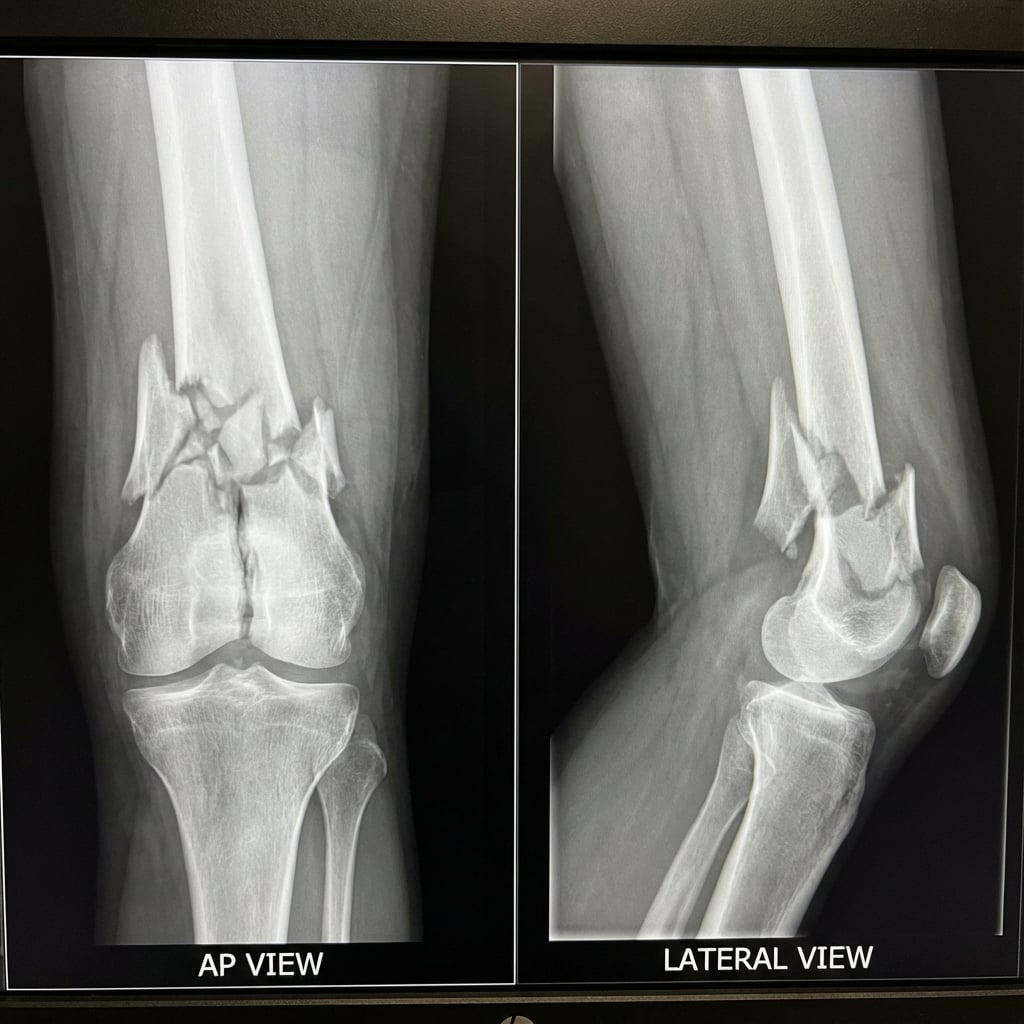
A 70-year-old woman with osteoporosis presents after a fall at home. She has obvious thigh deformity with shortening. X-rays show a comminuted supracondylar femur fracture with intra-articular extension. There is no vascular compromise. She has a well-functioning TKA in the other knee.
AP and lateral radiographs demonstrating comminuted supracondylar femur fracture with intra-articular extension (AO 33-C2). There is metaphyseal comminution, varus angulation, and shortening. The articular surface shows a simple sagittal split pattern requiring anatomic reduction.
Open Full Size

AP and lateral radiographs demonstrating comminuted supracondylar femur fracture with intra-articular extension (AO 33-C2). There is metaphyseal comminution, varus angulation, and shortening. The articular surface shows a simple sagittal split pattern requiring anatomic reduction.

Image source: Open Access medical literature (NIH/PubMed Central) • CC-BY License

Questions

Question 1 (5 marks)

How do you classify this fracture? What key features guide your management?

Question 2 (5 marks)

What are the surgical options and which approach would you use?

Question 3 (5 marks)

Describe your surgical technique for ORIF with lateral locked plate.

Question 4 (5 marks)

How do you manage fixation in osteoporotic bone?

Question 5 (5 marks)

This patient had a TKA. How would a periprosthetic fracture change your classification and management?

Question 6 (5 marks)

What are the expected outcomes and complications?

Exam Day Cheat Sheet

Must Mention

  • •AO: 33-A (extra-articular), 33-B (partial), 33-C (complete articular)
  • •Articular reduction = anatomic; Metaphyseal comminution = bridge
  • •All locking screws in osteoporosis
  • •Plate length: 2:1 working length ratio
  • •Rorabeck: I = brace, II = ORIF, III = revision
  • •Unicortical distal screws near prosthesis

Common Pitfalls

  • •Reducing comminuted metaphysis (strips blood supply, no benefit)
  • •Short plate in osteoporosis (fixation failure)
  • •Missing rotation (check lesser trochanter profile)
  • •Bicortical screws through prosthesis
  • •Not checking prosthesis stability before fixation decision
  • •Ignoring bone quality in elderly
Scenario Info
Answers Revealed0/6
Difficulty
advanced
Time Allowed6 min
Total Marks30
Questions6
Related Scenarios

Acetabular Fracture

trauma•26 marks

Atypical Femoral Fracture

trauma•26 marks

Calcaneal Fracture

trauma•24 marks

Chronic Elbow Dislocation

trauma•28 marks

Compartment Syndrome - Leg

trauma•26 marks