OrthoVellum
Knowledge Hub

Study

  • Topics
  • MCQs
  • ISAWE
  • Operative Surgery
  • Flashcards

Company

  • About Us
  • Editorial Policy
  • Contact
  • FAQ
  • Blog

Legal

  • Terms of Service
  • Privacy Policy
  • Cookie Policy
  • Medical Disclaimer
  • Copyright & DMCA
  • Refund Policy

Support

  • Help Center
  • Accessibility
  • Report an Issue
OrthoVellum

© 2026 OrthoVellum. For educational purposes only.

Not affiliated with the Royal Australasian College of Surgeons.

Back to ISAWE Scenarios
Contents
0%
trauma

Chronic Elbow Dislocation
advanced
6 min
28 marks
6 questions
Clinical Scenario
A 31-year-old woman presents 4 months after an injury sustained while hiking overseas. She had limited medical care at the time and now has a stiff, deformed elbow. She has pain with attempted use and significant functional limitation. The elbow is held in approximately 60° flexion with minimal further motion.
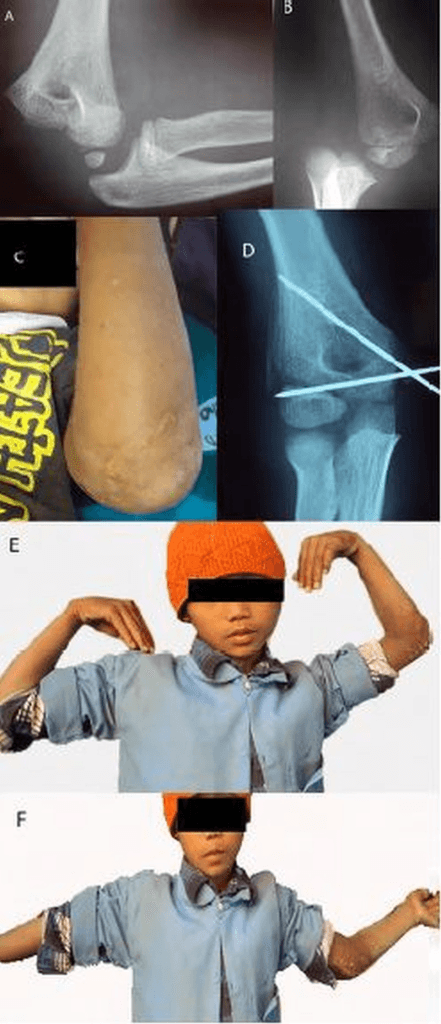
AP and lateral radiographs demonstrating chronic posterolateral elbow dislocation. There is heterotopic ossification around the joint, the coronoid is remodeled, and there is significant joint incongruity. The injury is 4 months old. The humeral trochlea shows early degenerative changes from chronic subluxation.
Open Full Size

AP and lateral radiographs demonstrating chronic posterolateral elbow dislocation. There is heterotopic ossification around the joint, the coronoid is remodeled, and there is significant joint incongruity. The injury is 4 months old. The humeral trochlea shows early degenerative changes from chronic subluxation.

Source: Radiological and Functional Outcome of Medial Epicondyle Fracture Treated Surgically in Children • PMC5293142 • CC-BY

Questions

Question 1 (4 marks)

Describe the radiographic findings and define chronic elbow dislocation.

Question 2 (5 marks)

What are the blocks to closed reduction and why is open surgery required?

Question 3 (6 marks)

Describe your surgical approach and technique for open reduction.

Question 4 (5 marks)

What stabilization options are available after reduction?

Question 5 (4 marks)

How do you manage the ulnar nerve in this situation?

Question 6 (4 marks)

What are the expected outcomes and how do you counsel the patient?

Exam Day Cheat Sheet

Must Mention

  • •Chronic = >3 weeks
  • •Blocks: triceps, capsule, collaterals, HO, intra-articular fibrosis
  • •Open reduction required
  • •Ulnar nerve - identify FIRST, protect, consider transposition
  • •Hinged external fixator if unstable
  • •Goal is functional arc (30-130°), not full ROM
  • •Outcome correlates with duration

Common Pitfalls

  • •Attempting closed reduction
  • •Not identifying ulnar nerve early
  • •Not having hinged fixator available
  • •Promising full ROM
  • •Forcing reduction without adequate release
  • •Missing HO on imaging (get CT)
Scenario Info
Answers Revealed0/6
Difficulty
advanced
Time Allowed6 min
Total Marks28
Questions6
Related Scenarios

Acetabular Fracture

trauma•26 marks

Atypical Femoral Fracture

trauma•26 marks

Calcaneal Fracture

trauma•24 marks

Compartment Syndrome - Leg

trauma•26 marks

Distal Femur Fracture

trauma•30 marks