OrthoVellum
Knowledge Hub

Study

  • Topics
  • MCQs
  • ISAWE
  • Operative Surgery
  • Flashcards

Company

  • About Us
  • Editorial Policy
  • Contact
  • FAQ
  • Blog

Legal

  • Terms of Service
  • Privacy Policy
  • Cookie Policy
  • Medical Disclaimer
  • Copyright & DMCA
  • Refund Policy

Support

  • Help Center
  • Accessibility
  • Report an Issue
OrthoVellum

© 2026 OrthoVellum. For educational purposes only.

Not affiliated with the Royal Australasian College of Surgeons.

Back to ISAWE Scenarios
Contents
0%
trauma

Femoral Neck Fracture - Young Patient
advanced
6 min
28 marks
6 questions
Clinical Scenario
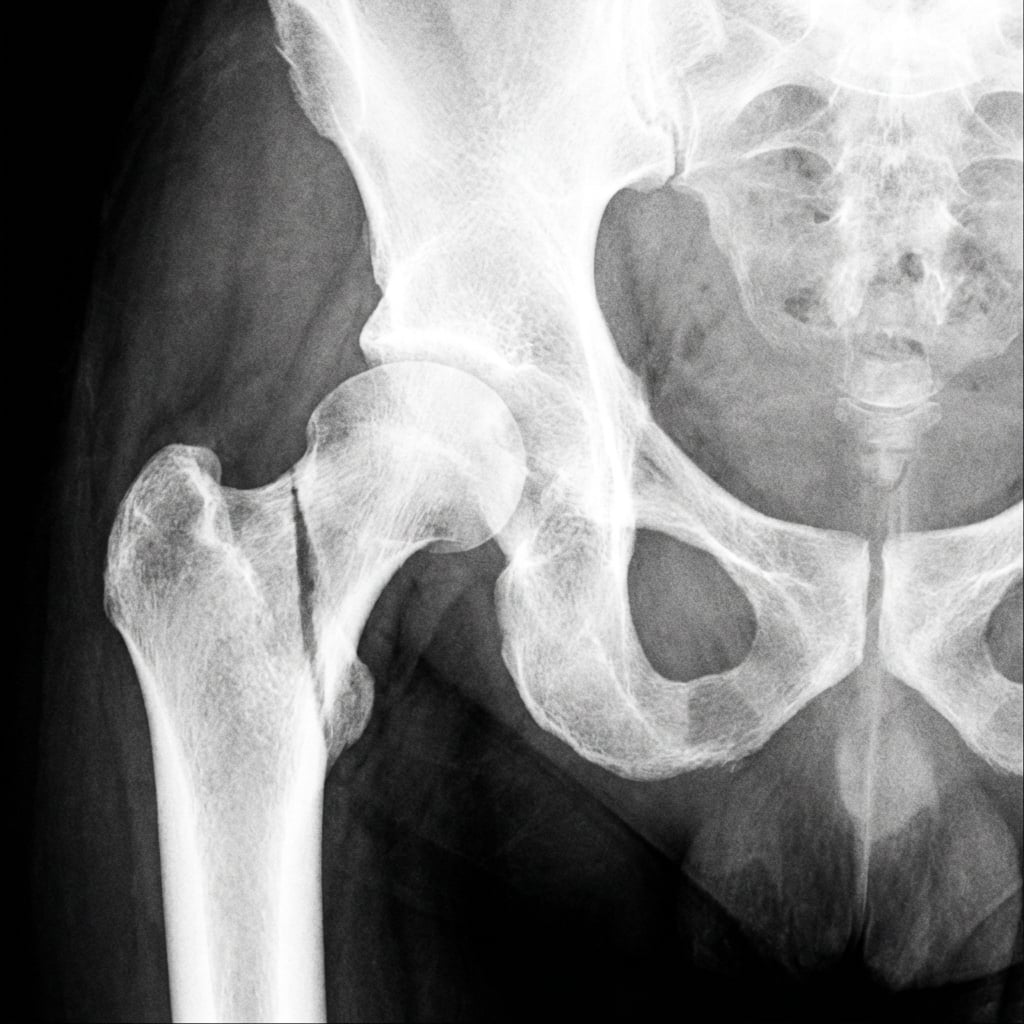
A 28-year-old male motorcyclist presents following a high-speed collision. He has severe left hip pain and is unable to weight bear. The leg is shortened and externally rotated. He has no other injuries identified. This is an isolated injury to an otherwise healthy young man.
AP pelvis radiograph demonstrating displaced subcapital femoral neck fracture (Garden IV) in a young adult. The femoral head is completely displaced with no contact between head and neck fragments. High Pauwels angle (>70°) indicating high shear forces. This is an orthopaedic emergency requiring urgent anatomic reduction and fixation.
Open Full Size

AP pelvis radiograph demonstrating displaced subcapital femoral neck fracture (Garden IV) in a young adult. The femoral head is completely displaced with no contact between head and neck fragments. High Pauwels angle (>70°) indicating high shear forces. This is an orthopaedic emergency requiring urgent anatomic reduction and fixation.

Image source: Open Access medical literature (NIH/PubMed Central) • CC-BY License

Questions

Question 1 (4 marks)

Classify this fracture using two classification systems and discuss their prognostic significance.

Question 2 (5 marks)

What is the urgency of treatment and what factors affect the risk of AVN?

Question 3 (6 marks)

Describe your operative management strategy and surgical technique.

Question 4 (5 marks)

What are the key technical points to achieve optimal fixation?

Question 5 (4 marks)

What are the expected outcomes and how do you follow up this patient?

Question 6 (4 marks)

If AVN develops, what are the management options in a young patient?

Exam Day Cheat Sheet

Must Mention

  • •ORTHOPAEDIC EMERGENCY in young patient
  • •Garden III-IV = displaced = highest AVN risk
  • •Anatomic reduction essential (Garden alignment index)
  • •3 cannulated screws in inverted triangle
  • •Calcar screw most important (resist varus)
  • •MFCA retinacular vessels = primary blood supply
  • •AVN 10-30% despite optimal treatment

Common Pitfalls

  • •Treating like elderly (don't replace head in young)
  • •Varus malreduction (causes failure)
  • •Screw threads not in femoral head
  • •Delayed surgery
  • •Not counseling on AVN risk
  • •Missing associated injuries (ipsilateral femur/knee)
  • •Not following for 2 years (late AVN)
Scenario Info
Answers Revealed0/6
Difficulty
advanced
Time Allowed6 min
Total Marks28
Questions6
Related Scenarios

Acetabular Fracture

trauma•26 marks

Atypical Femoral Fracture

trauma•26 marks

Calcaneal Fracture

trauma•24 marks

Chronic Elbow Dislocation

trauma•28 marks

Compartment Syndrome - Leg

trauma•26 marks