OrthoVellum
Knowledge Hub

Study

  • Topics
  • MCQs
  • ISAWE
  • Operative Surgery
  • Flashcards

Company

  • About Us
  • Editorial Policy
  • Contact
  • FAQ
  • Blog

Legal

  • Terms of Service
  • Privacy Policy
  • Cookie Policy
  • Medical Disclaimer
  • Copyright & DMCA
  • Refund Policy

Support

  • Help Center
  • Accessibility
  • Report an Issue
OrthoVellum

© 2026 OrthoVellum. For educational purposes only.

Not affiliated with the Royal Australasian College of Surgeons.

Back to ISAWE Scenarios
Contents
0%
trauma

Floating Elbow

advanced
6 min
28 marks
6 questions
Clinical Scenario
A 35-year-old male motorcyclist presents following a high-speed collision. He has obvious deformity of his left upper limb with swelling of the arm and forearm. He can move his fingers but has wrist drop. He is haemodynamically stable and this is his only significant injury.
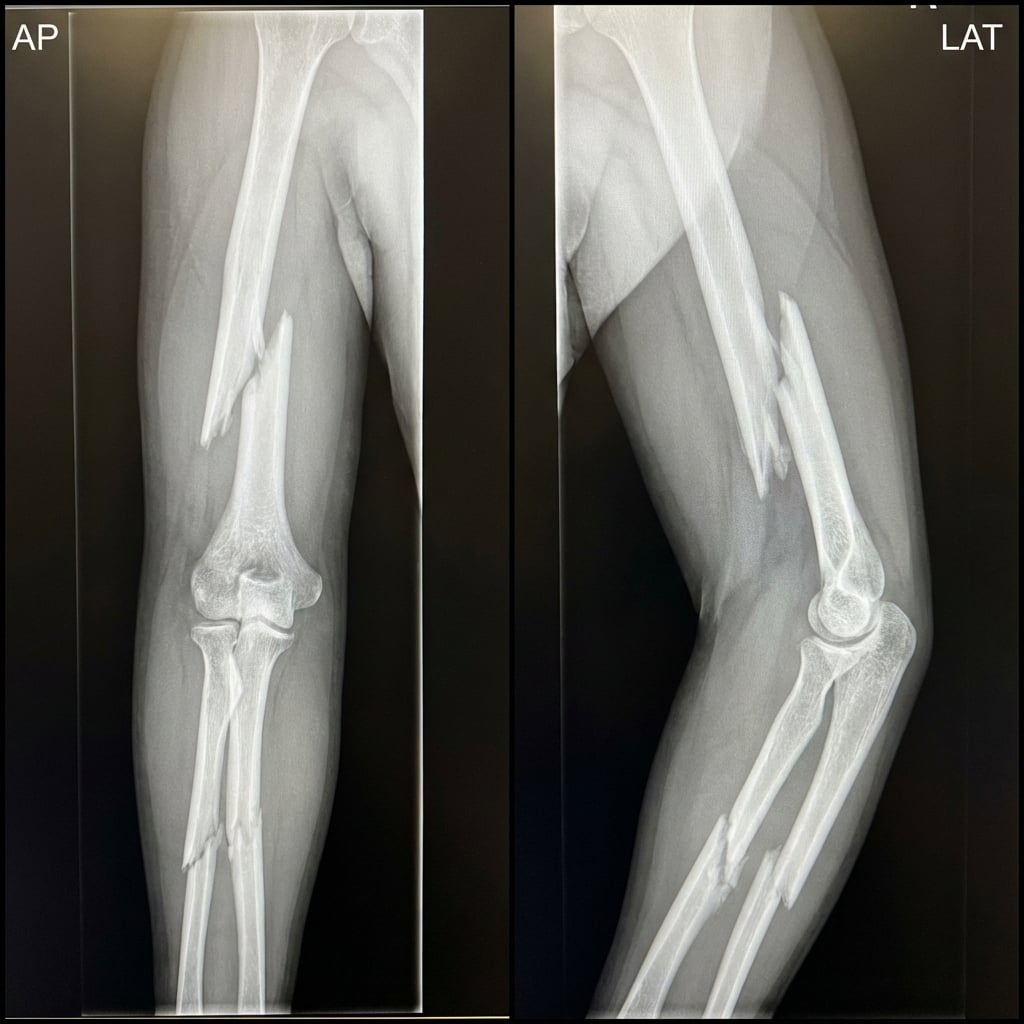
AP and lateral radiographs demonstrating displaced midshaft humerus fracture with spiral pattern and displaced both-bone forearm fracture in the same limb. The elbow joint appears concentrically reduced but without bony continuity to either shoulder or wrist. This is a floating elbow injury - a high-energy pattern with significant complication risk.
Open Full Size

AP and lateral radiographs demonstrating displaced midshaft humerus fracture with spiral pattern and displaced both-bone forearm fracture in the same limb. The elbow joint appears concentrically reduced but without bony continuity to either shoulder or wrist. This is a floating elbow injury - a high-energy pattern with significant complication risk.

Image source: Open Access medical literature (NIH/PubMed Central) • CC-BY License

Questions

Question 1 (4 marks)

Define this injury pattern and what are your initial assessment priorities?

Question 2 (5 marks)

What is the significance of this injury pattern and what complications should you anticipate?

Question 3 (6 marks)

Describe your operative strategy for fixation of both fractures.

Question 4 (5 marks)

How do you manage the radial nerve palsy identified preoperatively?

Question 5 (4 marks)

What rehabilitation protocol do you follow and what are expected outcomes?

Question 6 (4 marks)

How does management differ in children with this injury pattern?

Exam Day Cheat Sheet

Must Mention

  • •Document neuro status BEFORE manipulation
  • •Fix BOTH fractures same sitting
  • •Humerus first (limb stability)
  • •Radial nerve palsy 15-20%, 90% recover
  • •Early elbow ROM critical
  • •Don't explore primary radial palsy routinely

Common Pitfalls

  • •Not documenting neuro status pre-op
  • •Exploring radial nerve unnecessarily
  • •Fixing only one fracture
  • •Delayed mobilization → stiffness
  • •Missing compartment syndrome
  • •Secondary palsy not explored
Scenario Info
Answers Revealed0/6
Difficulty
advanced
Time Allowed6 min
Total Marks28
Questions6
Related Scenarios

Acetabular Fracture

trauma•26 marks

Atypical Femoral Fracture

trauma•26 marks

Calcaneal Fracture

trauma•24 marks

Chronic Elbow Dislocation

trauma•28 marks

Compartment Syndrome - Leg

trauma•26 marks