trauma
Floating Knee
advanced
6 min
26 marks
6 questions
Clinical Scenario
A 35-year-old male motorcyclist is brought to the trauma center following a high-speed collision. GCS is 15 and he is hemodynamically stable after initial resuscitation with 2 units blood. His left thigh and leg are deformed with an open wound over the proximal tibia exposing bone. The foot is warm with palpable dorsalis pedis pulse but decreased sensation in the first dorsal web space.
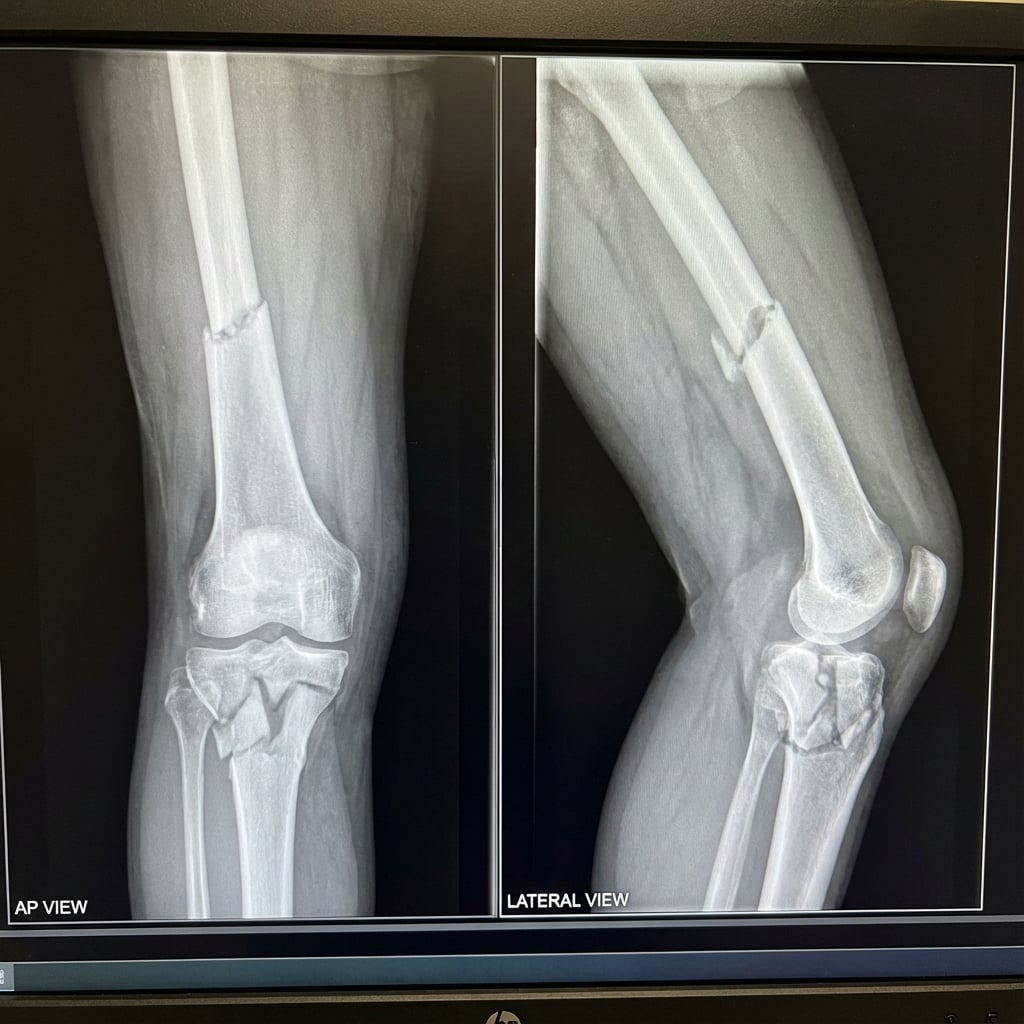
AP and lateral radiographs of the left leg showing ipsilateral displaced femoral shaft fracture (mid-diaphysis, transverse) and comminuted tibial plateau fracture. The knee is 'floating' without bony stability above or below.
Image source: Open Access medical literature (NIH/PubMed Central) • CC-BY License
Questions
Question 1 (4 marks)
Define floating knee and classify this injury using the Fraser classification.
Question 2 (5 marks)
What associated injuries must you assess for and why?
Question 3 (5 marks)
Describe your initial management and damage control strategy.
Question 4 (5 marks)
Outline the definitive surgical management plan including sequence of fixation.
Question 5 (4 marks)
How and when would you assess the knee ligaments?
Question 6 (3 marks)
What outcomes and complications would you discuss with the patient?
Exam Day Cheat Sheet
Must Mention
- •Fraser classification: I (both diaphyseal), IIa/b/c (intra-articular involvement)
- •Knee ligament injury in 30-50% (often occult)
- •Check ABI - popliteal artery at risk
- •DCO if physiologically unstable, polytrauma, or ISS >16
- •Fix femur first (restores length, allows tibia positioning)
- •Open fracture: antibiotics within 3 hours
Common Pitfalls
- •Definitive surgery in physiologically unstable patient (use DCO)
- •Missing popliteal artery injury (check ABI)
- •Not assessing knee ligaments (50% occult injury)
- •Missing compartment syndrome (two long bones = high risk)
- •Delayed antibiotics for open fracture (within 3 hours)
- •Wrong sequence (femur first usually)