OrthoVellum
Knowledge Hub

Study

  • Topics
  • MCQs
  • ISAWE
  • Operative Surgery
  • Flashcards

Company

  • About Us
  • Editorial Policy
  • Contact
  • FAQ
  • Blog

Legal

  • Terms of Service
  • Privacy Policy
  • Cookie Policy
  • Medical Disclaimer
  • Copyright & DMCA
  • Refund Policy

Support

  • Help Center
  • Accessibility
  • Report an Issue
OrthoVellum

© 2026 OrthoVellum. For educational purposes only.

Not affiliated with the Royal Australasian College of Surgeons.

Back to ISAWE Scenarios
Contents
0%
trauma

Forearm Compartment Syndrome
advanced
6 min
28 marks
6 questions
Clinical Scenario
A 22-year-old male had a closed reduction of a distal radius fracture 8 hours ago and is now in a below-elbow cast. The nursing staff is concerned as he is requiring escalating doses of opioid analgesia and is complaining of severe pain. The pain seems out of proportion to the injury.
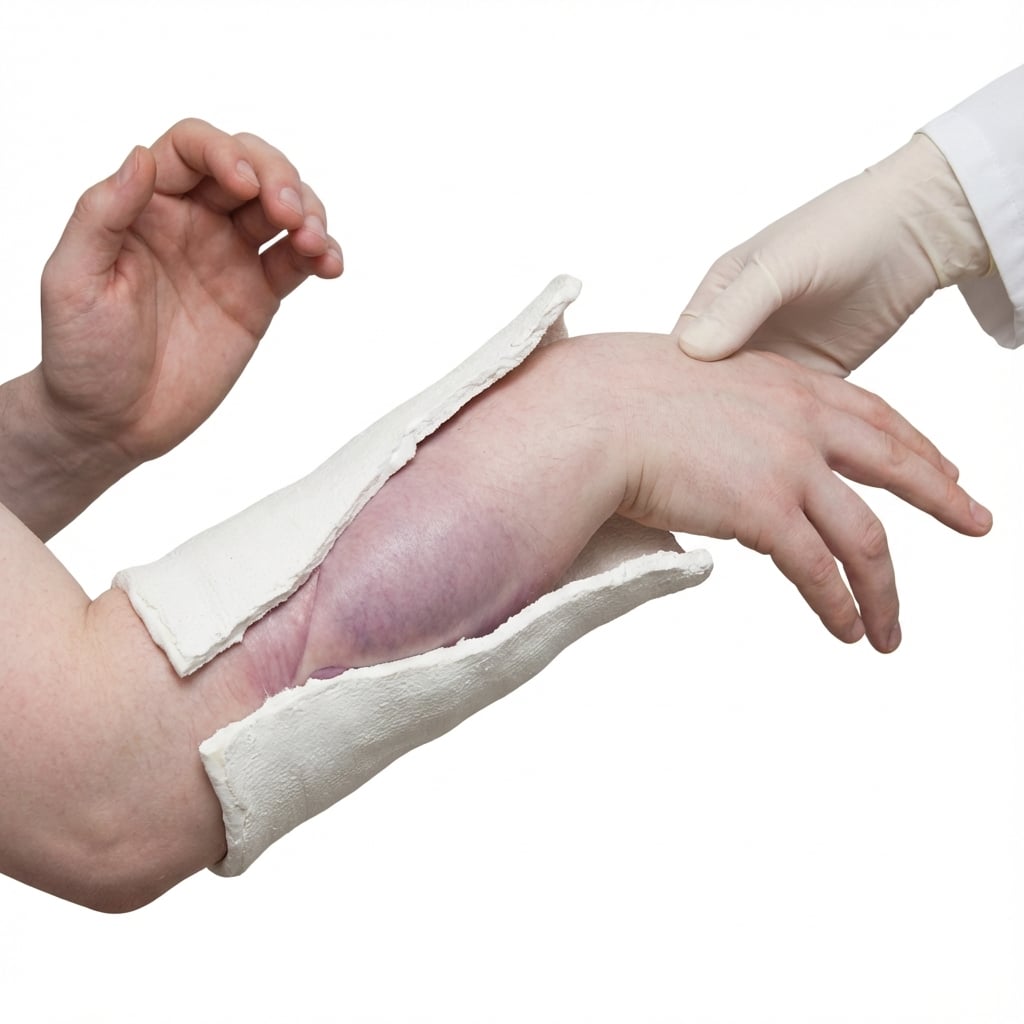
Clinical photograph demonstrating tense, swollen forearm with pain on passive finger extension. The patient has a reduced distal radius fracture in a cast. Cast has been bivalved revealing tense compartments. Radiograph shows acceptable fracture reduction. This represents acute compartment syndrome requiring emergency fasciotomy.
Open Full Size

Clinical photograph demonstrating tense, swollen forearm with pain on passive finger extension. The patient has a reduced distal radius fracture in a cast. Cast has been bivalved revealing tense compartments. Radiograph shows acceptable fracture reduction. This represents acute compartment syndrome requiring emergency fasciotomy.

Image source: Open Access medical literature (NIH/PubMed Central) • CC-BY License

Questions

Question 1 (4 marks)

What is the clinical diagnosis and what are the classical clinical features?

Question 2 (5 marks)

How do you confirm the diagnosis and what are the pressure thresholds?

Question 3 (6 marks)

Describe your surgical technique for forearm fasciotomy.

Question 4 (5 marks)

What is the anatomy of forearm compartments and which structures are at risk?

Question 5 (4 marks)

What is Volkmann's ischemic contracture and how is it classified?

Question 6 (4 marks)

What is your post-operative management and wound closure strategy?

Exam Day Cheat Sheet

Must Mention

  • •Pain out of proportion = compartment syndrome
  • •Pain on passive stretch = most sensitive sign
  • •Delta pressure (DBP - compartment) <30mmHg = fasciotomy
  • •Clinical diagnosis - don't delay for measurements
  • •3 compartments: volar superficial, volar deep, dorsal
  • •Carpal tunnel release ROUTINE with volar fasciotomy
  • •Volkmann's contracture is preventable

Common Pitfalls

  • •Waiting for measurements when diagnosis clinical
  • •Not releasing carpal tunnel
  • •Incomplete fasciotomy (short incision)
  • •Relying on pulselessness
  • •Missing dorsal compartment
  • •Delayed second look
  • •Tight closure causing recurrence
Scenario Info
Answers Revealed0/6
Difficulty
advanced
Time Allowed6 min
Total Marks28
Questions6
Related Scenarios

Acetabular Fracture

trauma•26 marks

Atypical Femoral Fracture

trauma•26 marks

Calcaneal Fracture

trauma•24 marks

Chronic Elbow Dislocation

trauma•28 marks

Compartment Syndrome - Leg

trauma•26 marks