OrthoVellum
Knowledge Hub

Study

  • Topics
  • MCQs
  • ISAWE
  • Operative Surgery
  • Flashcards

Company

  • About Us
  • Editorial Policy
  • Contact
  • FAQ
  • Blog

Legal

  • Terms of Service
  • Privacy Policy
  • Cookie Policy
  • Medical Disclaimer
  • Copyright & DMCA
  • Refund Policy

Support

  • Help Center
  • Accessibility
  • Report an Issue
OrthoVellum

© 2026 OrthoVellum. For educational purposes only.

Not affiliated with the Royal Australasian College of Surgeons.

Back to ISAWE Scenarios
Contents
0%
trauma

Humeral Shaft Fracture with Radial Nerve Palsy
advanced
6 min
28 marks
6 questions
Clinical Scenario
A 35-year-old man presents after an arm wrestling injury. He reports sudden pain and a "crack" in his right arm during the contest. His arm is deformed, and he immediately noticed he could not lift his wrist or extend his fingers. Examination confirms wrist drop, inability to extend MCP joints, and numbness over the dorsal first web space.
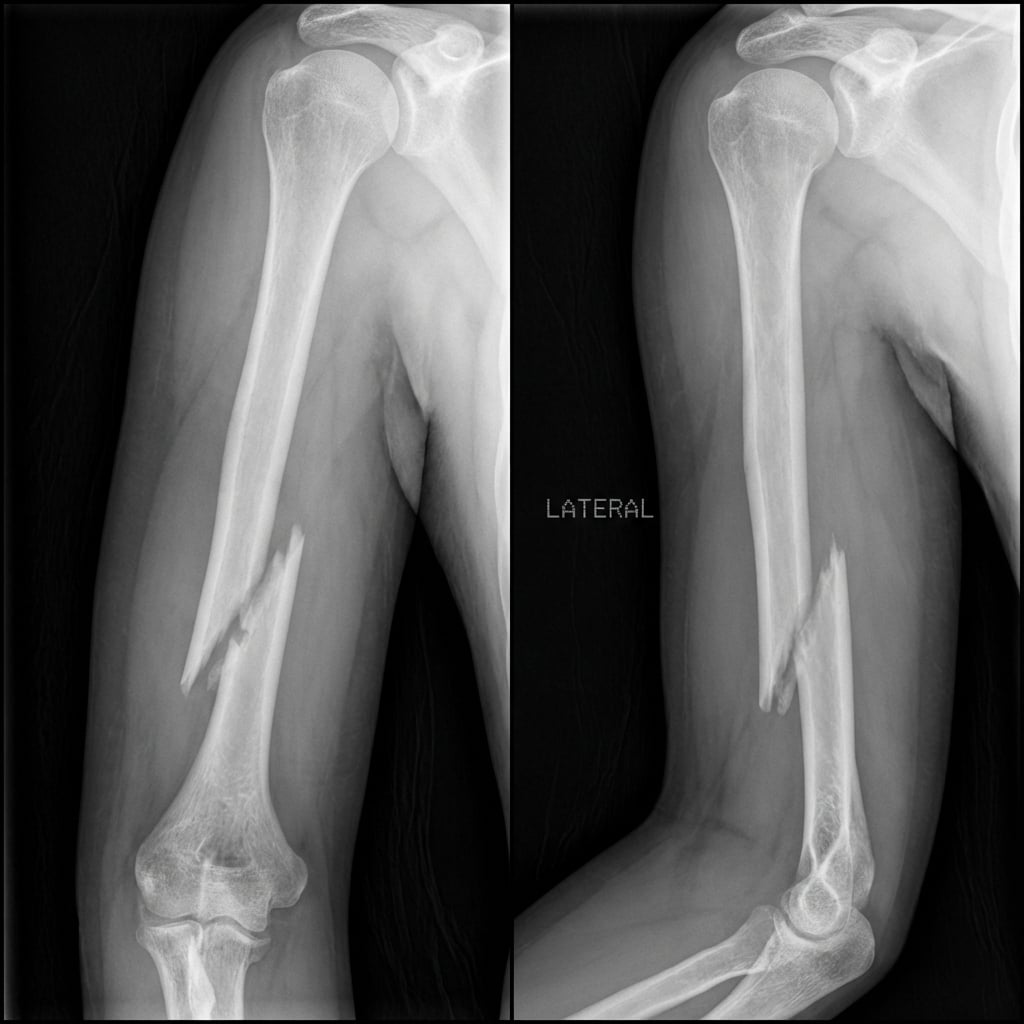
AP and lateral radiographs demonstrating spiral fracture of the distal third humeral shaft (Holstein-Lewis pattern) with shortening and angulation. The radial nerve crosses the posterior humerus at the junction of middle and distal thirds where it is vulnerable to injury.
Open Full Size

AP and lateral radiographs demonstrating spiral fracture of the distal third humeral shaft (Holstein-Lewis pattern) with shortening and angulation. The radial nerve crosses the posterior humerus at the junction of middle and distal thirds where it is vulnerable to injury.

Image source: Open Access medical literature (NIH/PubMed Central) • CC-BY License

Questions

Question 1 (4 marks)

Describe the radiographic findings and explain the anatomy that makes radial nerve injury likely.

Question 2 (5 marks)

What is the incidence and prognosis of radial nerve palsy with humeral shaft fractures?

Question 3 (5 marks)

What is your initial management strategy for this patient?

Question 4 (5 marks)

The patient has no recovery at 4 months and EMG shows no reinnervation. What are your options?

Question 5 (5 marks)

Describe your surgical technique for fixation with nerve exploration.

Question 6 (4 marks)

If nerve recovery fails, what tendon transfers are available for radial nerve palsy?

Exam Day Cheat Sheet

Must Mention

  • •Radial nerve palsy: 7-17% (up to 22% in Holstein-Lewis)
  • •70-90% spontaneous recovery (most are neurapraxia)
  • •Functional bracing (Sarmiento): 90%+ union rate
  • •EMG at 3 weeks (baseline), 3 months (recovery assessment)
  • •Explore if: secondary palsy, no recovery at 3-4 months
  • •Tendon transfers: PT-ECRB, FCR-EDC, PL-EPL

Common Pitfalls

  • •Exploring primary palsy immediately (90% recover spontaneously)
  • •Not documenting nerve status before manipulation
  • •Missing secondary palsy after reduction (needs urgent exploration)
  • •Not using Sarmiento functional bracing (90%+ union)
  • •Waiting too long for tendon transfers (>12-18 months = motor endplate degeneration)
  • •Not knowing standard triple transfer: PT-ECRB, FCR-EDC, PL-EPL
Scenario Info
Answers Revealed0/6
Difficulty
advanced
Time Allowed6 min
Total Marks28
Questions6
Related Scenarios

Acetabular Fracture

trauma•26 marks

Atypical Femoral Fracture

trauma•26 marks

Calcaneal Fracture

trauma•24 marks

Chronic Elbow Dislocation

trauma•28 marks

Compartment Syndrome - Leg

trauma•26 marks