OrthoVellum
Knowledge Hub

Study

  • Topics
  • MCQs
  • ISAWE
  • Operative Surgery
  • Flashcards

Company

  • About Us
  • Editorial Policy
  • Contact
  • FAQ
  • Blog

Legal

  • Terms of Service
  • Privacy Policy
  • Cookie Policy
  • Medical Disclaimer
  • Copyright & DMCA
  • Refund Policy

Support

  • Help Center
  • Accessibility
  • Report an Issue
OrthoVellum

© 2026 OrthoVellum. For educational purposes only.

Not affiliated with the Royal Australasian College of Surgeons.

Back to ISAWE Scenarios
Contents
0%
trauma

Mangled Extremity

advanced
6 min
28 marks
6 questions
Clinical Scenario
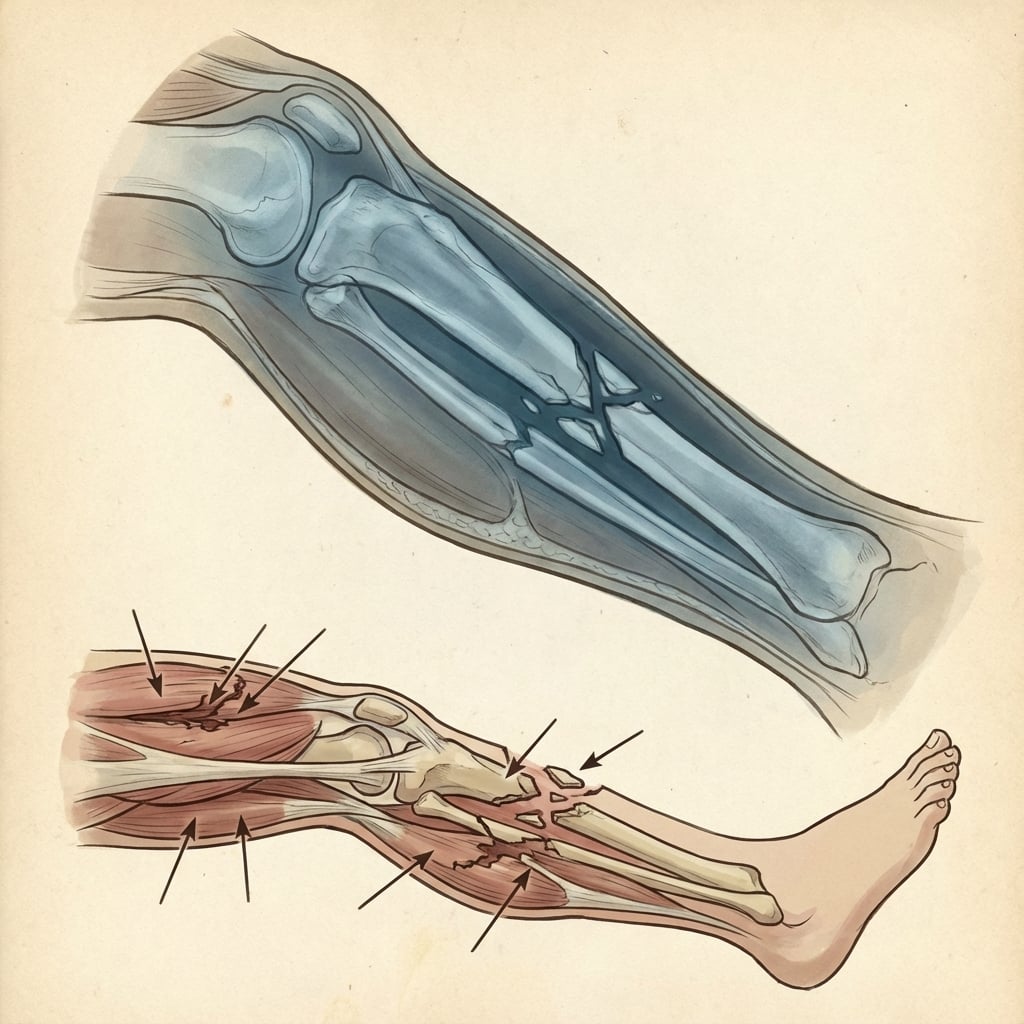
A 30-year-old farmer presents following a farm machinery accident. He has a severe injury to his right leg with extensive soft tissue loss, exposed bone, and contamination. The foot is pale and cool with absent pulses. He is haemodynamically stable with an isolated injury.
Clinical photographs demonstrating severe lower limb injury with extensive soft tissue destruction, exposed bone and muscle, contamination from farm machinery. AP and lateral radiographs showing comminuted tibial shaft fracture with significant bone loss. Clinical signs of vascular compromise with absent distal pulses. This represents a limb-threatening injury requiring multidisciplinary assessment.
Open Full Size

Clinical photographs demonstrating severe lower limb injury with extensive soft tissue destruction, exposed bone and muscle, contamination from farm machinery. AP and lateral radiographs showing comminuted tibial shaft fracture with significant bone loss. Clinical signs of vascular compromise with absent distal pulses. This represents a limb-threatening injury requiring multidisciplinary assessment.

Image source: Open Access medical literature (NIH/PubMed Central) • CC-BY License

Questions

Question 1 (4 marks)

What scoring systems are used to assess limb salvage potential and what are their limitations?

Question 2 (5 marks)

What factors influence the decision between limb salvage and primary amputation?

Question 3 (6 marks)

Describe your initial surgical management priorities and the staged approach.

Question 4 (5 marks)

What are the key considerations for soft tissue coverage and bone reconstruction?

Question 5 (4 marks)

What outcomes would you discuss with the patient and family?

Question 6 (4 marks)

How do you approach the patient who refuses amputation despite poor prognosis?

Exam Day Cheat Sheet

Must Mention

  • •MESS score guides but does not dictate decision
  • •LEAP study: similar 2-year outcomes salvage vs amputation
  • •Tibial nerve = most important functional predictor
  • •Staged approach with serial debridement
  • •Fasciotomy MANDATORY with revascularization
  • •Soft tissue coverage within 7-10 days
  • •Average 4-5 surgeries for salvage

Common Pitfalls

  • •MESS score as absolute indication for amputation
  • •Not involving patient in decision
  • •Delayed fasciotomy causing muscle necrosis
  • •Delayed soft tissue coverage (>10 days)
  • •Not addressing tibial nerve status
  • •Not discussing realistic outcomes
  • •Missing ongoing infection
Scenario Info
Answers Revealed0/6
Difficulty
advanced
Time Allowed6 min
Total Marks28
Questions6
Related Scenarios

Acetabular Fracture

trauma•26 marks

Atypical Femoral Fracture

trauma•26 marks

Calcaneal Fracture

trauma•24 marks

Chronic Elbow Dislocation

trauma•28 marks

Compartment Syndrome - Leg

trauma•26 marks