trauma
Open Tibial Fracture
advanced
6 min
24 marks
6 questions
Clinical Scenario
A 28-year-old motorcyclist presents to the emergency department following a high-speed road traffic accident. His left leg is deformed with an 8cm wound over the anterolateral tibia. There is exposed bone and moderate soil contamination. He is hemodynamically stable with no other apparent injuries. Distal pulses are palpable but weak.
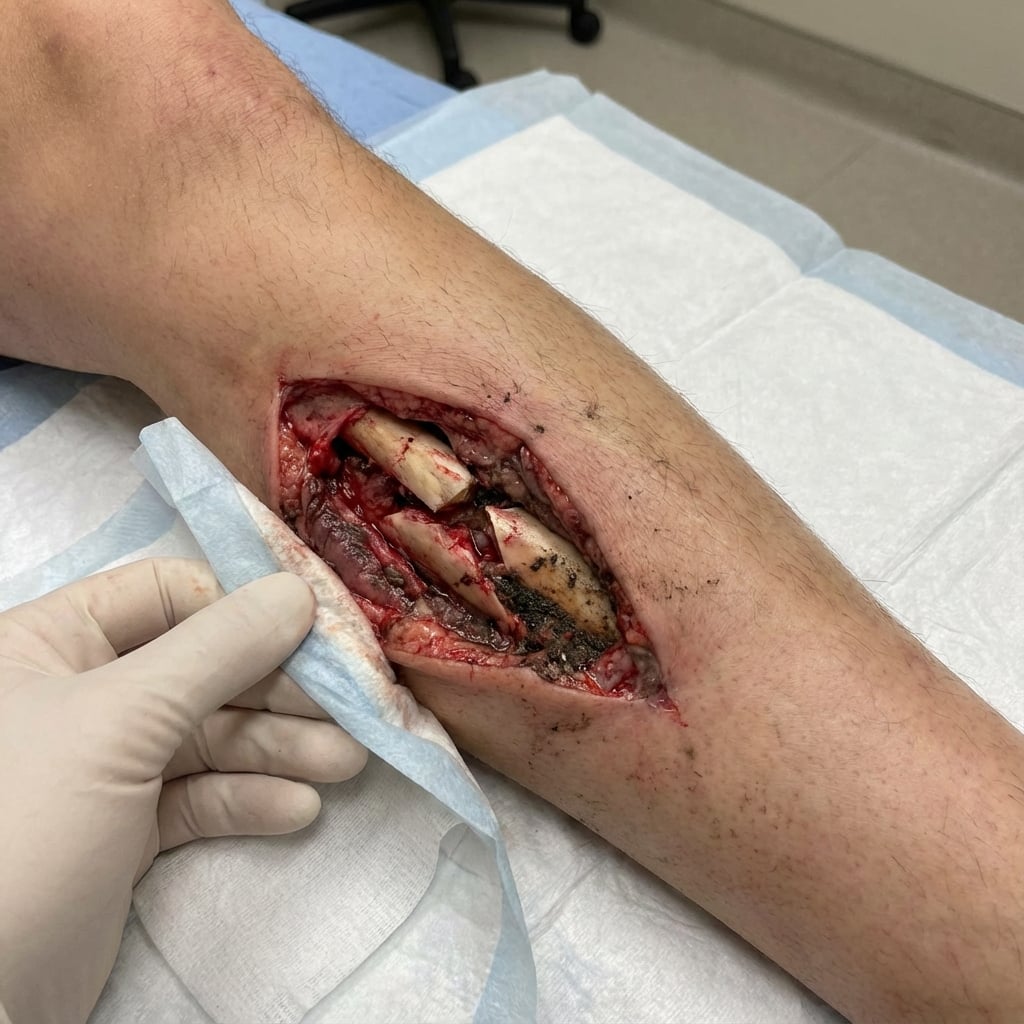
Clinical photograph showing open tibial shaft fracture with 8cm wound over the anterolateral leg, exposed comminuted bone fragments, and moderate soft tissue contamination. High-energy mechanism from motorcycle accident.
Image source: Open Access medical literature (NIH/PubMed Central) • CC-BY License
Questions
Question 1 (4 marks)
Describe the Gustilo-Anderson classification and classify this injury.
Question 2 (4 marks)
Outline your initial emergency department management according to BOAST guidelines.
Question 3 (5 marks)
Describe your surgical debridement technique.
Question 4 (4 marks)
What are the definitive fixation options and their indications?
Question 5 (4 marks)
The wound cannot be closed primarily. Describe soft tissue coverage options by tibial location.
Question 6 (3 marks)
What is the 'fix and flap' principle and what is the evidence behind it?
Exam Day Cheat Sheet
Must Mention
- •Gustilo-Anderson: I (<1cm clean), II (1-10cm), IIIA (coverage possible), IIIB (needs flap), IIIC (vascular)
- •Antibiotics within 3 hours: Cefazolin + Gentamicin for Type III
- •Theatre within 24 hours (BOAST) - earlier if contaminated
- •4 Cs of muscle viability
- •IM nail gold standard for tibial shaft
- •Photograph wound ONCE then cover - no repeated inspections
- •Fix and flap within 72 hours for Type IIIB
Common Pitfalls
- •Delayed antibiotics (>3 hours significantly increases infection)
- •Primary wound closure (never for Type III)
- •Repeated wound inspections (photograph once)
- •Missing compartment syndrome
- •Late plastic surgery involvement
- •High-pressure irrigation (damages tissues)