OrthoVellum
Knowledge Hub

Study

  • Topics
  • MCQs
  • ISAWE
  • Operative Surgery
  • Flashcards

Company

  • About Us
  • Editorial Policy
  • Contact
  • FAQ
  • Blog

Legal

  • Terms of Service
  • Privacy Policy
  • Cookie Policy
  • Medical Disclaimer
  • Copyright & DMCA
  • Refund Policy

Support

  • Help Center
  • Accessibility
  • Report an Issue
OrthoVellum

© 2026 OrthoVellum. For educational purposes only.

Not affiliated with the Royal Australasian College of Surgeons.

Back to ISAWE Scenarios
Contents
0%
trauma

Patella Fracture

advanced
6 min
28 marks
6 questions
Clinical Scenario
A 55-year-old woman presents after a direct blow to the knee from falling onto the kneecap. She is unable to perform a straight leg raise. There is significant swelling with a palpable gap over the patella. Distal neurovascular examination is intact.
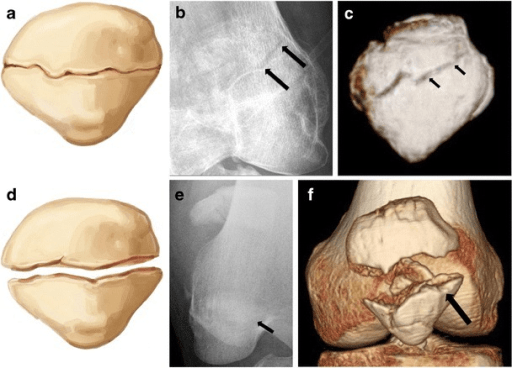
AP and lateral radiographs demonstrating displaced transverse patella fracture through the mid-portion with 5mm separation between fragments. The proximal pole is migrated superiorly due to quadriceps pull, indicating extensor mechanism disruption. Knee effusion is present.
Open Full Size

AP and lateral radiographs demonstrating displaced transverse patella fracture through the mid-portion with 5mm separation between fragments. The proximal pole is migrated superiorly due to quadriceps pull, indicating extensor mechanism disruption. Knee effusion is present.

Source: Imaging of Patellar Fractures: Transverse Fracture • PMC5265199 • CC-BY

Questions

Question 1 (4 marks)

Describe the radiographic findings and classify this fracture.

Question 2 (5 marks)

What clinical features determine operative versus non-operative management?

Question 3 (6 marks)

Describe the surgical techniques available and your tension band wiring technique.

Question 4 (5 marks)

What is the post-operative rehabilitation protocol?

Question 5 (4 marks)

What complications would you discuss and when would you remove hardware?

Question 6 (4 marks)

How does management differ for comminuted inferior pole fractures?

Exam Day Cheat Sheet

Must Mention

  • •SLR = key clinical test for extensor mechanism
  • •Surgery if: >2-3mm gap, unable to SLR, >2mm step
  • •TBW converts tensile → compressive forces
  • •Wire anterior to transverse axis of patella
  • •Hardware prominence 20-30% (most common complication)
  • •Early ROM essential

Common Pitfalls

  • •K-wires posterior to transverse axis (lose TBW advantage)
  • •Not repairing retinaculum
  • •Delayed mobilization → stiffness
  • •Not checking ROM in theatre
  • •Attempting TBW for severely comminuted
  • •Missing bipartite patella (check contralateral)
Scenario Info
Answers Revealed0/6
Difficulty
advanced
Time Allowed6 min
Total Marks28
Questions6
Related Scenarios

Acetabular Fracture

trauma•26 marks

Atypical Femoral Fracture

trauma•26 marks

Calcaneal Fracture

trauma•24 marks

Chronic Elbow Dislocation

trauma•28 marks

Compartment Syndrome - Leg

trauma•26 marks