OrthoVellum
Knowledge Hub

Study

  • Topics
  • MCQs
  • ISAWE
  • Operative Surgery
  • Flashcards

Company

  • About Us
  • Editorial Policy
  • Contact
  • FAQ
  • Blog

Legal

  • Terms of Service
  • Privacy Policy
  • Cookie Policy
  • Medical Disclaimer
  • Copyright & DMCA
  • Refund Policy

Support

  • Help Center
  • Accessibility
  • Report an Issue
OrthoVellum

Β© 2026 OrthoVellum. For educational purposes only.

Not affiliated with the Royal Australasian College of Surgeons.

Back to ISAWE Scenarios
Contents
0%
trauma

Pelvic Ring Injury

advanced
6 min
28 marks
6 questions
Clinical Scenario
A 35-year-old male motorcyclist presents following a high-speed collision. He is hypotensive (BP 80/50) with tachycardia (HR 130). GCS is 14 (confused). The pelvis is unstable on examination. Paramedics have applied a pelvic binder. There is blood at the urethral meatus. He is receiving IV fluids via large bore cannulae.
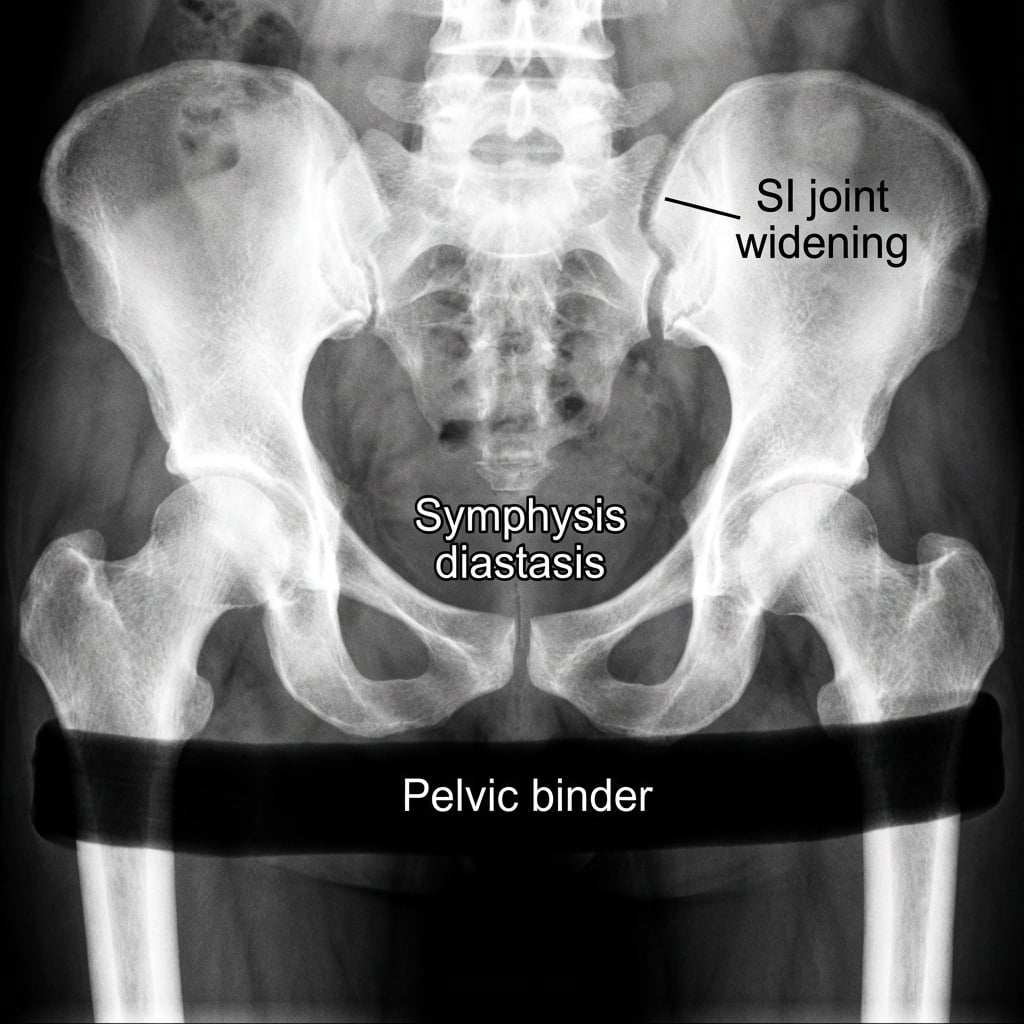
AP pelvis radiograph showing APC-III (open book) injury with symphysis pubis diastasis >2.5cm and widening of the left sacroiliac joint. The hemipelvis is externally rotated indicating complete posterior ring disruption. Pelvic binder in situ.
Open Full Size

AP pelvis radiograph showing APC-III (open book) injury with symphysis pubis diastasis >2.5cm and widening of the left sacroiliac joint. The hemipelvis is externally rotated indicating complete posterior ring disruption. Pelvic binder in situ.

Source: AI-Generated: APC-III Pelvic Ring Injury Educational Radiograph β€’ OrthoVellum AI β€’ OrthoVellum Educational Use

Questions

Question 1 (5 marks)

Classify this pelvic injury using both Young-Burgess and Tile classifications. Describe the implications for hemorrhage.

Question 2 (5 marks)

Describe your immediate resuscitation priorities and the hemorrhage control algorithm.

Question 3 (4 marks)

There is blood at the urethral meatus. What associated injuries must you assess for?

Question 4 (5 marks)

The patient stabilizes after angioembolization. Describe your definitive fixation strategy.

Question 5 (5 marks)

What are the indications for emergent interventions? Describe REBOA, pelvic packing, and angioembolization.

Question 6 (4 marks)

What complications and long-term outcomes would you counsel the patient about?

Exam Day Cheat Sheet

Must Mention

  • β€’Pelvic binder at GREATER TROCHANTERS (not iliac crests)
  • β€’Blood at meatus = DO NOT catheterize until retrograde urethrogram
  • β€’MTP 1:1:1 ratio; avoid crystalloid boluses
  • β€’80% venous (packing), 20% arterial (angio)
  • β€’Posterior ring fixation is priority (SI screws)
  • β€’APC injuries respond best to binder (reduces volume)

Common Pitfalls

  • β€’Pelvic binder at iliac crests (should be at trochanters)
  • β€’Urethral catheter with blood at meatus
  • β€’Repeated pelvic spring test (increases bleeding)
  • β€’Crystalloid boluses (dilutional coagulopathy)
  • β€’Anterior-only fixation for unstable (Type C) injury
  • β€’Operating before physiological optimization
Scenario Info
Answers Revealed0/6
Difficulty
advanced
Time Allowed6 min
Total Marks28
Questions6
Related Scenarios

Acetabular Fracture

traumaβ€’26 marks

Atypical Femoral Fracture

traumaβ€’26 marks

Calcaneal Fracture

traumaβ€’24 marks

Chronic Elbow Dislocation

traumaβ€’28 marks

Compartment Syndrome - Leg

traumaβ€’26 marks