OrthoVellum
Knowledge Hub

Study

  • Topics
  • MCQs
  • ISAWE
  • Operative Surgery
  • Flashcards

Company

  • About Us
  • Editorial Policy
  • Contact
  • FAQ
  • Blog

Legal

  • Terms of Service
  • Privacy Policy
  • Cookie Policy
  • Medical Disclaimer
  • Copyright & DMCA
  • Refund Policy

Support

  • Help Center
  • Accessibility
  • Report an Issue
OrthoVellum

© 2026 OrthoVellum. For educational purposes only.

Not affiliated with the Royal Australasian College of Surgeons.

Back to ISAWE Scenarios
Contents
0%
trauma

Periprosthetic Femur Fracture - THA
advanced
6 min
28 marks
6 questions
Clinical Scenario
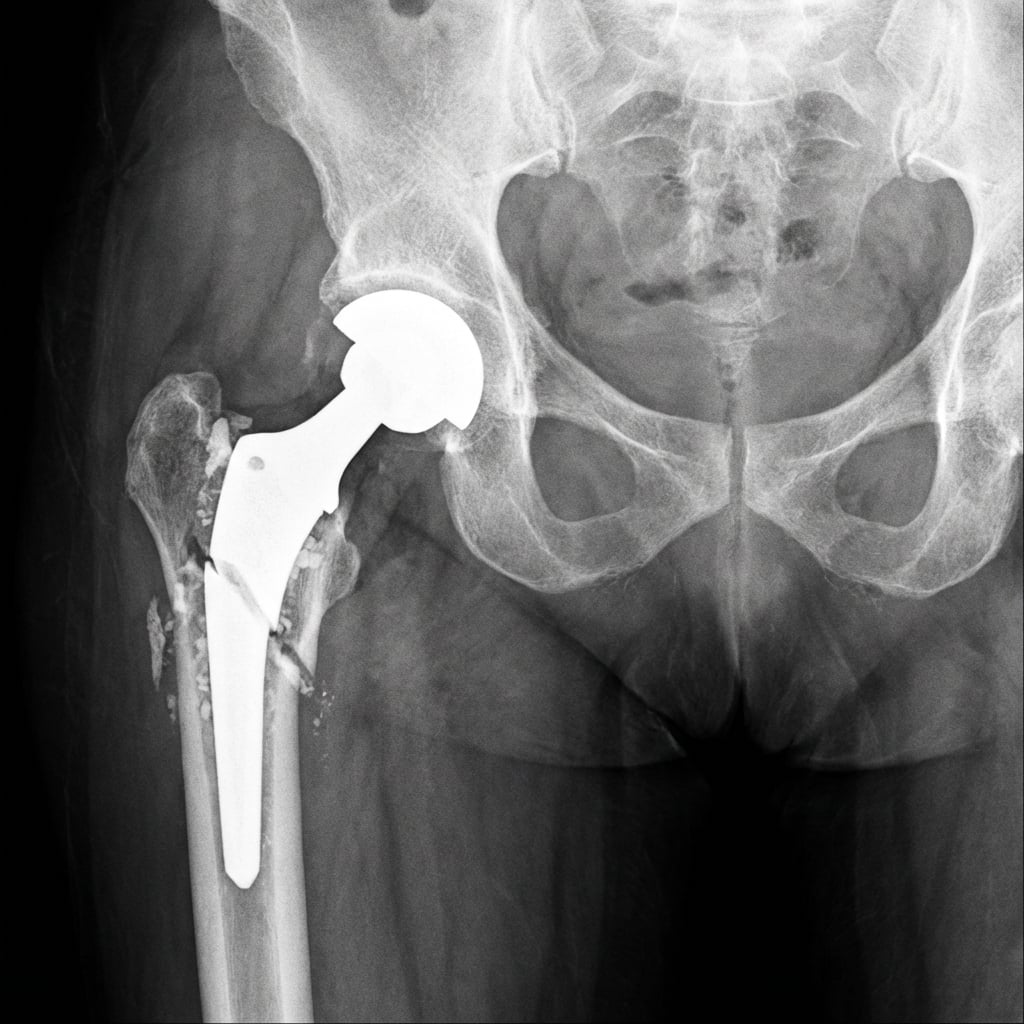
An 82-year-old woman presents after a fall at home. She had a cemented total hip arthroplasty 8 years ago for osteoarthritis. She was previously mobile with a frame but had progressive hip pain for the past 6 months before the fall. She cannot weight bear and the leg is shortened and externally rotated.
AP pelvis radiograph demonstrating periprosthetic femur fracture around a cemented total hip arthroplasty. The fracture is at the level of the stem tip with oblique pattern extending proximally. Evidence of cement mantle fracture and possible stem subsidence. The patient had pre-injury pain suggesting loosening. This is a Vancouver B2 pattern requiring revision arthroplasty.
Open Full Size

AP pelvis radiograph demonstrating periprosthetic femur fracture around a cemented total hip arthroplasty. The fracture is at the level of the stem tip with oblique pattern extending proximally. Evidence of cement mantle fracture and possible stem subsidence. The patient had pre-injury pain suggesting loosening. This is a Vancouver B2 pattern requiring revision arthroplasty.

Image source: Open Access medical literature (NIH/PubMed Central) • CC-BY License

Questions

Question 1 (4 marks)

Classify this fracture using the Vancouver classification and explain the treatment implications.

Question 2 (5 marks)

What preoperative assessment and investigations are required?

Question 3 (6 marks)

Describe your surgical approach for a Vancouver B2 fracture.

Question 4 (5 marks)

What implant options are available and how do you select the appropriate stem?

Question 5 (4 marks)

What are the key technical points for cerclage fixation and fracture management?

Question 6 (4 marks)

What outcomes would you discuss and how do you optimize the patient?

Exam Day Cheat Sheet

Must Mention

  • •Vancouver classification guides treatment
  • •B2 = loose stem = revision arthroplasty
  • •Pre-injury pain = loosening until proven otherwise
  • •Bypass fracture by 2 cortical diameters
  • •Long uncemented tapered fluted stem
  • •Extended trochanteric osteotomy for access
  • •1-year mortality 10-11%

Common Pitfalls

  • •ORIF for B2 (stem is loose)
  • •Not recognizing loosening (pre-injury pain)
  • •Short stem not bypassing fracture
  • •Delayed surgery in elderly
  • •Not excluding infection
  • •Not assessing acetabulum
Scenario Info
Answers Revealed0/6
Difficulty
advanced
Time Allowed6 min
Total Marks28
Questions6
Related Scenarios

Acetabular Fracture

trauma•26 marks

Atypical Femoral Fracture

trauma•26 marks

Calcaneal Fracture

trauma•24 marks

Chronic Elbow Dislocation

trauma•28 marks

Compartment Syndrome - Leg

trauma•26 marks