OrthoVellum
Knowledge Hub

Study

  • Topics
  • MCQs
  • ISAWE
  • Operative Surgery
  • Flashcards

Company

  • About Us
  • Editorial Policy
  • Contact
  • FAQ
  • Blog

Legal

  • Terms of Service
  • Privacy Policy
  • Cookie Policy
  • Medical Disclaimer
  • Copyright & DMCA
  • Refund Policy

Support

  • Help Center
  • Accessibility
  • Report an Issue
OrthoVellum

© 2026 OrthoVellum. For educational purposes only.

Not affiliated with the Royal Australasian College of Surgeons.

Back to ISAWE Scenarios
Contents
0%
trauma

Polytrauma and Damage Control Orthopaedics
advanced
6 min
30 marks
6 questions
Clinical Scenario
A 32-year-old unrestrained driver presents following a high-speed motor vehicle collision. GCS is 12 (E3V4M5), BP 85/60, HR 130, temperature 34.8°C. Primary survey reveals decreased breath sounds on the left with tracheal deviation. He has an obvious deformity of the right thigh and an unstable pelvis on examination. Blood gas shows pH 7.18, base excess -8, lactate 6.2. INR is 1.8 and he has received 4 units blood en route.
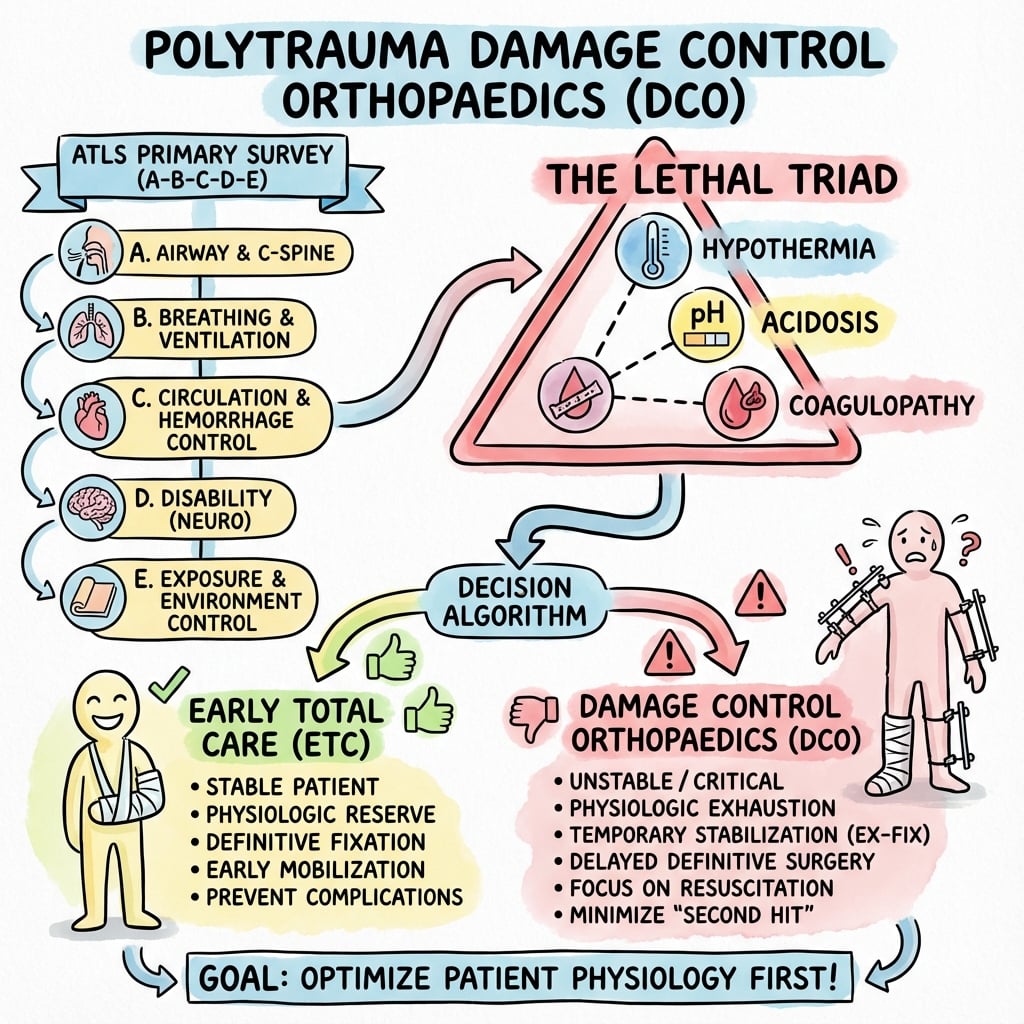
Diagram showing ATLS primary survey approach (A-B-C-D-E) with decision algorithm for Damage Control Orthopaedics versus Early Total Care based on physiological parameters (lethal triad: hypothermia, acidosis, coagulopathy).
Open Full Size

Diagram showing ATLS primary survey approach (A-B-C-D-E) with decision algorithm for Damage Control Orthopaedics versus Early Total Care based on physiological parameters (lethal triad: hypothermia, acidosis, coagulopathy).

Image source: Open Access medical literature (NIH/PubMed Central) • CC-BY License

Questions

Question 1 (5 marks)

Describe your immediate management priorities in order for this patient.

Question 2 (5 marks)

Define Damage Control Orthopaedics (DCO) and explain the indications and rationale in this patient.

Question 3 (5 marks)

Describe your acute orthopaedic surgical management plan.

Question 4 (5 marks)

What parameters would you monitor and when would you proceed to definitive fixation?

Question 5 (5 marks)

The patient develops increasing oxygen requirements and confusion 48 hours post-injury. What is your differential and management?

Question 6 (5 marks)

Describe complications specific to polytrauma and how to prevent/manage them.

Exam Day Cheat Sheet

Must Mention

  • •ATLS order: A-B-C-D-E (tension pneumothorax before ortho)
  • •Lethal triad: hypothermia (<35°C), acidosis (pH <7.25), coagulopathy (INR >1.5)
  • •"Second hit" phenomenon
  • •DCO: temporary ex-fix → convert to IM nail in window (days 5-10)
  • •Convert external fixator within 2 weeks (infection risk)
  • •Fat embolism syndrome: hypoxia, confusion, petechiae at 24-72 hours

Common Pitfalls

  • •ORIF in unstable patient (second hit → ARDS, MODS, death)
  • •Not recognizing lethal triad (hypothermia, acidosis, coagulopathy)
  • •Orthopaedics before life-threatening injuries (ATLS order)
  • •Not applying pelvic binder early
  • •Converting ex-fix to nail too late (>2 weeks = infection)
  • •Missing fat embolism syndrome (confusion + hypoxia 24-72h)
  • •Not doing tertiary survey for missed injuries
  • •Not monitoring for compartment syndrome
Scenario Info
Answers Revealed0/6
Difficulty
advanced
Time Allowed6 min
Total Marks30
Questions6
Related Scenarios

Acetabular Fracture

trauma•26 marks

Atypical Femoral Fracture

trauma•26 marks

Calcaneal Fracture

trauma•24 marks

Chronic Elbow Dislocation

trauma•28 marks

Compartment Syndrome - Leg

trauma•26 marks