OrthoVellum
Knowledge Hub

Study

  • Topics
  • MCQs
  • ISAWE
  • Operative Surgery
  • Flashcards

Company

  • About Us
  • Editorial Policy
  • Contact
  • FAQ
  • Blog

Legal

  • Terms of Service
  • Privacy Policy
  • Cookie Policy
  • Medical Disclaimer
  • Copyright & DMCA
  • Refund Policy

Support

  • Help Center
  • Accessibility
  • Report an Issue
OrthoVellum

© 2026 OrthoVellum. For educational purposes only.

Not affiliated with the Royal Australasian College of Surgeons.

Back to ISAWE Scenarios
Contents
0%
trauma

Posterior Sternoclavicular Joint Dislocation
advanced
6 min
28 marks
6 questions
Clinical Scenario
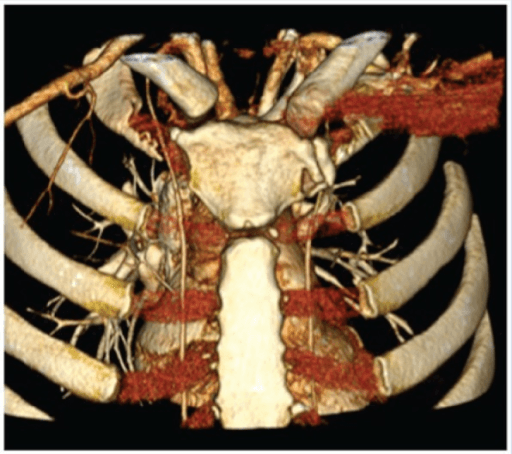
A 25-year-old male presents following a motor vehicle collision where he was an unrestrained driver. He has anterior chest pain and difficulty swallowing. On examination, there is a palpable depression over the medial clavicle on the left side. He has no respiratory distress but feels like there is something stuck in his throat.
Axial CT scan demonstrating posterior displacement of the medial clavicle behind the sternum. The displaced clavicle is in close proximity to the trachea, esophagus, and great vessels. There is soft tissue swelling anteriorly. This represents a potentially life-threatening injury requiring reduction in a controlled setting with cardiothoracic backup.
Open Full Size

Axial CT scan demonstrating posterior displacement of the medial clavicle behind the sternum. The displaced clavicle is in close proximity to the trachea, esophagus, and great vessels. There is soft tissue swelling anteriorly. This represents a potentially life-threatening injury requiring reduction in a controlled setting with cardiothoracic backup.

Source: Posterior Sternoclavicular Dislocation in Professional Athlete • PMC4481669 • CC-BY

Questions

Question 1 (4 marks)

Describe the imaging findings and classify this injury.

Question 2 (5 marks)

What mediastinal structures are at risk and what symptoms might indicate injury?

Question 3 (6 marks)

Describe your approach to closed reduction of this injury.

Question 4 (5 marks)

When is open reduction required and what is your surgical technique?

Question 5 (4 marks)

How do you manage chronic posterior SCJ dislocation?

Question 6 (4 marks)

What stabilization options are available and what is your follow-up protocol?

Exam Day Cheat Sheet

Must Mention

  • •Posterior SCJ = life-threatening (mediastinal structures at risk)
  • •ALWAYS CT scan for posterior dislocation
  • •Reduce in theatre with cardiothoracic standby
  • •Abduction-extension with sandbag between scapulae
  • •NO K-wires (fatal migration to heart)
  • •Chronic (>3 weeks) = reconstruction required
  • •Medial clavicle physis fuses last (23-25 years)

Common Pitfalls

  • •Not recognizing severity (posterior = dangerous)
  • •Not getting CT
  • •Reducing without cardiothoracic backup
  • •Using K-wires for stabilization
  • •Missing symptoms of compression
  • •Treating chronic like acute
Scenario Info
Answers Revealed0/6
Difficulty
advanced
Time Allowed6 min
Total Marks28
Questions6
Related Scenarios

Acetabular Fracture

trauma•26 marks

Atypical Femoral Fracture

trauma•26 marks

Calcaneal Fracture

trauma•24 marks

Chronic Elbow Dislocation

trauma•28 marks

Compartment Syndrome - Leg

trauma•26 marks