OrthoVellum
Knowledge Hub

Study

  • Topics
  • MCQs
  • ISAWE
  • Operative Surgery
  • Flashcards

Company

  • About Us
  • Editorial Policy
  • Contact
  • FAQ
  • Blog

Legal

  • Terms of Service
  • Privacy Policy
  • Cookie Policy
  • Medical Disclaimer
  • Copyright & DMCA
  • Refund Policy

Support

  • Help Center
  • Accessibility
  • Report an Issue
OrthoVellum

© 2026 OrthoVellum. For educational purposes only.

Not affiliated with the Royal Australasian College of Surgeons.

Back to ISAWE Scenarios
Contents
0%
trauma

Scapula Fracture

advanced
6 min
24 marks
6 questions
Clinical Scenario
A 55-year-old motorcyclist presents after a high-speed collision with multiple injuries. Chest injuries have been managed by the trauma team (rib fractures and haemothorax). He has significant right shoulder pain and difficulty moving his arm. On examination, there is bruising over the scapula and shoulder with painful limited range of motion. Peripheral neurovascular status is intact.
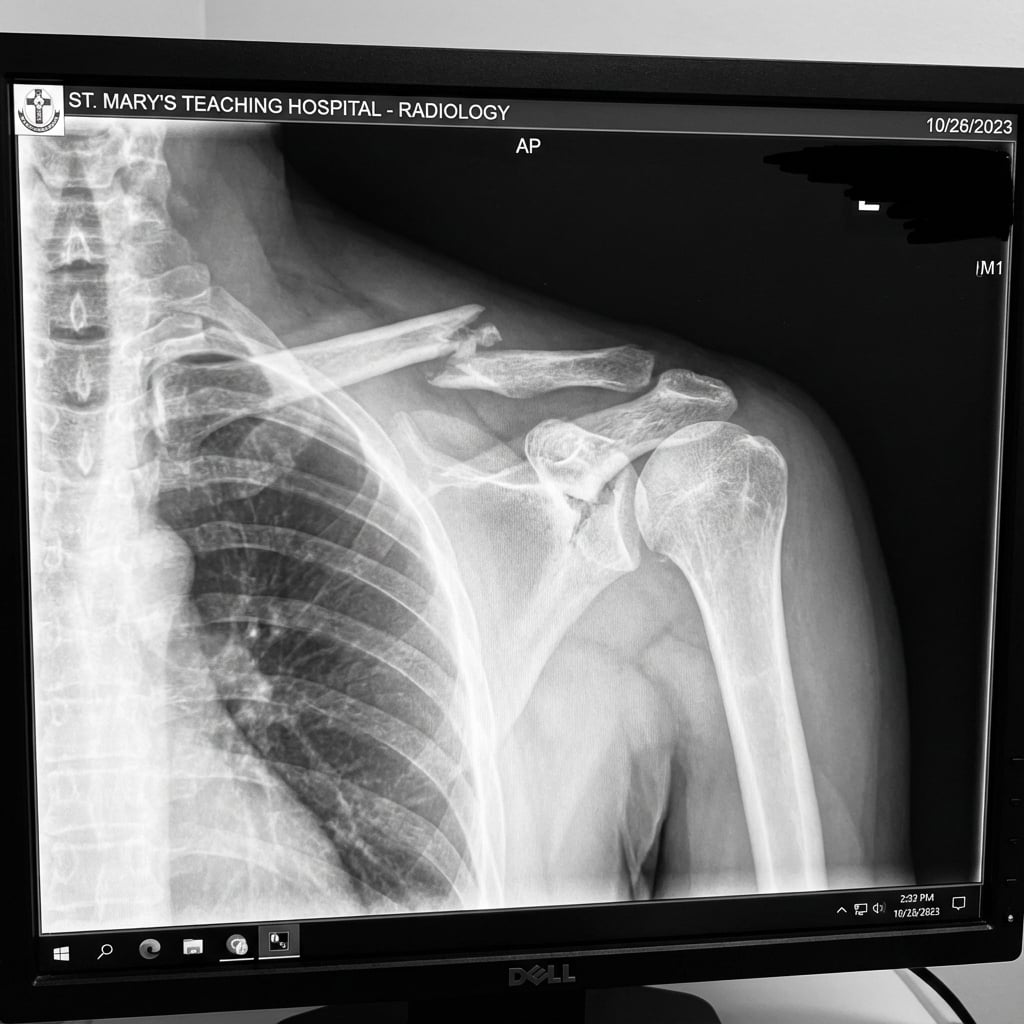
AP and Y-view scapular radiographs showing displaced scapular body and neck fracture with medialization of the glenoid. Associated clavicle fracture visible creating a floating shoulder pattern.
Open Full Size

AP and Y-view scapular radiographs showing displaced scapular body and neck fracture with medialization of the glenoid. Associated clavicle fracture visible creating a floating shoulder pattern.

Source: AI-Generated: Floating Shoulder (Scapula Neck + Clavicle Fracture) Radiograph • OrthoVellum AI • OrthoVellum Educational Use

Questions

Question 1 (4 marks)

What associated injuries should you assess for with this mechanism and fracture pattern?

Question 2 (4 marks)

Describe the Superior Shoulder Suspensory Complex (SSSC) and define a "floating shoulder."

Question 3 (5 marks)

What are the indications for operative management of scapular fractures?

Question 4 (5 marks)

Describe the surgical approach and fixation technique for scapular body/neck fractures.

Question 5 (3 marks)

How does a floating shoulder affect your management approach?

Question 6 (3 marks)

What outcomes would you counsel this patient about?

Exam Day Cheat Sheet

Must Mention

  • •80-90% have associated injuries (chest most common)
  • •SSSC = Superior Shoulder Suspensory Complex (bone-ligament ring)
  • •Floating shoulder = clavicle + scapula neck (double SSSC disruption)
  • •GPA <22° or medialization >15-20mm = surgical indication
  • •Judet posterior approach for scapula body/neck
  • •Fix clavicle first, then reassess scapula

Common Pitfalls

  • •Missing pulmonary/chest injuries (80%+ association)
  • •Not checking brachial plexus
  • •Not recognizing SSSC and floating shoulder concept
  • •Operating on isolated minimally displaced scapula
  • •Not fixing clavicle first in floating shoulder
  • •Suprascapular nerve injury during posterior approach
Scenario Info
Answers Revealed0/6
Difficulty
advanced
Time Allowed6 min
Total Marks24
Questions6
Related Scenarios

Acetabular Fracture

trauma•26 marks

Atypical Femoral Fracture

trauma•26 marks

Calcaneal Fracture

trauma•24 marks

Chronic Elbow Dislocation

trauma•28 marks

Compartment Syndrome - Leg

trauma•26 marks