OrthoVellum
Knowledge Hub

Study

  • Topics
  • MCQs
  • ISAWE
  • Operative Surgery
  • Flashcards

Company

  • About Us
  • Editorial Policy
  • Contact
  • FAQ
  • Blog

Legal

  • Terms of Service
  • Privacy Policy
  • Cookie Policy
  • Medical Disclaimer
  • Copyright & DMCA
  • Refund Policy

Support

  • Help Center
  • Accessibility
  • Report an Issue
OrthoVellum

© 2026 OrthoVellum. For educational purposes only.

Not affiliated with the Royal Australasian College of Surgeons.

Back to ISAWE Scenarios
Contents
0%
trauma

Tibial Plateau Fracture
advanced
6 min
24 marks
6 questions
Clinical Scenario
A 52-year-old motorcyclist presents following a high-speed collision. His right knee is swollen and deformed with a large hemarthrosis. He is unable to weight bear and describes severe pain. On examination, there is tense swelling around the knee, bruising, and valgus instability. The leg compartments feel tense. Distal pulses are palpable but the common peroneal nerve territory shows decreased sensation.
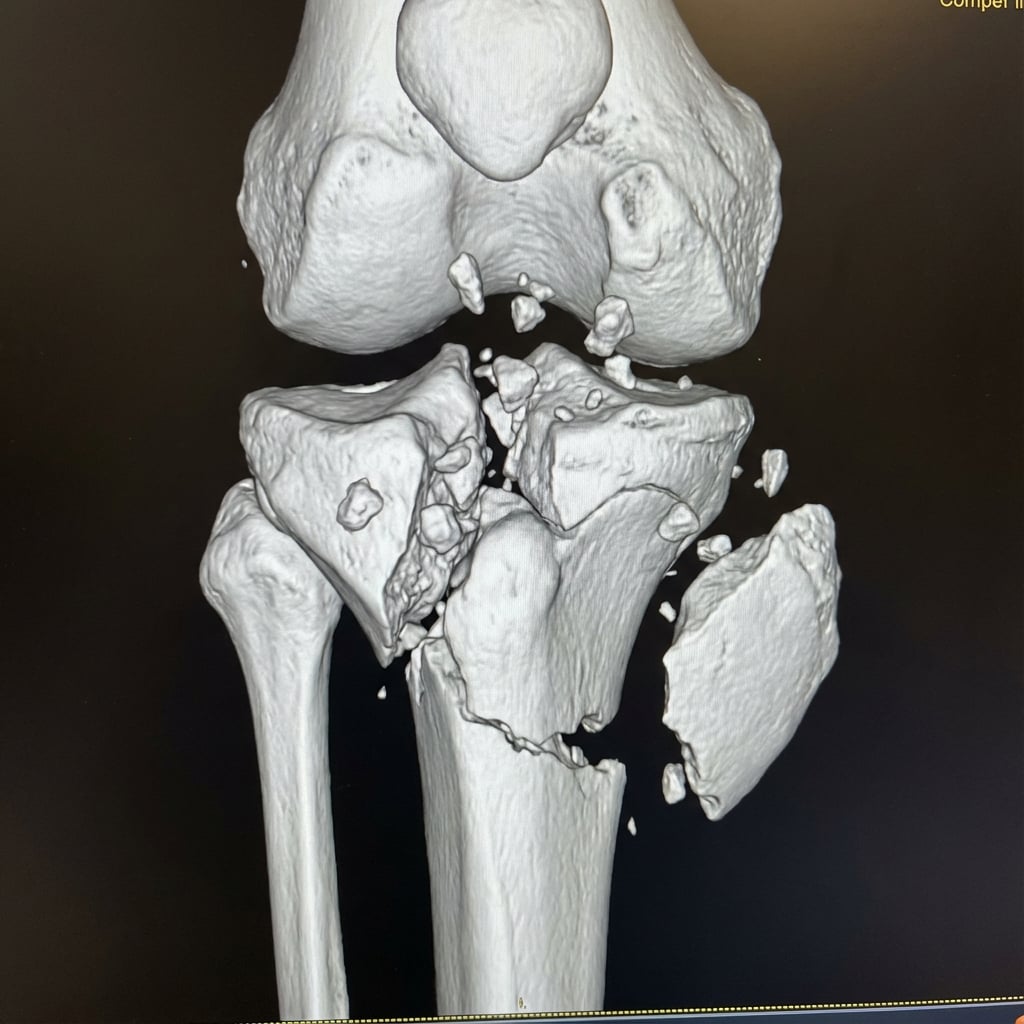
CT 3D reconstruction showing Schatzker VI bicondylar tibial plateau fracture with lateral plateau depression, medial split, and metaphyseal-diaphyseal dissociation. Note posteromedial fragment and articular comminution.
Open Full Size

CT 3D reconstruction showing Schatzker VI bicondylar tibial plateau fracture with lateral plateau depression, medial split, and metaphyseal-diaphyseal dissociation. Note posteromedial fragment and articular comminution.

Image source: Open Access medical literature (NIH/PubMed Central) • CC-BY License

Questions

Question 1 (4 marks)

What is your immediate clinical concern and how would you assess it?

Question 2 (4 marks)

Classify this fracture using Schatzker and describe the key CT features to assess for surgical planning.

Question 3 (5 marks)

Describe your initial management and the rationale for a staged approach.

Question 4 (5 marks)

Describe the surgical approaches and fixation strategy for a bicondylar tibial plateau fracture.

Question 5 (3 marks)

What are the early and late complications and how can they be minimized?

Question 6 (3 marks)

What rehabilitation protocol would you recommend and what factors affect prognosis?

Exam Day Cheat Sheet

Must Mention

  • •Schatzker classification: I-VI (VI = bicondylar with metaphyseal dissociation)
  • •Compartment syndrome risk: 10-17% with high-energy
  • •CT essential for surgical planning (coronal fractures, posteromedial fragment)
  • •Staged approach: ex-fix → wait for wrinkle test → ORIF
  • •Dual plating: anterolateral + posteromedial for bicondylar
  • •Post-traumatic OA: 20-40% at 10 years

Common Pitfalls

  • •Operating before wrinkle test positive
  • •Missing compartment syndrome (check compartments!)
  • •Forgetting posteromedial fragment (60% of bicondylar)
  • •Single approach for bicondylar fracture
  • •Inadequate bone grafting under elevated articular surface
  • •Not documenting peroneal nerve function preoperatively
Scenario Info
Answers Revealed0/6
Difficulty
advanced
Time Allowed6 min
Total Marks24
Questions6
Related Scenarios

Acetabular Fracture

trauma•26 marks

Atypical Femoral Fracture

trauma•26 marks

Calcaneal Fracture

trauma•24 marks

Chronic Elbow Dislocation

trauma•28 marks

Compartment Syndrome - Leg

trauma•26 marks