OrthoVellum
Knowledge Hub

Study

  • Topics
  • MCQs
  • ISAWE
  • Operative Surgery
  • Flashcards

Company

  • About Us
  • Editorial Policy
  • Contact
  • FAQ
  • Blog

Legal

  • Terms of Service
  • Privacy Policy
  • Cookie Policy
  • Medical Disclaimer
  • Copyright & DMCA
  • Refund Policy

Support

  • Help Center
  • Accessibility
  • Report an Issue
OrthoVellum

© 2026 OrthoVellum. For educational purposes only.

Not affiliated with the Royal Australasian College of Surgeons.

Back to ISAWE Scenarios
Contents
0%
trauma

Tibial Shaft Fracture
advanced
6 min
28 marks
6 questions
Clinical Scenario
A 32-year-old motorcyclist presents after a collision. He is unable to weight bear with obvious deformity of the left leg. GCS 15, isolated injury. On examination, the leg is swollen but the skin is intact. Pedal pulses are palpable and sensation is intact.
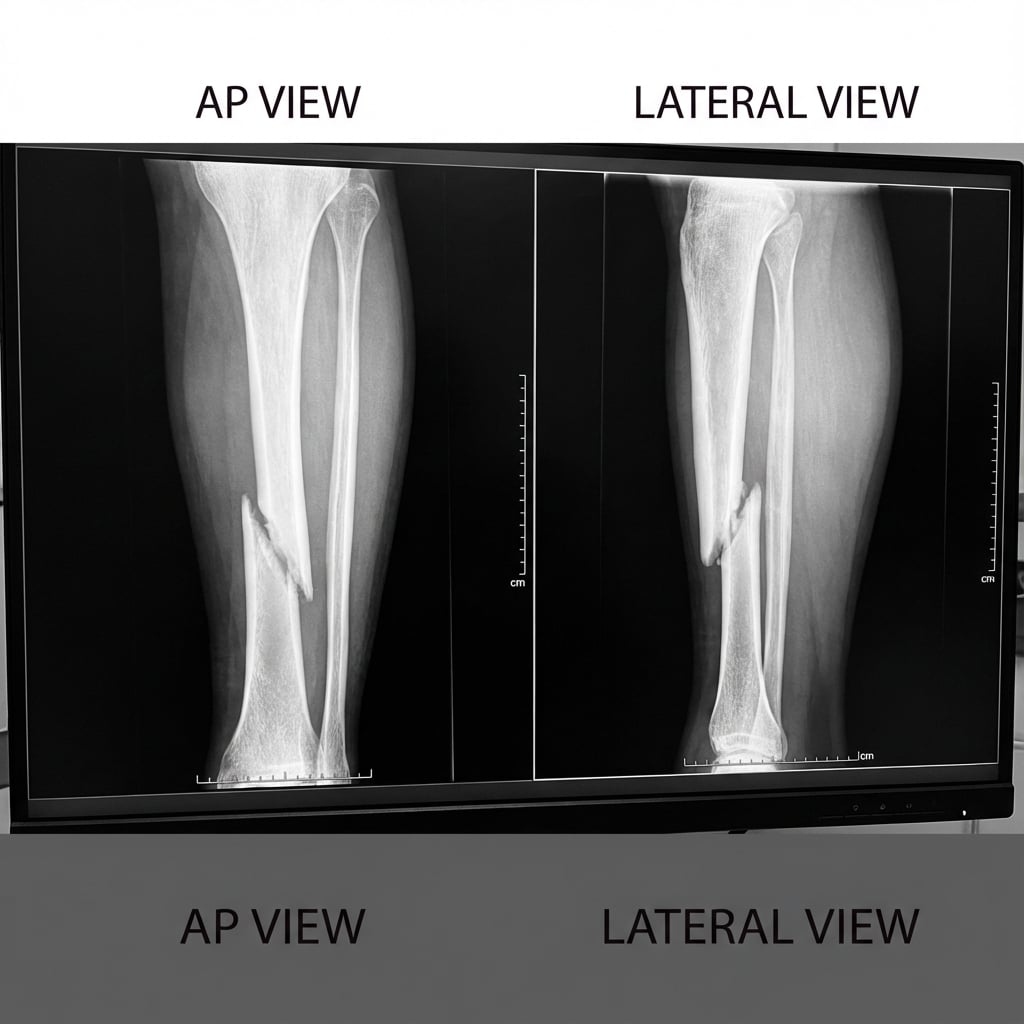
AP and lateral radiographs demonstrating displaced spiral fracture of the tibial shaft at the junction of middle and distal thirds with intact fibula. Approximately 1cm shortening with minimal angulation. The spiral pattern suggests a rotational mechanism with relatively low energy.
Open Full Size

AP and lateral radiographs demonstrating displaced spiral fracture of the tibial shaft at the junction of middle and distal thirds with intact fibula. Approximately 1cm shortening with minimal angulation. The spiral pattern suggests a rotational mechanism with relatively low energy.

Image source: Open Access medical literature (NIH/PubMed Central) • CC-BY License

Questions

Question 1 (4 marks)

Describe the radiographic findings and classify this fracture.

Question 2 (5 marks)

What are your clinical concerns and how do you assess them?

Question 3 (6 marks)

What are the treatment options and describe your preferred surgical technique?

Question 4 (5 marks)

What is the significance of the intact fibula and how do you manage it?

Question 5 (4 marks)

What complications would you discuss and what are the expected outcomes?

Question 6 (4 marks)

How does the management differ for proximal and distal third fractures?

Exam Day Cheat Sheet

Must Mention

  • •IM nail = gold standard (>95% union)
  • •Intact fibula = varus malunion risk
  • •Compartment syndrome assessment (5 Ps)
  • •Entry point determines alignment
  • •Blocking screws for proximal/distal fractures
  • •Rotation check essential (compare contralateral)

Common Pitfalls

  • •Not assessing for compartment syndrome serially
  • •Rotational malalignment (check clinically)
  • •Wrong entry point causing deformity
  • •Not using blocking screws for metaphyseal extension
  • •Missing open wound (small lacerations)
  • •Not checking ankle/knee for associated injury
Scenario Info
Answers Revealed0/6
Difficulty
advanced
Time Allowed6 min
Total Marks28
Questions6
Related Scenarios

Acetabular Fracture

trauma•26 marks

Atypical Femoral Fracture

trauma•26 marks

Calcaneal Fracture

trauma•24 marks

Chronic Elbow Dislocation

trauma•28 marks

Compartment Syndrome - Leg

trauma•26 marks