External rotation/open book injuries - high hemorrhage risk
- HEMORRHAGE is the primary killer - massive pelvic volume expansion
- External rotation opens pelvic ring increasing pelvic volume
- Binder/sheet CLOSES the book - early hemorrhage control
- APC-II = 'open book' with intact posterior SI ligaments
- APC-III = complete SI disruption = highest transfusion requirement and mortality of the mechanisms (APC 20% vs LC 7%, VS 0% in Burgess)
- “Symphysis widening 2.5cm is the key threshold (APC-I vs II) - but it is a CLASSIFICATION CONVENTION, not a validated cut-point, and a supine film under-reads the displacement at the moment of injury because the pelvis recoils (more so if a binder is already on)
- “Posterior injury determines stability - not anterior widening
- “Urgent pelvic binder before imaging in unstable patients
- “External fixator for anterior stabilization, NOT definitive for posterior
- “Assess for urological injury - bladder and urethra at high risk
Overview
Anteroposterior compression (APC) injuries are external rotation injuries of the pelvic ring, produced by a direct anterior impact or by the lower limbs being forced into external rotation. The force "opens" the ring like a book: the anterior structures fail first, and the injury progresses posteriorly as the force increases. APC injuries make up 15-20% of pelvic ring injuries, the second most common pattern after lateral compression, and they matter out of proportion to that because they carry the highest haemorrhage risk of all pelvic patterns and are the most common cause of massive pelvic haemorrhage.
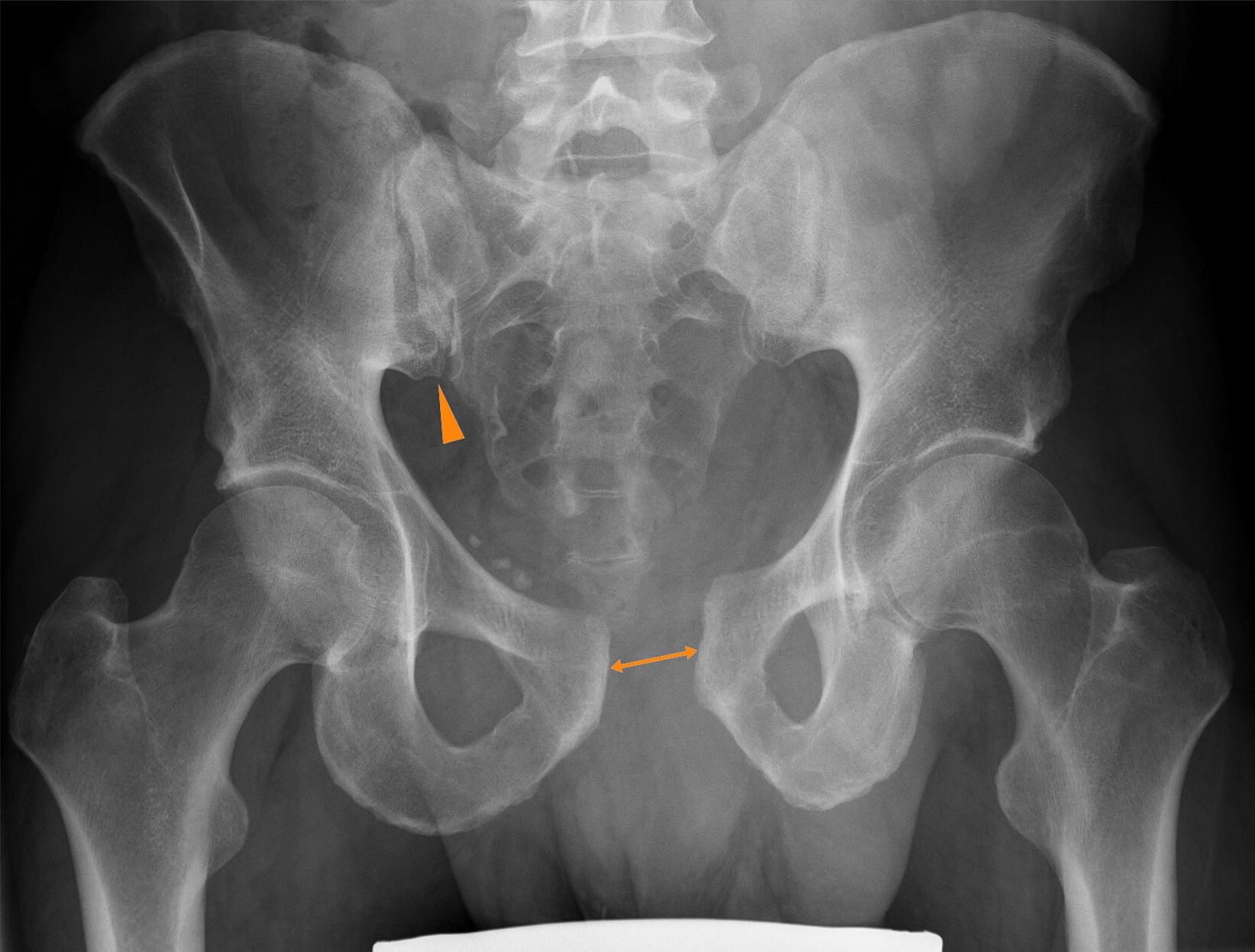
Mechanism. The force vector is anteroposterior, and the mechanisms that produce it are the ones to listen for in the history:
- Motorcycle collision, with the handlebars striking the pelvis
- Pedestrian struck anteriorly by a vehicle
- Frontal vehicle collision with an AP force vector
- Crush injury with anterior compression
- Fall with the legs forced into external rotation
- Fall from height with the legs apart
Who. Young males predominate, because the mechanism is high-energy trauma. Most have associated polytrauma, and their injury severity scores are typically higher than in lateral compression injuries.
Why the stakes are high. The haemorrhage, which the anatomy below explains, and the urological injury that follows symphysis disruption, since the bladder and urethra are directly affected by it.
Anatomy and Pathophysiology
The ring. The pelvis is a ring with anterior and posterior components, and its stability depends primarily on the posterior structures. Anteriorly, the pubic symphysis is a fibrocartilaginous joint with minimal inherent stability and a normal width of approximately 5mm; its disruption alone does not make the ring unstable. The pubic rami connect the symphysis to the acetabulum, fracture commonly alongside a symphysis disruption, and may fracture bilaterally.
The posterior ligaments. Each restrains something different. Force applied anteriorly makes them fail in sequence, front to back, and the Young-Burgess grades set out under Classification describe that sequence.
- Anterior SI ligaments - the first to fail in APC
- Interosseous SI ligaments - the main restraint to external rotation
- Posterior SI ligaments - the strongest, and the ultimate stability of the ring
- Sacrospinous ligament - resists external rotation
- Sacrotuberous ligament - resists vertical displacement
Why APC bleeds. Normal pelvic volume is approximately 1.5 litres; an APC-III can increase it to greater than 4 litres, so the pelvis can accommodate several litres of blood as a massive retroperitoneal haemorrhage, and the tamponade effect of an intact ring is lost once the ring opens. The vascular anatomy to know is the presacral venous plexus and the internal iliac veins, low-pressure, high-volume sources; the internal iliac branches, of which the superior gluteal artery is the most commonly involved; and the corona mortis, aberrant obturator vessels present in 30% of people.
Bleeding sources. Between 80 and 90% of the bleeding is venous, from disruption of the plexus, and 10-20% is arterial, often from the superior gluteal artery. The cancellous bone surfaces contribute as well.
Classification
The Young-Burgess classification stratifies APC injuries by severity and stability according to progressive ligamentous disruption. Symphyseal widening decides whether an injury is APC-I; the state of the posterior SI ligaments separates APC-II from APC-III. Posterior injury, not anterior widening, is what determines stability, and the grade predicts the haemorrhage risk and guides management.
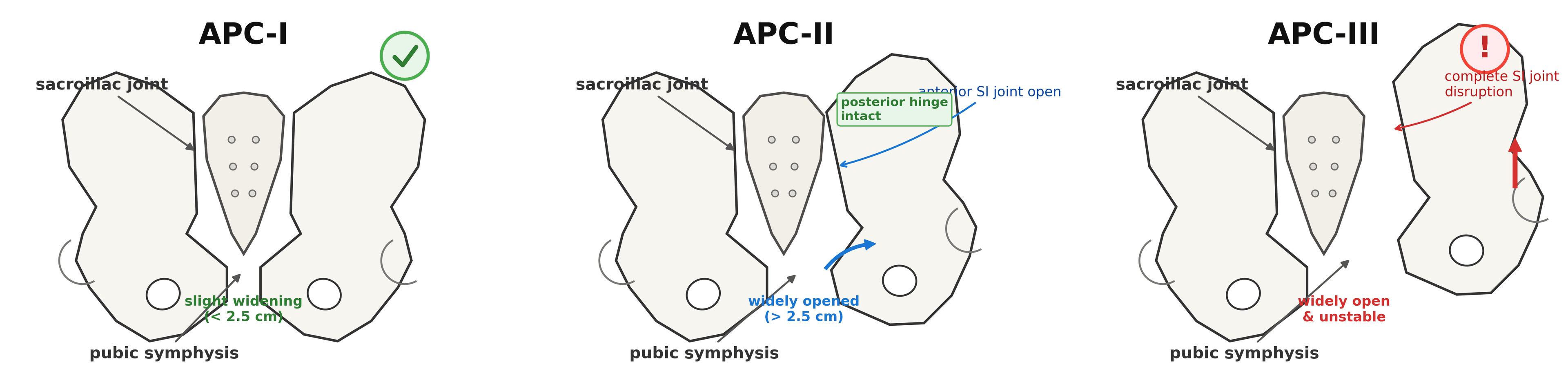
APC-I (stable). Symphysis widening of less than 2.5cm. The symphysis is partially disrupted and the anterior SI ligaments are sprained but not torn; the sacrospinous, sacrotuberous, posterior SI and interosseous ligaments are all intact. The ring is mechanically stable, the haemorrhage risk is moderate, the patient is usually ambulatory with weight-bearing restrictions, and conservative management is often appropriate.
APC-II (rotationally unstable, vertically stable). Symphysis widening greater than 2.5cm with the posterior SI ligaments intact, the "open book" on imaging. The symphysis and the anterior SI ligaments are completely torn, the sacrospinous ligament is torn and the pelvic floor is widened, while the posterior SI ligament complex holds and the sacrotuberous and interosseous ligaments are partially intact. The hemipelvis is unstable in external rotation but vertically stable, with no cephalad migration; the haemorrhage risk is significant and surgical fixation is usually required.
APC-III (rotationally and vertically unstable). Complete SI disruption with external rotation of the hemipelvis. All the anterior structures, all the posterior SI ligaments and the sacrospinous and sacrotuberous ligaments have failed, leaving the hemipelvis completely unstable. The pelvis is grossly unstable, the haemorrhage is life-threatening, haemodynamic instability is common and urgent surgical stabilisation is mandatory.
- APC-I
- Less than 2.5cm
- APC-II
- Greater than 2.5cm
- APC-III
- Greater than 2.5cm + complete SI diastasis
- APC-I
- Intact
- APC-II
- Intact
- APC-III
- Disrupted
- APC-I
- Intact
- APC-II
- Torn
- APC-III
- Torn
- APC-I
- Stable
- APC-II
- Unstable
- APC-III
- Unstable
- APC-I
- Stable
- APC-II
- Stable
- APC-III
- Mechanically unstable (Tile C) - but frank cephalad migration suggests vertical shear
- APC-I
- Moderate
- APC-II
- High
- APC-III
- Very high
- APC-I
- Conservative
- APC-II
- Surgical fixation
- APC-III
- Urgent surgical fixation
Clinical Assessment
The setting. APC injuries are diagnosed in the context of major trauma, and pelvic assessment follows ATLS principles within the primary survey. The mechanisms that should raise suspicion are those set out under Overview.
Inspection. The signs to look for:
- Limb length discrepancy (APC-III)
- External rotation deformity of the lower limbs
- Perineal swelling or ecchymosis
- Scrotal or labial haematoma
- Visible symphysis widening in severe cases
- Blood at the urethral meatus
Do not repeatedly "spring" or compress the pelvis. A single gentle assessment is acceptable; repeated manipulation can dislodge clot and restart haemorrhage. If instability is suspected, apply a binder and obtain imaging.
Palpation, gently and once only, is for a palpable symphysis gap, tenderness over the SI joints posteriorly and iliac crest tenderness.
Associated injuries. Three systems are always assessed:
- Urological - blood at the meatus or a high-riding prostate means urethral injury, and haematuria means bladder injury. Do not catheterise if urethral injury is suspected.
- Vascular - peripheral pulses, signs of hypovolaemic shock, an expanding haematoma.
- Neurological - L5 and S1 nerve root function and motor function from L2 to S1, sensory examination, perineal sensation (S2-4) and rectal tone, all documented.
Haemodynamic assessment. The unstable patient has tachycardia greater than 100 bpm, hypotension with a systolic pressure less than 90mmHg, a reduced GCS from hypoperfusion, poor peripheral perfusion, or a need for ongoing resuscitation. Presume the pelvis is the source when there is:
- Pelvic instability on examination
- No other obvious source of haemorrhage
- A high-risk mechanism
- An APC pattern on imaging
Differential diagnosis. The "open book" appearance and pelvic instability of an APC injury must be distinguished from other patterns that look similar on the AP film but demand opposite management, as the last column of the table shows. The binder that closes an externally rotated ring is not the reflex answer in lateral compression injuries, the vertically displaced hemipelvis of a vertical shear injury shares APC-III's posterior disruption but arrives by a different mechanism, and the ring principles common to all three are set out in pelvic ring injuries.
- Mechanism / vector
- Anterior force, external rotation
- Key distinguishing feature
- Symphysis widening greater than 2.5cm, pelvis opens
- Management contrast
- Binder CLOSES the book - first line
- Mechanism / vector
- Lateral force, internal rotation
- Key distinguishing feature
- Overlapping/impacted rami, pelvis closes; sacral impaction
- Management contrast
- Binder may over-compress - apply with caution
- Mechanism / vector
- Axial/vertical force (fall from height)
- Key distinguishing feature
- Cephalad hemipelvis migration on outlet view
- Management contrast
- Needs traction plus posterior fixation, not binder alone
- Mechanism / vector
- Force through femoral head
- Key distinguishing feature
- Disruption of acetabular lines (iliopectineal/ilioischial), ring often intact
- Management contrast
- Binder may displace - protected/ORIF pathway
- Mechanism / vector
- Hormonal laxity, not trauma
- Key distinguishing feature
- No high-energy mechanism, typically less than 1cm, no posterior injury
- Management contrast
- Conservative; pelvic support, analgesia
- Mechanism / vector
- Low-energy fall
- Key distinguishing feature
- Stable ring, no symphysis diastasis or SI disruption
- Management contrast
- Conservative, early mobilisation
Investigations
Plain radiographs. The AP pelvis is the first-line film in trauma and can be taken in the resuscitation bay. It is where the symphysis width is measured against the threshold under Classification, associated pubic rami fractures are looked for and SI joint symmetry is judged. The two further views:
- Inlet view - AP displacement, the symphysis diastasis clearly, and the anterior SI joint
- Outlet view - vertical displacement and a better view of the sacrum, which is what helps separate APC-III from APC-II
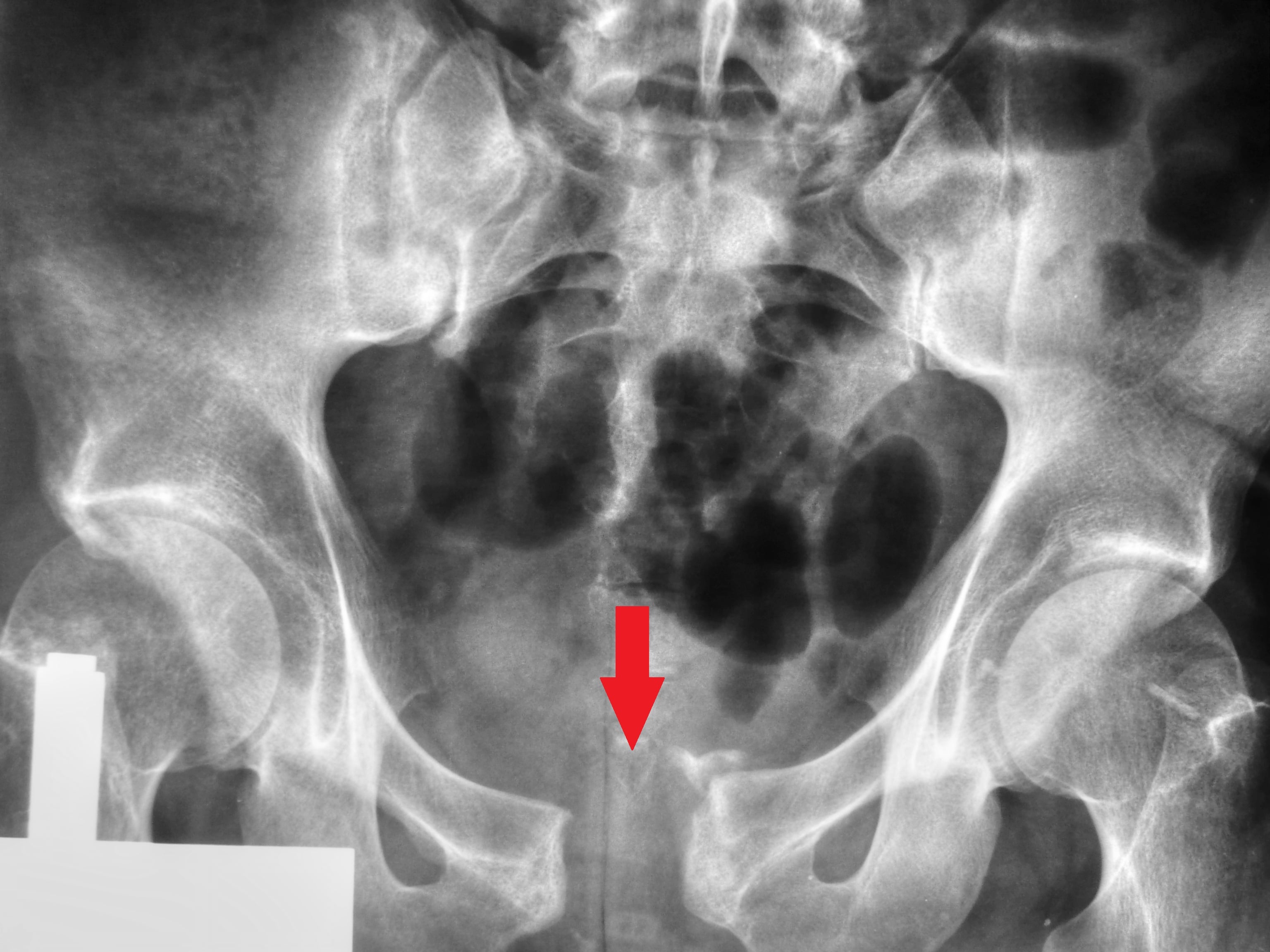
CT. Indicated for every stable patient with a suspected pelvic injury and, in the haemodynamically stable, for surgical planning, because it defines the posterior injury pattern precisely. It gives the symphysis diastasis measurement, anterior SI joint widening, the pattern of SI joint opening from which posterior ligament integrity is inferred, associated sacral and rami fractures and, with CT angiography, contrast extravasation. CT angiography shows active arterial extravasation and guides angioembolisation.
Retrograde urethrogram. Indicated for blood at the urethral meatus, a high-riding prostate on rectal examination, a perineal haematoma, and before catheterisation whenever urethral injury is suspected. Inject 20-30mL of water-soluble contrast gently via the meatus under fluoroscopic or plain film guidance.
Cystogram. For haematuria with a pelvic fracture, once urethral integrity has been confirmed, to look for bladder rupture. An intraperitoneal rupture shows contrast around bowel; an extraperitoneal rupture gives flame-shaped extravasation, and is the more common with APC.
Management
Apply the pelvic binder BEFORE imaging in any suspected APC injury with haemodynamic instability. Do not wait for X-ray confirmation.
The binder. It is the first-line treatment because it applies an internal rotation force that closes the open book, reduces the pelvic volume and restores the tamponade effect. It is a temporary measure, not definitive treatment.
- Position it at the level of the greater trochanters, not the iliac crests
- Apply circumferential compression; a commercial binder or a sheet wrap is acceptable
- Do not over-tighten, because of the risk of skin necrosis
- Re-evaluate after 24-48 hours at most
Contraindications. Lateral compression injuries, where the pelvis is already internally rotated and a binder makes the deformity worse, and acetabular fractures, which the binder may displace.
Damage control resuscitation. Permissive hypotension to a systolic pressure of 80-90mmHg, balanced transfusion in a 1:1:1 ratio, avoidance of crystalloid overload, early tranexamic acid and aggressive correction of coagulopathy. Early mechanical stabilisation combined with damage control resuscitation saves lives.
Pre-peritoneal (extraperitoneal) pelvic packing is the surgical complement to the binder for the non-responder, and is the favoured first-line haemorrhage adjunct in many (especially North American) trauma systems. Through a short suprapubic midline (or lower Pfannenstiel) incision kept anterior to the peritoneum, the surgeon develops the retropubic and paravesical space and packs three laparotomy swabs down each side of the true pelvis, against the sacroiliac region, the pelvic brim and the retropubic space. Packing tamponades venous and bony (cancellous) bleeding and only works against a closed, stabilised ring: a binder or anterior external fixator must be in place first to provide the counter-pressure. It does not control major arterial bleeding, so persistent instability after packing still mandates angioembolisation; the two are complementary, not alternatives. Packs are removed at a planned re-look at 24-48 hours. Unlike angiography it needs no interventional radiology and can be done in the emergency theatre during a damage-control laparotomy.
Surgical Technique
Indications. APC-II injuries; APC-III injuries, in combination with posterior fixation; and a symphysis diastasis over 2.5cm with rotational instability.
Pfannenstiel approach. It provides excellent access with minimal soft-tissue damage:
- Transverse skin incision 2cm above the symphysis
- Incise the linea alba vertically
- Protect the bladder by retracting it inferiorly
- Expose the symphysis and the superior pubic rami
- Reduce the symphysis with a clamp
- Apply the plate to the superior pubis
The plate. A 3.5mm reconstruction plate on the superior surface of the pubis, which is the strongest position. A 2-hole or 4-hole plate is used, with a 4-6 hole plate preferred for stability. Reduce before plating, protect the bladder throughout, and consider a second, inferior plate for APC-III.
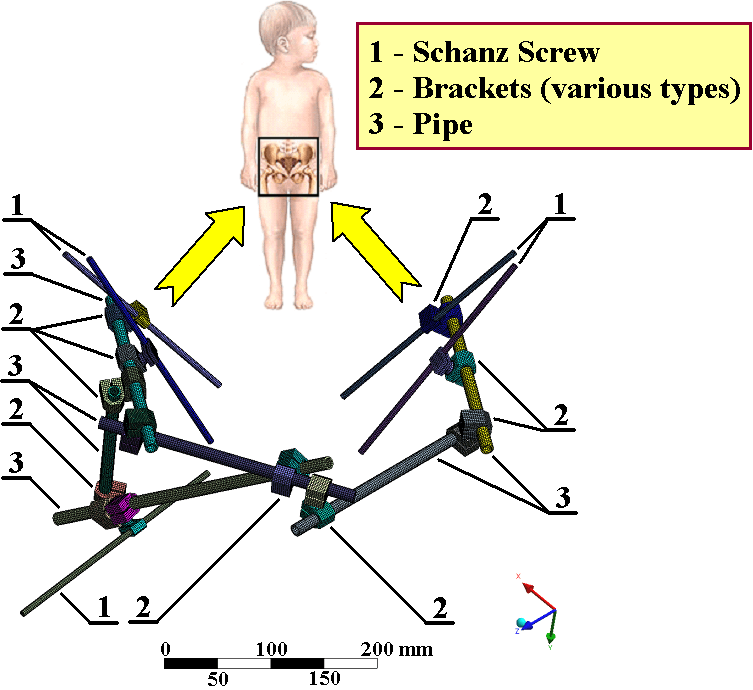
The safety of an iliosacral (SI) screw depends on the osseous corridor of the upper sacrum, and a substantial minority of people (often quoted around 30-40%) have a dysmorphic upper sacrum that narrows or angulates that corridor. Recognised features of sacral dysmorphism include: the upper sacral segment not recessed in the pelvis (the S1 body lies anterior, level with the iliac crests on a lateral view), mammillary (alar) tubercles, a residual S1-S2 disc, an acute alar slope, and tongue-in-groove SI joints. The practical consequence is that a transsacral S1 screw may be impossible because there is no safe transverse corridor (risking the L5 nerve root crossing the ala and the iliac vessels), so the surgeon must place an oblique, sacral-body-directed S1 screw or use the often more capacious S2 corridor, planned on the pre-operative CT and executed with true inlet and outlet fluoroscopy. Failing to recognise dysmorphism is a classic cause of an apparently in-bone but neurologically dangerous, malpositioned screw.
Complications
Bladder injury. Occurs in 15-25% of APC injuries. Extraperitoneal rupture is the more common, following the symphysis disruption; intraperitoneal rupture follows impact on a full bladder. Haematuria is the key finding. An extraperitoneal rupture is managed by catheter drainage for 10-14 days; an intraperitoneal rupture requires surgical repair.
Urethral injury. More common in males, whose membranous urethra is long. The signs and the urethrogram that must precede any catheter are under Clinical Assessment and Investigations; a complete disruption needs a suprapubic catheter.
Neurological injury. The L5 nerve root is the most vulnerable part of the lumbosacral plexus, giving foot drop and sensory loss; the S2-4 sacral roots carry bladder, bowel and sexual function.
Open pelvic fractures. Classified by Faringer according to the wound:
- Type I - iliac wing (low risk)
- Type II - perineum or buttock (moderate)
- Type III - rectum or vagina (high mortality)
Management is faecal diversion for rectal involvement, wound debridement and broad-spectrum antibiotics. Mortality is high, up to 50%.
Early complications. Haemorrhagic shock is the most common cause of early death, with massive transfusion requirements and a coagulopathy that compounds the bleeding. Venous stasis and the injury itself make the DVT risk high, and PE can be fatal, so prophylaxis starts early once it is safe. Surgical site infection occurs; osteomyelitis is rare with closed injuries.
Malunion and nonunion. Malunion means residual diastasis or SI joint malreduction, and affects gait and causes pain. Nonunion is rare with adequate fixation; a symphysis nonunion gives painful instability, and an SI nonunion may need fusion.
Hardware. Symphysis plate loosening, which is activity related, and screw pullout; removal may be needed if symptomatic.
Chronic pain. The sources are SI joint arthritis and symphysis pain. SI joint pain affects 20-40% of APC-II and APC-III patients and symphysis pain 15-25%; a sacral fracture malunion contributes, and SI fusion may be of benefit.
Sexual and urological. Erectile dysfunction in 15-30% of males and dyspareunia in 20-40% of females, both more common with urethral injury, and chronic urethral stricture.
Leg length discrepancy. Rare with accurate reduction; it results from malreduction of a vertical component.
Postoperative Care
Days 0-14. In intensive care the priorities are continued haemodynamic monitoring, serial haemoglobin checks, DVT prophylaxis with low-molecular-weight heparin once haemostasis is achieved, and early removal of the pelvic binder once the fixation is stable. Watch the surgical incisions and the pin sites of any external fixator for signs of infection.
Mobility. Bed rest initially for severe injuries, toe-touch weight-bearing once haemodynamically stable, and log-roll precautions after posterior fixation. Early mobilisation improves outcomes, but it must be balanced against the stability of the injury.
Outcomes and Prognosis
Mortality. Quote a source, because the grade-specific numbers in circulation are estimates. In Burgess's original 210-patient series (PMID 2381002) mortality by mechanism was APC 20.0%, lateral compression 7.0%, combined mechanical 18.0% and vertical shear 0%, against 8.6% overall. The commonly quoted grade-specific figures (APC-I under 5%, APC-II 5-15%, APC-III up to 25%) are extrapolations from this and later series rather than published sub-grade rates.
The caveat from the same paper. The cause of death was attributable to the pelvic fracture in fewer than half of cases. Most of these patients die of their associated injuries, which is why the registry data find that haemodynamics and chest injury, not the pelvic grade, predict death: population-based registry mortality for severe pelvic ring fracture is 19% (348 cases; PMID 21733513), with age 65 or over (AOR 7.6) and hypotension at scene (AOR 5.5) the dominant predictors.
Transfusion. The transfusion requirement is the number that best captures why APC bleeds: average blood replacement was 14.8 units for APC, against 9.2 for vertical shear, 8.5 for combined mechanical and 3.6 for lateral compression (PMID 2381002).
Function. Prognosis depends heavily on the initial injury severity and the associated injuries.
- Union Rate
- Over 95%
- Return to Work
- 3-4 months
- Chronic Pain
- 10-15%
- Union Rate
- 90-95%
- Return to Work
- 4-6 months
- Chronic Pain
- 20-30%
- Union Rate
- 85-90%
- Return to Work
- 6-12 months
- Chronic Pain
- 40-50%
Guidelines, Registries & Global Practice
Global Epidemiology
- Severe pelvic ring disruption is uncommon but high-lethality. In the population-based Victorian State Trauma Registry (Australia), overall mortality after severe pelvic ring fracture was 19%, with scene/admission hypotension and age 65 years or older as the dominant predictors (Gabbe et al., 2011, PMID 21733513).
- In the original Young-Burgess cohort, the APC pattern carried the highest pattern-specific mortality (20%) and the greatest transfusion requirement (mean 14.8 units) of all pelvic patterns (Burgess et al., 1990, PMID 2381002).
- High-energy mechanisms (motor vehicle, motorcycle, pedestrian, fall from height) dominate worldwide; bimodal age distribution exists, with high-energy injuries in younger patients and lower-energy ring injuries in older patients.
Side-by-Side Guideline & System Guidance
- Core recommendation
- Classify by haemodynamic status; immediate circumferential compression then physiology-guided escalation (packing / angioembolisation / REBOA)
- Evidence basis
- Consensus guideline (PMID 28115984)
- Core recommendation
- Pelvic binder at trochanters in suspected unstable ring injury before imaging; balanced 1:1:1 transfusion
- Evidence basis
- Course/consensus standard
- Core recommendation
- Apply purpose-made pelvic binder for suspected active bleeding from pelvic fracture; CT in haemodynamically normal/stabilised adults
- Evidence basis
- Guideline (level varies)
- Core recommendation
- Time-critical transfer to specialist pelvic unit; binder plus damage-control resuscitation; definitive fixation by pelvic surgeon
- Evidence basis
- Standard of care
- Core recommendation
- Anterior fixation for rotational (APC-II) instability; combined anterior plus posterior fixation for APC-III; percutaneous SI screws for posterior ring
- Evidence basis
- Technique consensus
Tranexamic Acid and Resuscitation
The CRASH-2 randomised trial established that tranexamic acid given within 3 hours of injury reduces all-cause and bleeding-related mortality in trauma haemorrhage without increasing vascular occlusive events (PMID 20554319). It is now embedded in essentially all major trauma-system massive transfusion protocols globally.
Registry & Practice-Variation Evidence
- Registry data (Victorian State Trauma Registry) show no independent association between the definitive hospital and mortality after adjustment, reinforcing that rapid physiological control rather than the receiving centre drives survival (PMID 21733513).
- A 40-year systematic review of published algorithms confirms convergence of global practice: steadily rising use of pelvic binders/sheets and CT plus angiography, external fixation as the most common stabilisation technique, and increasing incorporation of REBOA and INFIX, while diagnostic peritoneal lavage has been abandoned (PMID 39731120).
- Persistent variation remains in the first-line haemorrhage adjunct: many North American centres favour pre-peritoneal packing, while several European and Asian centres prioritise early angioembolisation - the WSES framework accommodates both within a physiology-led pathway.
- DVT/PE risk after major pelvic ring injury is universal; chemical prophylaxis with low-molecular-weight heparin is started once haemostasis is secure and typically continued for several weeks, with extended prophylaxis for prolonged immobility.
Exam Focus Points
High-Yield Concepts
The 2.5cm symphysis widening threshold is CRITICAL for exam purposes. Less than 2.5cm = APC-I (stable, usually conservative). Greater than 2.5cm = APC-II or III (unstable, usually surgical). This simple number drives management decisions.
Key Differentiators
- APC: External rotation, pelvis OPENS
- LC: Internal rotation, pelvis CLOSES
- APC: Higher hemorrhage (volume expands)
- LC: Associated head injury (same vector)
- Both have symphysis widening greater than 2.5cm
- APC-II: Posterior SI ligaments INTACT (key)
- APC-III: Complete SI disruption
- APC-II: Anterior fixation only
- APC-III: Anterior AND posterior fixation
Hemorrhage Management Sequence
- Recognize APC pattern and instability
- BIND - Pelvic binder at trochanters
- Resuscitate - MTP, TXA, permissive hypotension
- Image - When stable enough for CT
- Intervene - Angioembolization if arterial source
- Fix - Definitive surgical stabilization
Surgical Fixation Principles
- Pfannenstiel approach
- Superior plate position
- Protect bladder
- 2-4 hole plate
- Percutaneous SI screws (most common)
- S1 body target (avoid ala)
- Protect L5 nerve root
- May need multiple screws
Viva Scenarios
Clinical Decision Scenarios
Practise clinical reasoning and management decisions out loud
“A 35-year-old motorcyclist presents after a head-on collision. He is tachycardic (HR 125), hypotensive (BP 85/50), and has gross external rotation of both lower limbs. AP pelvis shows symphysis diastasis of 4cm. Describe your immediate management.”
“Describe the Young-Burgess APC classification and explain why understanding this system is important for management decisions.”
“A patient with an APC-II pelvic injury is scheduled for symphysis fixation. Describe your surgical approach and technique.”
MCQ Practice Points
Q: What symphysis widening threshold distinguishes APC-I from APC-II? A: 2.5cm. Less than 2.5cm = APC-I (stable, usually conservative). Greater than 2.5cm = APC-II or III (unstable, usually surgical).
Q: What determines stability in APC injuries - anterior or posterior structures? A: Posterior ligaments. The posterior SI ligament complex determines stability. APC-II has intact posterior ligaments (rotationally unstable). APC-III has complete disruption (globally unstable).
Q: Where should the pelvic binder be positioned? A: At the level of the greater trochanters (NOT the iliac crests). This applies internal rotation force to close the "open book."
Q: What pelvic injury pattern is a CONTRAINDICATION to pelvic binder? A: Lateral compression (LC) injuries. The pelvis is already internally rotated - a binder would worsen the deformity.
Q: What percentage of pelvic hemorrhage is venous vs arterial? A: 80% venous, 20% arterial. The pelvic binder addresses venous bleeding by restoring tamponade. Angioembolization targets arterial bleeding.
Classification
- APC-I: Symphysis less than 2.5cm, stable
- APC-II: Symphysis greater than 2.5cm, posterior SI intact
- APC-III: Complete SI disruption, unstable
- Posterior ligaments determine stability
Hemorrhage
- HIGHEST hemorrhage risk of all patterns
- 80% venous, 20% arterial bleeding
- Pelvic binder addresses venous component
- Angioembolization for arterial bleeding
Immediate Management
- Pelvic binder at TROCHANTERS (not iliac crests)
- MTP activation (1:1:1 ratio)
- TXA 1g IV
- Permissive hypotension (SBP 80-90)
Surgical Fixation
- APC-II: Symphysis plating only
- APC-III: BOTH anterior AND posterior fixation
- Pfannenstiel approach for symphysis
- SI screws target S1 body (avoid ala)
Key Pitfalls
- Delaying binder for imaging
- Binder at iliac crests (too high)
- Blind catheterization with blood at meatus
- LC injuries contraindicate binder
Evidence Base
Young-Burgess Classification (Landmark)
- Series of 210 high-energy pelvic ring disruptions stratified by force vector into lateral compression, anteroposterior compression, vertical shear and combined mechanical injury - the basis of the Young-Burgess system.
- Anteroposterior compression injuries had the highest mean blood replacement (14.8 units vs 3.6 for lateral compression) and the highest pattern-specific mortality (20%).
WSES Classification & Guidelines for Pelvic Trauma
- International consensus classifying pelvic trauma primarily by haemodynamic status rather than fracture pattern alone, and integrating non-invasive compression, pre-peritoneal packing, angioembolisation and REBOA.
- Recommends immediate circumferential pelvic compression and physiology-driven escalation in unstable patients.
CRASH-2: Tranexamic Acid in Trauma Haemorrhage (Landmark RCT)
- 20,211 trauma patients across 40 countries; tranexamic acid reduced all-cause mortality (14.5% vs 16.0%, RR 0.91, 95% CI 0.85-0.97) with no excess vascular occlusive events.
- Death due to bleeding was significantly reduced (4.9% vs 5.7%, RR 0.85, 95% CI 0.76-0.96).
Evolution of Algorithms for Unstable Pelvic Ring Injuries
- Systematic review of 32 published treatment algorithms over ~40 years; use of pelvic binders/sheets and CT plus angiography has risen steadily while diagnostic peritoneal lavage has become obsolete.
- Physiological assessment remains the central trigger for escalation, with external fixation the most commonly used stabilisation technique and REBOA/INFIX increasingly incorporated.
Predictors of Mortality After Severe Pelvic Ring Fracture (Registry)
- 348 severe pelvic ring fractures from the population-based Victorian State Trauma Registry (Australia); overall mortality 19%.
- Scene hypotension (AOR 5.5), admission hypotension (AOR 3.7) and age 65 years or older (AOR 7.6) independently predicted death; definitive hospital did not after adjustment.