Failed Fusion Accessory Ossicle | Usually Incidental | Fracture Mimic
- Definition: A patella formed from more than one ossification centre that never fused, leaving an accessory bony fragment joined by a fibrocartilaginous synchondrosis.
- Frequency: Present in roughly 1-2% of people. The vast majority are asymptomatic and found incidentally.
- Most common type: Saupe type III - the superolateral fragment - accounts for about 75% and is where almost all symptomatic cases arise.
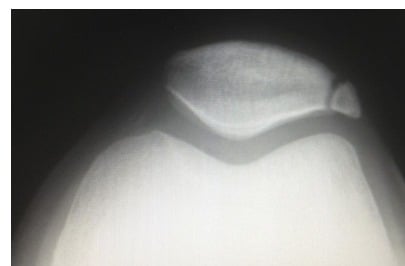
- The trap: It mimics a fracture. Smooth, rounded, corticated margins and a typical superolateral site point to bipartite, not a fresh break.
- Bilateral clue: Often bilateral - get a film of the other knee. A symmetrical superolateral ossicle strongly favours bipartite over acute fracture.
- Treatment: Almost always conservative. Surgery (fragment excision is the best-supported option) only for pain refractory to prolonged non-operative care.
- “The vastus lateralis inserts onto the superolateral fragment - its repeated traction is the proposed reason this type becomes painful and why lateral release can help.
- “Corticated, smooth, rounded edges = bipartite. Sharp, irregular, non-corticated edges with a matching donor site = fracture.
- “A skyline (tangential) view best profiles the superolateral fragment; the contralateral knee film is your free comparison.
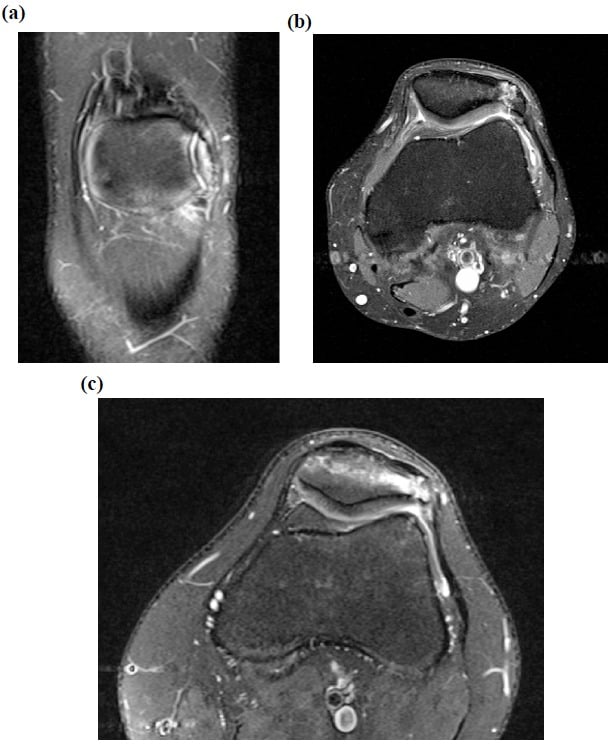
- “MRI bone-marrow oedema across the synchondrosis indicates a SYMPTOMATIC (painful) bipartite, not just an incidental one.
Overview and Epidemiology
Definition. The patella develops from a main ossification centre that appears at around 3-6 years, often with one or more accessory (secondary) centres that should fuse by adolescence. A bipartite patella is the failure of one of these accessory centres to fuse, leaving a separate fragment joined to the main patella by a fibrocartilaginous synchondrosis rather than solid bone. When more than one accessory centre persists the patella is termed multipartite (tri- or quadripartite).
Who has one. Roughly 1-2% of the population; an open-excision outcome series quotes about 2% (Pan and Hennrikus, Cureus 2022). It is more common in males and frequently bilateral, which is a key diagnostic clue. Most are silent, incidental findings, and only a small fraction ever become painful, typically in active adolescents and young adults after sport, overuse or direct trauma.
Why examiners ask about it. It is one of the classic fracture mimics of the knee. The examiner wants to know that you recognise it, that you do not over-treat it, and that you know the evidence-based pathway for the rare painful fragment.
Pathophysiology and Anatomy
The anatomy. The patella is the largest sesamoid bone, embedded within the quadriceps-patellar tendon (extensor) mechanism. Its superolateral corner is the insertion zone of the vastus lateralis, and the common type III fragment lies exactly there. The synchondrosis between fragment and main patella is the source of pain when the variant becomes symptomatic.
Why the superolateral fragment becomes painful. The vastus lateralis and the lateral retinaculum attach onto or near the superolateral fragment, so repetitive or forceful quadriceps activity transmits traction (tensile) and shear forces across the synchondrosis. Overuse or a direct blow disrupts it, producing a painful pseudarthrosis or non-union with local inflammation and bone-marrow oedema.
What follows from the mechanism. It explains the clinical picture, activity-related superolateral pain, and the rationale for the two main surgical options: excise the fragment, or release the lateral traction by lateral release or vastus lateralis detachment.
Why Some Bipartites Hurt: The Trochlear Dysplasia Link
The association. An MRI study found that trochlear dysplasia and patellofemoral maltracking are more frequent in symptomatic than asymptomatic bipartite patellae, suggesting that abnormal patellar tracking loads the synchondrosis and contributes to symptoms (Atay, Cureus 2023). That reframes the symptomatic bipartite as partly a patellofemoral-overload problem, not purely a local fragment.
What the data show. Atay's series comprised 46 MRI-confirmed bipartite patellae, 17 of them symptomatic. The symptomatic group had significantly more frequent and more severe trochlear dysplasia, with a higher trochlear sulcus angle (p=0.007) and a shallower trochlear depth (p=0.006), and more often a dysplastic patella morphology (Wiberg type III/IV). There was no significant difference in TT-TG distance (p=0.247), so the association is with trochlear and patellar shape, not with tibial-tubercle lateralisation.
- Symptomatic bipartite
- More frequent and more severe
- Implication
- A shallow trochlea is the key associated abnormality
- Symptomatic bipartite
- More often dysplastic (type III/IV)
- Implication
- Disproportionate facet loads the superolateral corner
- Symptomatic bipartite
- No significant difference
- Implication
- Tubercle lateralisation is NOT the driver - so tubercle realignment is not the answer
The mechanism. A shallow, dysplastic trochlea permits abnormal patellar tilt and tracking that concentrates load on the superolateral synchondrosis, tipping a previously silent bipartite into a painful one. This explains why the painful bipartite clusters at the vastus lateralis corner and why some are stubborn.
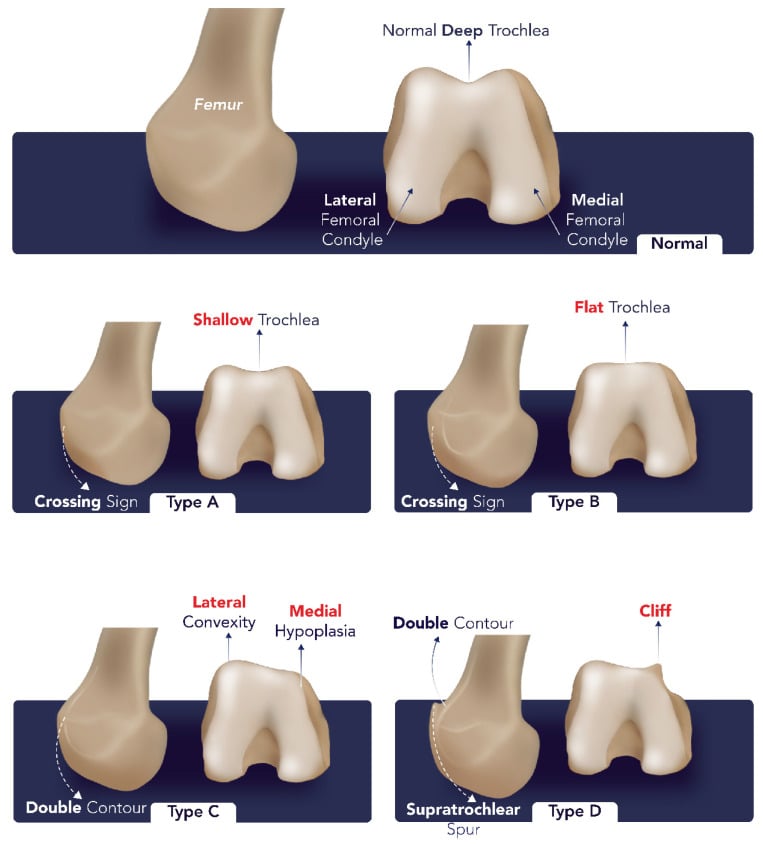
What it does not justify. Because the abnormal parameter is trochlear and patellar shape rather than the TT-TG, tubercle-medialisation realignment is not indicated, and trochleoplasty is not standard for this benign condition. Current practice still treats the fragment, conservatively and then by excision or release, but recognising the dysplastic substrate justifies assessing and rehabilitating patellar tracking as part of conservative care. Whether tracking should be addressed alongside the fragment remains an open question, and doing so is currently not standard. The full patellofemoral-instability work-up (Dejour dysplasia grading, MPFL, TT-TG and trochleoplasty) belongs to the patellofemoral-instability topic.
Classification
Saupe classification. The universal scheme groups bipartite patellae purely by the location of the accessory fragment. Type III, the superolateral fragment, is by far the most common and the type that becomes symptomatic, owing to vastus lateralis traction.
- Location of Fragment
- Inferior pole
- Approximate Frequency
- ~5% (rarest)
- Exam Note
- Differentiate from sleeve / inferior-pole avulsion fracture in a child or adolescent
- Location of Fragment
- Entire lateral margin
- Approximate Frequency
- ~20%
- Exam Note
- Vertical lucency can mimic a longitudinal fracture
- Location of Fragment
- Superolateral corner
- Approximate Frequency
- ~75% (most common)
- Exam Note
- Where almost all symptomatic cases occur
By clinical behaviour. The overwhelming majority are asymptomatic and incidental: no tenderness, no marrow oedema, found by chance. The symptomatic minority has a painful synchondrosis, with focal, activity-related superolateral pain and point tenderness, and marrow oedema across the synchondrosis on MRI. The same anatomical fragment can be silent for years and then become painful after overuse or a direct blow.
Clinical Assessment
History. Most are discovered on a knee film taken for another reason, and the patient has no complaint. The painful case is an active adolescent or young adult with anterior or superolateral knee pain, brought on by sport, jumping, squatting or kneeling, and relieved by rest. Onset may follow a period of overuse or a direct blow to the front of the knee.
Examination. Focal tenderness directly over the superolateral pole of the patella is the single most useful sign in symptomatic cases. Look also for:
- Local swelling palpable over the fragment
- Pain on resisted knee extension or with quadriceps loading (vastus lateralis traction)
- Abnormal patellar tracking or instability, since maltracking and trochlear dysplasia are associated with symptomatic cases
Active extension. Full active extension is preserved, unlike an extensor-mechanism rupture or a displaced patellar fracture. Loss of active extension should make you doubt the diagnosis.
Investigations
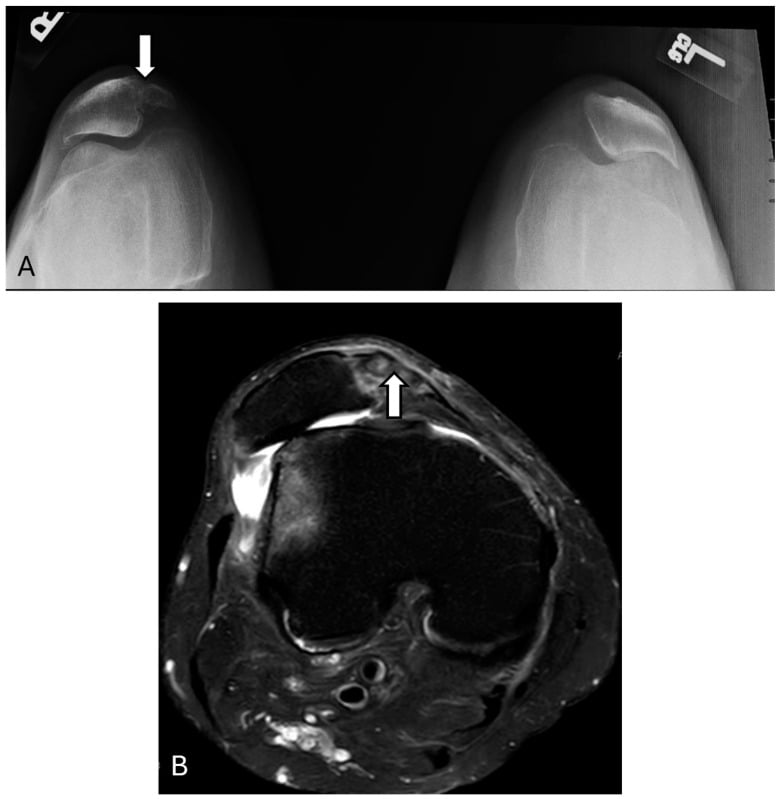
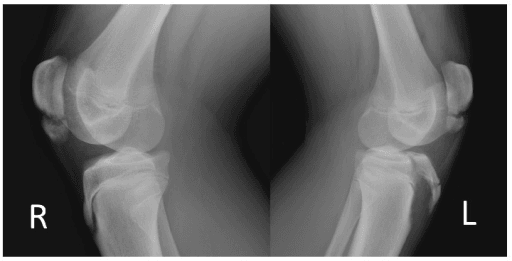
Radiographs. AP, lateral and skyline (tangential) views; the diagnosis is usually radiographic. The fragment sits most often at the superolateral corner (type III), and its smooth, rounded, corticated edges are the hallmark that distinguishes it from a fracture. The skyline view best profiles the superolateral fragment.
The other knee. Image it too. A bilateral, mirror-image ossicle strongly supports bipartite.
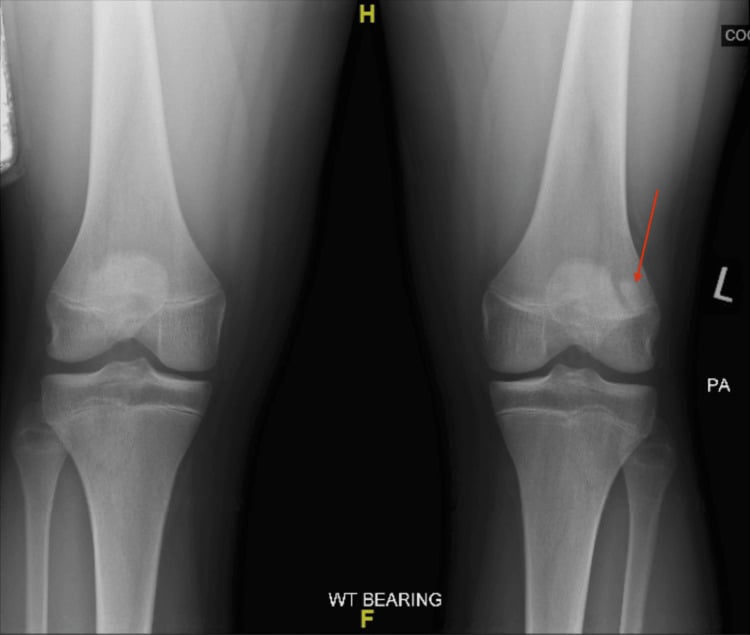
CT confirms the separate corticated fragment and the synchondrosis. It is useful when the radiograph is equivocal, or to plan surgery.
MRI is the key test for deciding whether a bipartite is the actual pain generator. Bone-marrow oedema straddling the synchondrosis, in the fragment and the adjacent patella, indicates a symptomatic, painful synchondrosis; its absence suggests the bipartite is an innocent bystander. MRI also assesses trochlear dysplasia and tracking.
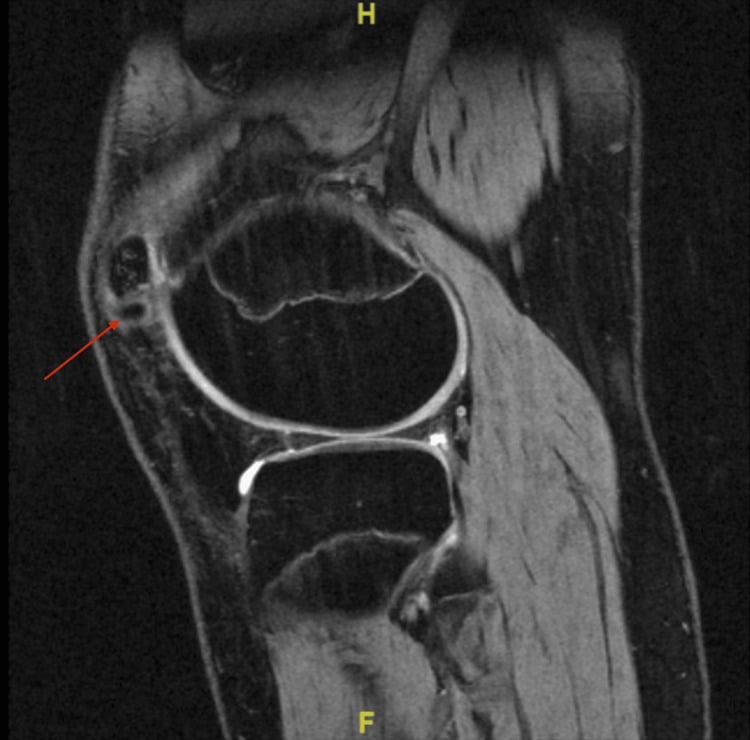
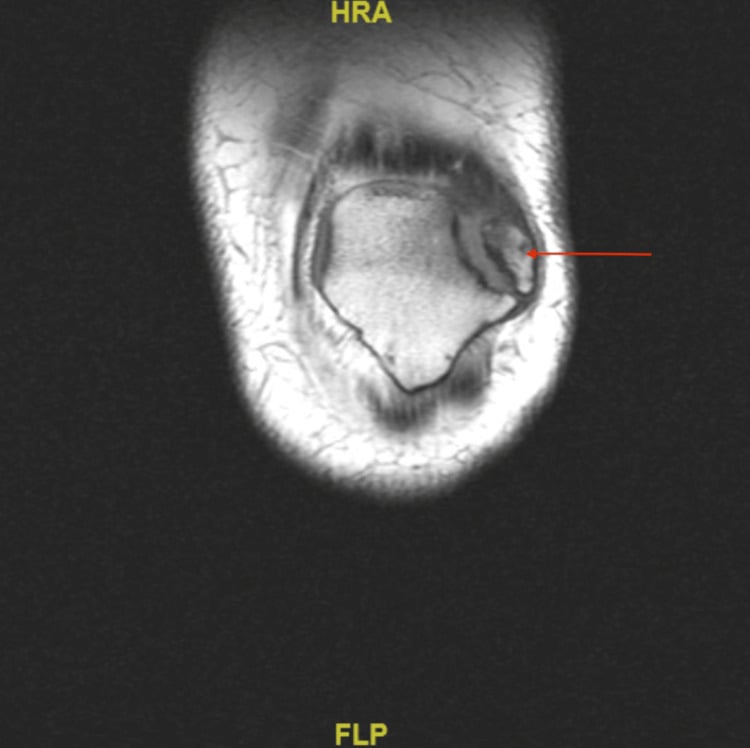
Bone scan or SPECT. Increased uptake at the synchondrosis can localise the pain source when MRI is unavailable, though it is less specific.
Differential Diagnosis
Bipartite or fracture. The features below separate a bipartite fragment from an acute fracture.
- Bipartite Patella
- Smooth, rounded, corticated
- Acute Fracture
- Sharp, irregular, non-corticated
- Bipartite Patella
- Superolateral corner (type III)
- Acute Fracture
- Anywhere - often transverse mid-body
- Bipartite Patella
- Often bilateral / symmetrical
- Acute Fracture
- Unilateral, matches the injured knee
- Bipartite Patella
- No matching defect on main patella
- Acute Fracture
- Fragment edges match the donor site
- Bipartite Patella
- Often no single significant injury
- Acute Fracture
- Clear, usually higher-energy injury
- Bipartite Patella
- Preserved
- Acute Fracture
- May be lost if extensor mechanism disrupted
Other entities to consider.
- Dorsal defect of the patella - a focal lucency or cyst within the bone; see the next section
- Inferior-pole sleeve or avulsion fracture - the main confounder for the rare type I; active extension may be lost and the history is acute
- Patellar stress fracture - particularly in athletes; marrow oedema may overlap, but a fresh fracture line and donor site differ
- Osgood-Schlatter or Sinding-Larsen-Johansson - apophyseal pain at the tibial tubercle or inferior pole in adolescents; can coexist
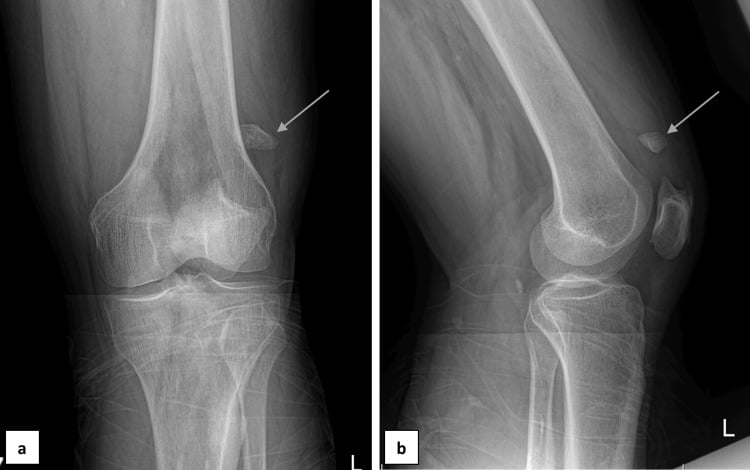
Traumatic separation. Trauma can displace a bipartite fragment away from the patella, a different problem from an asymptomatic corticated ossicle.
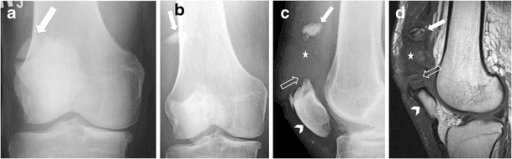
Dorsal Defect of the Patella: The Other Superolateral Lesion
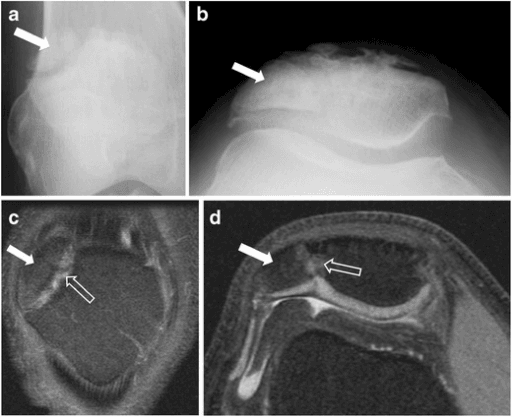
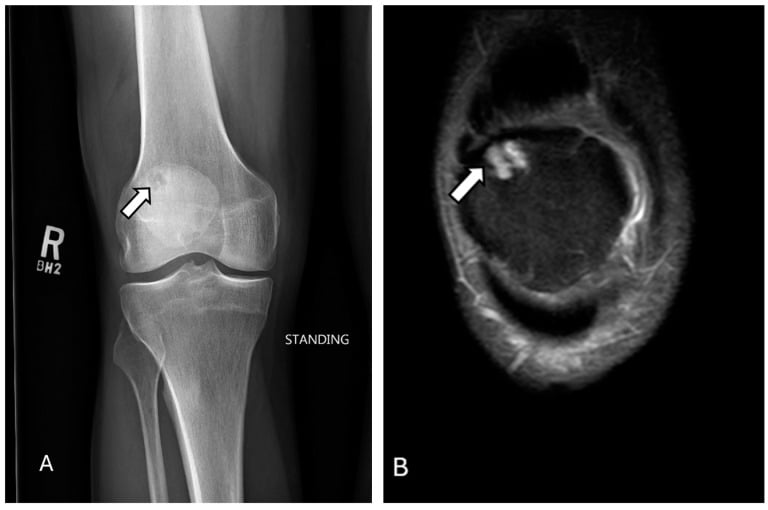
What it is. A dorsal defect of the patella (DDP) is a well-defined, rounded, lucent defect in the subchondral bone of the superolateral patella, typically around 1 to 2 cm, filled with fibrous tissue. It is usually found incidentally in adolescents and young adults, is frequently bilateral, is almost always asymptomatic, and characteristically resolves spontaneously as the skeleton matures. It sits at the same superolateral corner as the type III bipartite, which is exactly why the two are confused.
How it differs from a bipartite. A dorsal defect is a focal lucency within an intact, continuous patella: there is no separate ossicle and no synchondrosis, and it lacks the marrow oedema of a symptomatic bipartite fragment. On MRI the articular cartilage overlying the defect is intact, which both confirms the diagnosis and separates it from osteochondritis dissecans.
The developmental link. DDP and the type III bipartite are thought to share a developmental origin at the superolateral corner, the region loaded by the vastus lateralis, and the two can coexist. They are nonetheless distinct lesions, and should not be merged.
- Dorsal defect of patella
- Lucent defect WITHIN an intact patella
- Bipartite patella
- Separate ossicle + fibrocartilaginous synchondrosis
- Dorsal defect of patella
- Superolateral subchondral bone
- Bipartite patella
- Superolateral corner (type III)
- Dorsal defect of patella
- Intact
- Bipartite patella
- Continuous over the synchondrosis
- Dorsal defect of patella
- Usually resolves with skeletal maturity
- Bipartite patella
- Persists; usually remains asymptomatic
- Dorsal defect of patella
- Mistaken for OCD, infection or tumour
- Bipartite patella
- Mistaken for an acute fracture
Why it matters. A dorsal defect is benign and self-limiting and needs no treatment. The danger is mistaking its lucency for osteochondritis dissecans, an infection or a tumour and over-investigating or biopsying it. The intact overlying cartilage on MRI and the typical superolateral, often bilateral pattern settle it.
Management
The principle. An incidental bipartite needs no treatment. The rare painful bipartite is treated conservatively first, and surgically only if pain is refractory. Splinting a fracture that is not there, or taking a variant to theatre, is the error to avoid.
Conservative care. For a symptomatic bipartite with a confirmed painful synchondrosis, or a strong clinical picture, and no other cause:
- Activity and load modification - reduce the offending loading (jumping, kneeling, deep squatting)
- Relative rest - with a short period of immobilisation in some protocols, followed by graded return
- Physiotherapy - quadriceps and core conditioning, correction of patellar maltracking, hip-knee kinematics
- Analgesia and NSAIDs for pain control
How often it works. Most settle over weeks to a few months. A pooled paediatric and adolescent review found that about three-quarters of symptomatic knees resolved with conservative management at a median of around two months, with surgery reserved for the refractory minority (Hines et al, J Child Orthop 2024).
When to operate. Surgery is for persistent, disabling pain despite an adequate trial of conservative care, commonly framed as failure after roughly 3-6 months. Because a bipartite can be an innocent bystander, confirming the pain source before committing to surgery, with MRI marrow oedema or local uptake on bone scan, is increasingly emphasised.
The operations. No technique is proven superior; fragment excision has the most consistent results.
- Fragment excision, open or arthroscopic/arthroscopic-assisted - removes the painful accessory fragment and is best supported for return to activity. Take care with very large fragments bearing significant articular surface, where excision risks patellofemoral incongruity
- Lateral retinacular release or vastus lateralis detachment - removes the traction force across the synchondrosis, allowing the fragment to settle or unite while preserving patellar bone stock, which makes it attractive for larger fragments
- Open reduction and internal fixation (ORIF) of the fragment - aims for bony union and has more limited literature support
- Combined excision and release in selected cases
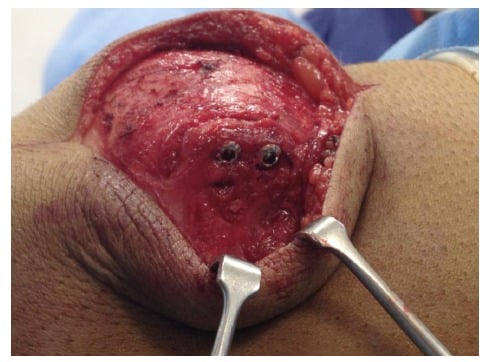
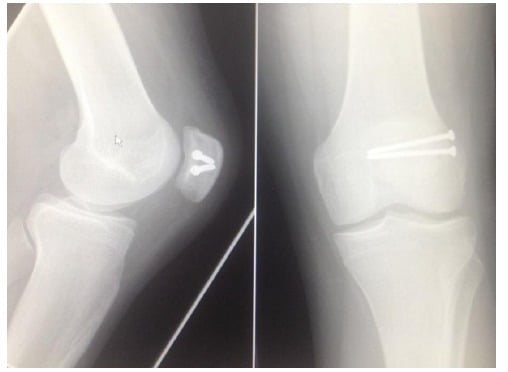
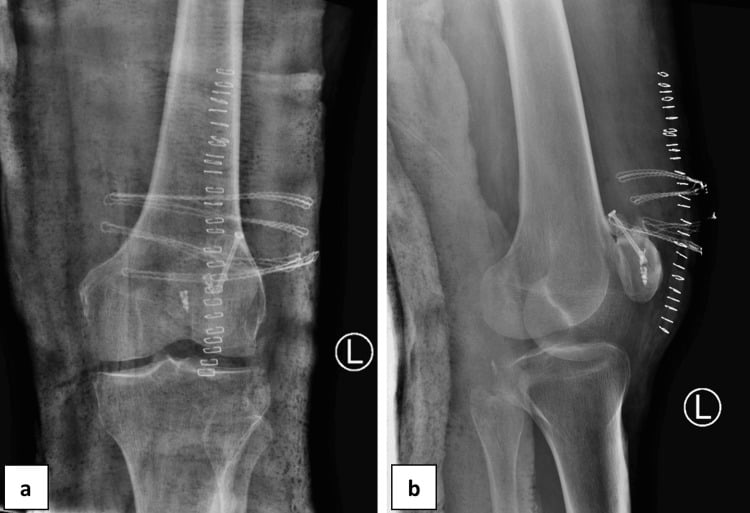
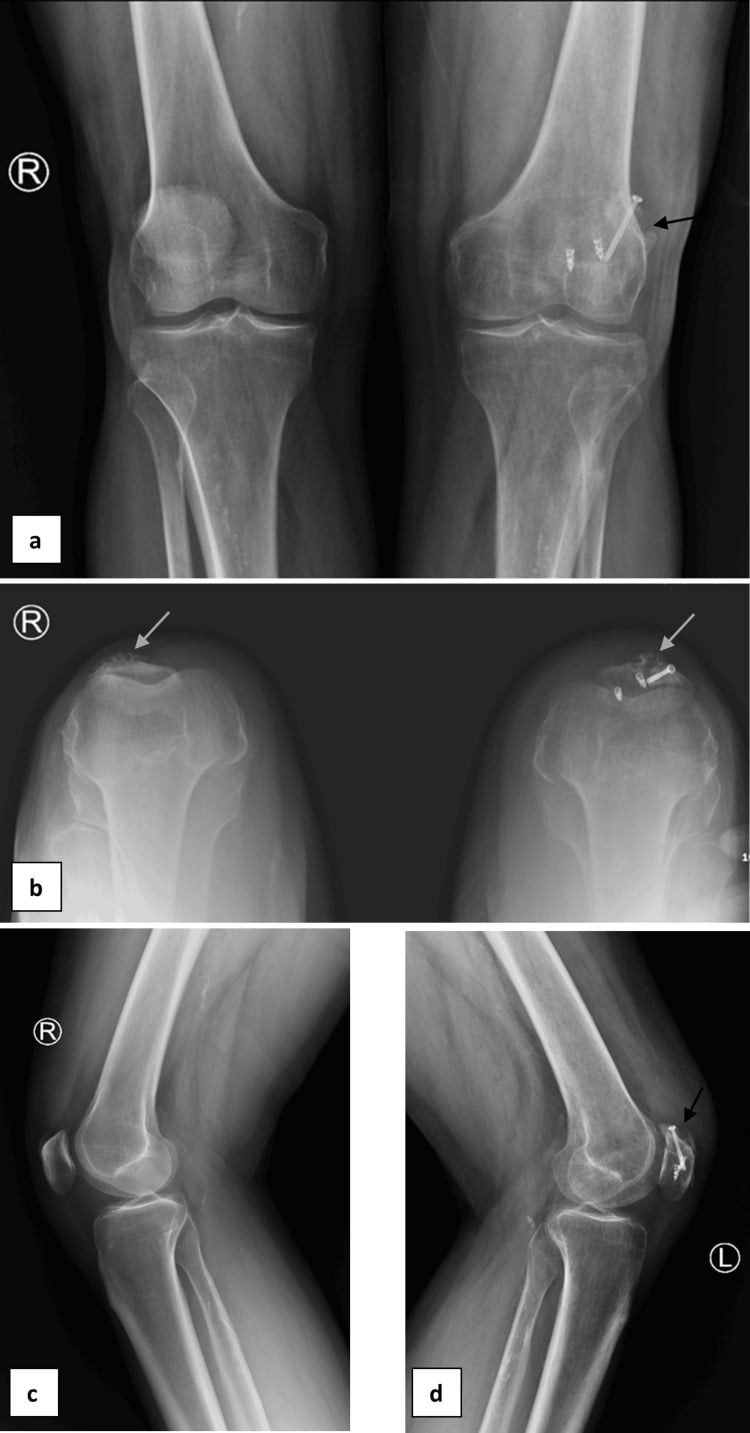
Fixation. In the two-screw technique shown below, the fragment is exposed through the retinaculum and the synchondrosis prepared, and two cortical screws compress the fragment while preserving its articular surface and quadriceps attachment. After the traumatic separation shown under the differential diagnosis, a cannulated compression screw restored the fragment while anchors reattached the disrupted quadriceps tendon and retinaculum. At follow-up that fixation was stable with patellar alignment maintained, and anterior osteophytes documented the residual degenerative burden.
Return to sport. For athletes the aim is a reliable, symptom-free return. A systematic review of athletes found that excision of the painful fragment produced the best return-to-sport results, with ~91% returning without symptoms, and that surgery overall returned most athletes to their prior level (Matic and Flanigan, The Knee 2015). Arthroscopic management, by excision or lateral release, is a safe, effective, minimally invasive alternative to open surgery with rapid return to sport, at a mean of ~2.6 months (Loewen et al, Orthop J Sports Med 2021).
Complications
Misdiagnosis. The commonest "complication" is diagnostic: over-treating an incidental variant as an acute fracture, or missing a real fracture by dismissing it as bipartite.
Persistent or recurrent pain. Symptoms can persist or recur after surgery, sometimes from residual ossicles, an inadequate release, or an unaddressed maltracking problem.
Patellofemoral incongruity. Excising a large fragment that carries a meaningful portion of articular surface can leave an incongruent patellofemoral joint, which is why a patella-preserving technique is favoured for big fragments.
Quadriceps weakness. Aggressive vastus lateralis detachment or extensive surgery can weaken the extensor mechanism. Preserving quadriceps function is a stated goal of treatment, and the extensor mechanism attached to the fragment should be preserved or repaired during excision or fixation.
Clinical Relevance and Controversies
The best operation is unsettled. Multiple systematic reviews agree that excision, lateral release, ORIF and arthroscopic variants all give good results, but the literature is entirely low-level case series, so no technique is proven superior (McMahon et al, Knee Surg Sports Traumatol Arthrosc 2016; Hines et al 2024). McMahon's review reported excellent-to-good outcomes from all techniques and suggested that patella-preserving methods such as release may suit larger fragments.
Reconciling the reviews. The athlete review does name excision as best for return to sport, and the two positions are compatible. No study compared treatments in comparable fragments, so the apparent superiority of any one operation is confounded by which fragments surgeons chose it for. Excision suits the small fragment; the large articular fragment is better preserved.
How long is enough conservative care? Thresholds for moving to surgery (often 3-6 months) are pragmatic rather than evidence-defined. Earlier surgery, within a relatively short window of refractory symptoms, has been linked to better outcomes in younger patients in some reviews.
Guidelines, Registries & Global Practice
There are no dedicated national society guidelines for bipartite patella; practice is driven by systematic reviews and consensus. The picture below is consistent across regions.
- Consensus Position
- No treatment; reassure
- Evidence Base
- Universally accepted (review, Atesok 2008)
- Consensus Position
- Conservative care; majority resolve
- Evidence Base
- ~75% resolution (Hines 2024, paediatric/adolescent)
- Consensus Position
- No proven superior technique; excision best for return to sport
- Evidence Base
- Systematic reviews (McMahon 2016, Matic 2015)
- Consensus Position
- Prefer patella-preserving (lateral release) over excision
- Evidence Base
- Review consensus (Atesok 2008)
- Consensus Position
- Arthroscopic excision / release safe and effective
- Evidence Base
- Systematic review (Loewen 2021)
Global epidemiology: prevalence is broadly quoted around 1-2% of the population worldwide, more common in males and frequently bilateral. There is no implant or arthroplasty registry relevance for this condition, as management is non-implant (conservative, fragment excision, or soft-tissue release).
Viva Scenarios
Clinical Decision Scenarios
Practise clinical reasoning and management decisions out loud
“What is this and how will you manage it?”
“How do you manage a symptomatic bipartite patella?”
“Give me your reasoning, and what you would do next.”
MCQ Practice Points
Q: Which Saupe type of bipartite patella is most common and most likely to be symptomatic?
A: Type III (superolateral corner) - roughly 75% of cases and nearly all painful ones, due to vastus lateralis traction across the synchondrosis.
Q: What single radiographic feature is most useful for distinguishing bipartite patella from an acute fracture?
A: Smooth, rounded, corticated margins (a fresh fracture has sharp, non-corticated edges and a matching donor defect). The frequent bilateral occurrence is a further clue.
Q: On MRI, what indicates that a bipartite patella is the genuine source of a patient's pain?
A: Bone-marrow oedema straddling the synchondrosis (in the fragment and adjacent patella). Its absence suggests the bipartite is an incidental bystander.
Q: A young athlete fails conservative care for a symptomatic bipartite patella. Which operation gives the best return-to-sport result?
A: Fragment excision (open or arthroscopic). For a large fragment carrying articular surface, a patella-preserving lateral release is preferred to avoid patellofemoral incongruity.
Core Facts
- Failed-fusion accessory ossicle joined by a synchondrosis
- ~1-2% prevalence; usually asymptomatic and incidental
- Often bilateral - image the other knee
- Saupe type III (superolateral) ~75%, most common and symptomatic type
Saupe Classification
- Type I: inferior pole (~5%, rarest)
- Type II: lateral margin (~20%)
- Type III: superolateral corner (~75%)
- Vastus lateralis traction explains painful type III
Bipartite vs Fracture
- Bipartite: smooth, rounded, corticated, superolateral, bilateral
- Fracture: sharp, non-corticated, matching donor defect, acute history
- Active extension preserved in bipartite
- MRI marrow oedema across synchondrosis = symptomatic
Management
- Incidental: no treatment, reassure
- Painful: conservative first (most resolve)
- Refractory: fragment excision (best return to sport)
- Large articular fragment: lateral release to preserve patella
Evidence Base
Treatment Alternatives for Symptomatic Bipartite Patella
- Bipartite patella is usually an asymptomatic incidental finding; in adolescents it can cause anterior knee pain after trauma or overuse.
- Most patients improve with non-surgical treatment; surgery is reserved for failure of conservative care.
- Excision is the most popular operation with good results, but for a large fragment with articular surface, excision may cause patellofemoral incongruity - lateral release or vastus lateralis detachment are alternatives that reduce traction on the fragment.
Systematic Review: Managing the Painful Bipartite Patella
- Reviewed 22 studies of conservative care, open and arthroscopic excision or fixation, and soft-tissue release.
- All methods produced good-to-excellent results with acceptable complication rates.
- No firm guidance on the single best technique; patella-conserving methods may be more appropriate for larger fragments.
Return to Activity in Athletes - Systematic Review
- 20 studies, 125 patients / 130 knees with symptomatic bipartite patella.
- Surgery returned most athletes (~85%) to their prior level without symptoms.
- Excision of the painful fragment gave the best return-to-sport results, with ~91% returning without symptoms.
Arthroscopic Management - Systematic Review
- 11 studies / 43 patients; most underwent arthroscopic lateral release, fewer had arthroscopic excision.
- All but one patient (who sustained postoperative trauma) were pain-free after arthroscopic treatment.
- Mean return to sport ~2.6 months.