Benign Incidental Finding | Brush Border | No Treatment
- Benign developmental anomaly of compact bone within cancellous bone
- Classic 'bone within bone' appearance with thorny/brush border
- Key feature: unchanged over time (stable on follow-up imaging)
- No treatment required - diagnosis of exclusion from blastic metastases
- Giant bone islands (greater than 2cm) warrant follow-up to confirm stability
- “Thorny/brush border radiating trabeculae is pathognomonic
- “Size does NOT correlate with clinical significance
- “May show uptake on bone scan if greater than 1-2cm (confounding)
- “MRI: often invisible or low signal (marrow replacement by cortical bone)
Bone Island (Enostosis)
Definition & Epidemiology
A bone island, or enostosis, is a benign, asymptomatic, developmental focus of mature compact (cortical) bone lying within the cancellous (trabecular) bone of the medullary cavity. It is normal lamellar bone in an abnormal location, which is what gives the classic "bone within bone" appearance on radiographs. Enostosis is the most accurate anatomical term; compact island, bone whorl and dense bone island are synonyms.
Defining traits. A bone island is:
- Benign, with no malignant potential
- Developmental, present from skeletal maturation and not acquired
- Static: it does not grow, although it may appear slightly larger with skeletal maturity
- Asymptomatic, an incidental finding that never causes symptoms
- Solitary as a rule; multiple lesions suggest osteopoikilosis
- Intramedullary, within the medullary canal rather than the cortex
Why it matters. Its clinical significance lies entirely in telling it apart from blastic metastases, osteoid osteoma and osteoblastic malignancies; it is a diagnosis of exclusion from blastic metastases and osteoblastic tumours. Misdiagnosis can lead to unnecessary biopsies, staging investigations or inappropriate treatment.
Prevalence. It is the most common benign bone lesion identified incidentally on imaging, reported in 1-14% of radiographs (the range varies with study methodology) and in up to 40% of individuals in autopsy studies. The gap between those figures indicates that most bone islands are too small, or too close in density to the surrounding trabecular bone, to be clinically apparent. Quoted detection rates are 1-5% on plain radiographs and 10-15% on CT, where they are incidental findings.
What finds more of them. Detection rises with high-resolution imaging (CT with bone windows), with older age, through cumulative detection rather than new formation, and with imaging of the axial skeleton, since the pelvis and spine are commonly screened.
Size. Most measure 2-20 mm, but they range from 1 mm (microscopic) to more than 40 mm; a lesion over 2 cm is a giant bone island. Size does not correlate with clinical significance, though giant lesions may warrant follow-up to confirm stability.
Who. A bone island can be present at any age after skeletal maturation and is most commonly detected at 30-60 years, the peak imaging age. It is rarely identified in children, whose trabeculae are less dense and give less contrast. There is no age-related malignant transformation: the lesion is stable throughout life.
No demographic signal. Males and females are affected equally, with no hormonal influence and no familial clustering outside osteopoikilosis. There is no known racial or ethnic predilection and it is a universal finding across populations, although the literature comes predominantly from Western populations and detection bias is possible. Bone islands have no relationship with osteoporosis, other metabolic bone disease, malignancy risk or systemic disease. That neutrality marks them as a ubiquitous developmental variant rather than a pathological entity.
Where. The pelvis dominates. In descending frequency:
- Pelvis (ilium, acetabulum) - 40%
- Femur (proximal metaphysis) - 25%
- Ribs - 10%
- Spine (vertebral body) - 8%
- Scapula - 5%
Other long bones account for the remaining 12%.
Axial and appendicular. The axial skeleton is the more common territory. In the pelvis, the most frequent site, bone islands are often multiple; in the vertebral bodies they may mimic a blastic metastasis; in the ribs they sit in the posterior elements and in the scapula in the body; in the sacrum they may be large and concerning on imaging. In the appendicular skeleton the proximal femur (intertrochanteric region and femoral neck) and the proximal humeral metaphysis are the usual sites. The distal femur is rare, and the hands and feet very rare, where a lesion suggests osteopoikilosis.
Within the bone. The metaphysis holds 80%, the diaphysis 15% and the epiphysis 5%, usually after physeal closure. The lesion is exclusively medullary by definition: it may abut the endosteal cortex but never breaches it, since a lesion involving the cortex is not an enostosis, and there is no periosteal reaction.
One side, one lesion. Bone islands are typically unilateral and solitary. Bilateral symmetry is rare and suggests osteopoikilosis, and multiple unilateral lesions are possible, with osteopoikilosis and metastases as the differential.
Site shifts the odds. A dense lesion in the pelvis or proximal femur is more likely a bone island than the same appearance in a distal tibial diaphysis, where blastic pathology should be considered more strongly.
Pathophysiology & Histology
Developmental arrest. The prevailing hypothesis is that a bone island is a focus of endochondral ossification that fails to undergo normal remodelling during skeletal development. Normally a cartilage template forms, the primary ossification centre forms compact bone, and remodelling then replaces that compact bone with trabecular bone in the medullary regions, leaving cortical bone at the periphery.
How the island is left behind. The focus ossifies normally, but remodelling fails in a discrete region, so compact bone persists within the medullary cavity, surrounded by normal trabecular bone. With no growth signal it remains stable throughout life. This theory best explains the universal presence, the stable nature and the lack of clinical significance of bone islands.
The alternative theories are less supported.
- Reactive sclerosis, the Wolff's-law idea that dense bone forms where localised stress is highest. Against it: the distribution does not correlate with loading patterns; the pelvis, a common site, has complex and variable stress; femoral neck stress distribution does not predict where an enostosis lies; bone islands occur in non-weight-bearing bones (ribs, scapula); and they are asymmetric between sides when loading should be symmetric
- Hamartomatous growth, a developmental anomaly with disorganised tissue. Histology showing normal bone architecture gives it partial support, but the lesion lacks the disorganisation typical of hamartomas
- Healed bone infarct, scar tissue replaced by bone. Against it: there is no history of trauma and the imaging appearance differs, since bone infarcts show serpiginous peripheral calcification and bone islands do not
Gross appearance. A dense, white, ivory-coloured focus, sharply demarcated from the surrounding trabecular bone and gritty from its increased mineralisation. There is no soft-tissue component, haemorrhage or necrosis.
Microscopy. Mature compact lamellar bone with Haversian systems, regular osteocyte lacunae and normal cement lines. There is no woven bone, which excludes fracture callus and osteoid osteoma, and no cartilage, which excludes enchondroma. Osteocyte density is normal; osteoblasts are not increased, which excludes osteoid osteoma and osteoblastoma; osteoclasts are absent because there is no active remodelling; and there are no inflammatory cells.
Mineral. The bone is densely mineralised, hence radiodense, with a mineral composition identical to normal cortical bone and normal type I collagen matrix.
The margin. At the bone-marrow interface the border is irregular and interdigitating, with trabeculae of compact bone projecting into the marrow as "thorns". There is no fibrous capsule, and the marrow at the interface is normal, with no inflammation or tumour cells.
- Bone Island
- Mature lamellar
- Osteoid Osteoma
- Woven + lamellar
- Blastic Metastasis
- Woven (reactive)
- Bone Island
- Normal
- Osteoid Osteoma
- Increased
- Blastic Metastasis
- Absent or tumour cells
- Bone Island
- Normal
- Osteoid Osteoma
- Vascular nidus
- Blastic Metastasis
- Tumour infiltration
- Bone Island
- Irregular
- Osteoid Osteoma
- Sharp (nidus)
- Blastic Metastasis
- Infiltrative
The histology confirms that a bone island is normal bone in an abnormal location, not a neoplastic or reactive process.
Mechanical behaviour. Compact bone has 10x the compressive strength of trabecular bone, so a bone island is an area of increased local strength, with no structural weakness or fracture predisposition; it may even reinforce bone in weight-bearing regions. The dense focus does alter the local stress distribution, and the surrounding trabecular bone may experience reduced loading, but this stress shielding has no clinical consequence: no bone loss and no fracture.
In theatre. There is no increased fracture risk and no weakening of the adjacent bone. Arthroplasty through or near a bone island is safe, osseointegration of implants is unaffected, and screws can safely be placed through an enostosis, where they gain dense purchase.
Radiographic Features
The diagnosis is made on the radiograph. A bone island is markedly radiodense, similar to cortical bone, and homogeneous, with no lucent areas. It is well defined and round, ovoid or oblong. Its signature is the margin: the brush border, or thorny radiations, where trabeculae radiate from the dense centre and blend smoothly into the surrounding bone. That border is pathognomonic.
- No sclerotic rim, unlike a bone infarct, and no lucent halo, unlike osteoid osteoma
- Entirely intramedullary: it may abut the cortex but does not breach it, with no cortical expansion or destruction and no endosteal scalloping
- No periosteal reaction; if present, consider an alternative diagnosis
- No soft-tissue mass, since the lesion is purely osseous
- Size stable over time, the key diagnostic feature
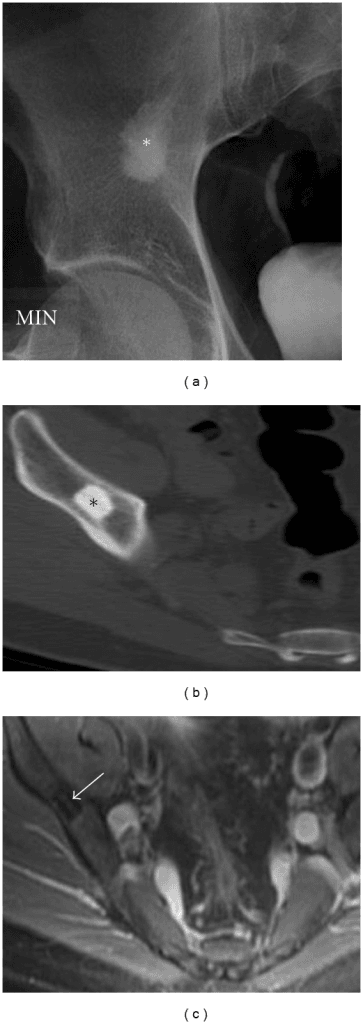
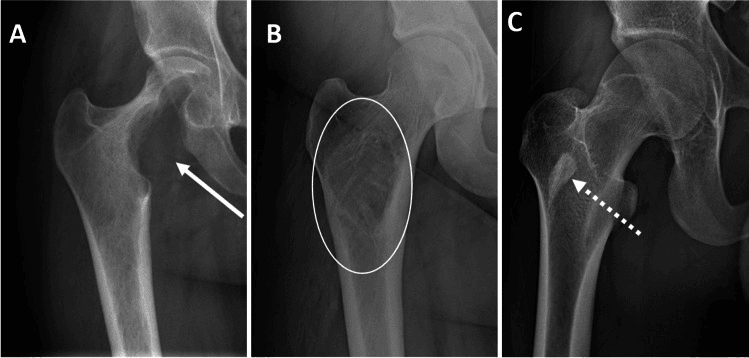
Giant bone islands. A lesion over 2 cm may raise concern for malignancy, but it carries the same radiographic features as a small enostosis, and its brush border is still present and still diagnostic. Stability over time confirms it. Consider short-term follow-up at 3-6 months to document stability; biopsy is rarely necessary if the classic features are present.
When to be cautious. Each of these moves the lesion away from a bone island:
- Irregular or infiltrative margins in place of a brush border
- A change in size on follow-up, since growth suggests pathology
- Associated periosteal reaction, cortical destruction or a soft-tissue component
- An atypical location, such as the distal tibial diaphysis
- Multiple lesions, where the question becomes osteopoikilosis or metastases
- Margins
- Brush border (thorny trabeculae)
- Periosteal Reaction
- None
- Size Change
- Stable
- Key Features
- Asymptomatic, intramedullary, homogeneous density
- Margins
- Central lucent nidus with sclerosis
- Periosteal Reaction
- Present
- Size Change
- Nidus less than 1-2 cm, stable
- Key Features
- Night pain, NSAIDs relieve, nidus visible
- Margins
- Expansile, variable sclerosis
- Periosteal Reaction
- Often present
- Size Change
- Progressive growth
- Key Features
- Greater than 2 cm, pain, expansion
- Margins
- Irregular, ill-defined
- Periosteal Reaction
- Variable
- Size Change
- Progressive
- Key Features
- Multiple lesions, older age, known primary
- Margins
- Serpiginous calcification
- Periosteal Reaction
- None
- Size Change
- Stable
- Key Features
- Peripheral calcification, central lucency
- Margins
- Well-defined, stippled calcification
- Periosteal Reaction
- None (unless fracture)
- Size Change
- Stable (benign) vs growing (malignant)
- Key Features
- Rings and arcs calcification, hands/feet common
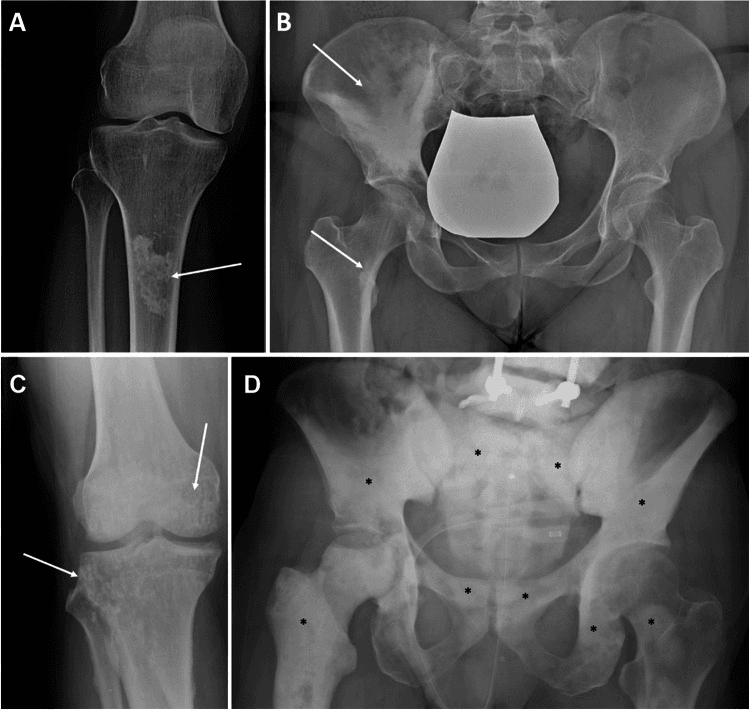
Against osteoid osteoma. A bone island is painless, homogeneous, free of periosteal reaction and medullary. Osteoid osteoma causes severe night pain, has a central lucent nidus and periosteal reaction, and may be cortical or medullary.
Against blastic metastasis. The bone island has a brush border where a metastasis has irregular, infiltrative margins. It is usually solitary where metastases are often multiple, occurs at any age without a cancer history where metastasis affects older patients with a known malignancy, and stays stable where a metastasis progresses.
Against bone infarct. The bone island is homogeneously dense, round or oval, with a dense centre. An infarct shows serpiginous peripheral calcification around a lucent centre (fat necrosis) and is geographic with a wavy border. When the radiographic features are equivocal, CT, MRI or short-term follow-up resolves the uncertainty.
Q: "You're shown a pelvic radiograph with a 1 cm sclerotic lesion in the ilium. How do you determine if this is a bone island or blastic metastasis?"
A systematic approach:
- Patient age/history: Young, no cancer history favours bone island
- Lesion characteristics: Brush border (bone island) vs ill-defined (metastasis)
- Multiplicity: Solitary favours bone island; multiple concerning
- Symptoms: Asymptomatic favours bone island; pain concerning
- Additional imaging: CT shows trabecular pattern; bone scan may be positive in both
- Follow-up: Stability over 3-6 months confirms bone island
Clinical scenarios. Three typical presentations:
- A 35-year-old with an ankle injury whose pelvic radiograph shows an 8 mm sclerotic lesion in the ilium, painless, with no cancer history and a classic brush border: a bone island, and no further work-up is needed
- A 65-year-old with breast cancer whose staging bone scan shows focal uptake in the femur, with a 15 mm sclerotic lesion with subtle margins on the radiograph: short-term follow-up at 3 months, calling it a bone island if stable and biopsying if it grows
- A 50-year-old with an incidental 4 cm sclerotic lesion in the proximal femur, brush border present but the size concerning: CT to confirm the trabecular pattern and a 6-month follow-up to confirm stability, with biopsy only for atypical features or growth
Common pitfalls. The errors to avoid:
- Over-investigation: ordering CT, MRI and bone scan for a classic bone island is unnecessary
- Biopsy of an obvious enostosis, which is invasive, risky and yields only "normal bone"
- Mistaking a bone infarct for a bone island, where serpiginous calcification is the key difference
- Assuming every sclerotic lesion in a cancer patient is a metastasis, when bone islands still occur
- Not following up an ambiguous lesion, when stability over time is diagnostic
When to image further. Recognising the classic features allows a confident diagnosis without additional testing; atypical features warrant further evaluation:
- Atypical radiographic features, such as no brush border or irregular margins
- A symptomatic lesion, since bone islands never cause pain
- Multiple lesions, to rule out metastases
- Known malignancy, where the lesion is cancer until proven otherwise
- A giant lesion over 2 cm without classic features
- Patient anxiety requiring a definitive diagnosis
Advanced Imaging
What CT adds. CT gives superior demonstration of trabecular architecture, confirms the intramedullary location, shows bone density in Hounsfield units similar to cortical bone, excludes cortical breach or a soft-tissue mass, and shows the brush border better than radiographs. It is also more sensitive than radiographs, detecting smaller lesions, and may reveal multiple small bone islands not visible on radiographs.
Typical findings. High attenuation, over 1000 HU and similar to cortex, homogeneous throughout, with a visible trabecular pattern, unlike a solid tumour, and radiating trabeculae blending with the surrounding bone. There is no cortical destruction and no soft-tissue component.
The attenuation threshold. A mean attenuation above ~885 HU, or a maximum above ~1060 HU, favours an enostosis over an untreated osteoblastic metastasis (Ulano 2016). Its limits after treatment are set out under Controversies.
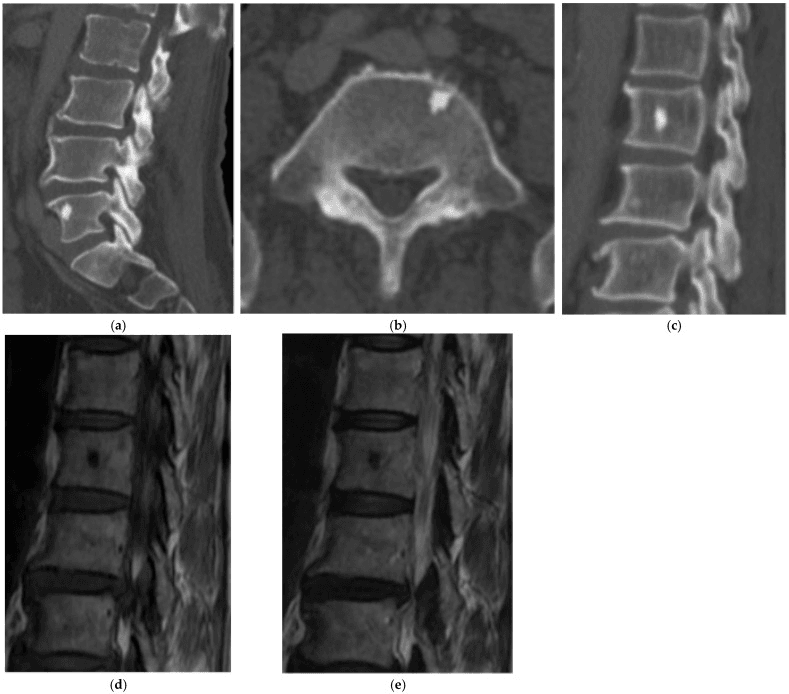
When CT is indicated. CT is the next step for:
- Ambiguous or atypical radiographic appearance with a low suspicion of malignancy
- A giant bone island, to confirm trabecular architecture
- Known malignancy with a sclerotic lesion, to differentiate it from metastasis
- Surgical planning near the lesion, to confirm it is benign and safe to instrument through
- Patient anxiety requiring definitive characterisation
Limitations. CT carries radiation exposure, especially in whole-body staging; it does not show marrow oedema, where MRI is superior; it cannot definitively exclude malignancy without biopsy; and it suffers beam-hardening artefact next to metal implants. It is most useful when radiographs show atypical features but a histological diagnosis seems excessive.
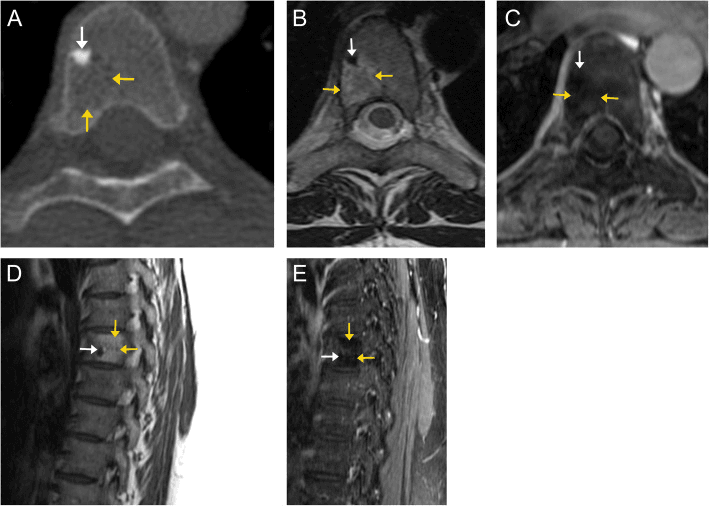
Molecular Imaging (PSMA-PET) in the Cancer Patient
Enostoses are usually non-avid. A bone island is metabolically inert, so it is typically cold on Tc-99m MDP (larger ones can be mildly warm), non-avid on FDG-PET and PSMA-non-avid on PSMA-PET. In prostate-cancer staging, a sclerotic focus that is PSMA-non-avid with a high CT density favours a benign enostosis and can spare a biopsy.
Avidity is not tumour-specific. PSMA (prostate-specific membrane antigen) is expressed in the neovascular endothelium of many non-prostatic and benign lesions: Paget disease, fibrous dysplasia, a healing fracture, haemangioma and occasionally benign bone. A PSMA-avid sclerotic focus is therefore not automatically a metastasis; correlate it with CT density and morphology (brush border). The same caveat applies to incidental FDG uptake.
The tracer can be falsely reassuring too. A treated or densely sclerotic osteoblastic metastasis can lose avidity and go cold, so a non-avid dense lesion in a treated patient is not proof of benignity. That is why the density threshold is validated only for untreated metastases.
The rule is unchanged. Across bone scan, FDG-PET and PSMA-PET, morphology and CT density decide, and functional-imaging avidity only raises or lowers suspicion. It neither confirms an enostosis nor, on its own, upgrades one to a metastasis.
The Dangerous Mimic: Low-Grade Central Osteosarcoma
Low-grade osteosarcoma is the one malignant lesion that genuinely mimics a giant enostosis, and separating the two is the whole clinical problem.
Why it deceives. Low-grade central (intramedullary) osteosarcoma is a well-differentiated, densely ossified intramedullary tumour that can resemble a large dense sclerotic focus. Like an enostosis it is often asymptomatic or minimally painful and slow-growing, so it is the sclerotic lesion most likely to be mislabelled a giant bone island. Rarely, a slowly enlarging dense lesion turns out to be one.
The features an enostosis never has. A true bone island has a sharp feathered brush border, is entirely intramedullary, and never involves the cortex or soft tissue. Any one of the following excludes an enostosis and mandates tissue:
- A focally ill-defined or permeative margin
- Endosteal scalloping, or cortical thinning or breakthrough
- A soft-tissue component
- Genuine interval enlargement
Interval growth is the key discriminator, and the main reason any change in size mandates a tissue diagnosis.
The biopsy trap. A small-sample biopsy of low-grade central osteosarcoma can look deceptively bland, "mature, normal-looking bone", the same report expected from an enostosis; this is why normal bone on a biopsy does not exclude adjacent pathology. MDM2 (and CDK4) amplification or immunostaining is positive in low-grade central osteosarcoma (and parosteal osteosarcoma) and negative in a bone island, so it is the decisive test when the histology looks bland but the imaging is atypical.
The safe rule. Any dense "enostosis" that grows, becomes painful or shows a margin other than a brush border must be worked up as a possible low-grade osteosarcoma, with MDM2/CDK4 studies on the biopsy, rather than dismissed. The tumour itself is detailed in the osteosarcoma topic.
GROWSRed Flags - When It Is NOT a Bone Island
Hook:If a sclerotic lesion GROWS or breaks any of these rules, stop calling it a bone island and investigate for metastasis, osteoid osteoma, osteoblastoma or low-grade osteosarcoma
When the Lesions Are Multiple: Osteopoikilosis and Gardner Syndrome
A solitary enostosis needs no more than recognition. Multiple dense bony lesions are a different question, because two syndromes sit behind them and one of them is life-threatening.
Osteopoikilosis is the benign one. It is an autosomal dominant condition, spotted bone disease, with multiple small, symmetrical bone islands throughout the skeleton, clustered around the joints. It is caused by a LEMD3 gene mutation on chromosome 12q; LEMD3 encodes the MAN1 protein, which has a role in TGF-β signalling. Patients are usually asymptomatic and the finding is incidental, though some have associated skin lesions, dermatofibrosis lenticularis disseminata.
Its radiographs. Numerous small sclerotic lesions in a bilateral, symmetrical distribution, predominating in the pelvis, femurs, hands and feet, each with the features of a bone island, brush border included.
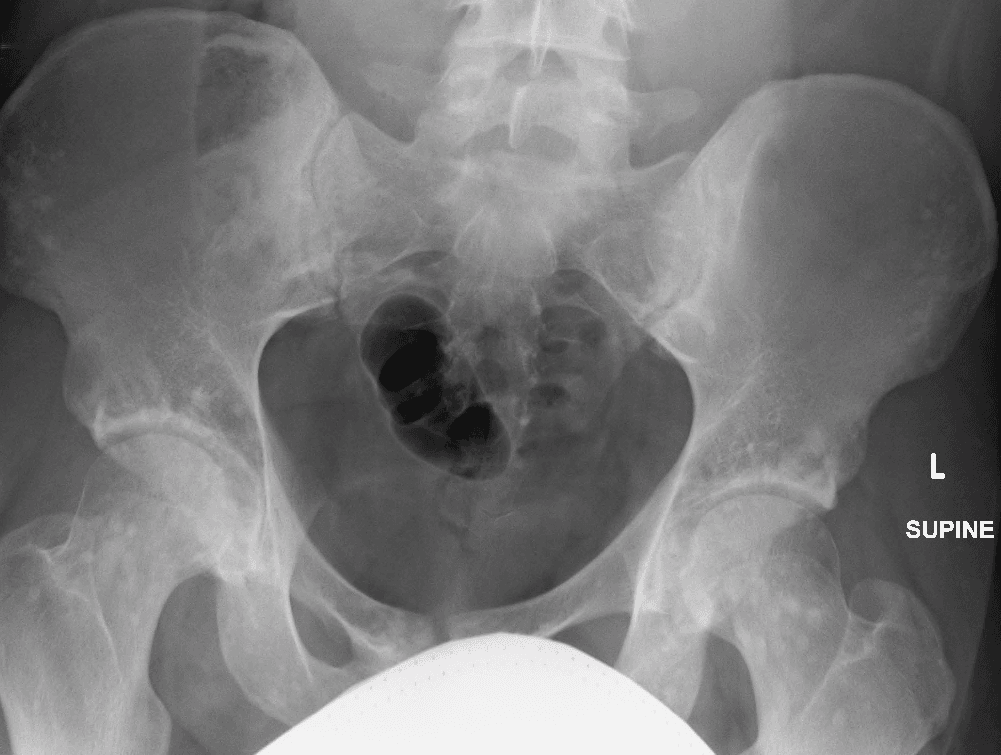
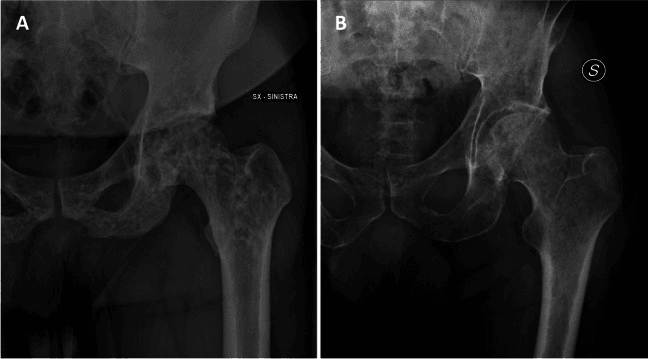
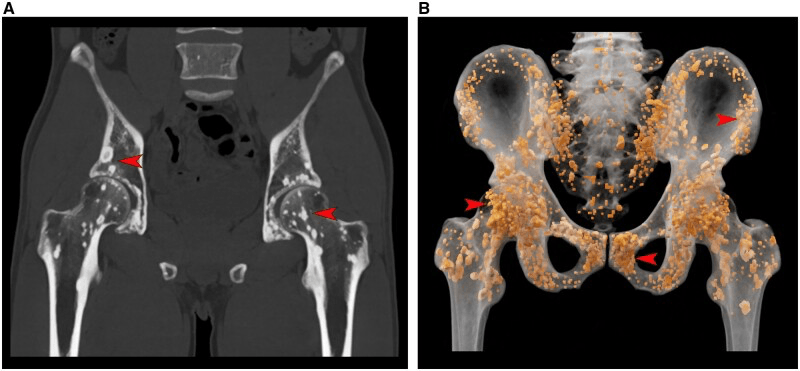
Its differential. The differential of multiple sclerotic foci includes:
- Blastic metastases: asymmetric and progressive, in an older patient with a cancer history
- Tuberous sclerosis: skeletal sclerosis with the other stigmata in the CNS, skin and kidney
- Mastocytosis: systemic symptoms and diffuse sclerosis, with mast cells on biopsy
Its management. The diagnosis rests on the family history and the characteristic imaging, and follows a benign course needing no treatment or follow-up; genetic counselling is offered if desired. Its importance is recognition, because the scattered dense spots are mistaken for widespread osteoblastic metastases.
Gardner syndrome is the one to act on. It is an autosomal-dominant phenotypic variant of familial adenomatous polyposis, caused by a germline mutation in the APC tumour-suppressor gene on 5q. Its skeletal marker is multiple osteomas, typically of the skull and mandible and sometimes the long bones, and these are frequently the first manifestation, appearing before any bowel symptom.
The rest of the phenotype. Beyond the osteomas:
- Colonic adenomatous polyposis, with hundreds to thousands of polyps and a near-100 percent lifetime colorectal-cancer risk if untreated
- Soft-tissue tumours: epidermoid and sebaceous cysts, desmoid fibromatosis (often intra-abdominal, and a major cause of morbidity in its own right) and lipomas
- Dental anomalies, including supernumerary or unerupted teeth and odontomas
- CHRPE, congenital hypertrophy of the retinal pigment epithelium, an early ocular marker
Why it matters to an orthopaedic surgeon. Recognising multiple osteomas should prompt genetics referral and colonoscopy. The polyps are premalignant and the definitive treatment is prophylactic colectomy, so a skeletal observation made in an orthopaedic or dental clinic can prevent a colorectal cancer.
Clinical Management
Observation alone. Most bone islands need only recognition. Observation is appropriate when the clinical and radiographic picture is classic:
- Asymptomatic, since any pain warrants further evaluation
- An incidental finding, not the reason for imaging
- No cancer history, so the pre-test probability of metastasis is low
- A young to middle-aged patient, as metastases are rare under age 40
- A classic brush border, homogeneous sclerosis and an intramedullary location
- A solitary lesion, or a few lesions in typical locations
- No concerning features: no cortical destruction, soft tissue or periosteal reaction
- Size under 2 cm, as giant lesions may warrant follow-up
Counselling. Tell the patient that this is a bone island, also called enostosis, a benign developmental finding and not a tumour. It will not grow, cause symptoms or require treatment, it has no cancer potential, there are no restrictions on activity, and no follow-up imaging is needed.
The anxious patient. Acknowledge the concern about an "abnormal" finding and explain how common bone islands are, up to 40% of people. Emphasise that the lesion is normal bone, not foreign tissue, provide written information if available, and offer a discussion with a radiology colleague if the patient wishes.
Documentation. Record the radiographic description (size, location, features), the assessment "Consistent with bone island (enostosis)", that no further imaging or follow-up is indicated, and that the patient has been counselled and understands the benign nature. This prevents future providers repeating an unnecessary work-up.
Bone Island in the Cancer Patient
The dilemma. A patient with known malignancy undergoes staging imaging (bone scan, PET-CT, skeletal survey), and a sclerotic lesion appears in the pelvis or proximal femur. The pre-test probability of metastasis is high, but bone islands still occur, their prevalence unchanged by cancer status, and the two must be differentiated to avoid understaging or over-treatment.
The approach. Work through it in order:
- Review prior imaging. A lesion present on old films from before the cancer diagnosis is likely a bone island; a new one is concerning for metastasis.
- Assess the radiographic features. A brush border strongly favours a bone island, even in a cancer patient; irregular margins and multiple lesions favour metastases.
- Consider the tumour type. Blastic metastases come from prostate, breast, carcinoid and medulloblastoma. Lytic metastases from renal, thyroid and lung primaries are less likely to mimic a bone island.
- Repeat imaging at a short interval (6-12 weeks). Stability favours a bone island; growth indicates metastasis.
- Biopsy if uncertain. The treatment plan depends on metastatic status and a tissue diagnosis is definitive, balanced against its invasiveness.
From oncologist's viewpoint, a sclerotic lesion in a cancer patient is metastasis until proven otherwise. Orthopaedic input regarding bone island diagnosis valuable, but biopsy often appropriate to avoid under-treatment of potentially curable disease.
Collaborative discussion:
- Orthopaedic: "Radiographic features consistent with bone island"
- Oncology: "Appreciate assessment; given treatment implications, recommend biopsy"
- Shared decision with patient
Management Algorithm
Morphology and stability decide, and bone islands themselves require no treatment. The pathway runs:
- An incidental sclerotic intramedullary lesion is found. First question: are all the classic bone-island features present - brush border, homogeneous sclerosis, an asymptomatic patient, and no aggressive signs (no cortical destruction, periosteal reaction or soft-tissue mass)?
- All classic features present. Reassure and discharge: no treatment, no further imaging, no routine follow-up. Document the diagnosis so the work-up is never repeated.
- Features absent or uncertain. Ask the pivot question: is there a known malignancy, or would the answer change cancer staging or treatment?
- No known malignancy: problem-solving imaging. CT looks for a trabecular pattern and high attenuation (above the Ulano threshold); MRI should show low T1 and low T2 signal with no marrow oedema.
- Known malignancy or staging at stake: review all prior imaging for long-standing stability and discuss with radiology and oncology. CT/MRI characterisation comes first; biopsy only when the residual uncertainty would change cancer treatment.
- Final check on every pathway: is the morphology stable and benign?
- Yes: observe or discharge. A single 3-6 month radiograph is reasonable for atypical or giant (over 2 cm) lesions; stability confirms enostosis.
- No: concerning features - pain, interval growth, cortical destruction, soft-tissue mass or low CT density - trigger biopsy and tumour work-up. The lesion is not labelled a bone island until malignancy is excluded.
Guidelines, Registries & Global Practice
Global Epidemiology
- Most common benign sclerotic skeletal lesion worldwide; reported in roughly 1-14% of radiographs and up to ~40% of autopsy series, with no sex predilection and no known geographic or ethnic predilection.
- Detection rate rises with cross-sectional imaging (CT) and with the increasing volume of whole-body PSMA-PET, FDG-PET and oncologic staging studies, so incidental enostoses are encountered more often, not because they are forming more often.
- Osteopoikilosis (multiple enostoses) is rare (estimated ~1 in 50,000), autosomal dominant, due to LEMD3 (MAN1) loss-of-function (Hellemans 2004).
Guidelines & Society Positions (Side by Side)
- Position on the incidental sclerotic bone lesion
- A morphologically classic, asymptomatic enostosis needs no further imaging or follow-up; characterise indeterminate sclerotic lesions before escalating
- Position on the incidental sclerotic bone lesion
- Structured reporting should name a classic enostosis explicitly ("benign bone island, no follow-up") rather than the ambiguous "sclerotic focus" that triggers downstream work-up
- Position on the incidental sclerotic bone lesion
- In cancer staging, a solitary sclerotic focus is not automatically a metastasis; correlate morphology and CT density, use PET tracer behaviour to help, biopsy only if it changes management
- Position on the incidental sclerotic bone lesion
- Classic bone island is a "leave-me-alone" lesion; reserve biopsy for atypical, growing or symptomatic lesions where metastasis or primary tumour cannot be excluded
The common thread across societies is identical: morphology decides. There is no guideline anywhere recommending routine biopsy or routine follow-up of a classic enostosis.
Registry & Quantitative Practice Notes
- CT attenuation is the most reproducible objective discriminator: mean attenuation above ~885 HU (or max above ~1060 HU) favours enostosis over untreated osteoblastic metastasis (Ulano 2016).
- Functional imaging behaviour: enostoses are typically photopenic/cold on Tc-99m MDP bone scan and PSMA-negative on PSMA-PET, and usually FDG-non-avid; larger lesions can show mild MDP uptake, which does not upgrade the diagnosis (Greenspan 1991, 1995).
High- vs Limited-Resource Practice Variation
- High-resource settings: Problem-solving CT (attenuation measurement), MRI (low signal on all sequences, no marrow oedema), and PET/SPECT-CT are readily available to characterise indeterminate lesions and avoid biopsy.
- Limited-resource settings: Diagnosis rests on the plain radiograph plus interval follow-up films, which remain highly effective - a stable, asymptomatic lesion with a brush border can be confidently called benign without advanced imaging. Short-interval repeat radiography (3-6 months) is a low-cost substitute for CT/MRI when characterisation is uncertain.
Exam Relevance (All Boards)
Bone island is a recurring imaging-interpretation and viva item. The two questions examiners almost always ask are "How do you differentiate this from a blastic metastasis?" and "When, if ever, would you biopsy?" - both answerable from morphology
Enostosis: Defining Concept and Diagnostic Criteria
CT Attenuation Thresholds Separate Enostoses from Osteoblastic Metastases
Scintigraphic Activity Does Not Reclassify a Bone Island
Radiologic-Pathologic Basis of 'Hot' Bone Islands
LEMD3 Loss-of-Function Underlies Osteopoikilosis (Multiple Enostoses)
Key References:
-
Greenspan A. Bone island (enostosis): current concept - a review. Skeletal Radiol. 1995;24(2):111-115.
-
Greenspan A, Steiner G, Knutzon R. Bone island (enostosis): clinical significance and radiologic and pathologic correlations. Skeletal Radiol. 1991;20(2):85-90.
-
Ulano A, Bredella MA, Burke P, et al. Distinguishing untreated osteoblastic metastases from enostoses using CT attenuation measurements. AJR Am J Roentgenol. 2016;207(2):362-368.
-
Hellemans J, Preobrazhenska O, Willaert A, et al. Loss-of-function mutations in LEMD3 result in osteopoikilosis, Buschke-Ollendorff syndrome and melorheostosis. Nat Genet. 2004;36(11):1213-1218.
-
Resnick D, Niwayama G. Enostosis, hyperostosis, and periostitis. In: Resnick D, ed. Diagnosis of Bone and Joint Disorders. 3rd ed. Philadelphia: WB Saunders; 1995:4406-4430.
Controversies & Areas of Uncertainty
Bone island is a benign, well-characterised entity, so the genuine uncertainty is diagnostic rather than therapeutic.
Defining "giant", and whether it warrants follow-up. The threshold of more than 2 cm is conventional, not evidence-based. Many authors observe classic giant lesions without any follow-up, while others document a single short-interval film for reassurance; there is no trial evidence favouring either, and practice is pragmatic.
The CT attenuation cut-off in practice. The Ulano thresholds (~885 HU mean, ~1060 HU maximum) are robust for untreated osteoblastic metastases, but treated or sclerosing metastases can become very dense and overlap with enostosis, so the threshold is less reliable after systemic therapy. Density must be read alongside morphology and clinical context.
The "hot" bone island. Scintigraphic activity in larger lesions remains a recognised pitfall. The consensus (Greenspan) that morphology overrides isotope uptake is well accepted, but the hot bone island still generates unnecessary biopsies in real-world oncology practice.
Pathogenesis. The developmental "failure of resorption during endochondral ossification" model is favoured but not proven; reactive and hamartomatous theories persist, and the molecular basis of solitary (non-osteopoikilosis) enostoses is unknown.
MCQ Practice Points
Q: What is a bone island (enostosis) and what are its characteristic radiographic features?
A: A bone island is a benign developmental anomaly consisting of mature compact (cortical) bone within the medullary cavity (cancellous bone). Radiographic features: Uniformly sclerotic, well-defined oval/round lesion; Spiculated margins with "brush border" (radiating trabeculae blending with surrounding bone); No periosteal reaction, cortical destruction, or soft tissue mass. Most commonly found in pelvis, femur, and spine.
Q: How do you differentiate a bone island from an osteoblastic metastasis?
A: Bone island: Spiculated/feathered margins with trabecular blending; Size typically less than 2cm; Stable on serial imaging; No uptake on bone scan (cold); Asymptomatic. Osteoblastic metastasis: Rounded, well-defined margins without trabecular blending; Often multiple; Increases in size/number on follow-up; Hot on bone scan; May be painful. CT shows bone island has similar density to cortical bone with characteristic brush border.
Q: What is the significance of bone island size and when is further investigation warranted?
A: Most bone islands are less than 2 cm and stable. Giant bone islands (greater than 2 cm) require differentiation from sclerotic tumors. Indications for further investigation: Size greater than 2 cm; Interval growth on serial imaging (greater than 25% or greater than 1 cm in 6 months); Atypical location; Associated symptoms. Investigation includes CT (confirms brush border) or MRI (low signal on all sequences). Biopsy rarely needed if classic features present.
Q: What is the histological appearance of a bone island?
A: Histologically, bone islands consist of mature lamellar bone with haversian systems (osteons) similar to cortical bone. Key features: Dense compact bone surrounded by normal trabecular bone; Smooth transition between compact and cancellous bone at margins (corresponds to radiographic brush border); No cellular atypia, mitoses, or immature bone. This differentiates from low-grade osteosarcoma which shows atypical cells and irregular bone formation.
Q: What conditions are associated with multiple bone islands (osteopoikilosis)?
A: Osteopoikilosis is characterized by multiple bone islands scattered throughout the skeleton, typically concentrated in the metaphyseal/epiphyseal regions of long bones and pelvis. It is autosomal dominant (LEMD3 gene mutation). Associated conditions: Buschke-Ollendorff syndrome (osteopoikilosis + connective tissue nevi called dermatofibrosis lenticularis disseminata). Clinical significance: Usually asymptomatic, incidental finding; Must differentiate from osteoblastic metastases (osteopoikilosis symmetric, periarticular distribution).
Exam Day Cheat Sheet
The single sentence to carry into any viva: a static, asymptomatic, intramedullary sclerotic focus with a brush border is a bone island - morphology and stability decide, not bone-scan uptake or size.
Clinical Decision Scenarios
Practise clinical reasoning and management decisions out loud
“A 42-year-old woman presents to emergency department after a minor motor vehicle collision. Pelvic radiograph shows no fracture but reveals a 12 mm well-defined sclerotic lesion in the left ilium with radiating trabeculae blending into surrounding bone. She is asymptomatic. No history of malignancy. How do you counsel this patient?”
“A 68-year-old man with recently diagnosed prostate cancer undergoes staging bone scan showing focal increased uptake in the right femoral neck. Radiograph demonstrates a 1.5 cm sclerotic lesion with subtle radiating margins. He denies hip pain. PSA is 12. How do you approach this case?”
“A 54-year-old man has a 3.8 cm densely sclerotic lesion in the proximal femur found incidentally on a knee-to-hip alignment film for osteoarthritis. It has spiculated margins blending with surrounding trabeculae. He is asymptomatic with no cancer history. The referring GP is worried it is too big to be benign and asks whether it should be biopsied. How do you assess and advise?”
Bone Island Definition
- Benign focus of compact bone within medullary cavity
- Developmental anomaly, not neoplastic or reactive
- Prevalence: 1-14% radiographs, up to 40% autopsy
- Always asymptomatic (if pain present, not bone island)
- No malignant potential, stable throughout life
- Most common locations: pelvis (40%), proximal femur (25%), ribs, spine
Pathognomonic Imaging Features
- Brush border: thorny radiating trabeculae blending with normal bone (KEY FEATURE)
- Homogeneous sclerosis (radiodense, similar to cortical bone)
- Intramedullary location (within medullary cavity)
- No cortical destruction or expansion
- No periosteal reaction (if present, alternative diagnosis)
- No soft tissue mass
- Stable size over time (bone islands do not grow)
Differential Diagnosis
- Osteoid osteoma: night pain, central lucent nidus, periosteal reaction, less than 2 cm
- Blastic metastasis: irregular margins, multiple lesions, older age, known cancer history, progressive
- Bone infarct: serpiginous peripheral calcification, central lucency, geographic
- Osteoblastoma: greater than 2 cm, expansile, pain, grows over time
- Enchondroma: stippled (rings and arcs) calcification, hands/feet, may be lucent
- Osteopoikilosis: multiple bone islands, bilateral symmetric, genetic
Advanced Imaging
- CT: trabecular architecture visible, HU greater than 1000, confirms brush border
- MRI: low T1/T2 signal (no marrow), no edema, no enhancement, often invisible
- Bone scan: variable uptake (small lesions negative, large may be positive), does NOT differentiate from metastasis
- PET-CT: typically no FDG uptake (no metabolic activity)
- Brush border on radiograph trumps bone scan uptake
Management Algorithm
- Classic features + asymptomatic: reassure, no further imaging or follow-up
- Atypical features but low suspicion: 3-6 month follow-up radiograph (stability confirms diagnosis)
- Giant bone island (greater than 2 cm): consider CT to confirm trabecular pattern, short-term follow-up
- Known malignancy: higher suspicion for metastasis, review old imaging, consider biopsy if treatment plan affected
- Symptomatic lesion: NOT bone island, investigate for osteoid osteoma, tumor, infection
- Progressive growth: NOT bone island, biopsy indicated
Biopsy Indications (Rare)
- Known malignancy with sclerotic lesion (cannot exclude metastasis)
- Progressive growth on serial imaging
- Symptomatic lesion (pain rules out bone island)
- Atypical radiographic features despite advanced imaging
- Biopsy shows: mature lamellar bone, no tumor cells, 'consistent with enostosis'
- Most bone islands should NEVER be biopsied (imaging diagnosis sufficient)
Special Situations
- Osteopoikilosis: multiple bone islands, autosomal dominant, LEMD3 gene, bilateral symmetric, benign, no treatment
- Cancer patient: pre-test probability metastasis higher, compare to old imaging, biopsy often appropriate
- Giant bone island: greater than 2 cm, confirm with CT (trabecular architecture), short-term follow-up acceptable
- Bone scan uptake: does NOT mean malignancy, correlate with radiograph morphology
- Incidental finding: reassure patient, document in chart to prevent future workup