Progressive Diaphyseal Dysplasia | TGFB1 Gain-of-Function | Symmetric Diaphyseal Hyperostosis
- Autosomal dominant, caused by activating mutations in TGFB1 (encodes TGF-beta1)
- Mutations cluster in the latency-associated peptide (LAP) domain, increasing active TGF-beta1 signalling and bone turnover
- Symmetric diaphyseal cortical hyperostosis of long bones (periosteal AND endosteal new bone) plus skull-base sclerosis
- Classic clinical triad: limb pain + waddling gait + proximal muscle weakness/wasting (mimics a myopathy)
- Epiphyses are spared; corticosteroids are first-line for pain and weakness; losartan is an emerging TGF-beta-targeted option
- “Diaphysis-centred disease, in contrast to osteopetrosis which is generalised
- “Thin, marfanoid, poorly muscled body habitus is characteristic
- “Skull-base hyperostosis can compress cranial nerves (vision, hearing, facial palsy)
- “Bone scan shows increased diaphyseal uptake and is useful to map disease activity
Overview and Epidemiology
Camurati-Engelmann disease (CED), also known as progressive diaphyseal dysplasia or Engelmann disease, is a rare autosomal dominant sclerosing bone dysplasia. New bone is deposited on both the periosteal (outer) and endosteal (inner) surfaces of the long-bone diaphyses, producing fusiform cortical thickening, and the skull, particularly the base, is also commonly affected. The disorder is characterised by bone pain, easy fatigue, decreased muscle mass and proximal lower-limb weakness leading to gait disturbance (Van Hul et al., Calcif Tissue Int 2019; DOI).
How rare. Only a few hundred families have been described worldwide. A Japanese epidemiological survey estimated roughly 50-60 affected individuals nationally (Kinoshita, Nihon Rinsho 2015; [DOI not available]).
Who, and when. Males and females are both affected. Onset is usually in childhood or adolescence, though milder cases may present in adulthood or be discovered incidentally.
Inheritance. Autosomal dominant, and both familial and apparently sporadic (de novo) cases occur. Expressivity is variable: expression varies widely even within one family carrying the same mutation.
The gene. The causative gene is TGFB1 on chromosome 19q13, encoding transforming growth factor beta-1 (TGF-beta1). Disease-causing mutations cluster in the latency-associated peptide (LAP) domain, and the single most common is R218C, an arginine-to-cysteine change at codon 218.
CED is TGFB1. Contrast it with the sclerosing dysplasias driven by other genes: osteopetrosis (TCIRG1/CLCN7), pyknodysostosis (cathepsin K / CTSK), and melorheostosis/osteopoikilosis (LEMD3).
Pathophysiology
The latent complex. TGF-beta1 is normally secreted as a latent complex, the active cytokine bound to its LAP, which keeps it inactive until it is released in a controlled way. In CED the LAP-domain mutations destabilise this latent complex; they are thought to disrupt the binding between TGF-beta1 and its LAP (Van Hul et al., Calcif Tissue Int 2019; DOI). The result is premature or excessive release of active TGF-beta1 and increased signalling through the TGF-beta type I receptor: a gain-of-function disorder.
What that does to bone. TGF-beta1 is a key coupling factor between osteoblasts and osteoclasts. Excess active signalling drives accelerated, uncoupled bone turnover with a net gain of cortical bone along the diaphyses.
High turnover, not absent resorption. Although CED produces dense bone, it is not simply a problem of absent resorption. In vitro, the R218C mutation increases TGF-beta1 bioactivity and enhances osteoclast formation and bone resorption, consistent with clinical evidence of increased bone formation and increased resorption rather than purely dense, inert bone (McGowan et al., J Clin Endocrinol Metab 2003; DOI). At the diaphyses, periosteal and endosteal apposition exceeds resorption, and the net result is cortical hyperostosis.
Why it hurts. The high overall turnover explains the bone pain, the raised inflammatory and bone-turnover markers, and the avid uptake on bone scan. The deep, aching limb pain comes from high-turnover periosteal new bone and periosteal stretching.
Osteopetrosis = osteoclasts present but cannot resorb (low turnover, inert dense bone). Camurati-Engelmann = high-turnover bone driven by excess TGF-beta1, with both osteoblasts and osteoclasts activated. Same "dense bone" on film, opposite biology.
Why the muscles are weak. The reduced muscle mass and proximal, myopathy-like weakness are genuine. The precise mechanism is incompletely understood, but it is linked to the systemic TGF-beta1 excess and to disuse from pain.
Why the cranial nerves are at risk. Skull-base hyperostosis narrows the neural foramina, threatening the optic, vestibulocochlear and facial nerves, and occasionally raises intracranial pressure.
Clinical Presentation
The typical patient. A child or adolescent, often thin and tall for age, with a marfanoid habitus and poor muscle bulk. Delayed puberty and delayed sexual development are described in some series (Nishimura et al., Am J Med Genet 2002; DOI).
The complaints. Pain leads, and the rest is the picture of a proximal myopathy:
- Limb pain, deep and aching, in the legs and arms: the dominant complaint and the most consistent symptom
- Easy fatigue and reduced exercise tolerance
- Proximal lower-limb weakness and muscle wasting
- A waddling, myopathic gait, and delayed walking in younger children
- Flexion contractures of the hips and knees in more severe cases
The 17- and 11-year-old pair reported by Nishimura and colleagues shows the constellation together: marfanoid habitus, waddling gait, muscular weakness, intense leg pain and flexion contractures.
Proximal lower-limb weakness, wasting, a waddling gait and easy fatigue can mimic a primary muscle disease. The clues are the bone pain and the radiographic hyperostosis. Do not anchor on a neuromuscular diagnosis.
Cranial symptoms. Skull-base involvement brings headaches, visual disturbance from optic canal narrowing and, less commonly, hearing loss and facial palsy. Ask about them and examine the cranial nerves, because skull-base disease changes the urgency and the management.
Mild and atypical disease. Some carriers are asymptomatic and are diagnosed only on family screening or incidental imaging. Disease may be limited to one or a few bones, for example confined to the tibia, rather than widespread.
Genotype and phenotype. Atypical phenotypes have been linked to specific mutations. A family with disease limited to the tibia plus obesity, a feature not usually associated with CED, carried a p.Arg156Cys (R156C) LAP-domain mutation (Collet et al., Am J Med Genet A 2013; DOI). Symptoms and radiographic extent do not always correlate, and a normal-looking relative may still carry the mutation.
Examination. A focused assessment covers:
- Inspection: habitus, muscle bulk and contractures; watch the waddling gait, and perform a sit-to-stand and Gowers-type assessment
- Power: proximal lower-limb power (hip flexors, abductors) is typically weak; compare proximal with distal to bring out the myopathic pattern
- The bones: tenderness over the long-bone diaphyses, limb length and any angular deformity
- Cranial nerves: visual acuity and fields, fundoscopy for optic atrophy, hearing and facial nerve function
- The abdomen, for clues to the differentials: there is no organomegaly, because CED does not cause hepatosplenomegaly, unlike severe osteopetrosis
Investigations
The diagnosis is clinical and radiographic, confirmed by TGFB1 testing. There is no diagnostic blood test.
Plain radiographs are the key test. They are usually diagnostic when the pattern is recognised: bilateral, symmetric, fusiform cortical thickening of the long-bone shafts (femur, tibia, humerus), narrowing the medullary canal. The disease is centred on the diaphysis and spreads toward the metaphysis, which is involved late, while the epiphysis is spared. That distribution is the diagnostic fingerprint; generalised, uniform sclerosis points instead to osteopetrosis.
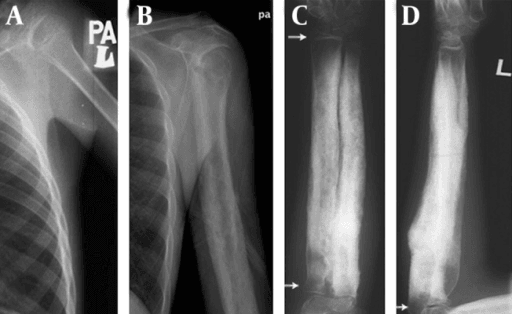
Progression. Lesions extend along the shaft over time, which is the "progressive" in the name, and serial films show advancing cortical thickening.
The skull. The skull base and calvarium thicken and sclerose. This can narrow the cranial foramina and may cause frontal bossing.
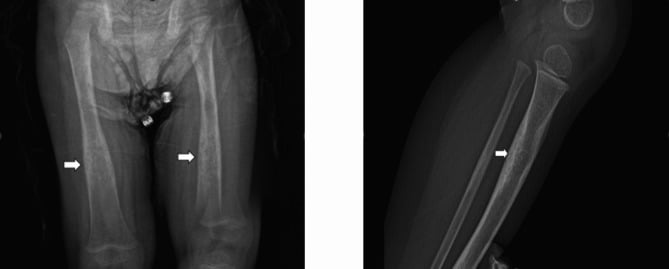
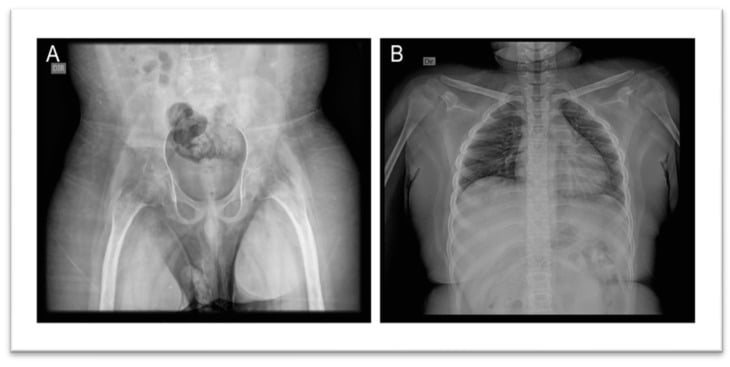
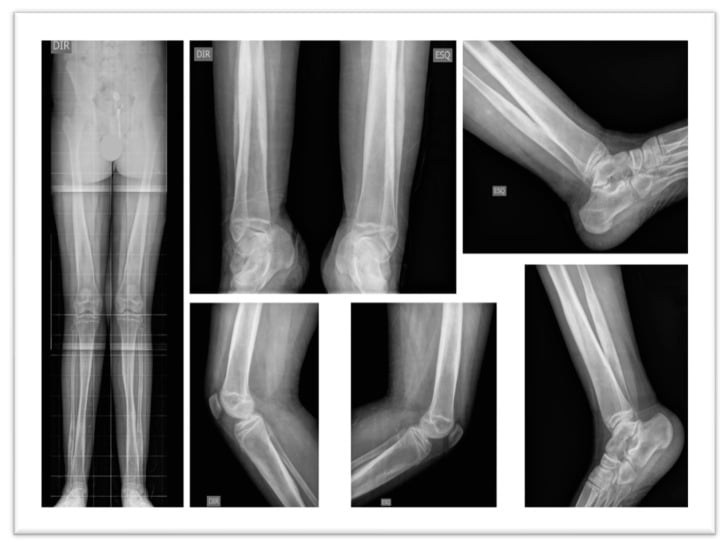
SHAFTRadiographic Pattern
Hook:Disease of the SHAFT - symmetric hyperostosis along the bone shafts.
Bone scan. Tracer uptake is increased along active diaphyseal disease. The scan maps disease activity, distinguishes active from quiescent lesions, and shows whether a painful site is metabolically active.
CT and MRI. CT best shows the skull-base hyperostosis and foraminal narrowing when there are cranial nerve symptoms. MRI helps exclude mimics, such as the marrow changes of osteomyelitis or tumour, and assesses the soft tissues.
Blood tests. Supportive findings include:
- Alkaline phosphatase may be elevated, from the increased bone turnover
- ESR and other inflammatory markers may be raised, reflecting active disease and contributing to the "inflammatory" feel of flares
- Calcium and phosphate are usually normal, which helps exclude metabolic bone disease and rickets mimics
- The full blood count is typically normal, with no pancytopenia, an important contrast with malignant osteopetrosis
Raised alkaline phosphatase and ESR were present in the symptomatic adolescents reported by Nishimura et al. (Am J Med Genet 2002; DOI).
Genetic testing. TGFB1 sequencing confirms the diagnosis in the majority of clinically typical cases; look particularly at the LAP-domain exons. Besides R218C, other recurrent LAP-domain changes such as R156C are described. Independently arising, LAP-domain-specific mutations have been confirmed across multiple unrelated families, underscoring that this domain is the hotspot (Kinoshita et al., Am J Med Genet A 2004; DOI).
A negative test. A subset of clinically typical patients have no detectable TGFB1 mutation ("TGFB1-negative CED"), which indicates genetic heterogeneity. A negative test therefore does not exclude CED if the radiographic and clinical picture is classic. Testing supports family counselling (autosomal dominant, 50% transmission risk) and clarifies atypical or borderline cases.
Differential Diagnosis
- Distribution / Distinguishing Feature
- Symmetric diaphyseal cortical hyperostosis + skull base; epiphyses spared; limb pain, waddling gait, proximal weakness
- Genetics / Cause
- TGFB1 (LAP domain, e.g. R218C); autosomal dominant
- Distribution / Distinguishing Feature
- Generalised dense skeleton; sandwich vertebrae, Erlenmeyer flask, bone-in-bone; brittle fractures, pancytopenia (severe form)
- Genetics / Cause
- TCIRG1, CLCN7; osteoclast dysfunction
- Distribution / Distinguishing Feature
- Adult onset; often asymmetric / single bone (tibia); milder, no proximal myopathy
- Genetics / Cause
- Autosomal recessive; distinct from CED
- Distribution / Distinguishing Feature
- Usually focal/single bone; infective or inflammatory history; may need biopsy/culture to exclude
- Genetics / Cause
- Acquired (infection / CRMO)
- Distribution / Distinguishing Feature
- Unilateral 'dripping candle wax' cortical sclerosis in a sclerotomal distribution
- Genetics / Cause
- LEMD3 (often mosaic)
- Distribution / Distinguishing Feature
- Focal nidus with reactive cortical sclerosis; night pain relieved by NSAIDs
- Genetics / Cause
- Benign osteoblastic tumour
Multiple diaphyseal sclerosis (Ribbing disease) and other sclerosing dysplasias are frequently confused with one another and with chronic sclerosing osteomyelitis, so the diagnosis rests on the distribution, clinical history and characteristic radiographic appearance (Cai et al., Medicine 2018; DOI). CED is the one with symmetric diaphyseal disease, skull-base involvement, and a myopathy-like presentation.
Management
CED is largely a medical disease, and surgery has a limited, selective role.
Corticosteroids first. Corticosteroids are the mainstay of treatment and often produce a striking response. They relieve bone pain, improve muscle weakness and fatigue, can improve gait, and may also reduce radiographic disease activity in some patients. Treatment options are currently mostly limited to corticosteroids that may relieve pain and improve muscle weakness and fatigue (Van Hul et al., Calcif Tissue Int 2019; DOI).
Why a drug that harms bone helps here. Glucocorticoids normally cause osteoporosis by suppressing osteoblast bone formation. In CED, where the problem is excess formation and high turnover, that same suppression is therapeutic, damping the periosteal and endosteal new-bone activity. CED also behaves like a high-turnover, inflammatory state, with a raised ESR and deep periosteal bone pain, and steroids give a potent anti-inflammatory and analgesic effect.
Corticosteroids work but carry real harms in children: growth suppression, osteopenia, weight gain and adrenal suppression. Use the lowest effective dose, often low-dose or alternate-day prednisone/prednisolone, monitor growth and bone health, and involve paediatric endocrinology.
Losartan and the TGF-beta pathway. Because CED is driven by excess TGF-beta1 signalling, drugs that dampen the pathway are of interest. Losartan is an angiotensin II type 1 (AT1) receptor blocker, and angiotensin II acting at the AT1 receptor upregulates the expression and activation of TGF-beta1; blocking the receptor therefore lowers TGF-beta1 signalling, independent of the drug's blood-pressure action. It was first explored in Marfan syndrome, another TGF-beta-driven disorder, and its use in CED is a rational repurposing aimed directly at the disease pathway.
But losartan is not reliable. Responses are variable. Some reports describe benefit, but failure of both conventional treatment and losartan has also been reported (Combier et al., Joint Bone Spine 2018; DOI). The evidence is limited, so losartan is an adjunct to, not a replacement for, corticosteroids and supportive care.
Therapies in development. TGF-beta type I receptor inhibition ameliorated the high bone turnover in preclinical models, supporting the pathway as the central driver and future receptor-targeted therapy (Van Hul et al., Calcif Tissue Int 2019; DOI). Patient-derived iPS-cell models are being used to develop novel agents, as CED mouse models have been difficult to establish (Kinoshita, Nihon Rinsho 2015).
Analgesia and rehabilitation. NSAIDs and simple analgesics treat the pain, and some patients use stronger analgesia during flares. Physiotherapy maintains strength, range of motion and gait and counters contractures and disuse weakness, with activity modification during painful flares.
The surgeon's role. Surgery is reserved for deformity and for cranial nerve or cord compression. Corrective osteotomy may be considered for significant limb deformity, but the dense, hyperostotic cortical bone is technically difficult to cut and fix: anticipate hard bone, prolonged drilling and a higher complication rate, the same operative caveats as other sclerosing dysplasias.
The skull base. Cranial nerve compression is a neurosurgical problem, and decompression may be considered for progressive visual or other cranial nerve loss. Monitor for raised intracranial pressure where skull involvement is marked.
Follow-up. Surveillance covers:
- Clinical: pain scores, muscle power and gait, with growth and puberty in children
- Cranial nerves: periodic vision and hearing assessment, especially with skull-base disease
- Imaging: serial radiographs to track progression, and a bone scan to assess activity if symptoms change
- Bloods: alkaline phosphatase and inflammatory markers can reflect activity; monitor for steroid side effects (glucose, bone density, growth)
- The family: genetic counselling and family screening
Complications
- Complication
- Chronic limb pain, proximal weakness, contractures, gait impairment
- Comment
- Main source of disability; drives quality-of-life impact
- Complication
- Optic, vestibulocochlear and facial nerve compression; headaches; raised intracranial pressure
- Comment
- From skull-base hyperostosis; requires surveillance
- Complication
- Thin marfanoid habitus, low muscle mass, delayed puberty in some
- Comment
- Plus steroid effects on growth if treated long-term
- Complication
- Corticosteroid side effects (growth suppression, osteopenia, weight gain)
- Comment
- Balance symptom control against harms
- Complication
- Hard hyperostotic bone makes osteotomy/fixation difficult; higher complication rate
- Comment
- Reserve surgery for clear deformity or cord/nerve compression
Guidelines, Registries & Global Practice
Global Epidemiology
- Figure
- Very rare; a few hundred families described worldwide
- Source population
- International literature
- Figure
- Approximately 50-60 affected individuals
- Source population
- Japanese epidemiological survey
- Figure
- Autosomal dominant, variable expressivity; sporadic (de novo) cases occur
- Source population
- Worldwide
- Figure
- TGFB1 R218C (LAP domain)
- Source population
- International cohorts
Because CED is extremely rare, there are no randomised trials and no formal society guidelines; practice rests on case series, registries of rare bone disease, and expert consensus.
Working Consensus Across Reports
- Working consensus
- Clinical + radiographic, confirmed by TGFB1 testing
- Comment
- Negative TGFB1 does not exclude classic CED
- Working consensus
- Corticosteroids
- Comment
- Relieve pain and improve weakness/fatigue; lowest effective dose
- Working consensus
- Losartan / anti-TGF-beta
- Comment
- Rational but variable; failures reported - individualise
- Working consensus
- Selective
- Comment
- Reserved for deformity or cranial nerve/cord compression; hard bone is technically difficult
- Working consensus
- Vision, hearing, growth, serial imaging
- Comment
- Skull-base disease mandates cranial nerve monitoring
Registries and Networks
There is no dedicated CED registry; affected individuals are captured through rare-bone-disease reference networks (for example ERN-BOND in Europe) and skeletal dysplasia registries, which coordinate genetic confirmation and multidisciplinary care. Patient-derived iPS-cell models are being used to develop future therapies given the difficulty of producing animal models.
High- vs Limited-Resource Practice Variation
- Well-resourced settings: access to TGFB1 sequencing, bone scintigraphy, paediatric endocrinology and neurosurgical skull-base services, and trials of pathway-directed therapy.
- Limited-resource settings: diagnosis is often clinical and radiographic; genetic confirmation may be unavailable, and management centres on corticosteroids, analgesia and physiotherapy. Cranial nerve surveillance still matters where skull-base disease is present.
Controversies and Areas of Uncertainty
How long to give corticosteroids, and at what cost Steroids are first-line and genuinely relieve pain and weakness, but the disease is lifelong and the patients are usually children. Nobody has defined the optimal dose, the schedule (daily versus alternate-day versus intermittent pulses), or when to stop. Why it stays unsettled: the condition is rare enough that no controlled trial is realistic, and the trade-off being made - years of growth suppression, bone loss and adrenal suppression against symptom relief in a non-fatal disease - has no agreed exchange rate. The uncomfortable truth is that the drug that helps the symptom also harms the skeleton.
Whether losartan does anything Reducing TGF-beta signalling is mechanistically the right idea, and there are convincing individual responses. Why it stays unsettled: the evidence is case reports and small series, publication favours successes, and clear failures are reported. Add to that a disease with a naturally fluctuating, relapsing-remitting pain pattern, and an uncontrolled improvement is very hard to attribute to the drug. Treat it as a reasonable adjunct in refractory or steroid-intolerant patients, not as established therapy.
No genotype-phenotype rule Members of the same family carrying the identical TGFB1 mutation range from radiographically obvious but asymptomatic to severely disabled. Why it stays unsettled: the modifiers are unknown, so genetics confirms the diagnosis but cannot predict severity, cannot identify who will develop skull-base disease, and cannot be used to reassure a newly diagnosed relative.
How aggressively to survey the skull base Cranial nerve compromise - vision, hearing, facial nerve - is the complication that causes permanent harm, but there is no agreed imaging interval, no threshold of sclerosis that mandates intervention, and no evidence that decompressing a narrowing foramen before symptoms appear helps. Why it stays unsettled: the events are rare and the operations are formidable, so practice is symptom-triggered surveillance by default rather than by demonstration.
Whether the diaphyseal pain is bone pain at all Pain correlates poorly with radiographic severity, and some of the disability is muscular. Whether the dominant mechanism is raised intramedullary pressure, periosteal stretch, or a genuine TGF-beta-driven myopathy is unresolved - which matters, because it determines whether analgesia, pathway-directed therapy or rehabilitation should lead.
Self-Assessment Questions
What gene causes Camurati-Engelmann disease and how do the mutations act?
A: TGFB1 (encoding TGF-beta1). Mutations cluster in the latency-associated peptide (LAP) domain (most commonly R218C) and destabilise the latent complex, releasing more active TGF-beta1 and increasing signalling and bone turnover - a gain-of-function. Inheritance is autosomal dominant.
Describe the classic radiographic appearance.
A: Symmetric cortical hyperostosis of the long-bone diaphyses from both periosteal and endosteal new bone, narrowing the medullary canal, with sparing of the epiphyses and skull-base sclerosis. The disease progresses along the shafts over time.
What is the typical clinical presentation?
A: A thin, marfanoid child or young adult with limb (bone) pain, easy fatigue, proximal lower-limb weakness and wasting, and a waddling, myopathic gait. Skull-base involvement can cause visual loss, hearing loss or facial palsy.
How does CED differ from osteopetrosis?
A: CED is diaphysis-centred, high-turnover disease from excess TGF-beta1; osteopetrosis is generalised, low-turnover, brittle bone from failed osteoclast resorption (with pancytopenia in severe forms). CED spares the epiphyses and does not cause pancytopenia.
What is first-line treatment and why might losartan be used?
A: Corticosteroids are first-line and relieve pain and improve muscle weakness and fatigue. Because the disease is driven by excess TGF-beta1, losartan (anti-TGF-beta activity) is a rational pathway-directed option, but responses are variable and failures are reported, so it is not uniformly effective.
What is the orthopaedic surgeon's role and the main technical caveat?
A: CED is largely a medical disease; surgery is reserved for significant deformity (corrective osteotomy) or cranial nerve/cord compression (neurosurgical decompression). The main caveat is that the dense hyperostotic cortical bone is hard to cut and fix, so anticipate difficult instrumentation and a higher complication rate.
Viva Scenarios
Practise clinical reasoning and management decisions out loud
“You are shown radiographs of both lower limbs of a thin 12-year-old who complains of leg pain and walks with a waddling gait. The films show symmetric cortical thickening of the femoral and tibial shafts with sparing of the joint ends. What is the diagnosis and how would you confirm it?”
“A candidate states that Camurati-Engelmann disease is 'a type of osteopetrosis with dense bones'. The examiner asks you to explain the actual mechanism and why it is different. How do you respond?”
“A 9-year-old is referred with chronic bilateral leg pain, fatigue and difficulty climbing stairs. The GP wondered about a muscle disease. How would you approach this and what features would point you toward Camurati-Engelmann disease?”
ESSENCE
- Progressive diaphyseal dysplasia
- Autosomal dominant sclerosing bone dysplasia
- TGFB1 gain-of-function (more active TGF-beta1)
- High bone turnover, NOT failed resorption
GENETICS
- Gene: TGFB1 (chromosome 19)
- Mutations cluster in LAP domain
- R218C most common; R156C atypical
- Negative test does not exclude classic CED
CLINICAL
- Limb (bone) pain - dominant symptom
- Waddling gait + proximal weakness/wasting
- Thin, marfanoid habitus, easy fatigue
- Skull base causes cranial nerve compression
RADIOLOGY
- Symmetric diaphyseal cortical hyperostosis
- Periosteal AND endosteal new bone
- Epiphyses spared; spreads to metaphysis
- Skull-base sclerosis; avid bone-scan uptake
INVESTIGATIONS
- Plain radiographs (key)
- ALP and ESR may be raised; Ca/PO4 normal
- FBC normal (no pancytopenia)
- TGFB1 sequencing to confirm
TREATMENT
- Corticosteroids = first-line for pain/weakness
- Losartan / anti-TGF-beta (variable, can fail)
- NSAIDs + physiotherapy
- Surgery only for deformity or nerve compression
DIFFERENTIALS
- Osteopetrosis (generalised, brittle, pancytopenia)
- Ribbing disease (adult, asymmetric, tibia)
- Chronic sclerosing osteomyelitis
- Melorheostosis (candle-wax, unilateral)
Evidence Base
Van Hul, Boudin, Vanhoenacker & Mortier
- CED (progressive diaphyseal dysplasia) is a rare autosomal dominant sclerosing dysplasia affecting mainly the skull and diaphyses of long bones
- Disease-causing mutations lie within TGFB1 and disrupt binding between TGF-beta1 and its latency-associated peptide, increasing pathway signalling and bone turnover
- Preclinical targeting of the TGF-beta type I receptor ameliorated the high bone turnover
- Current treatment is mostly limited to corticosteroids, which may relieve pain and improve muscle weakness and fatigue
McGowan, MacPherson, Janssens, Van Hul, Frith, Fraser, Ralston & Helfrich
- Studied osteoclast formation from blood mononuclear cells of three related CED patients with the R218C mutation
- Osteoclast formation was enhanced ~5-fold and bone resorption ~10-fold versus controls
- The increase was inhibited by soluble TGF-beta type II receptor; active TGF-beta1 was higher in patient cultures
- Concludes R218C increases TGF-beta1 bioactivity and enhances osteoclast formation, consistent with high-turnover bone