DDH | Ortolani | Barlow | Pavlik Harness | Pelvic Osteotomy
- Ortolani reduces a dislocated hip
- Barlow dislocates an unstable hip
- Pavlik harness for under 6 months
- Open reduction if Pavlik fails or late diagnosis
- Acetabular dysplasia needs osteotomy
- “Risk factors: breech, female, first-born, family history
- “Graf ultrasound classification
- “Pavlik success 90-95% if started under 6 weeks
- “Avascular necrosis is worst complication
Overview and Epidemiology
Developmental dysplasia of the hip is a spectrum of instability rather than a single lesion: a shallow acetabulum that still holds the head, a head that has partly left the socket, and a head that has left it altogether. Treatment intensity follows that step, not the word "click". True dysplasia or dislocation needing treatment occurs in about 1-3 per 1000 live births.
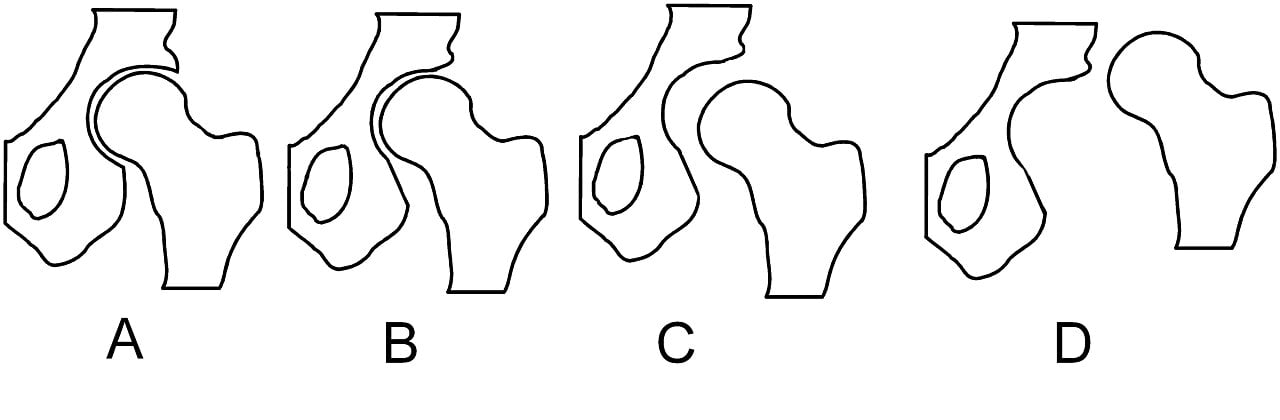
Who. Girls outnumber boys about 4:1. The left hip is affected in 60% of cases, the right in 20% and both in 20%: in utero the left hip lies against the mother's spine, a position that limits abduction and promotes dysplasia.
Risk factors. Breech presentation, female sex, first-born status and a family history; breech is a strong risk factor in its own right.
BFFFDDH Risk Factors
Hook:BFFF - Breech First-born Female with Family history!
Anatomy and Pathophysiology
Normal development. The femoral head and the acetabulum develop together, and movement stimulates that development; restricted movement causes dysplasia. The triradiate cartilage contributes to acetabular growth, the labrum deepens the socket, and the shape of the socket is influenced by where the head sits within it. Normal development therefore requires the hip to be reduced.
Why DDH develops. Ligamentous laxity from maternal hormones, mechanical factors such as breech position and oligohydramnios, and a shallow acetabulum that allows the head to dislocate. Once the head is out the acetabulum becomes shallower still, the labrum everts or inverts, the capsule elongates, and secondary changes accumulate if the hip is left untreated. Dysplasia proceeds to dislocation if untreated; early treatment prevents progressive deformity.
The acetabulum. Primary dysplasia is a shallow, saucer-shaped socket with poor anterior and lateral coverage. In dislocation the empty socket fills with fibrofatty tissue, the pulvinar, and in a high dislocation a false acetabulum forms on the ilium while the true acetabulum becomes shallow.
The femur. The ossific nucleus appears later on the affected side. A subluxed head loses its sphericity (coxa plana), lack of containment produces coxa valga with an increased neck-shaft angle, and increased femoral anteversion is common. This proximal femoral deformity complicates reduction.
Obstacles to reduction. In established DDH the following stand between the head and a concentric reduction, and in late cases they must be addressed surgically:
- Inverted labrum (limbus), folded into the joint, the Graf type IV hip
- Hypertrophied ligamentum teres, thickened and elongated
- Transverse acetabular ligament, hypertrophied and contracted across the inferior acetabulum
- Capsular constriction, the hourglass deformity of the capsule
- Iliopsoas tendon, tight and contracted where it crosses the capsule, with tight adductors alongside it
- Pulvinar, the fibrofatty tissue filling the socket
Classification
By severity. A dysplastic hip has an abnormal, shallow acetabulum with inadequate coverage but a located head. A subluxed hip has only partial contact between head and acetabulum. A dislocated hip has no contact at all. Severity guides treatment urgency and prognosis.
Teratologic DDH is a different condition: dislocation early in utero with severe soft-tissue contractures, associated with syndromes such as arthrogryposis, and more resistant to treatment.
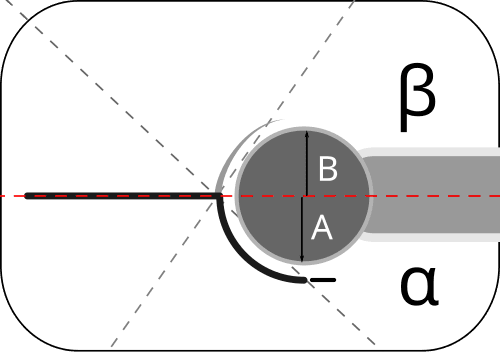
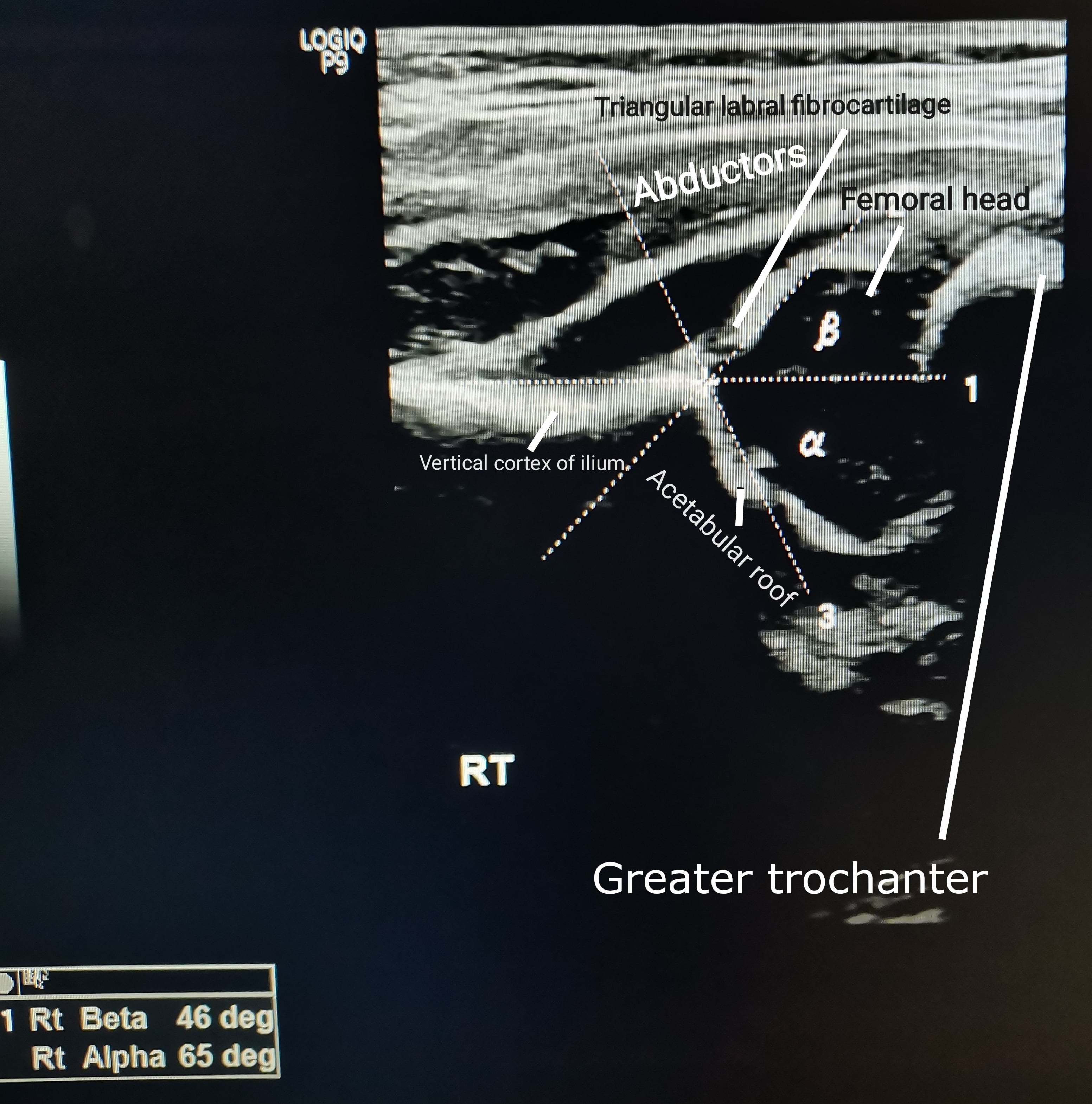
Graf ultrasound types. Graf is drawn off the iliac baseline. The alpha angle, between the ilium and the bony acetabular roof, measures bony coverage; the beta angle, between the ilium and the labrum, measures cartilaginous coverage. Types IIa and IIb share the same angles at a different age: a young IIa is observed, a IIb is treated.
- Alpha Angle
- Greater than 60
- Beta Angle
- Under 55
- Description
- Normal hip
- Alpha Angle
- 50-59
- Beta Angle
- 55-77
- Description
- Immature (under 3 months) - observe
- Alpha Angle
- 50-59
- Beta Angle
- 55-77
- Description
- Dysplastic (over 3 months) - treat
- Alpha Angle
- 43-49
- Beta Angle
- Under 77
- Description
- Critical zone - unstable
- Alpha Angle
- 43-49
- Beta Angle
- Greater than 77
- Description
- Decentered hip
- Alpha Angle
- Under 43
- Beta Angle
- Greater than 77
- Description
- Dislocated, labrum everted
- Alpha Angle
- Under 43
- Beta Angle
- Greater than 77
- Description
- Dislocated, labrum inverted
Tönnis radiographic grades. Used once the ossific nucleus is visible, after 4-6 months, and graded by how high the femoral head sits.
- Femoral Head Position
- Below Hilgenreiner line
- Description
- Normal
- Femoral Head Position
- Lateral to Perkin line, below Hilgenreiner
- Description
- Mild subluxation
- Femoral Head Position
- At level of acetabular roof
- Description
- Moderate subluxation
- Femoral Head Position
- Above acetabular roof
- Description
- High dislocation
- Femoral Head Position
- At level of anterior iliac spine
- Description
- Complete dislocation
Clinical Assessment
Every newborn should be screened. The two named tests answer different questions about the same hip.
Ortolani. Abduct the hip with anterior pressure on the greater trochanter. A clunk is the head reducing into the acetabulum, so a positive test means the hip was dislocated and is reducible.
Barlow. Adduct the hip with posterior pressure. A clunk is the head dislocating posteriorly, so a positive test means the hip is unstable and dislocatable.
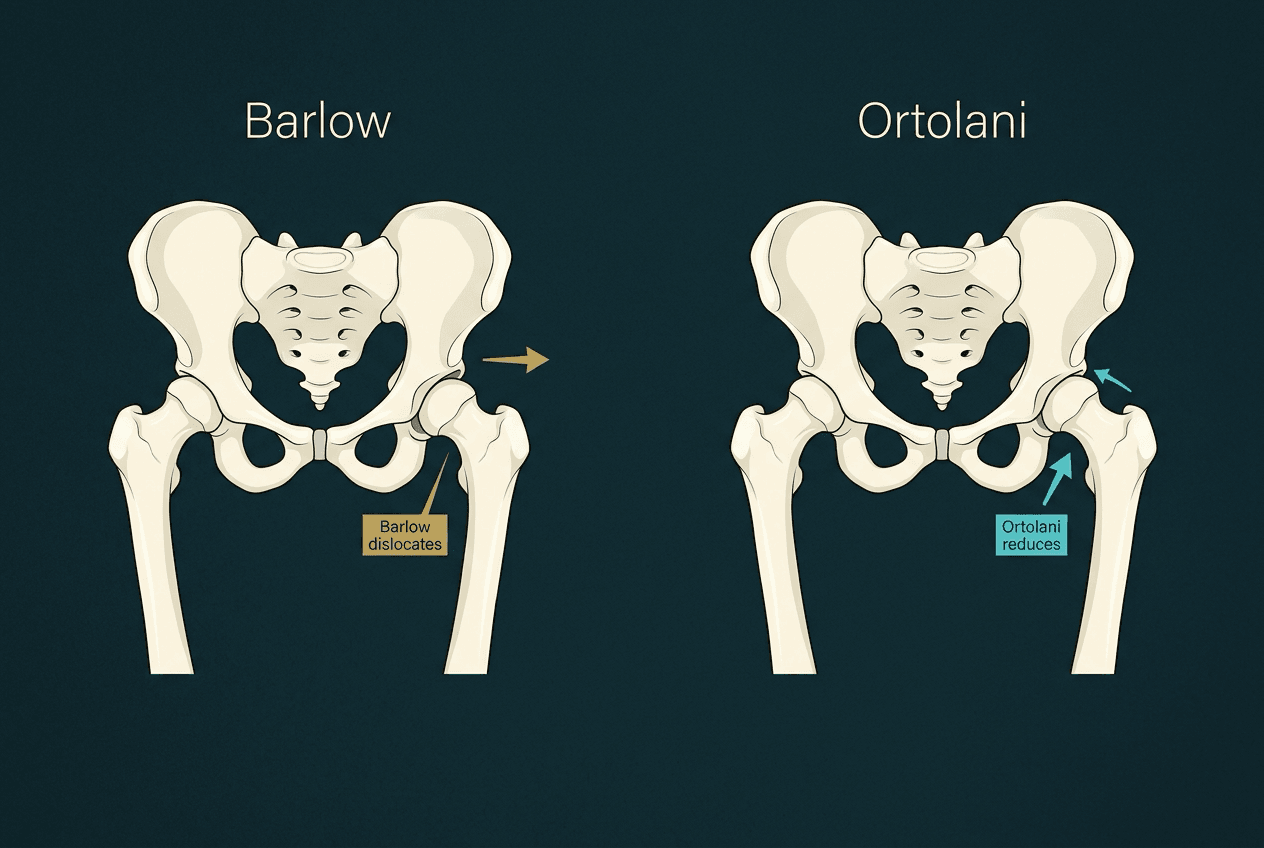
Click versus clunk. Soft clicks are common and usually benign. A clunk is palpable movement of the head, and that is what counts: DDH is a clunk, not a click.
The rest of the newborn examination. Assess stability, look for a limb length discrepancy, and note asymmetric skin folds, which are less reliable.
The older infant and child. Once the neonatal period is past the signs change:
- Limited hip abduction, the most reliable sign in the older infant
- Galeazzi sign, a limb length difference
- Asymmetric gluteal folds
- Trendelenburg gait at walking age
Late presentation is more challenging to treat.
- Distinguishing Features
- Positive Ortolani/Barlow in neonate; limited abduction and Galeazzi sign later; otherwise well child
- Key Discriminator
- Isolated unstable/dislocated hip with normal neurology
- Distinguishing Features
- Fixed, irreducible dislocation present in utero; rigid hip; associated syndrome (arthrogryposis, myelomeningocele)
- Key Discriminator
- NOT reducible by Ortolani; stiff joint, abnormal neurology
- Distinguishing Features
- Progressive subluxation due to spasticity/muscle imbalance; abnormal tone and reflexes
- Key Discriminator
- Underlying neurological diagnosis; develops over time, not congenital
- Distinguishing Features
- Short limb with abnormal femoral anatomy on radiograph; hip may be high but acetabulum often near normal
- Key Discriminator
- Femoral segment shortening; radiographic femoral dysgenesis
- Distinguishing Features
- Unwell, febrile, pseudoparalysis, pain on movement, raised inflammatory markers
- Key Discriminator
- Systemic sepsis and pain - an emergency, not DDH
- Distinguishing Features
- Soft high-pitched click from ligament/tendon, hip stable, no instability
- Key Discriminator
- Click without clunk; stable on Ortolani/Barlow
Investigations
Ultrasound. The investigation of the unossified hip. Screen at 4-6 weeks when risk factors are present, and scan for diagnosis whenever there is clinical suspicion. The report is written in Graf's types, and the angles it quotes are the ones in the classification table.
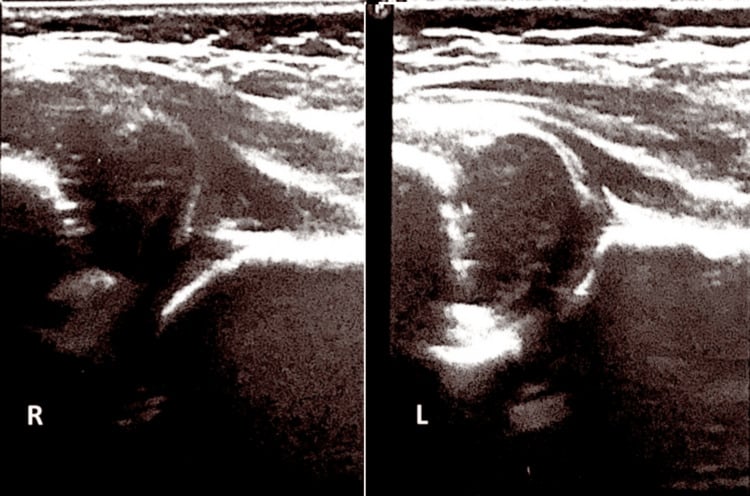
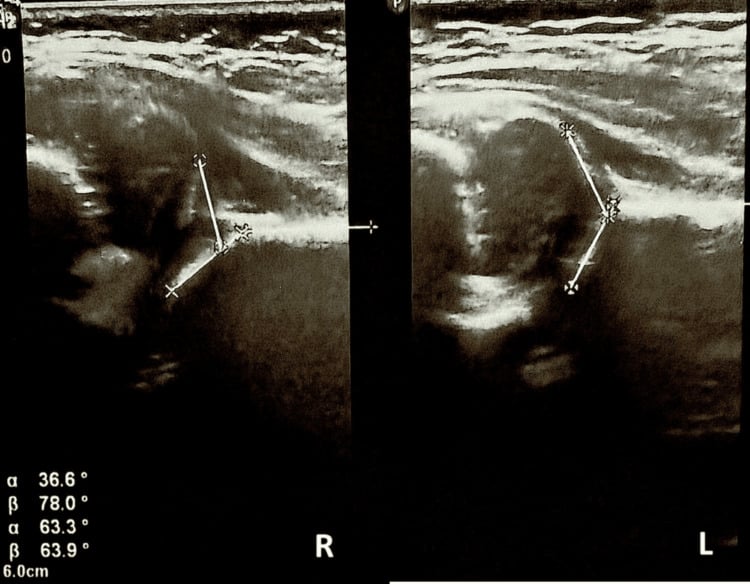
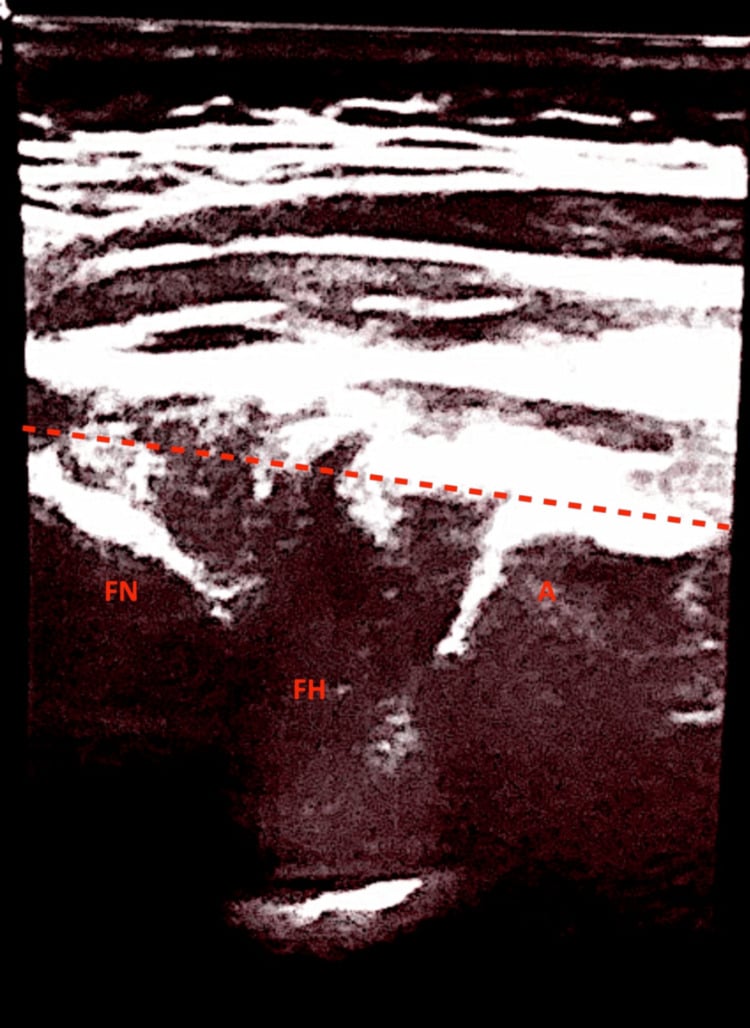
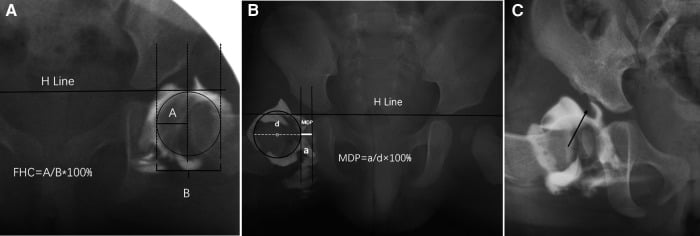
Plain radiographs. Useful after 4-6 months, once the femoral head ossifies, and the investigation for older children and for follow-up. Know the lines and their normal values: they are routinely shown, and they underpin the decision to treat residual dysplasia.
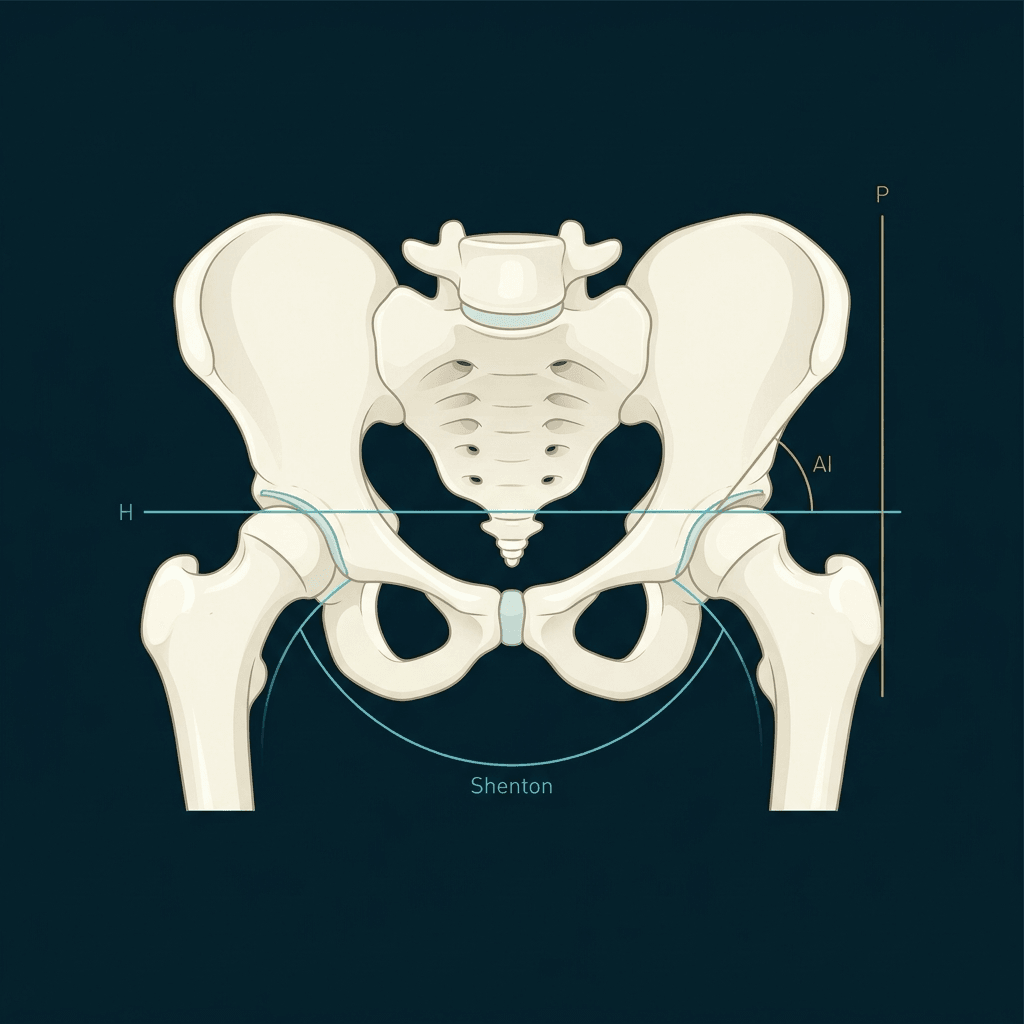
- How it is drawn
- Horizontal line through both triradiate cartilages
- Normal / abnormal
- The reference horizontal; the ossific nucleus should sit below it
- How it is drawn
- Vertical line through the lateral edge of the acetabulum, perpendicular to Hilgenreiner
- Normal / abnormal
- Femoral head / ossific nucleus should lie in the inferomedial quadrant; lateral or superior displacement = subluxation/dislocation
- How it is drawn
- Continuous arc from the medial femoral neck to the superior border of the obturator foramen (superior pubic ramus)
- Normal / abnormal
- Smooth and unbroken normally; DISRUPTED in subluxation/dislocation
- How it is drawn
- Angle between Hilgenreiner line and a line along the bony acetabular roof
- Normal / abnormal
- Age-dependent: roughly under 30 deg at birth, under 25 deg by 6-12 months, declining toward under 20-22 deg by ~2 years; a high or non-declining AI indicates dysplasia
- How it is drawn
- Angle between Perkin's vertical (through the femoral head centre) and a line from the head centre to the lateral acetabular edge
- Normal / abnormal
- Only reliable once the head is ossified (older child/adolescent): over 25 deg normal, 20-25 deg borderline, under 20 deg dysplastic — the key measure of lateral coverage for residual dysplasia and PAO planning
- How it is drawn
- Line along the femoral shaft axis with the hip abducted 45 deg
- Normal / abnormal
- Normally points into the acetabulum; points above the acetabulum (to the anterior superior iliac spine) in dislocation
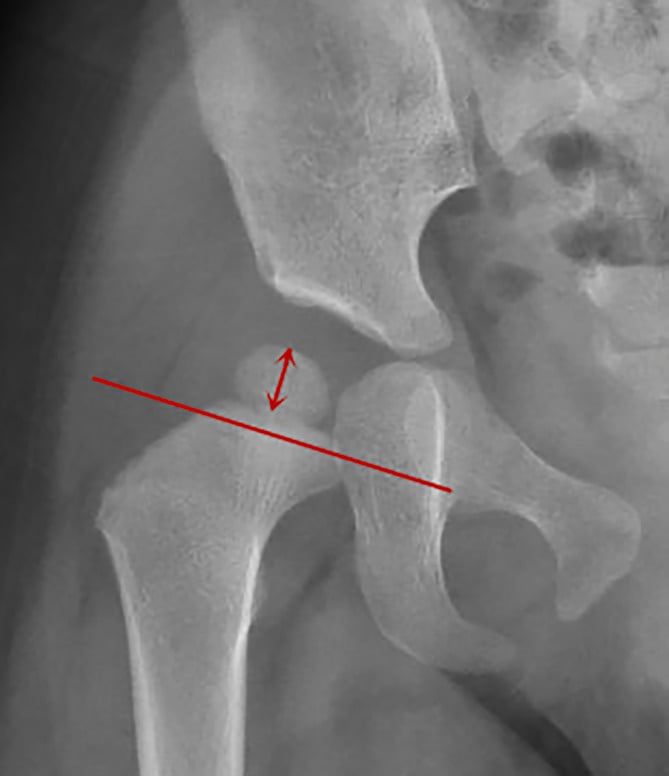
Arthrography at examination under anaesthesia. The arthrogram shows whether a reduction is concentric and, if it is not, what is in the way. A medial dye pool of more than about 5-7 mm between the femoral head and the acetabular floor means a non-concentric reduction with soft tissue interposed. The classic obstructive signs are the rose-thorn appearance of an inverted labrum (limbus) indenting the contrast, an hourglass or figure-of-eight capsular constriction produced by the iliopsoas tendon crossing the capsule, and pooling from a hypertrophied pulvinar and ligamentum teres.
Management
Age at diagnosis decides the treatment; each age band below has its own method and its own way of failing.
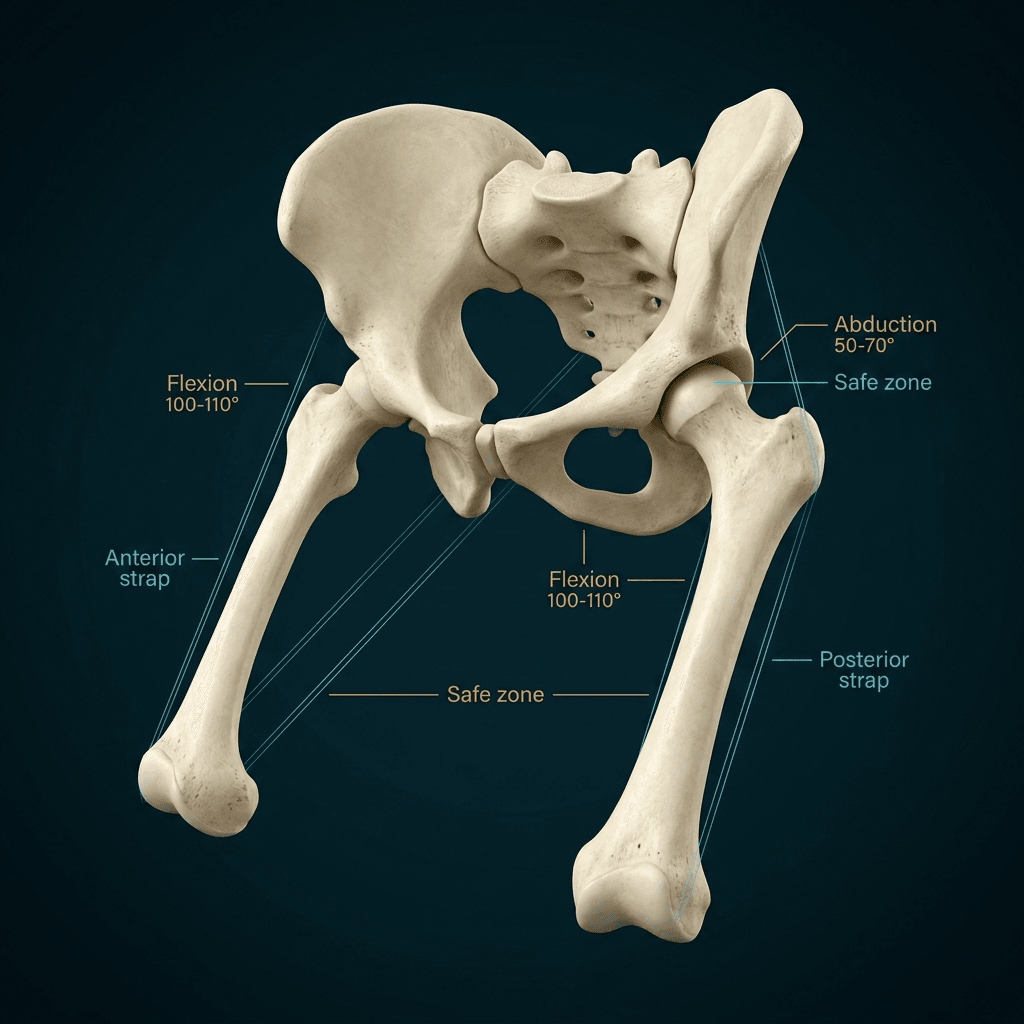
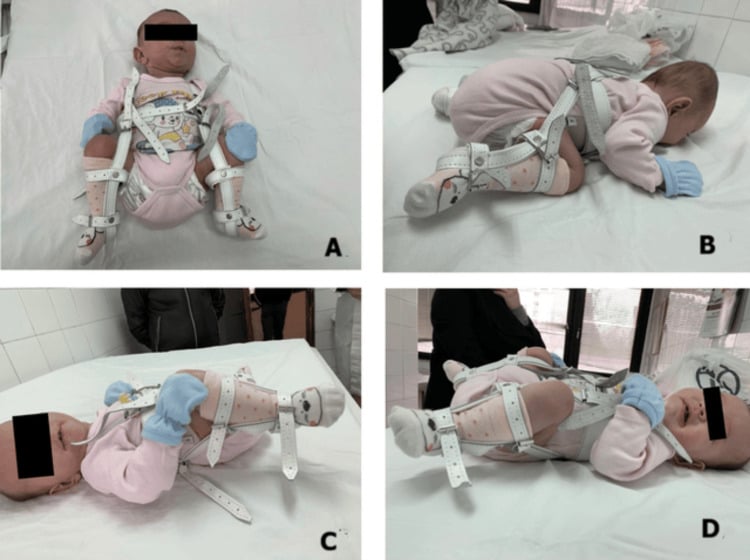
The harness. The Pavlik harness is first-line for newborn DDH when the hip is reducible. It holds both hips, even when only one is affected, in 100-110 degrees of flexion and 50-70 degrees of abduction, not forced: the position is the treatment. Wear is full-time at first, 23 hours a day, with weekly ultrasound to confirm that the hip is reduced.
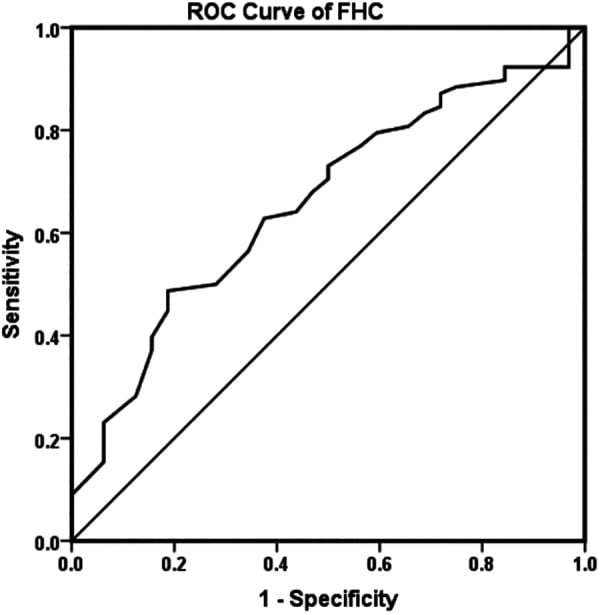
What predicts success. Age at initiation: about 90-95% when the harness is started under 6 weeks, and falling thereafter. Success decreases to 50% after 3 months, and the systematic review in the evidence base found success anywhere from 7% to 99% across series, so quote a range rather than a number. Graf type matters too, with better results for types II and III and poorer for type IV with its inverted labrum, and bilateral cases may need longer treatment.
Duration. Until the hip is stable on ultrasound, typically 6-12 weeks full-time, then part-time weaning.
Complications. The harness has its own ways of harming a hip:
- Femoral nerve palsy, from excessive flexion
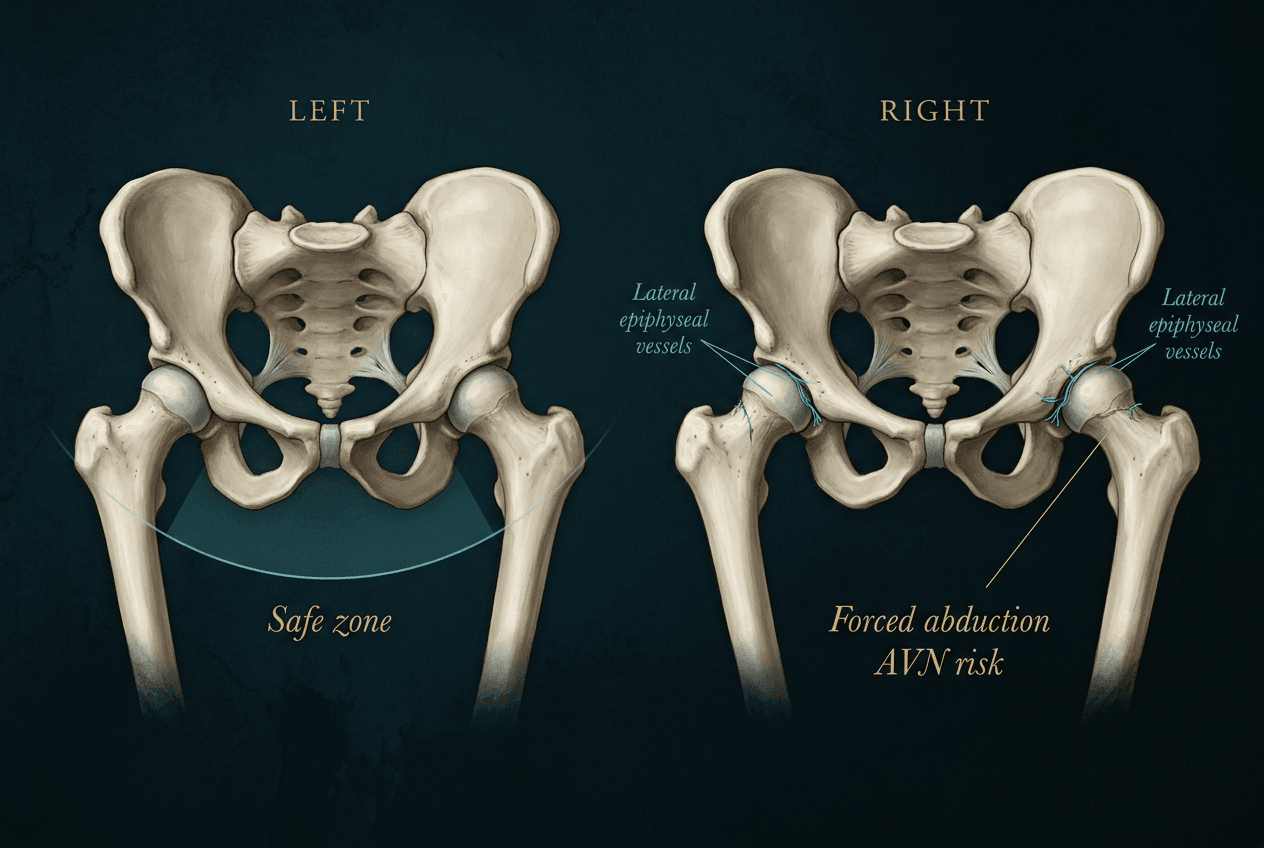
- Avascular necrosis, from forced abduction
- Inferior (obturator) dislocation, when too much flexion drives the head out of the bottom of the socket; stop the harness and reduce properly rather than congratulating yourself for keeping the hip flexed
- Skin irritation and pressure sores
When to stop. If the hip has not reduced after 3-4 weeks, discontinue the harness. Persisting risks Pavlik disease: the inverted labrum prevents reduction and is made worse by continued harness use.
Surgical Techniques
The approach. The medial (Ludloff) approach is preferred under 12 months: less dissection, it preserves the blood supply, and it avoids the need for a capsulorrhaphy. The anterior (Smith-Petersen) approach gives better visualisation in older children and allows a capsulorrhaphy.
Clearing the obstacles. The structures described under pathophysiology are dealt with in turn:
- Tight psoas tendon, released at the lesser trochanter
- Transverse acetabular ligament, divided
- Elongated ligamentum teres, excised
- Inverted labrum (limbus), reduced, or excised if severely deformed
- Pulvinar, cleared from the acetabulum
Femoral shortening. Essential in children over 2-3 years. It decompresses the femoral head, which reduces the AVN risk, and it lets the hip reduce without excessive tension; usually 1-2 cm is removed, depending on the degree of dislocation. Where reduction would need excessive force in an older child, shortening is preferred to brute reduction. A varus derotation osteotomy corrects coxa valga and anteversion and improves coverage, and femoral procedures are often combined with acetabular surgery.
Pelvic osteotomies. Choose by age and by the deformity, for the residual dysplasia in front of you rather than as a reflex add-on to every open reduction. The postoperative film has to show a seated head and a more horizontal roof, not just metal.
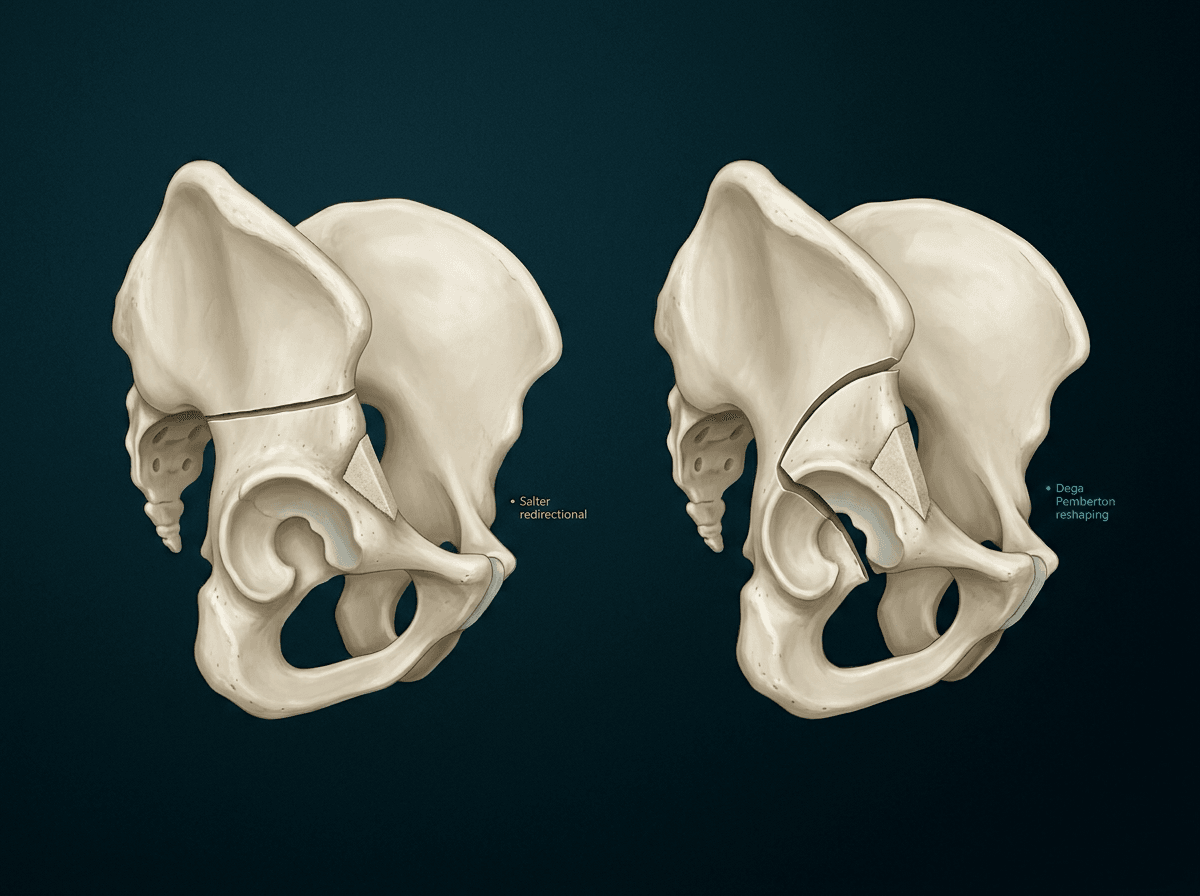
- Salter innominate osteotomy, 18 months to 6 years: redirectional. A complete iliac cut reorients the whole acetabulum anterolaterally, pivoting through the pubic symphysis, with a graft holding the rotation.
- Pemberton and Dega: reshaping. Incomplete cuts that hinge on the triradiate cartilage, for younger children.
- Triple osteotomy and periacetabular osteotomy (PAO): at skeletal maturity; the PAO is the most common choice for adolescent and adult dysplasia.
Complications
Avascular necrosis is the most feared complication, and the rate depends on how the hip was reduced:
- Pavlik harness: 0-5% with correct technique in experienced hands, against a published range of 0-28%; quote the low figure only when you can also say why it is low
- Closed reduction: 5-15%
- Open reduction: 10-25%
The risk factors are excessive abduction, prolonged immobilisation and older age at treatment. AVN may not manifest for 6-12 months after treatment.
Why the Pavlik figures differ so much. The 0-28% range is not noise; it is driven by technique and case mix. Failure to achieve reduction, forced abduction into the so-called safe zone, and persisting with a harness that is not working all push a unit toward the top of the range. The 0-5% figure is achievable only when reduction is confirmed early and the harness is abandoned promptly if it fails, which is why the Mubarak pitfalls paper, not the incidence figure, is the one to internalise.
Preventing it. Keep the hip in the middle of Ramsey's safe zone and never force abduction: forced frog-leg abduction compresses the lateral epiphyseal vessels against the acetabular rim, and that is how a reduced hip still gets AVN. Consider femoral shortening in the older child to reduce the pressure of reduction, and watch closely during treatment for signs of vascular compromise.
Residual dysplasia affects 10-20% of treated hips and is managed with an osteotomy at the appropriate age. A flattened, fragmented ossific nucleus (coxa plana) and a still-steep roof mean the child may need a later pelvic osteotomy even though the hip stayed reduced.
Redislocation rates are variable, and adequate immobilisation is the prevention. Femoral nerve palsy in the harness is rare and is prevented by proper application.
Postoperative Care and Outcomes
DDH Recovery Timeline
Hip spica cast for 6-12 weeks. Position: abduction and flexion within safe zone. Cast changes as needed.
Spica cast 6-12 weeks post-reduction. Cast changes for growth. X-ray to confirm reduction maintained.
Transition to abduction brace for 2-3 months. Night-time wear. Promotes hip stability.
Regular X-rays to assess acetabular development. Monitor for residual dysplasia until skeletal maturity. May need future osteotomy.
Prognosis. Better outcomes follow early diagnosis (under 6 weeks), Pavlik treatment and a concentric reduction; worse ones follow late diagnosis, open reduction, AVN and residual dysplasia. Most treated hips function normally if reduction is achieved early.
By age at diagnosis.
- Under 6 weeks: 90-95% success with the Pavlik harness alone
- 3-6 months: 70-80% success with the Pavlik harness; closed reduction may be needed
- 6-12 months: often closed reduction and spica
- 12-18 months: usually open reduction and spica
- Over 18 months: open reduction with pelvic and femoral osteotomy
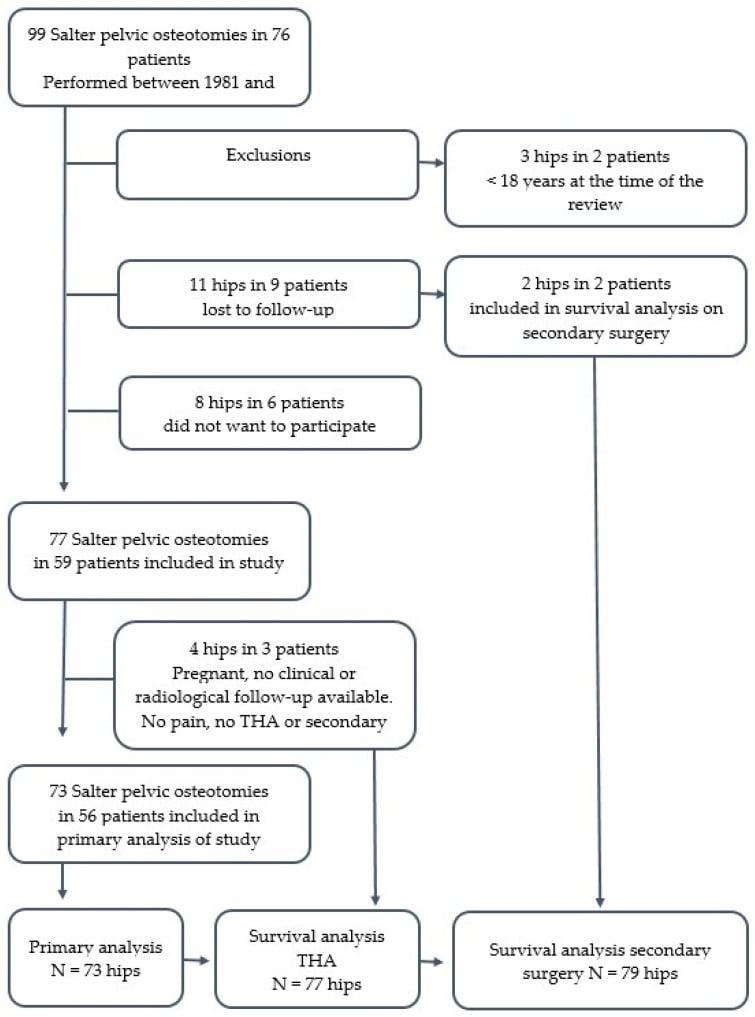
What to follow. The acetabular index and the centre-edge angle, until skeletal maturity: residual dysplasia may need a pelvic osteotomy at the appropriate age, a Salter between 18 months and 6 years or a PAO in adolescence. Osteoarthritis risk is higher with residual dysplasia or AVN, and such hips may need a total hip replacement in adulthood.
Guidelines, Registries & Global Practice
Global Epidemiology
- Say which number you mean. Neonatal hip instability detected on clinical examination is considerably commoner than established DDH, and most of it resolves spontaneously in the first weeks; the figure of roughly 1-3 per 1000 live births refers to true dysplasia or dislocation requiring treatment, not to the number of babies with an abnormal newborn examination. Quoting the treated-DDH figure as though it were the rate of neonatal instability is a common slip, and it makes spontaneous resolution look far rarer than it is.
- Sonographic dysplasia is far more common (immature/dysplastic hips in up to 15-20% of healthy neonates on early ultrasound), which is why universal early ultrasound generates substantial overtreatment.
- Marked geographic variation: very high prevalence in populations that swaddle with the hips extended/adducted (some Indigenous North American, Eastern European and Middle Eastern groups); very low rates where babies are carried abducted/straddled (parts of sub-Saharan Africa and Southeast Asia).
- Risk factors (BFFF): breech presentation, female sex (about 4:1), first-born, positive family history; also oligohydramnios and other packaging deformities (congenital muscular torticollis, metatarsus adductus, talipes).
Screening Strategy - Side by Side
- Screening Approach
- Concludes evidence is insufficient (I statement) to recommend universal screening
- Practical Emphasis
- Avoids universal US given overtreatment; relies on clinical exam
- Screening Approach
- Clinical exam of all newborns; selective US for risk factors or equivocal exam
- Practical Emphasis
- Image at 6 weeks not before, to reduce false positives
- Screening Approach
- Universal clinical exam (newborn + 6-8 weeks); selective US for breech, family history or unstable exam
- Practical Emphasis
- Structured national newborn examination programme
- Screening Approach
- Universal ultrasound screening of all newborns
- Practical Emphasis
- Highest detection but greatest treatment/follow-up burden
Most English-speaking programmes use universal clinical examination plus selective ultrasound for risk factors; German-speaking Europe uses universal ultrasound. The Bergen RCT (Rosendahl, Pediatrics 1994) showed universal US increases treatment rates with only a marginal, non-significant reduction in late cases - the evidence basis for the selective approach.
Treatment Guidance - Side by Side
- Key Recommendation
- Surveillance of stable hips with risk factors acceptable; treat dislocated/dislocatable hips
- Notable Position
- Stops short of mandating universal US; emphasises shared decision-making
- Key Recommendation
- Pavlik or rigid abduction brace first-line under 6 months; staged surgery thereafter
- Notable Position
- Promotes 'safe' (abducted, flexed) swaddling to reduce DDH
- Key Recommendation
- Selective US, treat under specialist; emphasise early detection to avoid open surgery
- Notable Position
- Late presentation audited as a quality marker
- Key Recommendation
- Concentric reduction is the priority; femoral shortening over forced reduction in older children
- Notable Position
- Avoid forced abduction to limit AVN
Registry and Surveillance Data
- DDH is tracked through national paediatric surveillance units (e.g. UK and Australian/New Zealand paediatric surveillance units) that monitor late-presenting DDH (diagnosed after the newborn period) as a key quality indicator of screening performance.
- Late-presentation rates of roughly 0.5-1.5 per 1000 persist even in well-resourced programmes, underscoring that no screening strategy eliminates missed cases.
- Unlike arthroplasty, there is no implant registry for paediatric DDH; long-term data come from osteotomy cohort follow-up rather than registries.
High- vs Limited-Resource Practice
Newborn clinical screening with selective (or universal, in German-speaking Europe) ultrasound, early Pavlik/brace treatment, EUA with arthrogram for irreducible hips, and access to paediatric orthopaedic subspecialists. Most cases detected and treated non-operatively before walking age.
Screening may be absent or clinical-only, so children frequently present late, at or after walking age, with established dislocation. Management shifts toward open reduction plus femoral shortening and pelvic osteotomy. Public-health messaging promoting abducted carrying/swaddling is a low-cost, high-impact intervention.
Hip-healthy (abducted, flexed) swaddling lowers DDH risk; tight extended-leg swaddling increases it. This is the single most generalisable, resource-independent preventive message and is endorsed by POSNA and the International Hip Dysplasia Institute.
Controversies and Areas of Uncertainty
Universal versus selective ultrasound. The central screening debate. Universal ultrasound detects more dysplasia but generates overtreatment without a proven reduction in late dislocation (Rosendahl RCT). German-speaking Europe favours universal ultrasound; most other programmes use selective ultrasound for risk factors. Reasonable practitioners still disagree.
The first-line device. The Pavlik harness is the default, but systematic review evidence suggests rigid splints (von Rosen) may achieve comparable or better success with less residual dysplasia. No adequately powered randomised trial settles the question.
The ossific nucleus. Whether to delay reduction until the femoral ossific nucleus appears, to lower the AVN risk, is contested. Meta-analysis (Niziol 2017) found no consistent protective effect overall, which challenges routine delay.
Pre-reduction traction. Historical practice held that traction before reduction lowers AVN and improves reducibility. Several modern cohorts dispute any benefit and many centres have abandoned it, but the evidence remains low quality.
MCQ Practice Points
Q: What does a positive Ortolani test indicate? A: The hip is dislocated but reducible. Abduction with anterior pressure reduces the femoral head into the acetabulum.
Q: What does a positive Barlow test indicate? A: The hip is unstable and can be dislocated. Adduction with posterior pressure causes the hip to dislocate.
Q: What is first-line treatment for DDH under 6 months? A: Pavlik harness. 90-95% success if started under 6 weeks.
Q: What increases AVN risk in DDH treatment? A: Forced abduction. Compresses lateral epiphyseal vessels. Keep within safe zone.
Q: What is the significance of Graf Type IV? A: Labrum inverted into acetabulum. Poor prognosis with Pavlik harness - often requires open reduction to clear the inverted limbus.
Q: A 5-year-old has acetabular index greater than 25 degrees. What surgery is indicated? A: Pelvic osteotomy (Salter or Pemberton). Redirects or reshapes acetabulum to improve coverage and prevent early OA.
Exam Viva Scenarios
Practise clinical reasoning and management decisions out loud
“A newborn girl born breech has a positive Ortolani test on the left hip. What is your diagnosis and management?”
“An 18-month-old girl presents with a limp. She has limited left hip abduction and a positive Galeazzi sign. X-ray shows a dislocated left hip with a shallow acetabulum. How do you manage this?”
“A 5-year-old female is seen for follow-up. She was treated with a Pavlik harness as an infant. She is asymptomatic. X-ray shows the Acetabular Index is 30 degrees (normal less than 20). What is your management?”
“A 4-month-old infant with DDH has been in a Pavlik harness for 4 weeks. Repeat ultrasound shows the hip remains dislocated (Graf Type IV). What is your management?”
Risk Factors (BFFF)
- Breech presentation
- Female (4:1)
- First-born
- Family history
- Oligohydramnios
- Torticollis/foot deformity
Examination
- Ortolani: reduces dislocated hip
- Barlow: dislocates unstable hip
- Clunk (not click) is significant
- Limited abduction (older infant)
- Galeazzi sign (limb length)
- Trendelenburg gait (walking age)
Imaging
- US under 4-6 months (Graf)
- X-ray after 4-6 months
- Alpha angle measures coverage
- Shenton line disrupted
- Acetabular index elevated
Treatment by Age
- 0-6 months: Pavlik harness
- 6-18 months: closed/open reduction
- Walking age: open + osteotomy
- Stop Pavlik if no reduction by 3-4 weeks
- Femoral shortening for late cases
Pavlik Harness
- Flexion 100-110 degrees
- Abduction 50-70 degrees
- 90-95% success if under 6 weeks
- Full-time wear initially
- Weekly US follow-up
Complications
- AVN (avoid forced abduction)
- Residual dysplasia
- Redislocation
- Pavlik disease (late reduction)
- Femoral nerve palsy
Evidence Base
Universal vs Selective Ultrasound Screening (Bergen RCT)
- Randomised controlled trial of 11,925 newborns: universal US vs selective US vs clinical only
- Universal US raised the treatment rate to 3.4% vs 2.0% (selective) and 1.8% (clinical only)
- Late subluxation/dislocation 0.3 vs 0.7 vs 1.3 per 1000 - the reduction with universal US was NOT statistically significant (p=0.11)
- The starkest overtreatment figure: among infants NOT treated, universal US put 13% into extra follow-up for inconclusive early findings, versus 1.8% with selective US and 0% with clinical screening alone
- The three groups did not differ in sex distribution or in positive Barlow/Ortolani rates, so the arms were comparable
- The authors concluded the effect on late DDH was at best marginal despite a considerable increase in diagnostic and therapeutic effort
Pavlik Harness - Success and Complication Range (Systematic Review)
- Pavlik harness remains the gold-standard first-line device for the reducible neonatal hip
- Reported success rates range widely from 7% to 99%, driven by initial severity (Graf type), age and compliance
- Avascular necrosis reported between 0% and 28% - the most devastating harness complication
- Beta angle, dynamic coverage index and superior/lateral head displacement predict likelihood of harness success
Pitfalls in the Use of the Pavlik Harness
- Classic series of 18 problem hips treated in a Pavlik harness
- Most common failure (12 of the dislocated hips) was failure to achieve reduction, usually from improper physician application
- In several infants 3-5 months elapsed before lack of reduction was recognised
- AVN developed in 3 infants; poor harness quality and poor compliance compounded failures
Open vs Closed Reduction and AVN Risk (Meta-analysis)
- PRISMA meta-analysis of 9 observational studies in children under 3 years (reduction without osteotomy)
- Open reduction carried higher odds of all-grade AVN than closed reduction (pooled OR 2.26, 95% CI 1.21-4.22)
- Grade II-IV AVN trend higher with open reduction (OR 2.46) but not statistically significant (95% CI 0.93-6.51)
- Closed reduction was associated with greater need for further surgery (OR for open reduction 0.30)
Reliability of the Bucholz-Ogden AVN Classification
- Seven raters graded 39 hips by the Bucholz-Ogden osteonecrosis classification, twice
- Inter-rater reliability was only fair (kappa 0.34; 0.31 among the three surgeons)
- Raters disagreed on grade in 26 of 39 hips (67%), most often confusing grades I and II
- Authors recommend caution interpreting DDH outcome studies based on this classification
Comparison of Abduction Devices for DDH Under 6 Months
- Systematic review (modified Cochrane method, PRISMA) of 30 studies comparing 5 abduction devices
- Devices compared: Pavlik harness, von Rosen splint, Tubingen brace, Frejka pillow, Aberdeen splint
- The von Rosen splint was superior for success rate and lower residual dysplasia (p<0.05)
- Authors stress the evidence base is flawed and a randomised trial is warranted