GMFCS risk, migration percentage and prevention of painful dislocation
- Hip displacement risk rises with increasing GMFCS level, especially GMFCS IV and V.
- Reimers migration percentage measures the proportion of femoral head lateral to the acetabular reference line.
- Most surveillance pathways recommend referral when migration percentage is over 30 percent or hip abduction is less than 30 degrees.
- Early migration may be painless; waiting for pain misses the prevention window.
- Care symptoms such as difficult hygiene, dressing, sitting and transfers are hip symptoms in severe cerebral palsy.
- Treatment ranges from surveillance and tone management to adductor-psoas release, VDRO, pelvic osteotomy and salvage care.
- “Confirm or assign GMFCS from real-world mobility; do not simply ask a family to provide a classification.
- “Clinical abduction does not replace radiographic migration percentage.
- “The question is not just whether the hip hurts; it is whether sitting, sleep, transfers and hygiene are becoming difficult.
- “The painful chronically dislocated CP hip is much harder than preventable subluxation.
Overview and Epidemiology
Hip displacement is a predictable musculoskeletal complication of cerebral palsy, especially in children with limited ambulatory function. The hip may migrate laterally before pain is obvious. Once a hip becomes chronically dislocated, stiff and painful, treatment becomes more complex and often shifts from prevention to salvage.
What a surveillance programme does. It identifies the children at risk, obtains AP pelvis radiographs at scheduled intervals, measures the Reimers migration percentage and escalates care when the hip is migrating or symptoms develop. It is not simply a radiograph schedule. Mobility, tone, hip motion, pelvis, spine, seating, hygiene and family goals are assessed together.
The principles that follow. A higher GMFCS level means a higher displacement risk, so functional classification sets the intensity of surveillance. A migration percentage means most when it is read against the last one: the trend is more useful than a single number in isolation. Loss of abduction and new care difficulty are meaningful clinical changes, hip and spine problems interact through pelvic obliquity and windswept posture, and early prevention is preferable to late salvage.
A CP hip can migrate substantially before the child has clear hip pain. Surveillance should be scheduled by risk and migration trend, not triggered only by symptoms.
Pathophysiology
Normal at birth. The hip in cerebral palsy is structurally normal at birth. Displacement is acquired, developing over years as spastic adductors and flexors act on a growing femur that never gets the loading a walking child's hip receives.
Why that shapes the screening. Newborn screening is useless here, unlike developmental dysplasia of the hip, because there is nothing to find at birth. The problem is not detection at one moment but detection of change over time, which is why the answer is a repeated, scheduled radiograph rather than a single test.
Risk tracks function, not the neurological label. A child who walks loads the hip and remodels the acetabulum; a child who does not, does not. That is why GMFCS level, what the child actually does, predicts displacement far better than the type or distribution of the cerebral palsy.
There is a window. Because displacement is gradual and silent, it can be caught while the hip is still containable and the acetabulum can still respond. Miss it and the same anatomy that was correctable becomes a painful fixed dislocation whose only options are salvage.
The forces. Displacement is driven by muscle imbalance, spasticity, weakness, abnormal posture and growth. Adductors and hip flexors tend to pull the femoral head laterally and superiorly, while coxa valga, excessive femoral anteversion and acetabular dysplasia reduce containment. Non-ambulant children have less protective loading and less active muscle balance around the hip.
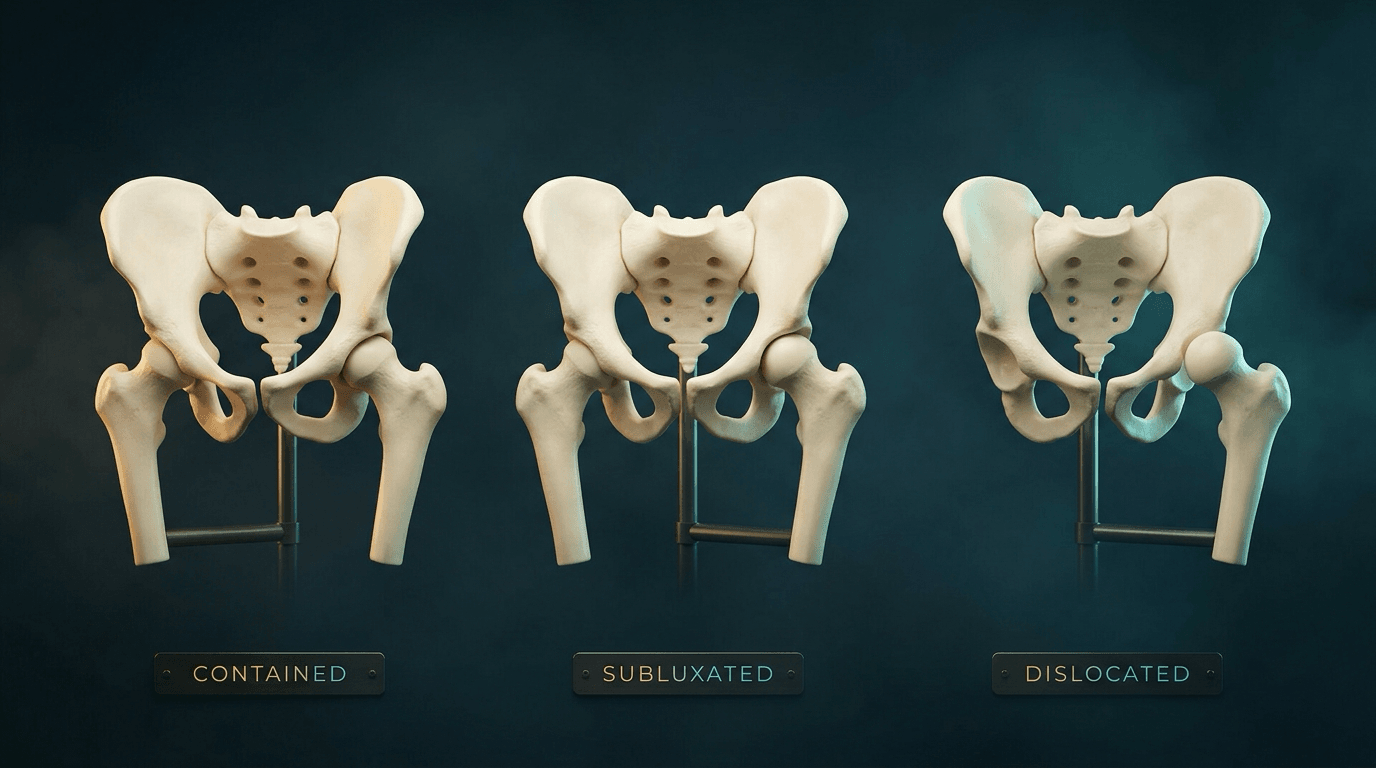
The cascade. As the head migrates the acetabulum no longer sees a centred femoral head, so acetabular development worsens and dysplasia can progress. Pelvic obliquity, scoliosis and windswept posture can then magnify the asymmetry. Migration percentage is therefore not simply a radiographic number; it marks loss of containment, worsening acetabular development and increasing risk of future pain, and a hip that began as a painless radiographic migration may become a painful stiff dislocation that affects sleep, sitting, hygiene and transfers.
Classification
A CP hip is described on three axes: how the child functions, how far the head has migrated, and what the child and carers are experiencing. Each axis carries its own default action.
- GMFCS I-II: lower risk, but still clinically assessed.
- GMFCS III: intermediate risk; surveillance depends on programme and migration trend.
- GMFCS IV-V: highest risk; regular AP pelvis surveillance is essential.
- Growth velocity and age modify progression risk.
Clinical Presentation
History. Do not ask only whether the hip hurts. A non-verbal or medically complex child may show a hip problem through care difficulty, sleep disturbance, irritability or seating intolerance, and in severe cerebral palsy difficult hygiene, seating intolerance and pain during transfers are hip symptoms even when the child cannot localise pain. Confirm or assign the GMFCS level from real-world mobility rather than asking the family to supply a classification: independent walking, walking with aids, wheelchair use, self-mobility and transfer function.
The answers that change management:
- Pain during dressing, nappy changes, toileting, transfers or physiotherapy.
- Sitting tolerance, pelvic obliquity, wheelchair fit and equipment problems.
- Sleep disturbance, rest pain or irritability.
- Hygiene difficulty and perineal care.
- Standing frame tolerance and ability to weight bear.
- Previous botulinum toxin, adductor releases, hip surgery or spine surgery.
- Feeding, nutrition, respiratory status, seizures and bone health.
- Family priorities: comfort, sitting, sleep, hygiene and ease of care.
CAREClinical History
Hook:CARE reminds the reader that carers often notice function before pain.
Examination. Examine both hips and the whole sitting unit: pelvis, spine, hips, knees and feet. Measure hip abduction with the hips flexed and extended, and assess adductor tone, psoas tightness, hamstring tightness, flexion contracture, pelvic obliquity, scoliosis and windswept posture. Look for pain with gentle range of motion and document skin pressure risk.
What the examination cannot do. Clinical abduction does not replace the radiographic migration percentage. Reduced abduction earns an earlier film, but passive hip range did not differ between displaced and non-displaced hips in Hägglund's total-population cohort, so examination alone is a poor screening test and never excludes displacement.
Investigations
The AP pelvis. The core investigation is a standardised AP pelvis radiograph. Positioning should be as consistent as possible, because pelvic rotation and hip abduction or adduction can affect the measurement. Measure both hips, record the migration percentage for each, and compare with the previous images; the trend is central.
Reimers migration percentage. Migration percentage is the proportion of the femoral head lateral to the acetabular reference line, calculated as the lateral uncovered head width divided by the total femoral head width, multiplied by 100. Record it consistently and read it with the child's age, GMFCS level, hip abduction and symptoms.
- Measurement action
- Use a standardised supine AP pelvis with femurs neutral.
- Practical point
- Adduction can overestimate migration and abduction can underestimate it.
- Measurement action
- Draw Hilgenreiner line through the triradiate cartilages, or through the teardrops after maturity.
- Practical point
- A consistent horizontal reference is needed before Perkin line is drawn.
- Measurement action
- Draw Perkin line perpendicular to Hilgenreiner line at the lateral acetabular edge.
- Practical point
- This defines the lateral acetabular coverage boundary.
- Measurement action
- Measure the uncovered lateral femoral head and divide by total ossified femoral-head width.
- Practical point
- Migration percentage equals uncovered width divided by total width, multiplied by 100.
- Measurement action
- Compare with the previous radiograph.
- Practical point
- Trend and rate of change are more useful than a single number alone.
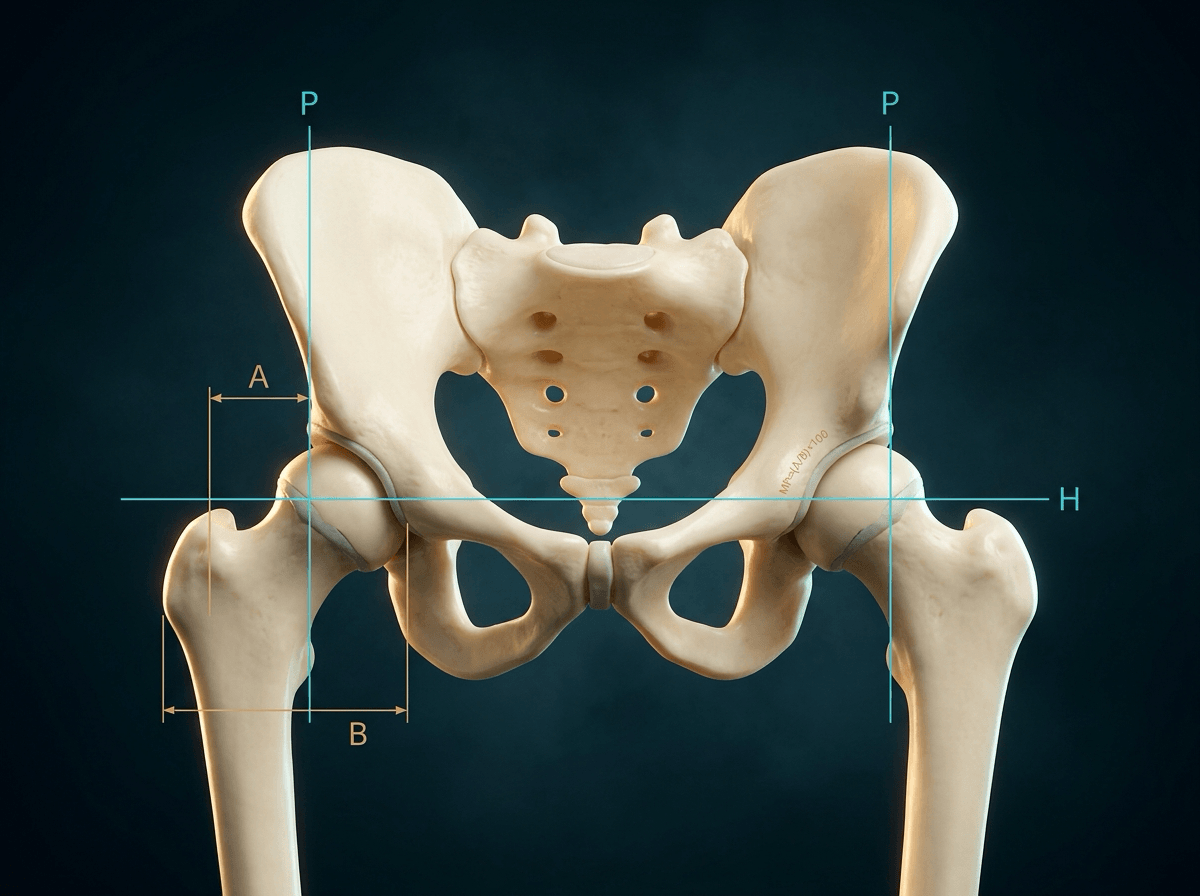
Matching the film to the child. The radiograph defines displacement and its trend; care, sitting, hygiene, sleep and abduction decide the urgency and the goals. Baseline risk comes from GMFCS level with clinical examination, and that is what sets how often the next film is taken.
Additional imaging. Spine imaging may be needed when scoliosis and pelvic obliquity affect sitting and hip position. CT and other additional imaging are selective, usually reserved for complex reconstructive or salvage planning where the anatomy needs clarifying.
Head-Shaft Angle and Predictive Measures
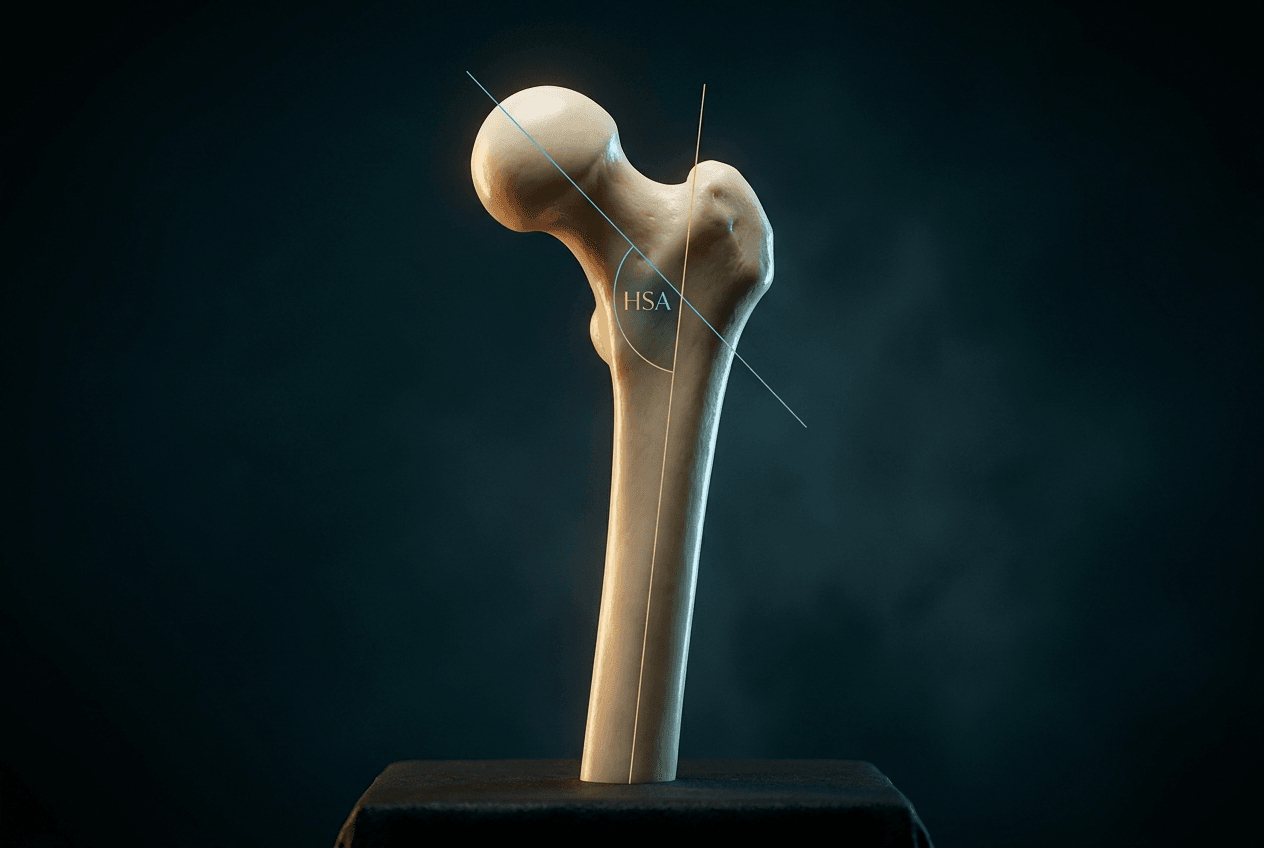
Migration percentage measures displacement that has already happened. Two further radiographic measures help predict the hip that is going to displace, and the head-shaft angle in particular is asked about directly in the viva because it is a component of the CPUP Hip Score.
Head-shaft angle. The angle between the proximal femoral physis and the femoral shaft axis, in effect the degree of coxa valga. A high, more valgus angle, roughly above 155 to 160 degrees, independently predicts future displacement, and combined with age, GMFCS level and migration percentage it forms the CPUP Hip Score. Because it captures the proximal femoral morphology that drives displacement, it predicts future migration in a way the migration percentage alone cannot: when the migration percentage is borderline, a high head-shaft angle in a GMFCS IV or V child marks the hip that warrants closer surveillance or earlier intervention.
Acetabular development. The acetabular index describes the slope and concavity of the acetabular roof, and so how well the socket is forming around the head. Worsening acetabular dysplasia signals that femoral correction alone may not contain the hip and that a pelvic osteotomy may be needed.
Migration percentage, for comparison. It stays the core surveillance number, but it is a measure of the current state rather than of future risk, which is what the predictive measures add.
Differential Diagnosis
Pain or care difficulty in a child with cerebral palsy is not always the hip. The non-verbal child cannot localise the problem, so actively exclude the common mimics before attributing distress to hip displacement. Migration percentage anchors the assessment, but a high migration percentage does not prove that the hip is the source of a new symptom.
- Discriminating features
- Reduced abduction, pain on hip rotation, rising migration percentage, windswept posture.
- Confirmatory step
- AP pelvis with migration percentage and trend.
- Discriminating features
- Tight adductors and reduced abduction but contained hip on radiograph.
- Confirmatory step
- Normal migration percentage on standardised AP pelvis.
- Discriminating features
- Sudden pain, swelling or warmth in an osteopenic non-ambulant child, often after minor handling.
- Confirmatory step
- Targeted radiograph of the painful segment; consider bone-health review.
- Discriminating features
- Fever, systemic upset, severe rest pain, raised inflammatory markers.
- Confirmatory step
- Bloods, ultrasound or aspiration; do not assume mechanical hip.
- Discriminating features
- Constipation, reflux, urinary infection, gastrostomy or shunt problems.
- Confirmatory step
- Abdominal and systemic examination, urinalysis, relevant imaging.
- Discriminating features
- Trunk or back pain, deteriorating sitting balance, asymmetric pressure.
- Confirmatory step
- Spine and pelvis assessment and imaging when indicated.
- Discriminating features
- Skin breakdown, new wheelchair or orthosis, pain only when seated.
- Confirmatory step
- Pressure-area check and seating review with the therapy team.
- Discriminating features
- Localised tenderness over plate or screws, often late after VDRO.
- Confirmatory step
- Radiograph and clinical correlation; consider removal if symptomatic.
In a distressed non-verbal child, examine the hip, the spine, the abdomen and the skin before concluding the hip is to blame, and confirm the hip hypothesis with a standardised migration percentage rather than examination alone.
Management
The decision. Direction of treatment follows the migration percentage and its rate of change, the hip's abduction and the shape of the acetabulum, all read in the context of the child's GMFCS level and age. Below the referral threshold the answer is continued surveillance. Above it, the question becomes whether soft-tissue surgery can still hold the hip or whether the bone has to be reoriented.
- Usual interpretation
- Contained hip or low current displacement risk.
- Management direction
- Continue surveillance according to GMFCS level, age and local pathway.
- Usual interpretation
- Hip at risk or clinically tightening hip.
- Management direction
- Refer to paediatric orthopaedics and intensify surveillance.
- Usual interpretation
- Progressive displacement is likely, especially in GMFCS IV-V.
- Management direction
- Assess for soft-tissue release versus reconstructive containment depending age, abduction and acetabular shape.
- Usual interpretation
- Soft-tissue treatment alone is unlikely to contain the hip.
- Management direction
- Plan VDRO, usually with pelvic osteotomy when acetabular deficiency is established.
- Usual interpretation
- Prevention window has passed for that hip.
- Management direction
- Prioritise comfort, sitting, hygiene, sleep and salvage options rather than radiographic perfection.
Surveillance starts by confirming or assigning the GMFCS level, measuring hip abduction and obtaining AP pelvis radiographs according to risk. Record migration percentage and trend at each review. Escalate for a migration percentage over 30 percent, a rising migration trend, abduction less than 30 degrees, pain, difficult care or pelvic imbalance, using local programme thresholds.
Salvage Options for the Painful Dislocated Hip
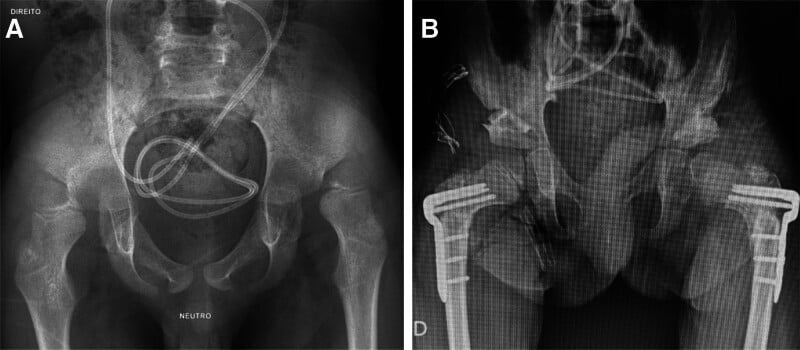
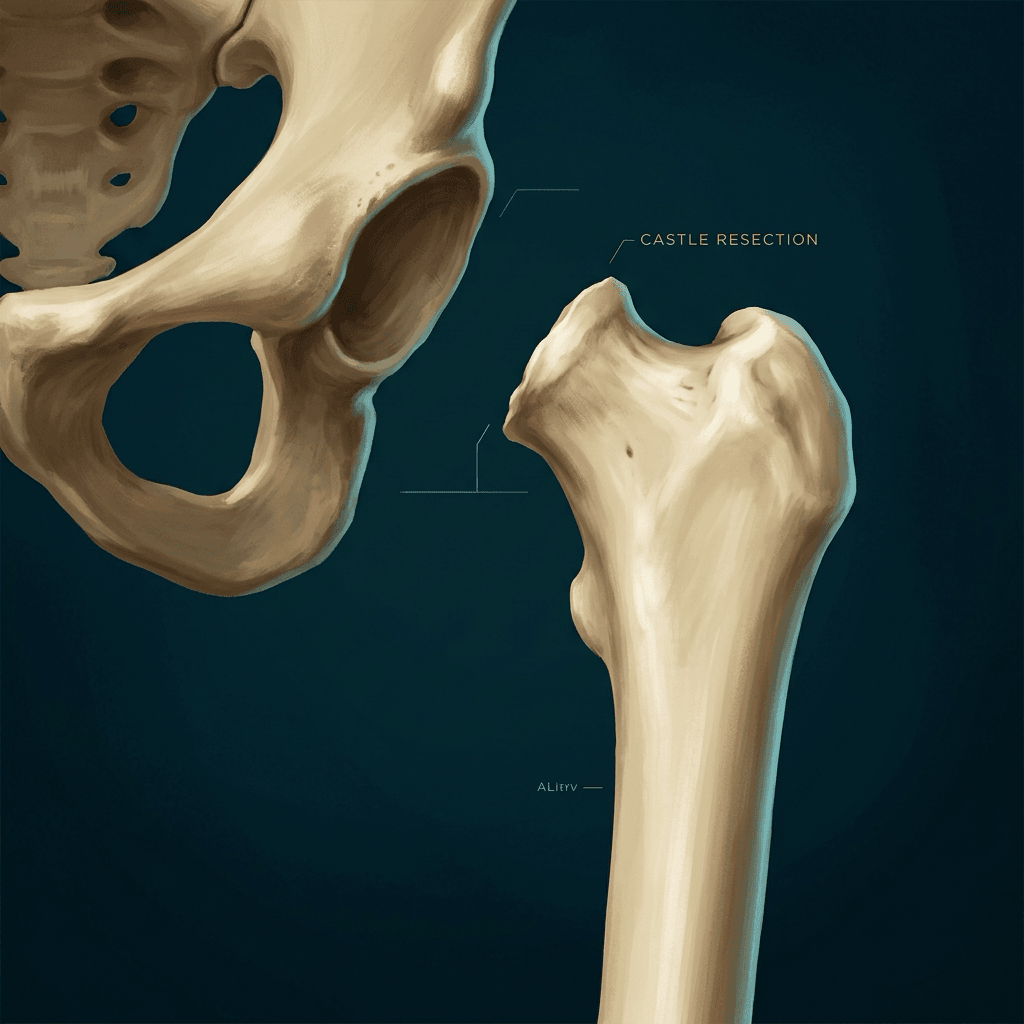
When a hip is already chronically dislocated, painful and not reconstructable, the goal shifts entirely to comfort, sitting, hygiene and ease of care. Several salvage procedures exist; the evidence is largely low-level and the choice depends on the child's anatomy, function and local expertise, so naming the options and their principles is what the viva expects.
- Principle
- Resect the proximal femur (around the lesser trochanter) and interpose soft tissue (capsule, vastus) over the cut end
- Considerations
- Reliable pain relief; risks include proximal femoral migration, heterotopic ossification and continued spasticity-driven impingement - traction or spica and HO prophylaxis are used
- Principle
- Excise the femoral head and perform a valgus osteotomy so the proximal femur buttresses against the pelvis
- Considerations
- Aims for a stable, painless fulcrum for sitting; an alternative to simple resection
- Principle
- Resection with an interposed spacer or soft-tissue cushion to limit proximal migration
- Considerations
- Less commonly used; technique varies by centre
- Principle
- Replace the joint in a selected, more functional or older patient with adequate bone stock
- Considerations
- Increasingly considered in higher-functioning patients; higher complication and dislocation risk than in idiopathic OA
- Principle
- Fuse a single painful hip in a more functional patient
- Considerations
- Rarely used; sacrifices motion and is poorly tolerated if the other hip or spine is also affected
There is no consensus best salvage for the painful unreconstructable CP hip - proximal femoral resection, the McHale valgus osteotomy, interposition, arthroplasty and arthrodesis all have advocates and the evidence is low level. State that the choice is driven by comfort, sitting, hygiene and family goals rather than radiographic appearance, with heterotopic-ossification prophylaxis and spasticity management as part of the plan.
Complications
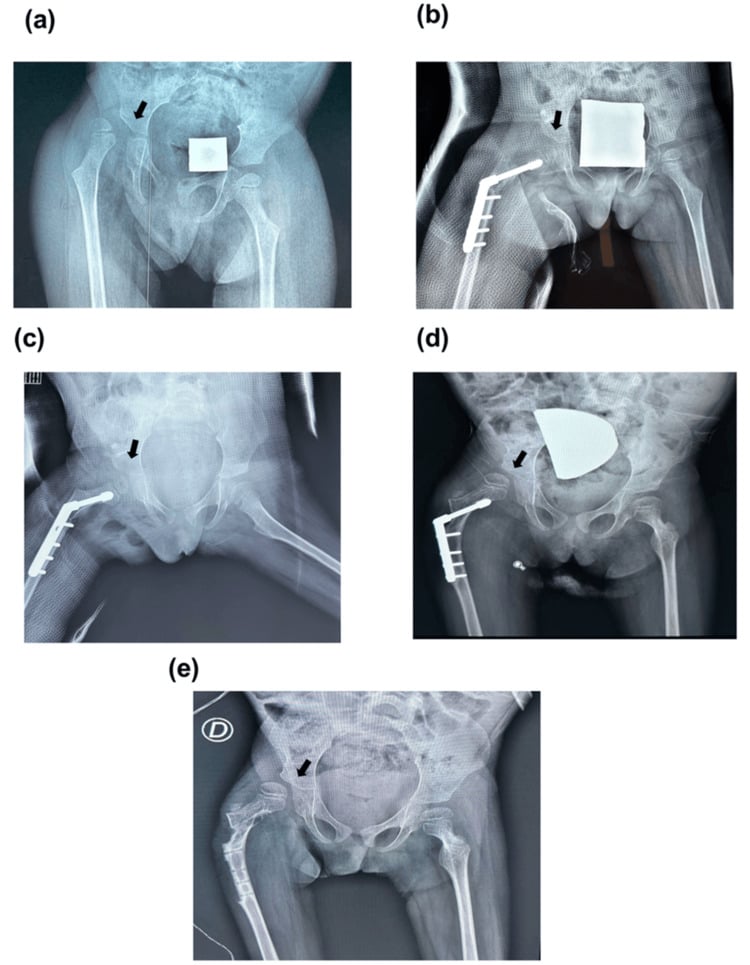
Missed or delayed surveillance. Silent migration progresses to fixed subluxation or dislocation, and the acetabular dysplasia that develops alongside it becomes harder to reconstruct. Pain, sleep disturbance and hygiene difficulty become established in the meantime.
Surgical and postoperative. These children are often medically complex, so the risks of an operation reach well beyond the hip itself:
- Wound problems or infection.
- Respiratory, nutrition or medical complications in medically complex children.
- Cast, brace or positioning difficulty.
- Loss of reduction or recurrent subluxation.
- Avascular necrosis, stiffness or heterotopic ossification.
- Hardware pain or need for removal.
Long-term problems. Painful chronic dislocation, recurrent displacement and the interaction between pelvic obliquity and scoliosis are the long-term problems. Care difficulty can persist even when the radiograph has improved, which is why goals are written in terms of comfort and care rather than radiographic appearance.
Decision-Making in Practice
Hip surveillance in cerebral palsy is a prevention pathway. The aim is to identify progressive migration early enough that soft-tissue balancing, bony containment surgery or salvage decisions can be made before the hip becomes painful, fixed or unreconstructable.
Link the examination to the radiograph. Hip abduction, pain with movement, pelvic obliquity, sitting tolerance, hygiene, sleep and transfers matter because the purpose of treatment is not a number on an X-ray; it is a painless, mobile, careable hip. The migration percentage remains the central surveillance measure, but treatment is chosen by combining migration, acetabular development, femoral head shape, femoral anteversion, neck-shaft angle, muscle balance and child-specific goals.
Set the intensity, then act on the trend. Surveillance interval follows GMFCS level, age, migration percentage, rate of change and clinical hip abduction, so the higher-risk child gets more frequent radiographs and earlier escalation. A rising migration percentage should not wait for pain, and a child whose migration percentage continues to rise after soft-tissue surgery needs reassessment for bony reconstruction rather than repeated isolated releases.
A useful treatment sequence:
- Identify risk by GMFCS level.
- Measure migration reliably, on both hips.
- Watch the rate of change.
- Preserve abduction.
- Contain the hip before fixed dislocation.
- Follow long enough to detect recurrence.
Guidelines, Registries & Global Practice
Hip surveillance is one of the clearest examples in paediatric orthopaedics where coordinated programmes change outcomes at a population level. The principles are remarkably consistent worldwide: stratify by GMFCS, measure migration percentage on a standardised AP pelvis, and act on trend before pain. The differences lie in thresholds, schedules and access.
Global epidemiology
- Cerebral palsy affects roughly 2 per 1000 live births and is the commonest cause of childhood physical disability worldwide.
- Hip displacement is the second most common musculoskeletal deformity in cerebral palsy after equinus.
- Displacement risk tracks GMFCS almost linearly: close to 0 percent at GMFCS I rising to around 60 to 90 percent at GMFCS V across population cohorts.
- CP subtype matters: near 0 percent risk in pure ataxia versus up to about 79 percent in spastic tetraplegia.
- Without surveillance, late painful dislocation historically affected a meaningful minority of non-ambulant children; structured programmes reduce dislocation to around or below 0.5 percent.
Side-by-side guidance
- Core trigger to refer or act
- Migration percentage over 30 percent or hip abduction under 30 degrees.
- Emphasis
- Evidence-graded pathway tying schedule to GMFCS, age and migration percentage.
- Core trigger to refer or act
- GMFCS-stratified radiograph schedule with defined start, frequency and discharge.
- Emphasis
- Consensus template widely adopted for programme design.
- Core trigger to refer or act
- Risk scoring combining age, GMFCS, head-shaft angle and migration percentage.
- Emphasis
- Registry-driven, predictive and auditable.
- Core trigger to refer or act
- Programmatic referral on rising migration percentage in non-ambulant children.
- Emphasis
- Embedding surveillance into routine CP care pathways.
- Core trigger to refer or act
- Bony reconstruction when soft-tissue surgery cannot contain the hip.
- Emphasis
- Operative containment: VDRO with pelvic osteotomy when acetabular deficiency is established.
Registries and programmatic data
- CPUP (Sweden) and CPIP (United Kingdom, Scotland and others) are the model national registries, providing the strongest population evidence that surveillance prevents dislocation.
- Registry data underpin risk tools such as the CPUP Hip Score and allow external validation across countries.
- Common themes: standardised migration percentage measurement, GMFCS-linked schedules and prospective audit of dislocation rates.
High- versus limited-resource practice
- High-resource settings: universal registries, scheduled radiographs from age 1 to 2 years, multidisciplinary clinics and timely preventive surgery.
- Limited-resource settings: surveillance may be opportunistic, presentation is often late with established painful dislocation, and salvage rather than prevention may dominate.
- A pragmatic minimum anywhere is to identify GMFCS IV and V children, obtain a baseline AP pelvis, and arrange repeat imaging on any rising migration percentage even when a formal registry is unavailable.
Whatever the country, the examinable principle is identical: GMFCS-based risk, standardised migration percentage and action on trend before pain. Programme details vary; the surveillance logic does not.
Controversies and Areas of Uncertainty
Hip surveillance is well established, but several practical questions remain genuinely contested and are good viva discriminators.
- Exact referral threshold. Migration percentage of 30 percent (AACPDM) versus 33 percent versus 40 percent (several registry definitions of displacement) are all in use. The trend and rate of change often matter more than crossing a single number.
- Best frequency and stopping point of radiographs. Schedules differ by GMFCS level and country, and the optimal point to discharge an ambulant child or a skeletally mature non-ambulant child is debated.
- Role of soft-tissue release alone. Adductor and psoas surgery can slow migration in younger children, but many hips progress and need later bony reconstruction. Selecting which early hips benefit remains imperfect.
- Timing of bony reconstruction. Whether to operate at a defined migration percentage or to wait for clear progression, and how to balance one-stage bilateral correction against staged surgery, varies between centres.
- Salvage choice. For a painful, unreconstructable dislocated hip there is no single best salvage; proximal femoral resection, valgus osteotomy, interposition and arthrodesis all have advocates, and the evidence is largely low level.
- Value of head-shaft angle and additional measures. Newer predictors (head-shaft angle, acetabular index) improve risk scores, but how much they should change individual decisions over migration percentage alone is still being defined.
- Surveillance after intervention. How long and how often to image after preventive or reconstructive surgery to detect recurrence lacks strong consensus.
In a viva, present thresholds as programme-dependent guides, not universal cut-offs, and emphasise trend, the whole clinical picture and family goals.
Clinical Decision Scenarios
Practise clinical reasoning and management decisions out loud
“A non-ambulant child with cerebral palsy attends for routine review. How do you assess hip risk?”
“A child with severe cerebral palsy has a painful chronically dislocated hip. What are the goals of treatment?”
“A 5-year-old with GMFCS IV spastic quadriplegia had a migration percentage of 25 percent last year. The new AP pelvis shows 42 percent on the left with reduced abduction. The hip is not yet obviously painful. What do you do?”
Risk
- GMFCS IV-V
- Reduced abduction
- Rising MP
- Pelvic obliquity
- Windswept posture
Measure
- AP pelvis
- Migration percentage
- Both hips
- Trend
- Hip abduction
Treat
- Surveillance
- Tone and seating
- Adductor-psoas release
- VDRO
- Pelvic osteotomy
- Salvage selected
Goals
- Comfort
- Sitting
- Hygiene
- Sleep
- Ease of care
Evidence Signals
Population-based surveillance prevents dislocation (landmark)
- In the southern Sweden CPUP programme, hip dislocation fell from 8 percent in a historical control cohort to 0.5 percent in the first surveillance cohort and 0 percent in the second.
- Across 689 surveilled children, 91 (13 percent) underwent preventive surgery and none in the second cohort dislocated.
- Every child who did dislocate reported severe pain at least periodically, and four needed salvage surgery.
Displacement risk rises steeply with GMFCS level and subtype
- Risk of displacement with migration percentage over 40 percent rose from 0 percent in GMFCS I to 64 percent in GMFCS V across 212 children.
- Risk by subtype ranged from 0 percent in pure ataxia to 79 percent in spastic tetraplegia.
- Passive hip range of motion did not differ between displaced and non-displaced hips, so abduction alone is a poor screening test.
Natural history: migration progresses with decreasing function
- Among 335 Norwegian children, displacement (migration percentage over 33 percent) occurred in 26 percent overall and 63 percent of those in GMFCS IV or V.
- Mean progression in migration percentage rose from 0.2 percent per year at GMFCS I to 9.5 percent per year at GMFCS V.
- Dislocation occurred at a mean age of about 4.5 years, supporting early surveillance from age 1 to 2 years.
- The authors' own conclusion is self-critical and worth quoting: 12 percent of the NON-AMBULANT children dislocated despite a running surveillance programme, so 'our routines for hip surveillance need improvement'.
CPUP Hip Score predicts displacement risk
- A risk score combining age, GMFCS level, head-shaft angle and initial migration percentage predicted displacement (migration percentage over 40 percent) within five years.
- All four variables independently affected risk in 145 GMFCS III to V children.
- Discriminatory accuracy was high, with an area under the curve of 0.87.
CPUP Hip Score externally validated in a new population
- In 367 Scottish children in GMFCS III to V, the CPUP Hip Score discriminated risk well, with an area under the curve of 0.78, rising to 0.85 with re-estimated weights.
- Calibration was insufficient and absolute risks were overestimated, so the score ranked risk better than it predicted exact probabilities.
- Discrimination held across a different national pathway, supporting the underlying risk variables.
Reimers migration percentage and adductor surgery
- Reimers tracked hip migration before and after adductor transfer versus adductor tenotomy in spastic cerebral palsy.
- Both procedures slowed migration with no significant difference (about 4 and 7 percent per year respectively).
- Adductor transfer was more burdensome with no proven advantage, so simple tenotomy was favoured.
Evidence Base
AACPDM hip surveillance care pathway
- Hip surveillance is based on GMFCS level, age and migration percentage.
- Referral is recommended when migration percentage is over 30 percent or hip abduction is less than 30 degrees.
- Surveillance aims to detect displacement before pain and dislocation.
Consensus standards: timing and frequency of surveillance
- A multidisciplinary consensus defined when to start, how often to repeat and when to discharge from hip surveillance by GMFCS level.
- Radiograph frequency is tied to GMFCS level and migration-percentage trajectory rather than symptoms.
- The statement became a widely adopted template for national surveillance pathways.
Surveillance as a risk-management system
- Hip displacement is silent but progressive and is driven by flexor-adductor spasticity, abductor weakness and delayed weight-bearing.
- Migration percentage and GMFCS underpin surveillance models worldwide.
- More than 25 years of evidence supports universal surveillance, yet awareness and access remain uneven globally.