Dorr Classification of Femoral Bone Morphology
- Mislabelling the bone. Thin cortices + wide canal + minimal flare = Type C (stovepipe), not A — and Type C is the common pattern in the elderly osteoporotic female who gets most primary THAs.
- Treating the CFI as a rule. The canal flare index (entrance ÷ isthmus) supports the qualitative cortical/canal assessment; the 3.0 and 4.7 thresholds vary between series — describe champagne-flute vs stovepipe, don't quote a number in isolation.
- Forcing a taper wedge into Type C. An undersized tapered wedge in a stovepipe femur sits in varus and loads a thin cortical shell → subsidence, varus migration, periprosthetic fracture. Have cement (or a distally-fixing/HA-coated design) available.
- Accepting a loose press-fit. If the broach is loose at the isthmus, stop and reconsider — a loose cementless stem will not improve; convert to cement or a better-filling design.
- Quoting old dogma as absolute. Modern evidence shows the right cementless design (a taper wedge, or a fully HA-coated stem with good canal fill) can succeed even in Type C — and a taper wedge beats a fit-and-fill stem in Type C.
The Dorr classification
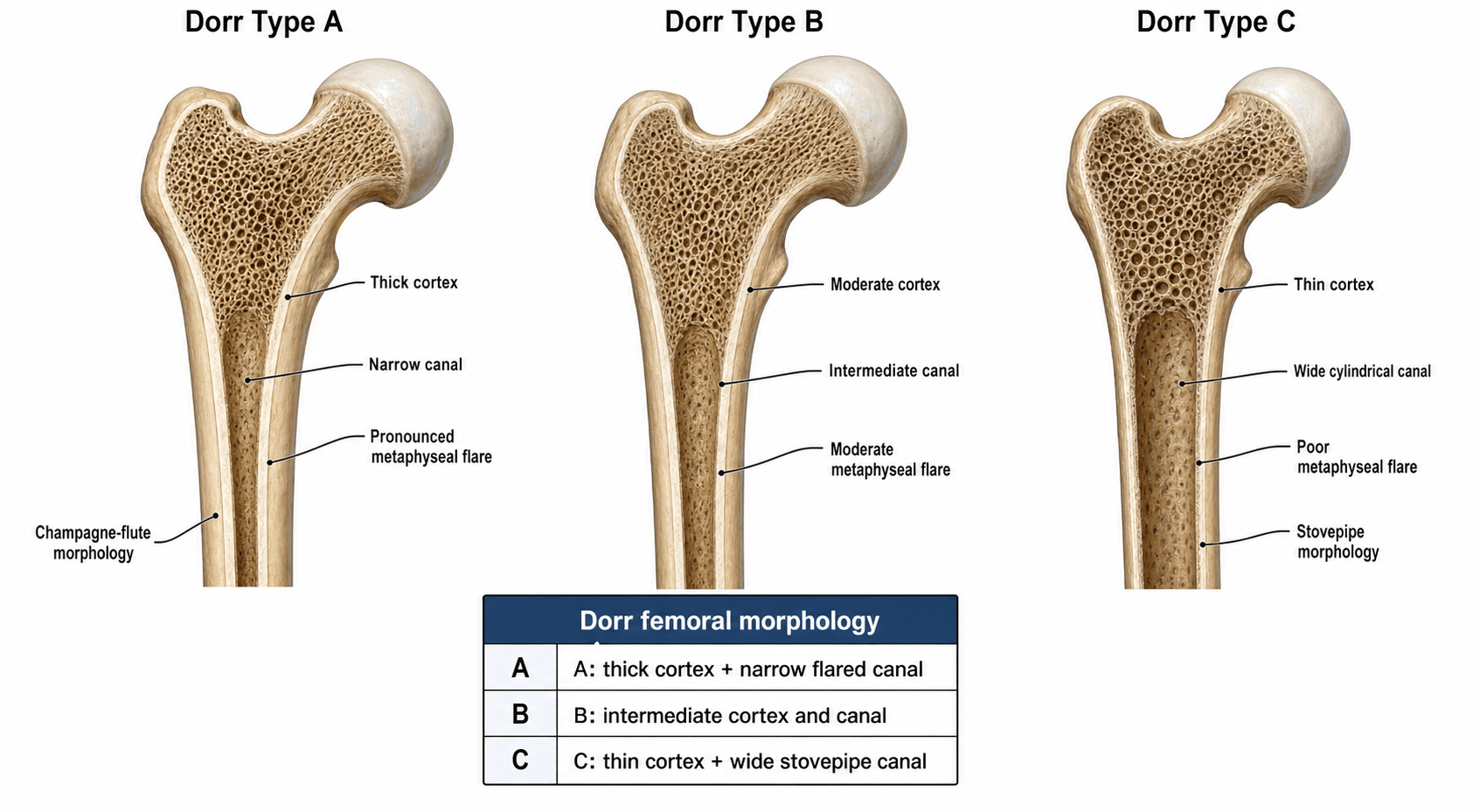
The Dorr classification, described by Lawrence Dorr, groups proximal femora into three morphological patterns based on cortical thickness and medullary canal geometry on a standard AP radiograph of the hip. It is assessed on the unaffected side (or the templated side pre-operatively) and is the primary pre-operative and intra-operative consideration for femoral stem selection in total hip arthroplasty.
- Type A — Champagne-flute
- Thick (cortex more than half the bone diameter)
- Type B — Intermediate
- Moderate (about half the bone diameter)
- Type C — Stovepipe
- Thin (cortex less than half the bone diameter)
- Type A — Champagne-flute
- Narrow isthmus
- Type B — Intermediate
- Average width
- Type C — Stovepipe
- Wide isthmus
- Type A — Champagne-flute
- Wide (marked funnel)
- Type B — Intermediate
- Moderate
- Type C — Stovepipe
- Minimal (tubular)
- Type A — Champagne-flute
- High (typically over 4.7)
- Type B — Intermediate
- Intermediate (~3.0 to 4.7)
- Type C — Stovepipe
- Low (typically under 3.0)
- Type A — Champagne-flute
- Excellent (ideal bone stock)
- Type B — Intermediate
- Acceptable (most stems work)
- Type C — Stovepipe
- Poor with a standard wedge (undersizing/subsidence risk)
- Type A — Champagne-flute
- Younger, good bone, male
- Type B — Intermediate
- Average bone quality
- Type C — Stovepipe
- Older, osteoporotic, female
A–B–CRemembering the three types
Hook:The letter is the mnemonic: A for Awesome bone, B for Between, C for Challenging bone.
Type C bone is the common pattern in elderly females with osteoporosis — the same population that receives the majority of primary total hip replacements. Recognising Dorr Type C on the pre-operative radiograph and planning accordingly (a cemented stem, or an appropriate cementless alternative) is one of the most practical decisions you make in routine arthroplasty.
Radiographic measurement & the canal flare index
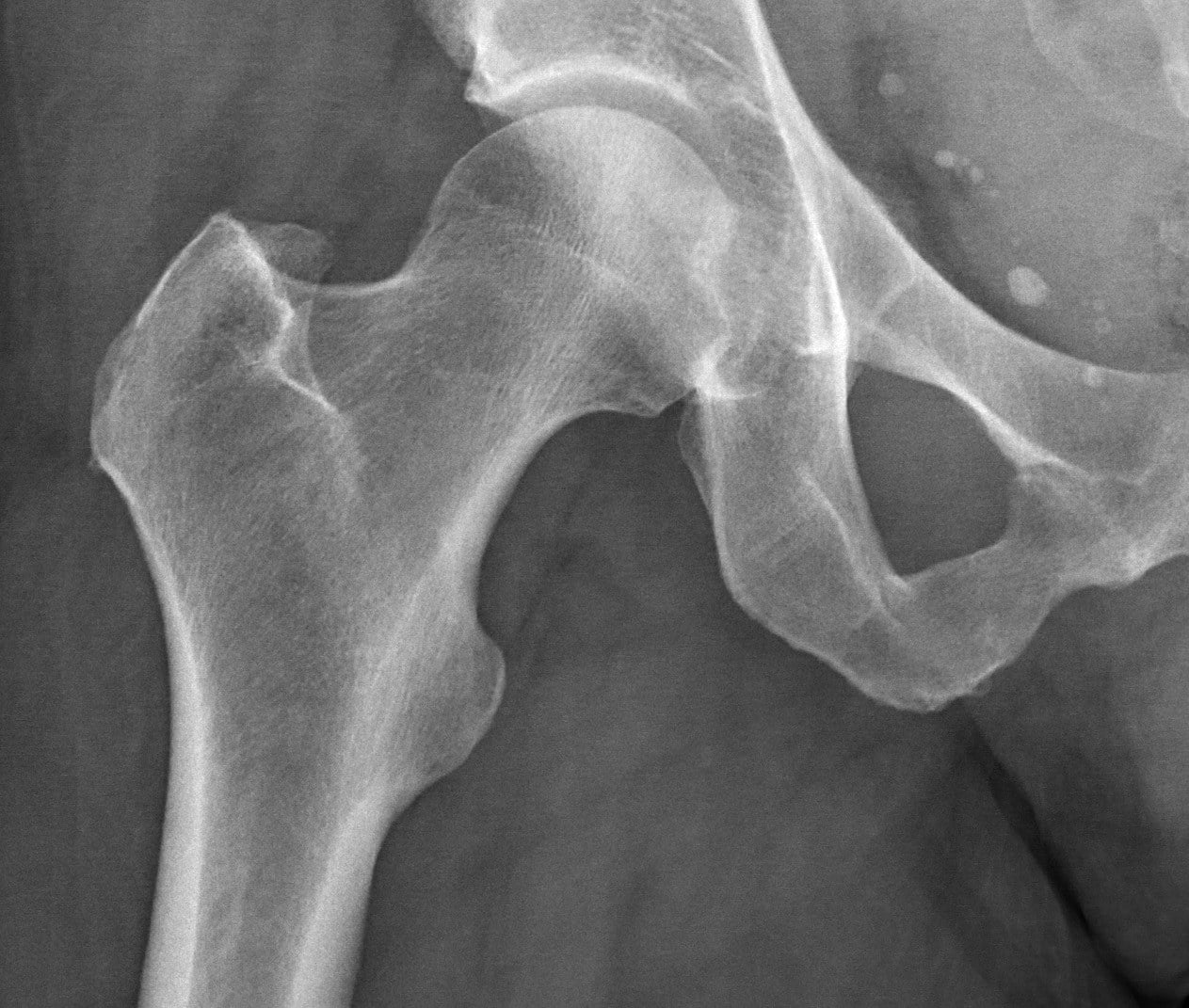
- Description
- Standard AP view of the proximal femur in neutral rotation, centred on the hip
- Description
- Measure the endosteal (medullary) diameter about 20 mm distal to the lesser trochanter — the widest metaphyseal point of the canal
- Description
- Measure the narrowest endosteal diameter of the diaphyseal canal, typically ~100–120 mm distal to the lesser trochanter
- Description
- CFI = canal entrance diameter ÷ isthmus diameter; a higher number means more metaphyseal flare relative to the isthmus
- Description
- CFI over 4.7 ≈ Type A; 3.0–4.7 ≈ Type B; under 3.0 ≈ Type C. Always cross-check against the cortical appearance
A champagne flute gives a large CFI (wide top, narrow bottom); a stovepipe gives a ratio close to 1 (uniform tube). The thresholds 3.0 and 4.7 are the most widely quoted but vary between published series — the examiner wants you to describe the cortical morphology and canal shape qualitatively (champagne-flute vs stovepipe) and use the CFI as supporting quantitative data, not as a numeric rule that overrides the visual assessment.
Surgical implications: cementless vs cemented stem choice
Dorr type is the principal bone-related factor in femoral stem selection. The decision also depends on age, activity demand, diagnosis and the available implant system, but bone morphology sets the boundaries of what is biomechanically sound.
The topic names the implants; the examiner wants the fixation principle behind each:
- Cemented — two philosophies: the taper-slip (force-closed) stem is polished and collarless (e.g. Exeter) and is designed to subside slightly within the cement mantle, converting load into radial compressive (hoop) stress — the stem–cement interface is deliberately unbonded; the composite-beam (shape-closed) stem is roughened/matt, often collared (e.g. Charnley/Stanmore) and is bonded to the cement so stem–cement–bone act as one unit, relying on a durable bond.
- Cementless — ingrowth vs ongrowth: fixation is by bone ingrowth into a porous coating (pore ~50 to 150 µm) or ongrowth onto a grit-blasted/HA surface, both of which need initial stability (micromotion under ~150 µm) and good canal fill.
- Level of cementless fixation: metaphyseal/proximal (taper wedge, proximally coated — needs good proximal bone, i.e. Dorr A/B) versus diaphyseal/distal (fully-coated cylindrical, modular fluted — bypasses weak proximal bone, hence useful in Dorr C / revision).
- Stress shielding: a stiff, distally-fixed stem unloads the proximal femur → proximal bone resorption (most marked with fully-coated cylindrical stems).
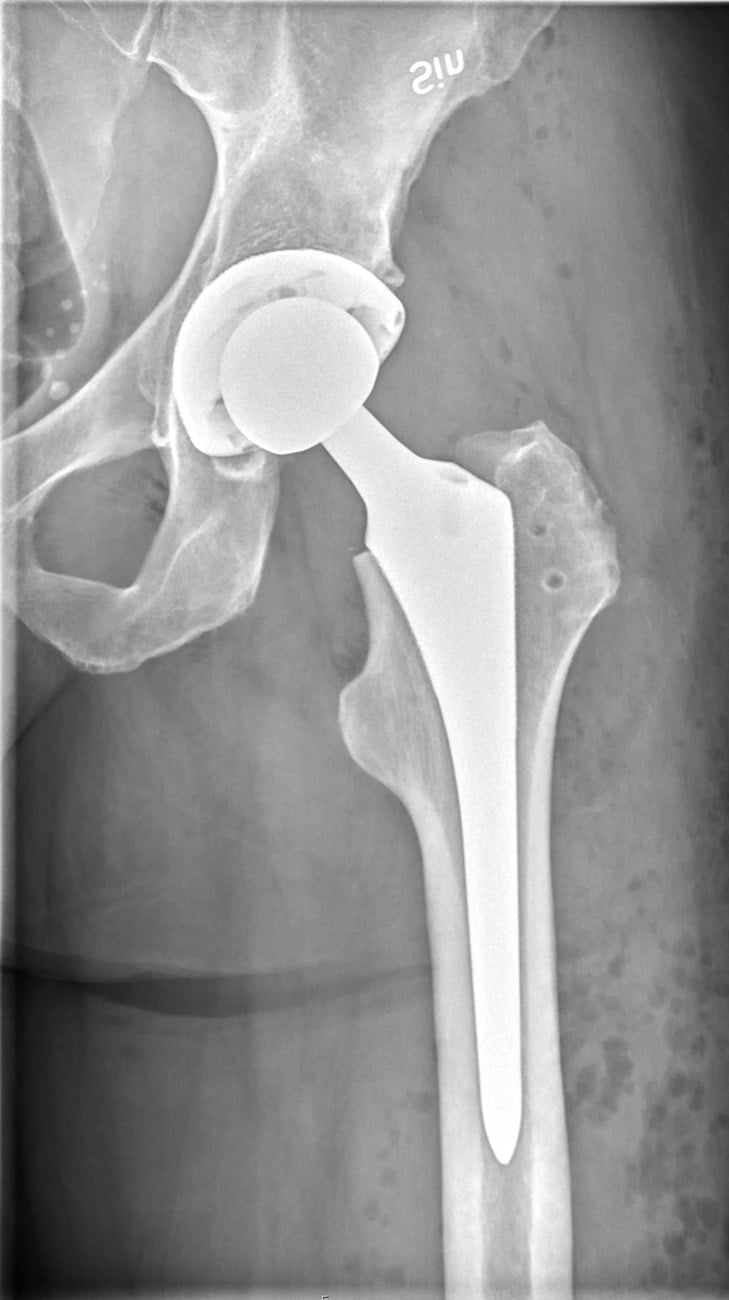
- 1Classify the femur (A/B/C)On the AP film, by cortical thickness and canal shape; CFI as support. Use the unaffected/templated side.
- 2Type A/B → cementless press-fitA tapered wedge is the ideal in Type A (excellent isthmus/metaphyseal fit) and reliable in Type B; cylindrical/fully-coated stems also work.
- 3Type C → choose deliberatelyA cemented stem (modern technique) is reliable and proven; cementless options that work are a fully HA-coated tapered or fully-coated cylindrical stem with good canal fill, or a modular fluted stem. Modern taper wedges can also succeed (better than fit-and-fill in Type C).
- 4Confirm the fit intra-operativelyIf the broach/rasp is loose at the isthmus and you cannot achieve a stable press-fit, STOP — convert to cement or a better-filling design. A loose press-fit will not improve; subsidence and fracture are predictable.
- Cementless taper wedge
- Excellent isthmus/metaphyseal fit; ideal indication
- Cementless cylindrical / fully coated
- May overfill; not first choice for primary
- Cemented stem
- Unnecessary in most cases
- Notes
- Gold-standard indication for a modern tapered wedge
- Cementless taper wedge
- Good press-fit in most patients
- Cementless cylindrical / fully coated
- Works well as an alternative
- Cemented stem
- Safe option; no disadvantage
- Notes
- The commonest type; most stems designed around this geometry
- Cementless taper wedge
- Risk of undersizing/subsidence with a standard wedge; modern designs can still work (better than fit-and-fill)
- Cementless cylindrical / fully coated
- Fully diaphyseal-coated stems and modular fluted stems fill wide canals; HA-coated tapers do well with good canal fill
- Cemented stem
- Reliable and well-proven; modern cement technique gives excellent results
- Notes
- The critical decision point — articulate why you would or would not use a given construct
A tapered wedge stem undersized into a Dorr Type C femur is a known failure mechanism: the stem sits in valgus, contact is limited to the proximal lateral cortex, and axial load is transmitted through a thin shell of bone that fractures or subsides. If you are inserting a cementless tapered wedge and the rasp does not achieve a tight fit at the isthmus, stop and reconsider — a cemented stem, a larger or differently designed implant, or a fully coated/diaphyseal-fixation stem may be the correct salvage.
Beyond the Dorr type, the cemented-versus-cementless decision is driven by age, bone quality and registry data:
- The registry/guideline message: large registries (NJR, AOANJRR) and national guidance (NICE, GIRFT) show cementless stems carry a higher early periprosthetic femoral fracture and early-revision risk in the elderly — especially older women with osteoporotic Dorr-C bone — driving a shift toward cemented (or hybrid) fixation in patients over roughly 70 to 75 (the "cement the elderly" message). Cementless is favoured in younger patients with good (Dorr A/B) bone for biological fixation and bone preservation.
- The cement trade-off — Bone Cement Implantation Syndrome (BCIS): hypotension, hypoxia, arrhythmia and even cardiac arrest on canal pressurisation / stem insertion, from embolisation of marrow and fat and the systemic effects of the methylmethacrylate monomer — highest in the frail/cardiopulmonary-compromised hip-fracture patient. Mitigate with thorough lavage, a cement restrictor, vacuum mixing, retrograde filling, suction/venting and communication with the anaesthetist.
- So in the Dorr-C elderly female the registry-supported default is a cemented (or hybrid) stem — weighed against that patient's BCIS risk.
Viva practice
Exam viva
Practise clinical reasoning and management decisions out loud
“A 72-year-old woman with osteoarthritis is listed for a right total hip arthroplasty. On the pre-operative radiograph, the proximal femur has thin cortices, a wide diaphyseal canal, and minimal metaphyseal flare. How would you classify this bone, and what femoral stem would you choose?”
“You are performing an uncemented total hip arthroplasty in a 68-year-old man. After the final rasp, the broach appears loose in the canal and you cannot achieve a stable press-fit at the isthmus. The pre-operative radiograph showed moderately thick cortices but you now notice the canal seems wider than templated. What do you do?”
Exam cheat sheet
A–B–CStem selection by Dorr type
Hook:A = Excellent wedge, B = Either, C = Cement-or-Coat (don't accept a loose taper in Type C).
- A champagne-flute (thick cortex, narrow canal, wide flare); B intermediate; C stovepipe (thin cortex, wide canal, minimal flare). Assess on the AP film, unaffected side.
- CFI = entrance ÷ isthmus (over 4.7 ≈ A, under 3.0 ≈ C) — supports, doesn't replace, the visual assessment.
- Type C is the elderly osteoporotic female — the bulk of primary THA.
- Type C is the decision point: cement (proven), fully-coated/HA-coated/modular fluted, or a modern taper wedge with good canal fill (evidence: taper wedge beats fit-and-fill in Type C).
- Never implant a loose press-fit stem — subsidence, varus migration, periprosthetic fracture follow; convert to cement or a better-filling design.
The three Dorr types
- Type A (champagne-flute): thick cortex, narrow isthmus, wide flare — ideal cementless press-fit
- Type B (intermediate): moderate cortex and canal — most stems work, most common type
- Type C (stovepipe): thin cortex, wide canal, minimal flare — the decision point
- Assess on the AP radiograph of the hip; use the unaffected side when available
Canal flare index
- CFI = endosteal diameter at canal entrance (~20 mm below lesser trochanter) ÷ isthmus endosteal diameter
- High CFI (typically over 4.7) ≈ Type A; low CFI (typically under 3.0) ≈ Type C
- Thresholds vary between publications — use CFI as quantitative support, not a rigid rule
Stem selection by Dorr type
- Type A: tapered wedge cementless — excellent press-fit, first choice
- Type B: tapered wedge or cylindrical cementless — either works
- Type C: cemented (modern technique), fully-coated/HA-coated taper, or modular fluted; a taper wedge outperforms a fit-and-fill stem in Type C
- Never force a loose cementless taper into Type C bone — subsidence, varus migration and periprosthetic fracture follow
Evidence Base
Structural and cellular assessment of bone quality of proximal femur
- The original description of three proximal-femoral morphologies based on radiographic cortical thickness, medullary canal geometry and cellular bone assessment.
- Type A femurs had the thickest cortices and narrowest isthmus canals; Type C the thinnest cortices and widest canals.
- Developed to predict which femurs would achieve reliable press-fit with cementless stems.
The anatomic basis of femoral component design
- Large cadaveric/anatomic analysis showing the femoral canal shape is far more variable than most implant designs accommodate.
- Defined the canal flare index (metaphyseal-to-isthmus ratio) as a descriptor of canal geometry and cementless fit.
- Argued that distal as well as proximal canal fill is often needed for stable cementless fixation, especially in revision.
According to PubMed, the classification comes from Dorr et al. 1993 (DOI), the canal flare index from Noble et al. 1988 (Clin Orthop Relat Res 1988;(235):148-65, PMID 3416522), and the modern Type-C cementless evidence from Dalury et al. 2012 (DOI), Lee et al. 2024 (DOI; taper wedge > fit-and-fill in Type C) and Rattanaprichavej et al. 2019 (DOI; canal fill drives stability). The cement-technique and stem-design principles are standard arthroplasty teaching.