The Race Against Pulmonary Insufficiency
- Thoracic Insufficiency Syndrome (TIS): the inability of the thorax to support normal respiration or lung growth - Campbell's definition (JBJS Am 2003), and the concept that reoriented the field away from early fusion.
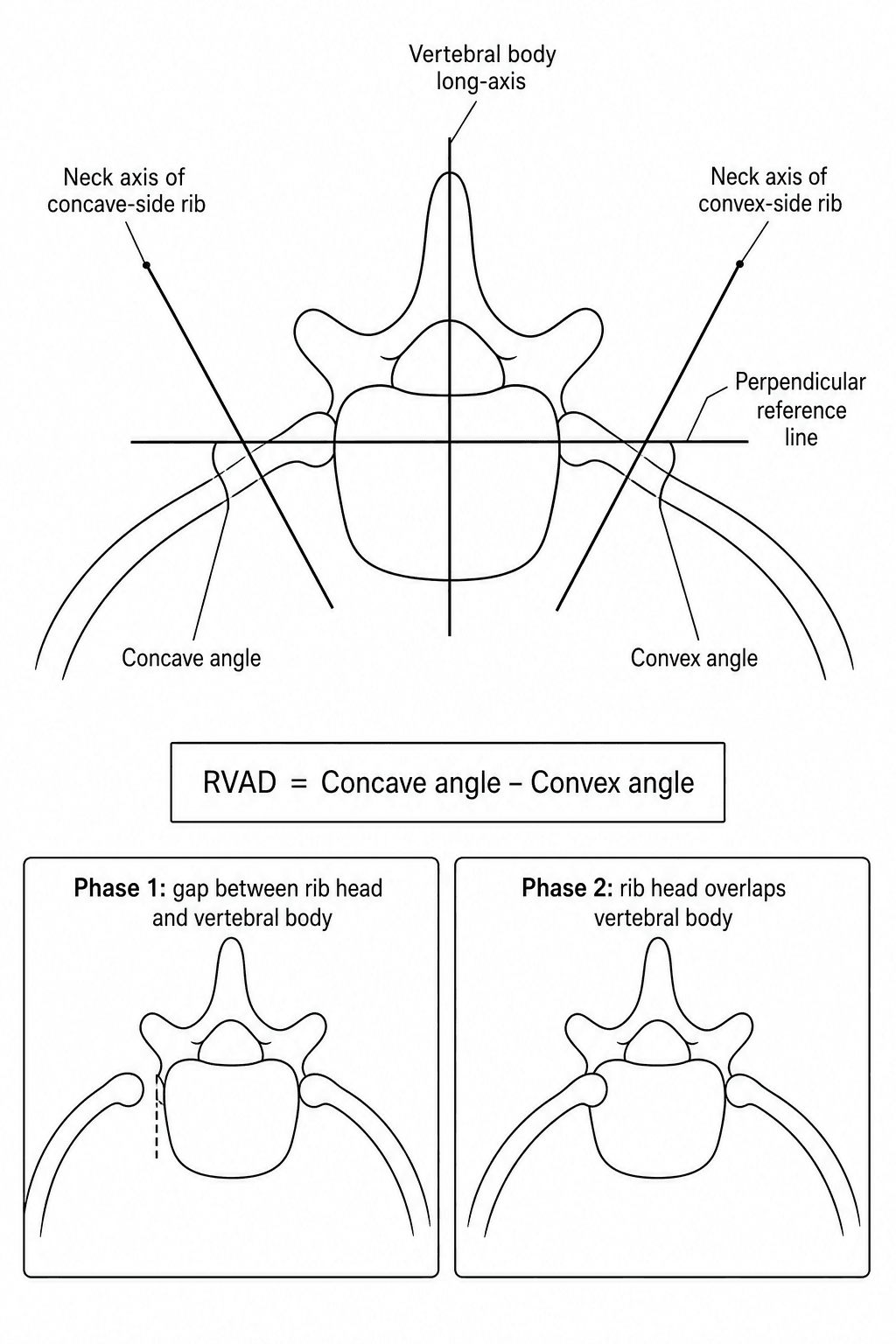
- Mehta Angle (RVAD): The key predictor of progression in infantile scoliosis.
- MRI: mandatory in all early-onset scoliosis before deformity surgery - a normal neurological examination does not exclude a Chiari malformation or syrinx.
- C-EOS Classification: Aetiology, Cobb, Kyphosis, Progression.
- Treatment: Delay fusion! Use Casting, Bracing, or Growing Rods.
- “Look for cutaneous stigmata (hairy patch, dimple) - Intraspinal pathology
- “Assess flexibility (Bending films)
- “Neurology is mandatory (Abdominal reflexes)
- “Plagiocephaly is often associated with Infantile Scoliosis
Overview and Epidemiology
Early-onset scoliosis (EOS) is a time-based definition: scoliosis with onset before age 10. It spans a heterogeneous group of diagnoses, and the primary concern is the lung. Unlike adolescent idiopathic scoliosis, EOS carries a high mortality if untreated, through thoracic insufficiency syndrome (TIS), which Campbell defined as the inability of the thorax to support normal respiration or lung growth.
The lung is still growing. Alveoli multiply rapidly until age 8. Severe deformity restricts lung volume, and the cascade runs from restrictive lung disease to pulmonary hypertension, cor pulmonale and early death. Fusion does the same harm: fusing more than 4 thoracic segments before age 9 stunts lung development and leads to TIS.
Infantile and juvenile idiopathic curves. Infantile idiopathic scoliosis is rare, under 1% of all idiopathic scoliosis in most series, with a higher incidence historically reported in Europe than in North America. Juvenile idiopathic curves are right thoracic, like AIS, and their progression is common and often relentless without treatment.
- Infantile
- Male
- Juvenile
- Female
- Adolescent (AIS)
- Female
- Infantile
- Left Thoracic
- Juvenile
- Right Thoracic
- Adolescent (AIS)
- Right Thoracic
- Infantile
- High (MRI mandatory)
- Juvenile
- High (MRI mandatory)
- Adolescent (AIS)
- Low (MRI if red flags)
- Infantile
- Resolves (80%) or Severe
- Juvenile
- Often Progresses
- Adolescent (AIS)
- Variable
Predicting Progression: the Mehta Angle
The rib-vertebral angle difference (RVAD). Mehta's angle is measured at the apical vertebra, as the angle between the rib neck and the vertebral body on each side. The RVAD is the concave-side angle minus the convex-side angle, and it separates the two infantile curves:
- Under 20° - resolving, with an 80% chance of spontaneous resolution
- Over 20° - progressive, with an 80% chance of progression
The rib-head phase. In Phase 1 there is a prominent gap between the rib head and the vertebral body. In Phase 2 the rib head overlaps the vertebral body, which indicates progression. Alongside the RVAD and the phase, a Cobb angle greater than 30° marks an infantile curve at risk of progression.
Classification Systems
C-EOS (2014). The classification describes the curve on four axes:
- Aetiology - congenital (failure of formation or segmentation), neuromuscular (muscle imbalance), syndromic (connective tissue disorders) or idiopathic (a diagnosis of exclusion)
- Cobb angle - the current magnitude of the major curve
- Kyphosis - hyperkyphosis (greater than 50) is a major negative predictor for pulmonary function
- Progression modifier - P0 stable (under 10° a year), P1 progressive (over 10° a year), P2 malignant (over 20° a year)
Stiff or flexible. Flexibility drives the surgical decision. A flexible deformity can be managed with distraction-based techniques such as growing rods or VEPTR. A stiff, ankylosed deformity, such as one with congenital bars or fused ribs, requires release (osteotomy) or resection (vertebrectomy) before distraction.
Clinical Assessment
History. Ask about the birth (prematurity, NICU admission), about development (walking age and milestones, for a neuromuscular cause) and about a family history of neurofibromatosis or Marfan syndrome.
Examination. Plagiocephaly is often associated with infantile scoliosis. The examination covers four areas:
- Skin - café-au-lait spots (NF1), a hairy patch (spinal dysraphism), laxity (Ehlers-Danlos)
- Neurology - a full examination; the abdominal reflexes are critical for syringomyelia
- Spine - flexibility: can the curve be corrected with traction or bending?
- Chest - pectus deformity, rib hump
Investigations
Radiographs. Whole-spine PA and lateral films measure the Cobb angle and kyphosis, and bending or traction films assess flexibility. In an infantile curve the RVAD is calculated on the apical vertebra.
Whole-spine MRI. MRI is mandatory for all patients, and it is obtained before any deformity surgery rather than only when there are signs. A substantial minority of children with EOS have a neural axis abnormality, a Chiari malformation or syrinx, despite a normal neurological examination. Dobbs (2002) found an abnormality in 21.7% of infantile idiopathic curves of 20° or more (10 of 46, of whom 8 needed neurosurgery), and the global Pediatric Spine Study Group registry (Williams 2020) found an abnormal pretreatment MRI in 24% across all EOS types (13% idiopathic, 39% neuromuscular). The scan looks for Chiari malformation, syrinx, tethered cord, diastematomyelia and intraspinal tumours.
Genetic testing. Consider a microarray if syndromic features are present.
Management Algorithm
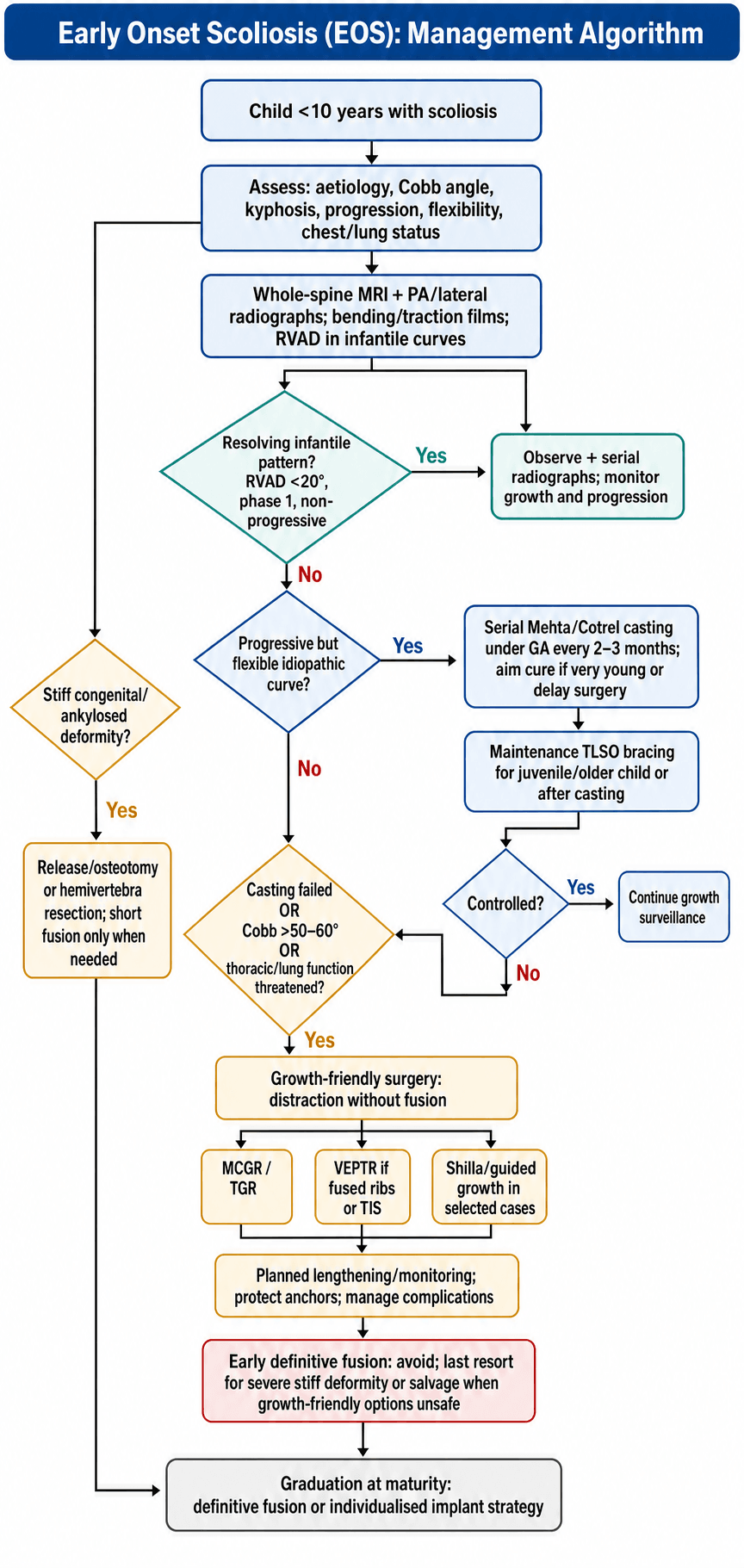
The goals are to maximise thoracic volume, control the deformity and allow vertical growth, which means delaying fusion.
Serial casting (Mehta/Cotrel). The indication is a progressive, flexible, idiopathic infantile curve. Under general anaesthesia the spine is put under traction and derotated and a plaster jacket applied, changed every 2-3 months. Cure is possible if casting starts young, under 2 years; otherwise the aim is to delay surgery.
Bracing (TLSO). A brace is used for juvenile cases, older children, or maintenance after casting. It is less effective than casting for true infantile curves.
Growth-friendly surgery. The indications are failed casting, a curve greater than 50-60°, or threatened lung function. The principle is distraction without fusion, and the options are:
- Traditional growing rods (TGR)
- Magnetically controlled growing rods (MCGR)
- VEPTR (rib-based)
- Shilla (self-sliding)
Early fusion. A last resort, for a severe stiff deformity. It stops lung growth and leaves a short trunk.
The Three Categories of Growth-Friendly Surgery
- How it works
- Periodically lengthened to push the spine/thorax apart and outgrow the deformity
- Examples
- Traditional growing rods (surgical lengthening), MCGR (external magnet), VEPTR (rib-based, expands thorax)
- Trade-off
- Workhorse, but repeated procedures/auto-fusion and the law of diminishing returns
- How it works
- Anchors fixed at the apex/foundations; the spine slides and grows along the rod without repeated lengthenings
- Examples
- Shilla (apex fixed, sliding end screws), Luque trolley
- Trade-off
- Avoids repeated lengthening surgery but gives less deformity control and generates metal debris
- How it works
- Tether/staple the convex side to slow convex growth so the concave side catches up (Hueter-Volkmann)
- Examples
- Convex hemiepiphysiodesis, vertebral body stapling, anterior vertebral body tethering
- Trade-off
- Only for smaller, flexible curves with substantial growth remaining
The device follows the curve. A large, progressive curve needs the corrective power of distraction. A curve where repeated surgery is undesirable may suit growth-guidance, and a small, flexible curve with lots of growth left is the candidate for compression or growth modulation. Name the category and the behaviour follows.
Surgical Techniques
Magnetically controlled growing rods. Proximal and distal anchors (screws or hooks) span the deformity and are connected by a rod with a magnetic actuator. Through limited exposures at the top and bottom, the rods are passed sub-muscularly. Lengthening is done in clinic with an external magnet, so there are no repeated operations to lengthen; the costs are metal artefact on MRI and actuator failure.
VEPTR (vertical expandable prosthetic titanium rib). The indications are thoracic insufficiency syndrome, fused ribs or absent ribs. Anchored rib-to-rib or rib-to-spine (lamina), it expands the chest wall and so addresses lung volume directly. Its price is a high rate of rib migration and cut-out, and prominent hardware that can break down the skin.
Congenital hemivertebra. Fusing the convex side (hemiepiphysiodesis) lets the concave side keep growing, potentially correcting the curve over time. Resecting the hemivertebra entirely is more aggressive and gives better correction.
Foundations and Anchors: Where the Construct Holds
- Options
- Upper thoracic pedicle screws/hooks (claw construct)
- Trade-off
- Better deformity control, but risks proximal junctional kyphosis and proximal auto-fusion - do not end at the apex of a kyphosis
- Options
- Rib cradles/hooks (VEPTR-type)
- Trade-off
- Spares the immature proximal spine and expands the thorax, but rib migration/cut-out is common
- Options
- Lower lumbar pedicle screws
- Trade-off
- Preserves distal motion segments; used when the pelvis is level and distal bone is adequate
- Options
- Iliac / S-hook pelvic fixation
- Trade-off
- Needed for neuromuscular curves with pelvic obliquity or poor distal bone stock
Failure modes follow the foundation. Anchor pull-out happens in small or osteoporotic bone, rib migration or cut-out with rib cradles, and PJK when the proximal foundation is too low. This is why a foundation uses multiple anchor points, and why salvage of failed rods often means moving the foundation, to the ribs proximally or to the pelvis distally.
Complications
- Rate
- High (Repeat surgeries)
- Prevention/Management
- Sub-muscular placement. MCGR reduces rate.
- Rate
- Common
- Prevention/Management
- Dual rods better than Single rods. Diameter increase.
- Rate
- Common
- Prevention/Management
- Hooks usually safer than screws in osteoporotic/small bone.
- Rate
- Common
- Prevention/Management
- Don't stop at the apex of kyphosis.
- Rate
- Inevitable
- Prevention/Management
- Delay open surgery as long as possible.
The law of diminishing returns. With traditional growing rods, every open lengthening leaves the spine stiffer (auto-fusion). By the time of the final fusion the spine may already be fused in a less-than-perfect position. MCGR helps avoid this by avoiding open surgery.
The crankshaft phenomenon. If the posterior elements are fused, or auto-fuse, while the anterior vertebral body growth plates remain open, the spine twists and rotates as it grows anteriorly. To prevent it, definitive fusion in young children (under 10) often requires anterior and posterior fusion to stop all growth centres.
Postoperative Care
Growth-Friendly Postoperative Pathway
Most growing rod patients wear a brace postoperatively to protect the proximal and distal foundations while the anchor sites incorporate.
Essential to maintain flexibility and counter the autofusion that drives the law of diminishing returns.
Outpatient distraction with the external magnet in clinic - no anaesthetic.
Open surgical lengthening under anaesthesia for traditional growing rods and VEPTR.
Definitive fusion, or individualised watchful waiting / implant removal.
Outcomes/Prognosis
Pulmonary. Survival is the main goal. Early fusion (under age 5) results in severe TIS and death, and delaying fusion until age 10-12 significantly improves pulmonary volume.
Deformity and final fusion. Complete correction is rarely the goal; control is. Final fusion is usually performed at skeletal maturity, around age 12-14 in girls and 14-16 in boys, to lock in the correction.
Guidelines, Registries & Global Practice
Global epidemiology
- EOS is a heterogeneous, time-based group (onset under age 10). Idiopathic infantile scoliosis accounts for under 1% of idiopathic curves in most series, with historically higher reported rates in Europe than North America. Congenital and neuromuscular aetiologies dominate the structural/progressive end of the spectrum worldwide.
Society guidance, side by side
- Emphasis
- C-EOS classification (Aetiology–Cobb–Kyphosis–Progression); growth-friendly principles; final fusion at maturity
- Emphasis
- Whole-spine MRI mandatory in EOS; serial casting first-line for flexible idiopathic infantile curves; MCGR favoured to cut reoperations
- Emphasis
- Tertiary-centre management; RVAD/serial monitoring of infantile curves; casting and growth-friendly surgery pathways
- Emphasis
- Strong casting tradition (EDF/Cotrel); emphasis on lung growth and avoiding early fusion
Registry and multicentre evidence
- Practice is driven largely by multicentre prospective EOS registries (e.g. the Pediatric Spine Study Group / Growing Spine Study Group datasets) rather than national arthroplasty-style registries, given device diversity and small numbers. These cohorts underpin the data on dual-rod growth rates, MCGR diminishing returns, and complication profiles.
High- vs limited-resource practice variation
- High-resource settings: ready access to whole-spine MRI, MCGR (avoiding repeated open lengthenings), VEPTR, intraoperative neuromonitoring and multidisciplinary paediatric pulmonology/spine teams.
- Limited-resource settings: greater reliance on serial casting and traditional growing rods (lower implant cost but repeated GA), with MRI and MCGR access constrained. Halo-gravity traction is a valuable low-cost adjunct for severe rigid curves. Late presentation with established thoracic insufficiency is more common.
Controversies and Areas of Uncertainty
- RVAD threshold: The classic 20-degree Mehta cut-off is challenged — long-term data suggest an optimal threshold nearer 17 degrees and warn against relying on a single index measurement (Lloyd et al, 2020). Serial RVAD and Cobb trends are more reliable than any one value.
- MCGR metal ions and reliability: Magnetically controlled rods reduce open lengthenings, but elevated serum titanium, actuator/pin failure, and progressive loss of distraction (a residual "law of diminishing returns") generate ongoing debate about long-term safety and true cost-effectiveness.
- Casting vs early surgery: When to abandon casting for a growth-friendly construct is not standardised. Casting can be curative if started under age 2, but late or stiff curves respond poorly.
- Rib-based vs spine-based anchors: VEPTR (rib-based) directly expands the thorax but has high migration/cutout rates; spine-based anchors give better deformity control but less direct chest-wall benefit. The optimal hybrid is unsettled.
- Graduation strategy: Whether to perform definitive fusion, "watchful waiting" with retained rods, or remove implants at skeletal maturity remains individualised, with no consensus on the best endpoint.
- Crankshaft prevention: The need for anterior growth arrest (combined anterior/posterior fusion) in very young children is debated in the era of all-pedicle-screw posterior constructs.
Deep Dive: EDP (Early Derotation Plastering)
The Mehta Technique Min Mehta revolutionized the treatment of infantile scoliosis.
- Principle: The spine grows rapidly in the first 2 years. If you can hold it straight, the growth will correct the deformity (Hueter-Volkmann law).
- Technique:
- General Anaesthesia.
- Risser Table (Traction frame).
- Derotation: Correct the rotation, not just the lateral bend. Mold over the apical rib hump.
- Window: Cut a large anterior "mushroom" window for belly breathing (infants are diaphragmatic breathers).
- Result: Can result in a permanent cure for idiopathic curves if started early.
MCQ Practice Points
Q: What is the most reliable predictor of progression in infantile idiopathic scoliosis? A: The Mehta Angle (Rib-Vertebral Angle Difference - RVAD). Greater than 20 degrees = Progression.
Q: At what age does the multiplication of alveoli (lung development) plateau? A: Age 8. (This is why fusion before age 8 is so dangerous for lung function).
Q: What is the rate of neural axis abnormalities in "idiopathic" early onset scoliosis? A: About 1 in 5 - 21.7% in infantile idiopathic scoliosis (Dobbs 2002) and 18.7% in a 504-patient infantile/juvenile MRI series (Zhang 2016); 24% across all EOS types in the global registry (Williams 2020). Hence MRI is mandatory for all.
Q: What is the typical pattern of Infantile Idiopathic Scoliosis? A: Male gender, Left-sided Thoracic curve. (Opposite of Adolescent Idiopathic).
Q: What is the Crankshaft Phenomenon? A: Rotational deformity progression after posterior fusion, due to continued anterior growth.
Self-Assessment Quiz
Viva Scenarios
Practise clinical reasoning and management decisions out loud
“18-month-old boy. Left thoracic curve 35 degrees. Parents are worried.”
“3-year-old. L1 Hemivertebra noticed on X-ray. Fully segmented. Curve is 30 degrees.”
“8-year-old with SMA (SMA Type 2). Has growing rods. Now has proximal hook pull-out and skin breakdown.”
DEFINITIONS
- Age less than 10
- Infantile (0-3)
- Juvenile (4-10)
- Congenital / NM / Syndromic / Idiopathic
RED FLAGS
- Left curve (check MRI)
- Hairy Patch
- Pain (Osteoid Osteoma)
- Neuro Deficit
KEY NUMBERS
- Mehta greater than 20 deg (Progressive)
- RVAD less than 20 deg (Resolving)
- Alveoli age 8
- MRI abnormal in ~20-25%
MANAGEMENT
- Cast (Mehta)
- Brace (maintenance)
- Grow (Rods/VEPTR)
- Fuse (Final)
Evidence Base
Mehta (original description)
- Defined the Rib-Vertebral Angle Difference (RVAD) at the apical vertebra
- RVAD greater than 20 degrees identifies the progressive (vs resolving) infantile curve
- Phase 2 rib-head relationship (rib head overlaps vertebral body) indicates progression
Lloyd et al — RVAD long-term validation
- Retrospective UK tertiary-unit cohort of infantile idiopathic scoliosis
- Progressive curves had significantly higher index Cobb and RVAD than resolving curves
- Optimal RVAD threshold for predicting progression was 17.1 degrees, lower than the classic 20 degrees
- Authors advise caution in relying on a single index RVAD measurement
Campbell et al — Thoracic Insufficiency Syndrome
- Defined Thoracic Insufficiency Syndrome (TIS): inability of the thorax to support normal respiration or lung growth
- Characterised the 3D thorax — volume (rib-cage width/depth and spinal height) and function (diaphragm, accessory muscles)
- Described the thumb-excursion test and Space Available for Lung as clinical/radiographic markers
- Treatment should expand thoracic volume and stabilise the chest wall without spinal fusion
Akbarnia et al — Dual growing rod technique
- Multicentre series of 23 children treated with dual growing rods (no prior surgery, minimum 2-year follow-up)
- Mean scoliosis improved from 82 to 36 degrees and was maintained
- T1-S1 length increased an average of 1.21 cm/year; Space Available for Lung ratio improved from 0.87 to 1.0
- Complications in 11 of 23 patients (48%) over the treatment period
Emans et al — Expansion thoracostomy and VEPTR
- Prospective series of 31 children with fused ribs and TIS treated with VEPTR
- Spinal deformity controlled and thoracic-spine growth continued at near-normal rates in 30 patients
- Increased hemithorax and total lung volume were maintained at follow-up
- Complications included device migration, infection and brachial plexus palsy
Karol et al — Early fusion and lung function
- 28 patients fused before age 9 with minimum 5-year follow-up and pulmonary function testing
- Average forced vital capacity only 57.8% of age-matched normal; FVC under 50% in 12 of 28
- Extent of spine fused correlated inversely with FVC; proximal (T1-T2) fusions did worst
- Patients needing fusion of more than 4 segments, especially with rib anomalies, were at highest risk of restrictive disease
Bednar et al — MCGR vs other distraction technologies
- Systematic review and meta-analysis of 18 studies
- No significant difference in latest-follow-up Cobb angle vs other distraction implants
- Significantly lower complication rate (OR 0.42) and better EOSQ-24 quality-of-life scores with MCGR
- Serum titanium higher with MCGR; MCGR became cost-neutral/cost-effective by ~4 years postoperatively
Dobbs et al — Neural axis abnormalities in infantile idiopathic scoliosis
- 46 consecutive patients with infantile idiopathic scoliosis, curve 20 degrees or more, normal neurological examination, whole-spine MRI
- 10 (21.7%) had a neural axis abnormality - Chiari with syrinx, syringomyelia, low-lying conus, brainstem tumour
- 8 of the 10 required neurosurgical intervention
Morin & Kulkarni — Elongation-derotation casting
- Describes the elongation-derotation-flexion (EDF/Cotrel) serial casting technique with modifications
- Serial casting avoided spinal fusion in two-thirds of progressive idiopathic infantile cases
- Argues surgery is not the universal gold standard; casting remains the centerpiece for benign (Mehta) curves
- Success depends on meticulous casting technique under anaesthesia