Caisson Disease | Nitrogen Bubble Bone Death | Divers and Compressed-Air Workers
- Exposure is decompression - the leading model links inert-gas microbubbles, endothelial injury, venous stasis and raised intramedullary pressure to sterile bone infarction
- Two target groups - divers (especially indigenous/artisanal and technical divers) and compressed-air (caisson/tunnel) workers
- Humeral and femoral heads are the sites that matter - juxta-articular lesions cause pain and collapse
- Often silent for years - many lesions are found on screening or only declare once the joint surface collapses
- Prevention beats treatment - safe decompression schedules and medical surveillance dramatically lower risk
- “Dysbaric osteonecrosis is a form of avascular necrosis where the insult is decompression, not steroids, alcohol, or trauma
- “Shaft (diaphyseal) infarcts are usually harmless; juxta-articular head lesions are the ones that disable the patient
- “MRI is the most sensitive test and can detect pre-radiographic disease
- “Strict, well-monitored diving (e.g. many military programmes) shows very low rates - this is a largely preventable occupational disease
Overview and Epidemiology
Dysbaric osteonecrosis (DON) is osteonecrosis associated with decompression exposure. Its final common pathway is that of any avascular necrosis: ischaemia, osteocyte death, attempted repair and, at the joint surface, collapse. Frame it as a named cause within the broader osteonecrosis differential.
Why examiners like it. It is a favourite basic-science and viva linking topic. From one diagnosis an examiner can test decompression physiology (Henry's law, inert gas solubility), bone blood supply, the general principles of osteonecrosis, occupational medicine and imaging.
Who gets it. Two occupational groups: divers and compressed-air (caisson and tunnel) workers. The historical name "caisson disease" comes from the pressurised caissons used to build bridge foundations. Among divers, the risk depends on the population:
- Commercial and military divers - risk is low where strict decompression and medical surveillance are enforced
- Indigenous and artisanal diving fishermen - among the highest reported rates worldwide, reflecting deep, repetitive diving, often without safe decompression; modern cases cluster here
- Technical (deep mixed-gas) recreational divers - an emerging and increasing at-risk group as deep diving becomes more popular
How common. Reported prevalence in professional divers ranges anywhere from 0% to roughly 70%, depending heavily on the population and how strict its decompression practice is DOI.
The two extremes. In unsupervised artisanal diving fishermen, radiographic dysbaric osteonecrosis has been found in around three-quarters of those examined DOI. At the other extreme, a controlled MRI study found that experienced military divers following strict rules showed no excess of bone lesions over matched non-divers DOI.
The disease remains a recognised occupational hazard despite falling rates where safe decompression and surveillance are practised DOI.
The spread of reported prevalence, from essentially zero in disciplined, surveilled diving programmes to very high rates in unregulated artisanal diving, is itself the exam message. Dysbaric osteonecrosis is driven by exposure and decompression practice, and that contrast is the strongest evidence that it is preventable DOI DOI. Treatment of established juxta-articular collapse is far less satisfactory than prevention.
Risk factors. The recognised risk factors fit one mnemonic.
DIVERSRisk Factors for Dysbaric Osteonecrosis
Hook:DIVERS who go too deep, too often, and ascend too fast grow bone infarcts.
Mechanism and Pathophysiology: From Bubbles to Bone Death
The leading mechanistic model is that tissues load inert gas at pressure; during decompression, gas-phase formation within fatty marrow combines with endothelial injury, venous stasis and raised intramedullary pressure to impair perfusion and produce ischaemic bone death.
These are leading, overlapping mechanisms rather than a single proven causal sequence. Direct causation by one isolated bubble pathway has not been established, so describe this as the dominant model rather than settled proof.

The sequence. Within that model, the path from dive to collapsed joint runs in six steps, each on its own timescale.
- Gas loading (during the dive). Under increased ambient pressure more inert gas, usually nitrogen, dissolves into the tissues in proportion to its partial pressure (Henry's law). Fatty bone marrow takes up a disproportionate amount, and the deeper and longer the dive, the greater the gas load.
- Supersaturation (during ascent). Dissolved gas must be carried back to the lungs and exhaled. If ascent is faster than the tissues can offload it, they become supersaturated and gas comes out of solution as bubbles, the same process that causes decompression sickness.
- Bubbles in marrow (minutes). Bubbles nucleate within the fat-rich, poorly expansile marrow of long bones. Marrow adipocytes swell and raise pressure, and in a rigid, closed compartment even small volumes of gas can raise intramedullary pressure and compress the thin-walled sinusoidal vessels, while intravascular bubbles can obstruct flow directly.
- Ischaemia and osteocyte death (hours to days). Reduced perfusion starves osteocytes and marrow cells of oxygen. Osteocyte death produces the empty lacunae seen histologically, a sterile (non-infective) process, and subchondral bone, with its limited collateral supply, is especially vulnerable.
- Attempted repair, creeping substitution (weeks to months). Surviving bone at the margin attempts revascularisation and lays down new bone on dead trabeculae, producing the sclerotic rim seen radiologically. This repair transiently weakens the necrotic segment.
- Collapse at the joint surface (months to years). In juxta-articular lesions the weakened subchondral bone can fracture and collapse, giving a crescent sign and loss of the spherical joint surface, followed by secondary osteoarthritis. Shaft lesions, lacking an articular surface to fail, usually remain asymptomatic infarcts.
The single most testable physiological point is inert gas solubility in fat. Nitrogen is several times more soluble in lipid than in aqueous tissue, so the fatty marrow of the proximal humerus and femur loads heavily with nitrogen at depth and is then where bubbles preferentially form on ascent.
Add bone as a rigid compartment, so that gas raises pressure rather than expanding, and a relatively end-arterial subchondral blood supply, and you have the anatomical and physiological recipe for dysbaric osteonecrosis DOI.
Gas in the marrow can be imaged. CT in acute decompression sickness can show gas within the marrow cavities of the humerus and femur, a marker of acute exposure. In one case, CT before hyperbaric oxygen treatment showed gas foci in both proximal humeral marrow cavities and the right shoulder joint, with resolution on follow-up imaging.
That supports the biological plausibility of the model, but intramedullary gas does not by itself predict later dysbaric osteonecrosis, and the long-term relationship between transient marrow gas and established osteonecrosis remains uncertain.


Same pathway, different trigger. Set against steroid, alcohol and post-traumatic osteonecrosis, the final pathway is shared; the trigger, sites, population and prevention differ.
- Dysbaric Osteonecrosis
- Decompression (nitrogen bubbles in marrow)
- Steroid/Alcohol Osteonecrosis
- Marrow fat hypertrophy and fat emboli
- Post-traumatic Osteonecrosis
- Direct disruption of blood supply
- Dysbaric Osteonecrosis
- Humeral head, femoral head, long-bone shafts
- Steroid/Alcohol Osteonecrosis
- Femoral head (often bilateral)
- Post-traumatic Osteonecrosis
- Femoral head, scaphoid, talus
- Dysbaric Osteonecrosis
- Divers and compressed-air workers
- Steroid/Alcohol Osteonecrosis
- Patients on steroids or heavy alcohol use
- Post-traumatic Osteonecrosis
- Patients after fracture or dislocation
- Dysbaric Osteonecrosis
- Common and usually harmless
- Steroid/Alcohol Osteonecrosis
- Can occur
- Post-traumatic Osteonecrosis
- Uncommon
- Dysbaric Osteonecrosis
- Safe decompression and surveillance - largely preventable
- Steroid/Alcohol Osteonecrosis
- Minimise steroid/alcohol exposure
- Post-traumatic Osteonecrosis
- Anatomic reduction, urgent dislocation reduction
Lesion Distribution and Classification
Where the lesions lie. Lesions predominate in the proximal humerus and proximal femur DOI. They are commonly bilateral and multifocal, because the whole skeleton was exposed to the same decompression stress.
Site predicts symptoms. In diving and occupational medicine, lesions are grouped by where they lie in the long bone into two families, and severity within a joint is then graded radiographically. Only juxta-articular lesions threaten the joint surface, so they are the ones that cause pain, collapse and arthritis.
- Location
- Subchondral bone of the humeral head and femoral head
- Radiographic appearance
- Dense (sclerotic) areas, segmental or linear opacities and cystic lucencies with an intact articular cortex, through to structural failure: a subchondral translucent band (the crescent), sequestration, flattening and secondary osteoarthritis
- Behaviour and importance
- Can collapse, causing pain and secondary arthritis. High - these are the disabling lesions
- Location
- Metaphysis and diaphysis of the humerus, femur and tibia
- Radiographic appearance
- Dense areas, irregular serpentine ('smoke up a chimney') calcification, and translucent areas or cysts
- Behaviour and importance
- Usually a stable, asymptomatic bone infarct found incidentally. Low - important mainly as a marker of exposure and for the rare late risk of malignant change


Staging borrows from general osteonecrosis. Because dysbaric osteonecrosis is a form of osteonecrosis, the same staging logic used for femoral head osteonecrosis applies to its juxta-articular lesions: pre-radiographic (MRI-only) disease, then radiographic sclerosis or cysts without collapse, then subchondral fracture and collapse, then secondary arthritis.
- Imaging
- MRI positive, X-ray normal
- Joint surface
- Intact
- Implication
- Stop exposure, define extent, and surveil
- Imaging
- Sclerotic rim, cysts, bone island
- Joint surface
- Intact, spherical
- Implication
- Joint preservation may be considered
- Imaging
- Crescent sign, flattening
- Joint surface
- Failing
- Implication
- Joint preservation usually fails
- Imaging
- Joint space loss, osteophytes
- Joint surface
- Destroyed
- Implication
- Arthroplasty for the affected joint
The watershed. The crescent sign (subchondral fracture) is the watershed between salvageable and unsalvageable joints, exactly as in steroid or alcohol osteonecrosis of the femoral head.
Natural history. In the majority of cases lesions progress despite the absence of further dysbaric exposure DOI. Stopping diving does not reliably reverse an established juxta-articular lesion.
Clinical Presentation and Investigations
History. The occupational history is the key: depth, dive frequency, bottom times, decompression practice, years diving and any past decompression sickness. Past decompression sickness, especially musculoskeletal "limb bends", should prompt suspicion of later bone lesions.
Often silent. Dysbaric osteonecrosis is often asymptomatic until late. Many shaft lesions and even some early head lesions cause no symptoms and are found on screening, and many lesions only declare themselves once the joint surface collapses.
Symptomatic head lesions. These present with deep shoulder or groin and hip pain, worse on loading, with progressive stiffness as the joint surface fails.
Examination. Examine both shoulders and both hips, and image both shoulders and both hips when dysbaric osteonecrosis is suspected.
- Shoulder - painful, restricted rotation; later, crepitus and fixed loss of movement with collapse
- Hip - painful, restricted internal rotation; an antalgic gait once the head collapses
Exclude other causes. Ask about steroids, alcohol, sickle cell and prior trauma, because dysbaric osteonecrosis is a diagnosis made in the right exposure context, and dysbaric and non-dysbaric osteonecrosis can coexist.
Targeted tests. These exclude alternative causes (a haemoglobinopathy screen, for example, if relevant) and characterise the joint before any surgery.
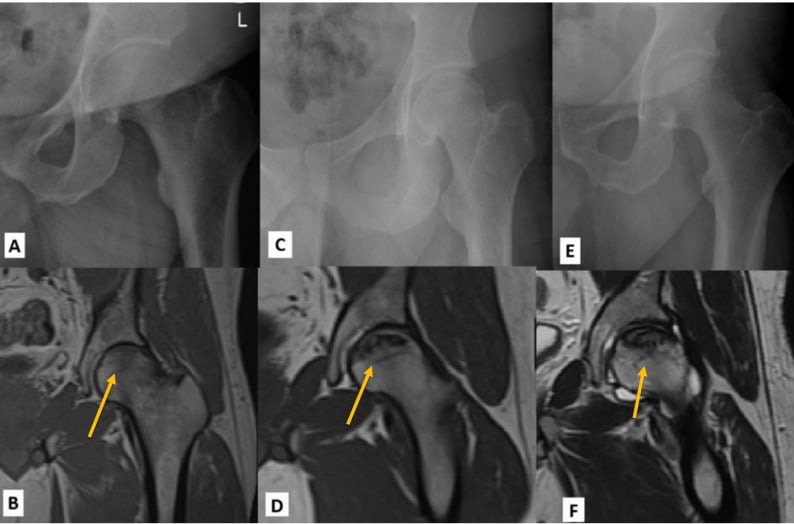
MRI. The most sensitive test for marrow change and early necrosis, and it detects pre-radiographic disease. It shows the geographic necrotic segment and the low-signal reactive interface (the "band"), and can survey several joints. Early osteonecrosis appears on T1-weighted images as a band-like low-signal boundary around the necrotic segment; in a focal lesion the segment itself is low-signal on T1, and on T2 the boundary is an irregular low-signal line.
Because it involves no ionising radiation, it is also used for surveillance where indicated.


Radiographs. Radiographs of both shoulders, both hips and the knees are the traditional screening and staging tool, and large historical occupational surveys used skeletal radiography to map lesion prevalence and distribution.
What the films show. The classic findings are decalcification, cystic lesions, osteosclerotic patterns, non-traumatic fractures, bone islands and a subchondral crescent sign DOI.
The sclerotic band marks the interface between dead and living bone, and once collapse occurs the humeral or femoral head flattens and loses congruity; how the findings distribute between head and shaft is set out in the classification above.

The artisanal-fishermen survey counted a joint as diseased only at Grade II or higher and still found dysbaric osteonecrosis in 76.9% of divers DOI. Plain-film grading is blind to pre-radiographic disease, so radiograph-based figures under-report the true burden, whereas MRI is far more sensitive.
That single methodological point explains much of the 0-70% prevalence range: MRI surveys of disciplined military divers find no excess over non-divers, while radiograph surveys of unregulated deep divers approach three-quarters affected DOI.
CT. CT can clarify the extent of a lesion and detect a subchondral fracture (the crescent) better than plain films, and is useful for surgical planning.
Axial CT through the proximal humerus can show the mottled lucency, sclerosis and crescentic subchondral lucency of an established head lesion.


Management Principles
Prevention is the real treatment. The most effective interventions are the ones that control exposure and decompression:
- Safe decompression schedules with appropriate ascent rates and decompression stops
- Depth and bottom-time discipline, avoiding provocative repetitive deep profiles
- Medical surveillance of at-risk workers and divers, with education for high-risk artisanal communities
- Prompt, correct treatment of decompression sickness (recompression and hyperbaric oxygen)
- Fitness-to-dive review - established juxta-articular DON may render a person unfit to continue diving
Shaft infarcts. Diaphyseal infarcts are usually observed, because they rarely cause symptoms and do not threaten a joint surface.
Management is reassurance with documentation and follow-up imaging, removing or reducing ongoing dysbaric exposure to prevent new lesions, and counselling about the very rare late risk of malignant change while keeping that risk in proportion.
Juxta-articular lesions. Management mirrors osteonecrosis of the femoral or humeral head from any cause, and the stage decides it.
- Pre-collapse - joint-preserving options such as core decompression, and biological or structural augmentation including free vascularised fibular grafting, aiming to relieve intramedullary pressure and support the subchondral plate; core decompression and free vascularised fibular grafting are the described surgical options DOI
- Post-collapse or secondary arthritis - arthroplasty of the affected joint (hemiarthroplasty or total joint replacement) for definitive pain relief
- Non-operative adjuncts - activity modification, analgesia, physiotherapy, and stopping further dysbaric exposure; monitoring and bisphosphonate therapy are also described DOI
For juxta-articular dysbaric osteonecrosis, treat the joint as you would any osteonecrotic head: joint preservation before collapse, arthroplasty after. The genuinely high-yield answer in a viva is that prevention through safe decompression and surveillance is the only intervention that reliably changes the disease.
Malignant Transformation of a Bone Infarct: the Rare but Lethal Late Risk
Why it matters. A long-standing medullary bone infarct, including the shaft infarcts of dysbaric osteonecrosis, can rarely give rise to a sarcoma. That converts an otherwise benign finding into a diagnosis you must not miss.
What the tumour usually is. In a classic review of 16 infarct-associated sarcomas, the tumour was usually a fibrosarcoma or malignant fibrous histiocytoma (now termed undifferentiated pleomorphic sarcoma). Patients were typically older men, lesions arose most often in the tibia and femur, and four of the sixteen patients had caisson disease. The risk appeared greatest in infarcts with a large medullary component, and the outcome was frequently rapidly fatal DOI.
Dysbarism is among the recognised causes of the bone infarcts in which this transformation has been documented DOI.
Suspect malignant change when a previously stable, quiescent infarct becomes painful, or when imaging shows a new destructive lytic area, cortical destruction or a soft-tissue mass. New or increasing pain, or a destructive lesion, in a long-standing bone infarct is malignant transformation until proven otherwise, and that patient needs MRI, biopsy and staging, not reassurance.

Guidelines, Registries & Global Practice
Worldwide Burden and Demographics
Historical caisson work: bridge and tunnel construction in compressed air gave "caisson disease" its name and the first large case series
Highest modern rates: indigenous and artisanal diving fishermen (for example in parts of Mexico and South-East Asia), where surface-supplied deep diving is common and decompression is often unsafe DOI
Lowest rates: disciplined military and commercial diving programmes with enforced decompression and surveillance DOI
Emerging group: deep technical recreational divers DOI
Exposure dose: number of joints affected correlates with lifetime maximum depth and average bottom time DOI
Decompression practice: inadequate or absent decompression is the dominant modifiable driver
Prior decompression sickness: associated with later bone lesions
Age and career length: longer exposure histories carry more lesions DOI
MCQ Practice Points
Q: Why does fatty bone marrow play a central role in dysbaric osteonecrosis? A: Because nitrogen is far more soluble in fat than in water, so at depth the fat-rich marrow of long bones loads with a disproportionate amount of dissolved inert gas. On rapid ascent this marrow becomes supersaturated and bubbles form preferentially there. Within the rigid bony compartment the bubbles raise intramedullary pressure and obstruct sinusoidal blood flow, producing the ischaemia that kills bone. The combination of high fat solubility, a non-expansile compartment, and a relatively end-arterial subchondral supply explains why long-bone heads are targeted DOI.
Q: A diver has a calcified medullary infarct in the femoral shaft and a separate lesion in the femoral head. Which matters more and why? A: The femoral head (juxta-articular) lesion matters more. Juxta-articular lesions can undergo subchondral fracture and collapse, leading to pain and secondary arthritis, whereas diaphyseal shaft infarcts have no articular surface to fail and are usually stable, asymptomatic, and managed by observation. Lesions cluster in the proximal humerus and femur, and it is the head lesions that drive the disability DOI.
Q: Why does reported prevalence of dysbaric osteonecrosis range from 0% to about 70%? A: Because prevalence is driven by decompression discipline and surveillance, not by diving alone. Strictly regulated military divers following decompression rules and undergoing periodic examination can show no excess of bone lesions over non-divers, while unregulated artisanal diving fishermen who dive deep, often, and without safe decompression show some of the highest rates recorded - around three-quarters in one radiographic series. The wide range is the exam's way of saying the disease is largely preventable DOI DOI.
Q: Which imaging test detects dysbaric osteonecrosis earliest? A: MRI. It detects marrow change and the reactive low-signal interface band before any abnormality appears on plain radiographs, and it allows several joints to be surveyed without ionising radiation. Radiographs are used for staging (sclerosis, cysts, bone islands, crescent sign, head flattening) and CT helps define lesion extent and detect a subchondral fracture before surgery DOI.
Exam Viva Scenarios
Practise clinical reasoning and management decisions out loud
“A diver is found to have osteonecrosis of the humeral head. Explain to me, from first principles, how diving could have caused this.”
“A 45-year-old artisanal diving fisherman presents with chronic right shoulder pain. He has dived deep on surface-supplied air for over 20 years and has had several episodes of joint pains after dives. How would you assess and investigate him?”
Core Concept
- Osteonecrosis caused by decompression - nitrogen bubbles in fatty marrow cut off blood flow
- Same final pathway as any avascular necrosis; the trigger is decompression, not steroids/alcohol/trauma
- Henry's law plus high fat-solubility of nitrogen = fatty marrow loads heavily at depth
- Bone is a rigid compartment - bubbles raise intramedullary pressure and obstruct sinusoids
Who and Where
- Divers (artisanal/indigenous highest risk; technical divers emerging) and compressed-air/caisson workers
- Sites that matter: humeral head and femoral head (juxta-articular)
- Shaft (diaphyseal) infarcts are usually asymptomatic and observed
- Frequently bilateral and multifocal - image both shoulders and both hips
Diagnosis
- MRI most sensitive - detects pre-radiographic disease and the reactive band
- Radiographs stage: sclerosis, cysts, bone islands, shaft infarct calcification, crescent sign, flattening
- CT defines lesion extent and detects the subchondral fracture (crescent)
- Crescent sign is the watershed between salvageable and unsalvageable joints
Management
- Prevention is the real treatment: safe decompression, depth/bottom-time limits, surveillance, prompt DCS treatment
- Asymptomatic shaft lesions: observe and reassure
- Pre-collapse head lesions: core decompression, free vascularised fibular graft
- Post-collapse / secondary arthritis: arthroplasty of the affected joint
Exam Triggers
- Prevalence 0% to about 70% - driven by decompression discipline, not diving itself
- Disciplined military divers may show no excess over non-divers (preventable disease)
- Established juxta-articular lesions often progress even after diving stops
- Address fitness to dive once juxta-articular disease is confirmed
Evidence Base and Key Literature
Dysbaric Osteonecrosis: Pathophysiology, Presentation and Management - Literature Review
- Dysbaric osteonecrosis is associated with prolonged hyperbaric exposure and rapid decompression that drive nitrogen bubbles into fatty marrow-containing shafts of long bones, reducing blood flow and causing osteonecrosis
- Patients are frequently asymptomatic; typical radiographic findings are decalcification, cystic lesions, osteosclerotic patterns, non-traumatic fractures, bone islands and a subchondral crescent sign
- Surgical options include core decompression and free vascularised fibular graft; non-surgical options include monitoring, physical therapy and bisphosphonate therapy
- Incidence has fallen markedly over recent decades but delayed diagnosis and suboptimal management keep the condition relevant
Dysbaric Osteonecrosis Among Professional Divers: A Literature Review
- Reported prevalence of dysbaric osteonecrosis in professional divers ranges from 0% to 70.6%, highest in settings such as Turkey, Hawaii, Korea and Japan and dependent on activity and medical monitoring
- Risk is very low for military divers who strictly follow decompression rules and undergo periodic medical examination
- Lesions predominate in the proximal femur and proximal humerus
- In the majority of cases lesions progress despite the absence of further dysbaric exposure