Subacromial Impingement | Neer Stages | Cuff Compression
- External impingement = compression of supraspinatus between humeral head and acromion
- Neer stages progress from edema (I) to fibrosis (II) to cuff tear (III)
- Acromial morphology (Type 3 hooked) increases impingement risk
- Non-operative treatment first-line for Stage I-II
- Acromioplasty removes impinging bone but evidence is debated
- “Bigliani Type 3 (hooked) acromion = higher impingement risk
- “Hawkins and Neer tests assess subacromial impingement
- “Differentiate from internal impingement (posterior/superior, throwers)
- “Subacromial injection test helps confirm diagnosis
Stage I: Edema and hemorrhage (under 25 years, reversible). Stage II: Fibrosis and tendinitis (25-40 years, chronic). Stage III: Rotator cuff tear (over 40 years, often irreversible). Progression is not inevitable.
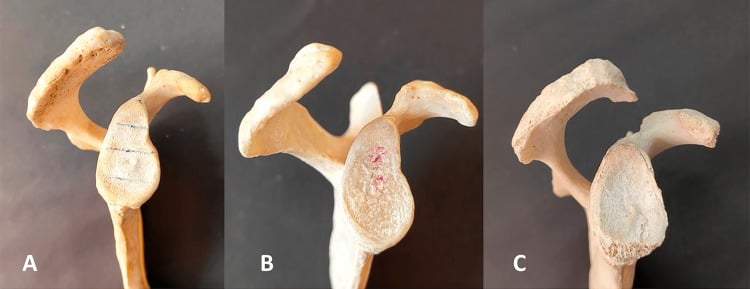
Bigliani classification: Type 1 (flat), Type 2 (curved), Type 3 (hooked). Type 3 has highest impingement risk. Outlet view X-ray or sagittal MRI shows acromion shape.
External = subacromial, anterior cuff compression, older patients. Internal = posterior-superior, articular side cuff, throwers/overhead athletes in abduction-ER. Know the distinction.
Recent RCTs (CSAW, FIMPACT) show acromioplasty may not be superior to sham surgery for isolated impingement. This is controversial but important to know for examination.
- External (Subacromial)
- Subacromial space, anterior
- Internal (Posterior-Superior)
- Posterior-superior, articular
- External (Subacromial)
- Bursal side
- Internal (Posterior-Superior)
- Articular side
- External (Subacromial)
- Over 35, degenerative
- Internal (Posterior-Superior)
- Under 35, throwers/athletes
- External (Subacromial)
- Cuff compressed under acromion
- Internal (Posterior-Superior)
- Cuff pinched on glenoid rim in abd-ER
- External (Subacromial)
- Physio, injection, acromioplasty
- Internal (Posterior-Superior)
- Physio, posterior capsule stretch
EFTNeer Stages
Hook:EFT = Edema, Fibrosis, Tear - Neer stages progress with age and chronicity!
1-2-3Bigliani Acromion Types
Hook:Bigliani 1-2-3: Flat, Curved, Hooked - Type 3 is trouble!
Overview and Epidemiology
External (subacromial) impingement is one of the most common causes of shoulder pain. Understanding the spectrum from edema to cuff tear, the role of acromial morphology, and the evidence around treatment options is essential for examination and clinical practice.
- Over 35 years typical onset
- Occupational overhead workers
- Athletes (overhead sports)
- Degenerative component with aging
- Both genders equally affected
- Type 3 hooked acromion
- Os acromiale
- Acromioclavicular osteophytes
- Overhead repetitive activity
- Postural factors (kyphosis)
Pathophysiology and Mechanisms
The subacromial space lies between the acromion/coracoacromial ligament above and the humeral head below. The supraspinatus tendon passes through this space. In external impingement, this space is narrowed, causing mechanical compression of the rotator cuff, particularly during forward flexion and internal rotation.
- Intrinsic (Within Tendon)
- Tendon degeneration
- Intrinsic (Within Tendon)
- Tendon calcification
- Intrinsic (Within Tendon)
- Cuff tear (partial/full)
- Intrinsic (Within Tendon)
- Tendon thickening from tendinitis
- Acromion - anterior-superior coverage
- Coracoacromial ligament - connects acromion to coracoid
- Coracoid process - anterior
- This arch forms the "roof" that can impinge
- Critical zone of supraspinatus (1cm from insertion)
- Watershed area - relatively avascular
- Bursal surface affected in external impingement
- Articular surface affected in internal impingement
Primary vs Secondary Subacromial Impingement
- Primary (structural / outlet) impingement. A fixed, anatomical narrowing of the subacromial outlet — a Bigliani type-3 hooked acromion, a subacromial or AC-joint osteophyte, a thickened coracoacromial ligament, or an os acromiale. The mechanical block is the primary problem (the classic Neer model).
- Secondary (functional / non-outlet) impingement. The outlet is anatomically normal, but it is dynamically narrowed because the humeral head rides up: from rotator-cuff weakness or fatigue (loss of the head-depressor force couple), scapular dyskinesis (loss of acromial upward rotation and posterior tilt), or glenohumeral instability (the head translates under load, especially in young throwers). Here impingement is a symptom of another problem.
- Why the distinction matters. Secondary impingement is treated by restoring dynamic control (rotator-cuff and scapular rehabilitation, addressing instability) — not by removing bone. This is a key reason the high-level trials (CSAW, FIMPACT) found decompression no better than placebo: most "impingement" has a large functional component that bone resection does not address, whereas structured exercise does.
- Practical rule. Reserve any thought of decompression for genuine primary/structural impingement (a defined mechanical lesion); a normal-outlet shoulder with weakness, dyskinesis or instability is secondary and is a rehabilitation (or instability) problem. Scapular dyskinesis and instability are developed in their own topics.
Q: Why did decompression prove no better than placebo, and how does that link to primary vs secondary impingement? A: Most subacromial impingement is secondary (functional) — the outlet is normal but the humeral head rides up from cuff weakness, scapular dyskinesis or instability. Removing acromial bone does nothing for that; restoring the force couple and scapular control (exercise) does — which is why CSAW/FIMPACT showed no benefit of ASD. Reserve decompression for true primary (structural) impingement with a defined mechanical lesion.
Classification Systems
Neer Classification of Impingement
- Pathology
- Edema and hemorrhage
- Age Group
- Under 25 years
- Treatment
- Rest, physio, NSAIDs
- Pathology
- Fibrosis and tendinitis
- Age Group
- 25-40 years
- Treatment
- Physio, injection, +/- surgery
- Pathology
- Rotator cuff tear
- Age Group
- Over 40 years
- Treatment
- Decompression +/- cuff repair
Neer's classification emphasizes the progressive nature of impingement syndrome, though progression is not inevitable.
Clinical Assessment
- Anterior-lateral shoulder pain
- Night pain (classic)
- Overhead activity exacerbates
- Painful arc during abduction
- Weakness if cuff involved
- Neer test - forward flex with scapula fixed
- Hawkins test - 90° flex, internal rotate
- Painful arc - 60-120° abduction
- Jobe test - supraspinatus strength
- Injection test - relief with subacromial LA
Neer test: Examiner stabilizes scapula, passively forward flexes arm. Positive if reproduces pain (compresses cuff against anterior acromion).
Hawkins test: Flex shoulder/elbow to 90°, then internally rotate forearm. Positive if reproduces pain (compresses cuff against coracoacromial ligament).
Subacromial injection test: Inject LA into subacromial space. If pain relief and improved strength, supports impingement diagnosis.
NHJClinical Tests
Hook:NHJ = Neer, Hawkins, Jobe - key shoulder tests!
Investigations
Investigation Protocol
AP, axillary, outlet (Y) views. Assess acromial morphology on outlet view. Look for AC joint arthritis, calcific tendinitis, superior migration of humeral head.
Dynamic assessment. Can visualize cuff tears, bursitis. Operator-dependent. Less detail than MRI.
Best for cuff assessment. Shows tendon pathology, tears, muscle quality. Sagittal views show acromial morphology. Reserve for suspected cuff tear or failed conservative treatment.
The supraspinatus outlet view (scapular Y-view) best demonstrates acromial morphology. Look for Type 3 hooked acromion, subacromial spurs, and os acromiale. This view is essential for impingement assessment.
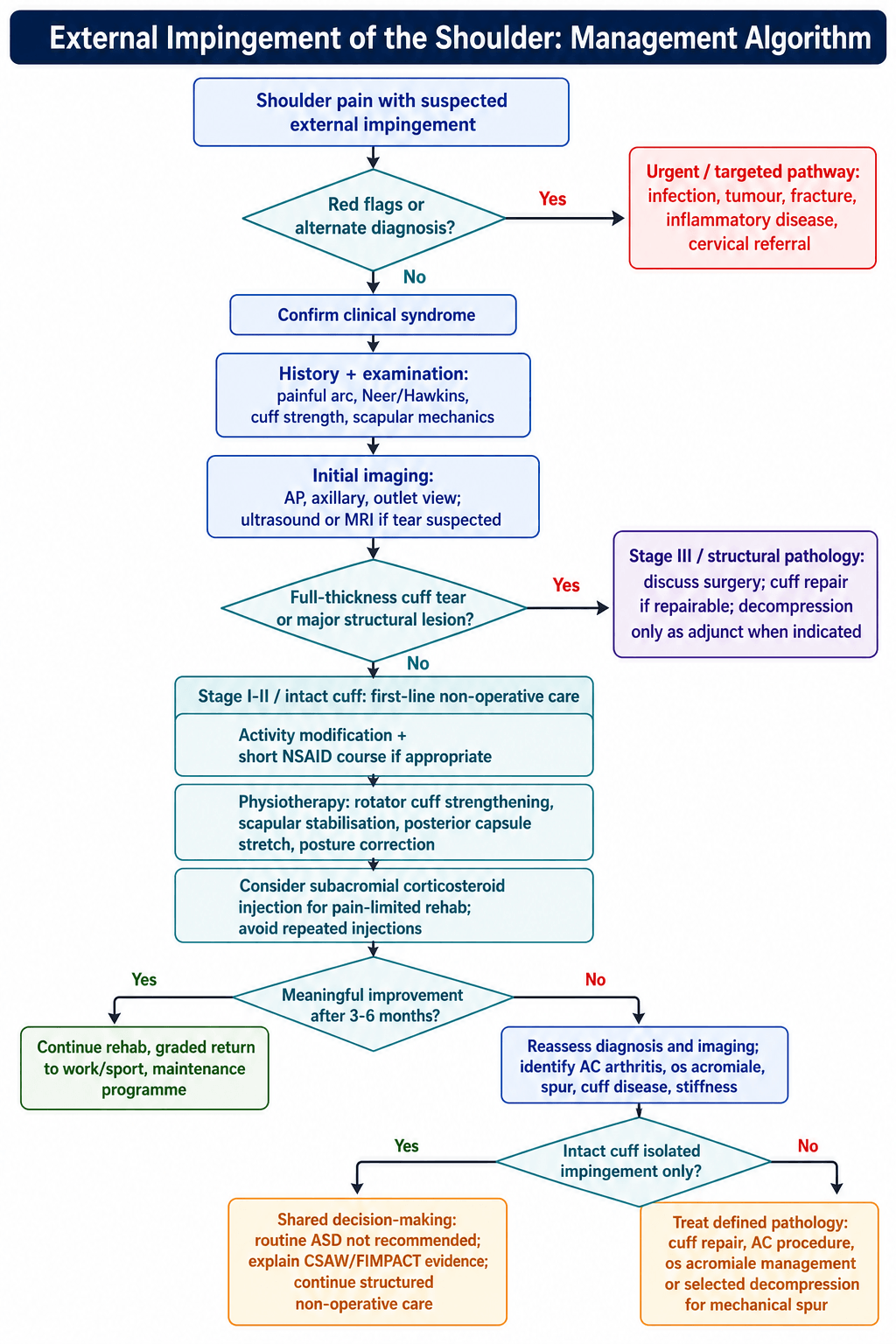
Management Algorithm
First-Line Treatment
Stage I and most Stage II are treated non-operatively:
- Avoid aggravating overhead activities
- Relative rest (not complete immobilization)
- Rotator cuff strengthening
- Scapular stabilization exercises
- Posterior capsule stretching
- Posture correction
- Short-term for pain relief
- Helps reduce inflammation
- Provides temporary relief
- Aids physiotherapy participation
- Max 3 injections per year
- Diminishing returns with repeated use
No source cited on this page reports a success rate for non-operative treatment. What the evidence does support is narrower and worth stating precisely: Kuhn's synthesis of eleven randomised trials found that exercise produces statistically and clinically significant improvement in pain and function, but no significant effect on range of motion or strength, and that a home programme performed as well as supervised therapy. Manual therapy augmented the effect of exercise. Set expectations around pain and function, and do not promise a percentage.
Pre-operative Planning
- Confirm acromial morphology
- Assess for cuff tear (MRI if needed)
- AC joint status
- Exclude other pathology
- Os acromiale evaluation
- Beach chair or lateral position
- Standard posterior/lateral portals
- Plan bursectomy extent
- Acromioplasty targets
- Consent includes limited evidence
Surgical Technique
Subacromial Decompression
Surgical Steps
Beach chair or lateral decubitus. Arm in holder with traction if lateral. Standard portals (posterior viewing, lateral working).
First evaluate the glenohumeral joint. Assess rotator cuff (articular side), biceps, labrum. Enter subacromial space.
Remove inflamed bursal tissue with shaver. Visualize undersurface of acromion, coracoacromial ligament, and rotator cuff.
Use burr to flatten anterior-inferior acromion. Remove impinging spurs. Aim for Type 1 (flat) morphology. Do not over-resect.
Release coracoacromial ligament if thickened/impinging. Some preserve to maintain coracoacromial arch integrity.
Excessive acromial resection can cause fracture or deltoid detachment. Remove only enough to create flat undersurface. The coracoacromial ligament provides superior restraint - consider preserving if possible.
The Coracoacromial Arch: Why Not to Over-Release It
The surgical section says to "preserve the coracoacromial ligament to maintain arch integrity" — worth developing, because releasing it has a specific, feared consequence.
- The arch is a static superior restraint. The coracoacromial arch (acromion + coracoacromial ligament + coracoid) is the passive roof of the subacromial space. With an intact rotator cuff it is only a minor buttress, but in a cuff-deficient shoulder it becomes the last static restraint against anterosuperior escape of the humeral head.
- The danger of over-decompression. Aggressive acromioplasty with coracoacromial-ligament release in a shoulder that has (or later develops) a large or massive cuff tear can precipitate anterosuperior escape — the head subluxes up and forward through the deficient roof — a difficult, often effectively irreparable complication.
- The corollary for practice. Decompression should therefore be conservative and cuff-status-aware: release the coracoacromial ligament sparingly (or preserve it) when the cuff is deficient, remove only enough acromial undersurface to relieve a genuine mechanical spur, and protect the deltoid origin. It is a further argument (alongside CSAW/FIMPACT) against routine, aggressive bony decompression.
Q: Why can an aggressive acromioplasty with coracoacromial-ligament release be harmful in a shoulder with a massive cuff tear? A: The coracoacromial arch is the last static restraint against anterosuperior escape when the rotator cuff is deficient. Releasing the coracoacromial ligament and over-resecting the acromion removes that roof, allowing the humeral head to escape anterosuperiorly — a devastating, hard-to-salvage problem. Keep decompression conservative and cuff-status-aware.
Complications
- Incidence
- 10-30%
- Risk Factors
- Patient selection, technique
- Prevention/Management
- Proper indication, thorough decompression
- Incidence
- Rare
- Risk Factors
- Excessive resection
- Prevention/Management
- Conservative bone removal
- Incidence
- Rare
- Risk Factors
- Aggressive resection
- Prevention/Management
- Protect deltoid origin
- Incidence
- 5%
- Risk Factors
- Inadequate rehab
- Prevention/Management
- Early ROM protocol
The CSAW trial (UK, 2018) showed no significant difference between arthroscopic subacromial decompression and sham surgery at 6 months. This has led to questioning of routine ASD for isolated impingement. Patients should be informed of this evidence during consent.
Postoperative Care and Rehabilitation
Rehabilitation After ASD
Recovery Timeline
Sling comfort only. Begin pendulum exercises. Ice for swelling. May remove sling for exercises.
Active-assisted ROM progressing to active. Begin rotator cuff isometrics. Scapular stabilization.
Progressive strengthening. Rotator cuff and deltoid focus. Return to light activities.
Full return to activity. Sport-specific training. Most recovery by 3 months.
Recovery from isolated ASD is relatively quick compared to cuff repair.
Outcomes and Prognosis
- Success Rate
- 70-90%
- Notes
- First-line for Stage I-II
- Success Rate
- 50-70% at 6 weeks
- Notes
- Temporary benefit, aids PT
- Success Rate
- 65-85%
- Notes
- Debated benefit vs sham
- Success Rate
- 75-90%
- Notes
- Benefit from cuff repair
CSAW (UK, 6-month primary endpoint with concordant 1-year data) and FIMPACT (Finland, 24-month follow-up) both found no clinically important benefit of ASD over placebo arthroscopy for impingement with an intact cuff. The 2019 Cochrane review (1062 patients) and the BMJ Rapid Recommendation graded this as high-certainty evidence and recommended against routine ASD. The remaining debate is patient selection and whether a structural cuff tear changes the calculus - be prepared to discuss in examinations.
Guidelines, Registries & Global Practice
Global epidemiology. Shoulder pain is among the three most common musculoskeletal presentations worldwide; subacromial pain syndrome (the contemporary umbrella term for external impingement with an intact cuff) accounts for the majority of these consultations. Prevalence rises with age and overhead occupational or sporting load and is broadly similar across high- and limited-resource settings.
- Position on routine ASD for impingement (intact cuff)
- Strong recommendation AGAINST ASD; offer structured exercise first
- Position on routine ASD for impingement (intact cuff)
- Conservative care first-line; surgery not for isolated impingement without clear structural cause
- Position on routine ASD for impingement (intact cuff)
- Emphasises non-operative management; shared decision-making given equivocal surgical evidence
- Position on routine ASD for impingement (intact cuff)
- Reserve decompression for documented mechanical/structural lesions, not pain alone
- Cochrane 2019 (1062 patients): high-certainty no benefit of ASD vs placebo
- Declining ASD rates reported in several health systems post-CSAW/FIMPACT
- Serious harm after shoulder arthroscopy likely under 1%
- Convergent guidance across UK, US and Europe
- Well-resourced settings: MRI access, arthroscopy available but increasingly restrained
- Limited-resource settings: clinical diagnosis plus injection test, supervised/home exercise
- Exercise (supervised or home) performs similarly - key for low-resource equity
- Acromial morphology assessed on plain outlet view where MRI is scarce
Key documentation requirements:
- Document failed conservative treatment (type, duration, compliance)
- Record clinical examination with specific tests
- Note imaging findings (acromial morphology, cuff status)
- Consent must discuss: CSAW/FIMPACT evidence (ASD may not be better than sham), alternatives, expected outcomes, risks
- If proceeding to surgery, document patient's informed decision
Controversies & Areas of Uncertainty
- High-certainty RCT/Cochrane evidence: ASD gives no clinically important benefit over placebo surgery for impingement with an intact cuff
- Improvement after surgery is largely placebo plus rehabilitation
- "Impingement" is shifting to the broader, mechanism-neutral term subacromial pain syndrome
- Type 3 acromion associates with cuff tears, but causation is unproven
- Hooks may be traction enthesophytes (effect), not a primary cause
- Bigliani classification has poor inter-observer reliability
- Neer's extrinsic compression model is now balanced against intrinsic tendinopathy (age, vascularity, load)
- Most contemporary models are multifactorial
- Genuine structural lesions (e.g. large anterior spur, symptomatic os acromiale) - not pain alone
- Decompression as an adjunct during rotator-cuff repair remains accepted practice
MCQ Practice Points
Q: What pathology is seen in Neer Stage II impingement? A: Fibrosis and tendinitis - Stage I is edema/hemorrhage (under 25 years), Stage II is fibrosis/tendinitis (25-40 years), Stage III is rotator cuff tear (over 40 years).
Q: Which Bigliani acromial type has the highest impingement risk? A: Type 3 (Hooked) - Type 1 is flat (lowest risk), Type 2 is curved (moderate risk), Type 3 is hooked (highest risk and associated with cuff tears).
Q: How is the Neer impingement test performed? A: Forward flex the arm with scapula stabilized - The examiner stabilizes the scapula and passively forward flexes the arm overhead. This compresses the cuff against the anterior acromion. Positive if reproduces the patient's pain.
Q: How is the Hawkins impingement test performed? A: Flex shoulder and elbow to 90°, then internally rotate - The arm is positioned in 90° of forward flexion and elbow flexion, then the forearm is internally rotated. This compresses the cuff against the coracoacromial ligament.
Q: Which X-ray view best demonstrates acromial morphology? A: Outlet view (Supraspinatus outlet/Scapular Y-view) - This view shows the acromial profile and allows classification into Bigliani Types 1, 2, or 3. Also visible on sagittal MRI.
Q: What did the CSAW trial show regarding arthroscopic subacromial decompression? A: ASD was not significantly better than sham surgery at 6 months for isolated subacromial impingement without rotator cuff tear. This has led to debate about routine ASD for impingement.
Exam Viva Scenarios
Practise clinical reasoning and management decisions out loud
“A 45-year-old office worker presents with 6 months of right shoulder pain, worse at night and with overhead activities. How do you assess for subacromial impingement?”
“A 50-year-old man has Neer Stage II impingement confirmed clinically. MRI shows thickened supraspinatus tendon without tear. He has failed 3 months of physiotherapy. What is your management?”
“Describe the Bigliani classification of acromial morphology and its clinical significance.”
Definition
- Compression of supraspinatus under acromion
- External = subacromial (vs internal = posterior-superior)
- Bursal side cuff affected
- Degenerative/mechanical etiology
Neer Classification
- Stage I: Edema/hemorrhage (under 25 years)
- Stage II: Fibrosis/tendinitis (25-40 years)
- Stage III: Rotator cuff tear (over 40 years)
Bigliani Acromion Types
- Type 1: Flat (lowest risk)
- Type 2: Curved (moderate risk)
- Type 3: Hooked (highest risk)
- Seen on outlet view X-ray
Clinical Tests
- Neer: Forward flex with scapula fixed
- Hawkins: 90° flex, internal rotate
- Painful arc: 60-120° abduction
- Injection test: LA into subacromial space
Treatment
- Non-operative first (exercise improves pain and function; no success rate is established)
- Physio, NSAIDs, injection
- ASD gives no benefit over placebo surgery (CSAW, FIMPACT, Cochrane high-certainty)
- Surgery if cuff tear present
CSAW Trial
- ASD vs sham surgery comparison
- No significant difference at 6 months
- Questions routine ASD for isolated impingement
- Must discuss in consent
Evidence Base and Key Trials
CSAW Trial - ASD vs Placebo Arthroscopy vs No Treatment
- Multicentre UK 3-arm placebo-controlled RCT, 313 patients, 32 hospitals
- Oxford Shoulder Score equivalent for decompression vs arthroscopy-only placebo (mean diff -1.3, NS)
- Both surgical arms beat no treatment by a margin too small to be clinically important
- Difference over no treatment likely placebo effect and/or postoperative physiotherapy
FIMPACT Trial - ASD vs Diagnostic Arthroscopy vs Exercise
- Multicentre Finnish 3-arm RCT, 210 patients, 24-month follow-up
- No clinically relevant difference in pain (VAS) between ASD and diagnostic (placebo) arthroscopy
- ASD vs diagnostic arthroscopy difference under the 15-point MCID at rest and on activity
- Apparent ASD advantage over exercise did not exceed the MCID and was biased by selective dropout
Cochrane Review - Subacromial Decompression for Rotator Cuff Disease
- 8 RCTs, 1062 participants with impingement (full-thickness tears excluded)
- High-certainty evidence: ASD gives no improvement in pain, function or quality of life vs placebo at 1 year
- Mean pain difference 0.26 points (0-10 scale) favouring placebo arm - not clinically important
- Serious adverse-event risk after shoulder arthroscopy likely under 1%
Lähdeoja Meta-analysis - Basis for BMJ Rapid Recommendation
- Systematic review with meta-analysis underpinning the BMJ Rapid Recommendations panel
- High-certainty: no benefit of ASD over placebo surgery for pain at 1 year (MD -0.26, MID 1.5)
- Moderate-to-high certainty: no benefit for function or health-related quality of life
- Approximately 6 serious harms per 1000 patients undergoing ASD
Neer Original Description of Impingement
- Coined the impingement syndrome concept and three progressive stages
- Described anterior acromioplasty as the operative remedy
- Located impingement at the anterior third of the acromion and CA ligament
- Volume 54-A, pages 41-50 - the foundational paper of the field
Bigliani Acromial Morphology Classification
- Defined three acromial undersurface shapes: flat, curved, hooked
- Type 3 (hooked) acromion most strongly associated with full-thickness cuff tears in cadavers
- Best profiled on the supraspinatus outlet (scapular-Y) view
- Widely adopted descriptive classification
Kuhn - Exercise for Rotator Cuff Impingement (Evidence-Based Protocol)
- Systematic review of 11 level 1-2 RCTs of exercise for impingement
- Exercise produces statistically and clinically significant pain reduction and functional gain
- Manual therapy augments exercise; supervised and home programmes perform similarly
- Synthesised into a standard evidence-based rehabilitation protocol