Degenerative Spine Disease | Source of Axial Back Pain | Contribution to Stenosis
- Facet arthropathy is a major contributor to AXIAL MECHANICAL BACK PAIN (not radicular).
- Diagnostic facet joint blocks are the gold standard for diagnosis (80% pain relief threshold).
- Facet hypertrophy contributes to CENTRAL and LATERAL RECESS STENOSIS.
- Conservative management (PT, NSAIDs) is first-line for 6-12 weeks.
- Radiofrequency ablation is contested at the highest level of evidence: MINT found a mean difference of -0.18 (95% CI -0.76 to 0.40) against a 2-point clinically important threshold. Older uncontrolled series report months of relief; the randomised trials on this page do not.
- “Pain worse with EXTENSION and ROTATION (loads the facets).
- “Tenderness over facet joints (2-3 cm lateral to midline).
- “Single-level facet pain is rare; usually multi-level disease.
- “MRI changes correlate poorly with symptoms - clinical diagnosis is key.
Overview and Epidemiology
Facet arthropathy, or zygapophyseal joint osteoarthritis, is degenerative disease of the posterior synovial joints of the spine, characterised by cartilage loss, subchondral sclerosis, osteophyte formation and capsular hypertrophy. It is a major contributor to axial mechanical low back pain and to spinal stenosis.
Prevalence. On CT it is near-universal with age. The Framingham sample found it in 59.6% of men and 66.7% of women, in 24% of those under 40 and in 89.2% of those aged 60 to 69. It is commonest at L4-L5 (45.1%), then L5-S1, then L3-L4.
Contribution to back pain. No reliable figure exists. Framingham found no association between facet OA at any level and low back pain. Estimates of facet-mediated pain in the literature range from roughly 10% to 40%, and the width of that range reflects differing diagnostic-block criteria rather than differing populations.
Progression. Obesity, heavy labour and previous spine surgery (adjacent segment disease) accelerate it.
Why L4/5. L4/5 is the most mobile lumbar segment and bears the highest biomechanical stress. It is the fulcrum for lumbar lordosis and takes the maximum extension and rotation moments, which is why facet arthropathy and degenerative spondylolisthesis are both most common at this level.
Anatomy and Biomechanics
The joint. A synovial diarthrodial joint with hyaline cartilage, enclosed in a capsule richly innervated with mechanoreceptors and nociceptors. In the lumbar spine the joints are orientated sagittally, which resists rotation; in the thoracic spine they lie coronally, which allows it.
Innervation. Each joint has a dual supply, from the medial branches of the dorsal rami at the level above and the level below, so the L4/5 joint is supplied by the L3 and L4 medial branches. The medial branch courses over the SAP-TP junction, where the superior articular process meets the transverse process, and that point is the target for both diagnostic blocks and radiofrequency ablation. Because of the dual supply, two levels must be blocked or ablated for every joint.

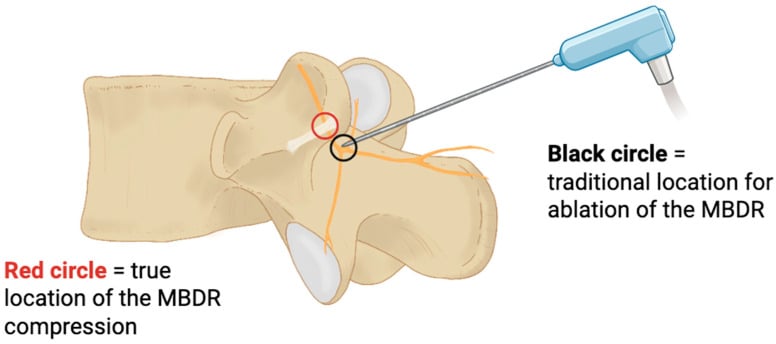
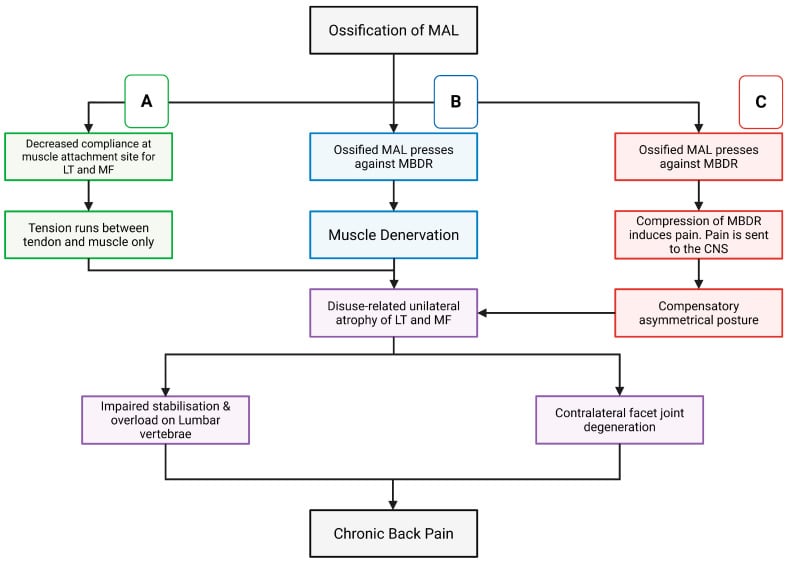
Load sharing. The facets bear 0-16% of axial load in neutral, rising to 40% in extension. They are the primary resistors of rotation and excessive translation, and they resist shear by preventing anterior translation of the vertebra above.
Pathophysiology
The degenerative cascade. Facet arthropathy develops through a well-defined sequence:
- Initiation - primary cartilage wear from ageing, repetitive loading or trauma triggers chondrocyte dysfunction
- Synovial inflammation - cartilage breakdown products stimulate synovitis, causing pain and joint effusion
- Subchondral change - bone sclerosis and subchondral cysts develop as cartilage protection is lost
- Osteophyte formation - marginal osteophytes form as a compensatory response to increased stress
- Capsular hypertrophy - the joint capsule thickens, contributing to lateral recess stenosis
- Instability - advanced degeneration may lead to subluxation and dynamic instability, and subluxation to spondylolisthesis
The three-joint complex. The disc and the two facet joints at each level degenerate together, in a vicious cycle. Disc degeneration costs height and increases facet load, which accelerates facet degeneration. Facet degeneration, through synovial hypertrophy, causes posterior element instability and shifts load, which accelerates disc degeneration and adjacent-level disease in turn.
Stenosis. Facet hypertrophy narrows the canal at three sites:
- Central - bilateral facet hypertrophy with ligamentum flavum thickening creates a trefoil canal
- Lateral recess - superior articular process hypertrophy compresses the traversing nerve root
- Foraminal - subluxation and osteophytes narrow the neural foramen
Classification Systems
The modified Fujiwara grades run from a normal joint to severe osteophytes with subchondral cysts and subluxation. Fujiwara's system is read on MRI and Pathria's on CT, and inter-rater agreement for both is only fair to moderate, which limits their use for treatment decisions.
- Findings
- Normal facet joint
- Clinical Correlation
- Asymptomatic
- Treatment
- None
- Findings
- Joint space narrowing, sclerosis
- Clinical Correlation
- Minimal symptoms
- Treatment
- Conservative
- Findings
- Moderate osteophytes, joint erosion
- Clinical Correlation
- Symptomatic facet pain
- Treatment
- Conservative, Blocks, RFA
- Findings
- Severe osteophytes, subchondral cysts, subluxation
- Clinical Correlation
- Stenosis, instability
- Treatment
- Decompression +/- Fusion
MRI and CT findings of facet arthropathy correlate poorly with symptoms, and many asymptomatic patients have Grade 3 changes. The diagnosis rests on history, examination and diagnostic blocks, not on imaging severity alone.
Clinical Assessment
History. Axial mechanical low back pain, worse with extension and rotation. Prolonged standing, walking and extension activities aggravate it; flexion, sitting and rest relieve it. Pain may radiate to the buttock or thigh but rarely below the knee, the pseudo-radicular pattern.
Stiffness and night pain. Morning stiffness is common and reflects an inflammatory component. Night pain is rare, and if present should make you consider other pathology.
Examination. Inspection shows loss of lumbar lordosis, a protective flexion posture. The facet joints are tender 2-3 cm lateral to the midline, extension and ipsilateral rotation are painful, and movement may bring audible or palpable crepitus. Neurology is usually normal unless there is concomitant stenosis or radiculopathy, and straight leg raise is negative unless there is a concurrent disc herniation.
The extension-rotation test. The patient stands, extends the lumbar spine, then rotates toward the painful side. Reproduction of the typical pain suggests facet-mediated pain, and sensitivity increases when it is combined with paraspinal tenderness over the facet joints. The 2020 multispecialty consensus found that no single history, examination or imaging finding reliably diagnoses facet pain in isolation, so a positive test suggests the diagnosis without confirming it.
Against discogenic pain. Disc pain is worse with flexion, sits in the midline or across both buttocks, and is axial, or in the leg if there is a herniation. Its imaging signs are disc desiccation, Modic changes and annular tears, and its diagnostic test, provocative discography, is controversial.
Atypical features suggest an alternative diagnosis:
- Night pain, constitutional symptoms: infection, malignancy
- Progressive neurological deficit: stenosis, cauda equina syndrome
- Young age (under 40): inflammatory spondyloarthropathy, infection
- Trauma history: fracture, instability
- No mechanical pattern: visceral referred pain, systemic disease
Investigations
Radiographs come first. AP and lateral films assess alignment, disc height and osteophytes, and oblique views show the facet joint space and the pars interarticularis. Flexion-extension laterals look for dynamic instability: translation over 3 mm or angulation over 10 degrees. The findings are joint space narrowing, sclerosis, osteophytes and the vacuum phenomenon.
MRI is second line, and its key finding is facet hypertrophy with ligamentum flavum thickening producing the trefoil canal. Each sequence shows something different:
- T2 sagittal and axial - facet joint effusion (high signal) and cartilage loss
- T1 - subchondral sclerosis (low signal) and fatty infiltration
- STIR - bone marrow oedema, a sign of active inflammation
CT is the alternative when MRI is degraded by metal artefact or detailed bony anatomy is needed. It shows osteophytes, subchondral cysts and joint orientation excellently.

SPECT-CT is the functional study, for discordant imaging and clinical findings or suspected facet pain. Increased tracer uptake indicates active inflammation, and in multi-level disease it guides which levels to block.
Diagnostic blocks. Imaging facet OA does not confirm the pain source. Controlled diagnostic medial branch blocks are the gold standard, and a positive result is 80% pain relief with concordant provocation on examination. A single block has a false-positive rate of 30-40%; two separate blocks, with a short-acting and a long-acting anaesthetic, reduce it to under 10%. The 80% threshold is itself disputed (see Controversies).
Management Algorithm
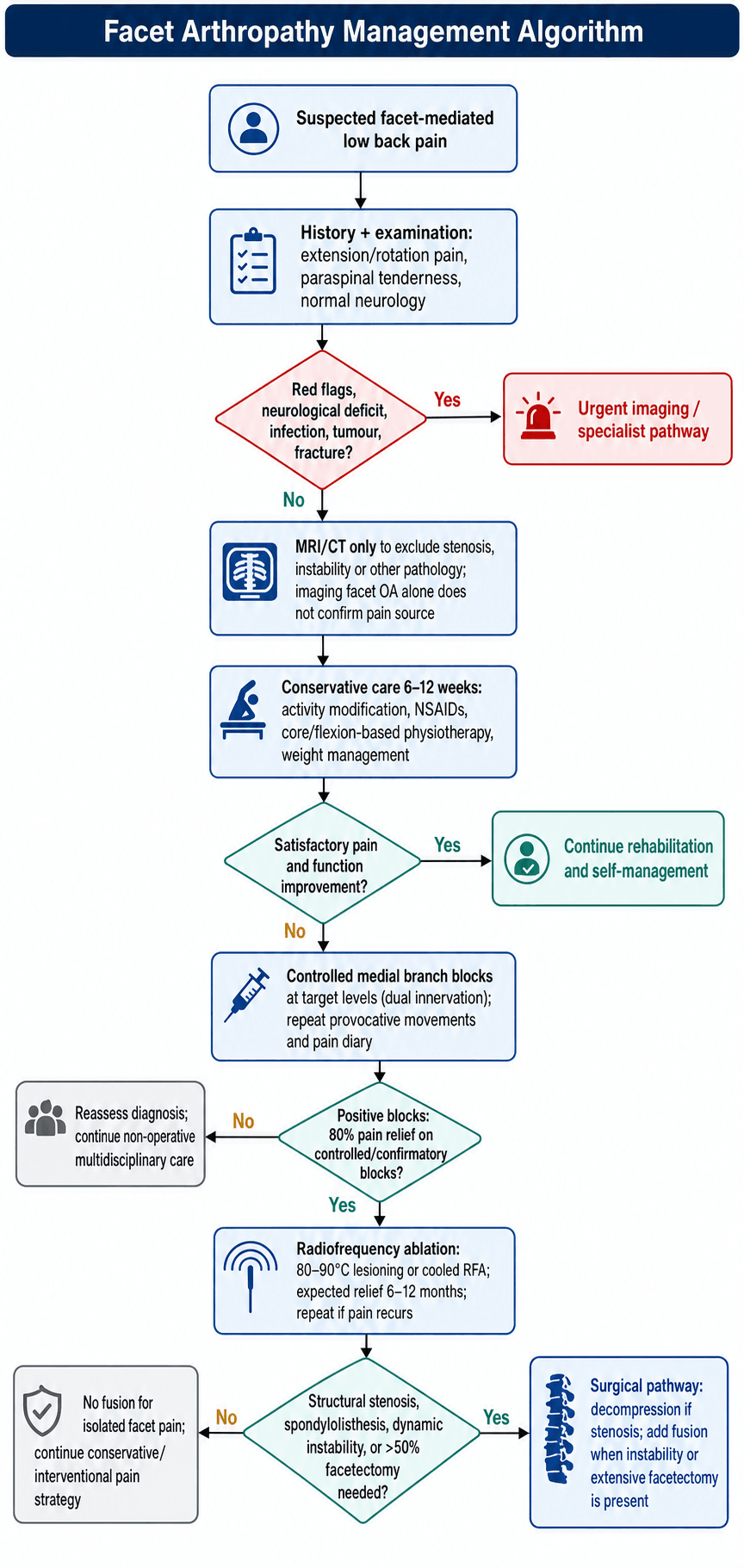
First line, for 6-12 weeks. The goals are to reduce inflammation, improve function and avoid surgery. The programme has two phases.
Acute phase, 0-6 weeks.
- Activity modification, avoiding extension-based activities
- NSAIDs in regular dosing for their anti-inflammatory effect, for 2-4 weeks
- Physiotherapy: core strengthening, flexion-based exercises, manual therapy
- Heat, ice and TENS for symptomatic relief
Subacute phase, 6-12 weeks.
- Continued physiotherapy: proprioceptive training, functional restoration
- Weight loss if BMI is over 30, to reduce facet load
- A lumbar corset for symptom control, not long-term
- Reassessment, with interventional options considered if there is no improvement
Who does well. Age under 50, symptoms for under 6 months, BMI under 30, no stenosis and good compliance with physiotherapy are favourable prognostic factors for conservative care.

Conventional vs Cooled Radiofrequency Ablation
The two techniques differ in lesion geometry, and the geometry dictates how the electrode must be positioned relative to the medial branch.
Conventional (thermal) RFA heats the active tip to roughly 80-90°C for 60-90 seconds. The lesion forms radially around the shaft of the active tip and extends only minimally beyond its end, so the electrode is placed parallel and tangential to the nerve as it crosses the SAP-TP junction, to capture the greatest length of medial branch. Lesion size grows with a larger-gauge cannula, a longer active tip, higher temperature and longer duration, and several overlapping lesions are often made to allow for anatomical variability in the course of the nerve.
Cooled (water-cooled) RFA circulates chilled water through the electrode to prevent the charring and impedance rise that limit conventional lesions. It deposits more energy, typically at a set tip temperature near 60°C, and creates a larger, more spherical lesion that projects beyond the tip. That permits a more perpendicular approach and, in theory, more reliable capture of a variably located nerve, at the cost of longer procedure time and higher consumable cost. Comparative trials are limited and have not established clear clinical superiority of either modality.
Why placement matters. The commonest technical cause of a "failed" RFA is a lesion that misses the nerve. Placement technique, active-tip length and multiple lesions drive success, not target temperature alone.
Before lesioning. Whatever the modality, sensory stimulation (50 Hz, seeking concordant paraesthesia at low voltage) and motor stimulation (2 Hz, confirming the absence of lower-limb muscle contraction that would signal proximity to the ventral ramus) confirm safe, accurate targeting.
Pulsed RFA uses bursts that keep tissue below roughly 42°C and is non-neurodestructive. It is generally considered insufficient for durable medial branch denervation and is not the standard for facet pain; continuous thermal or cooled lesioning is preferred.
Intra-Articular Facet Injection vs Medial Branch Block
Two targets. An intra-articular (IA) injection places local anaesthetic, with or without corticosteroid, into the facet joint capsule under fluoroscopic or CT guidance. The joint holds only about 1-2 mL and over-distension can rupture the capsule; the injection anaesthetises the joint itself, and the steroid is given with therapeutic intent, though evidence for durable benefit is weak. A medial branch block (MBB) anaesthetises the nerves that supply the joint, not the joint cavity.
Why MBB comes before ablation. The medial branch is the exact structure that radiofrequency ablation denervates, so a positive MBB maps directly onto the RFA target and a positive IA injection does not. The 2020 multispecialty consensus concluded that MBB is more predictive of RFA success than IA injection. In FACTS the two blocks behaved similarly, with positive-block rates of 54% (IA) and 55% (MBB) and post-RFA responder rates of 51% and 56%. Neither was therapeutic: both blocks are prognostic, not therapeutic, and their role is to select candidates.
- Intra-Articular Facet Injection
- Facet joint cavity
- Medial Branch Block
- Medial branch nerve (SAP-TP junction)
- Intra-Articular Facet Injection
- 1-2 mL (small joint capacity)
- Medial Branch Block
- 0.5-1 mL per level
- Intra-Articular Facet Injection
- No (joint, not nerve)
- Medial Branch Block
- Yes (same nerve RFA denervates)
- Intra-Articular Facet Injection
- Lower (per consensus)
- Medial Branch Block
- Higher — preferred selection test
- Intra-Articular Facet Injection
- Weak (steroid aspiration)
- Medial Branch Block
- Not therapeutic (diagnostic/prognostic)
Complications
- Incidence
- 20-30% at 10 years post-fusion (widely quoted teaching range; no page-cited source - varies by definition)
- Risk Factors
- Long fusion constructs, sagittal imbalance
- Management
- Extend fusion if symptomatic
- Incidence
- 10-15%
- Risk Factors
- Over 50% facet resection, preoperative subluxation
- Management
- Revision fusion
- Incidence
- 10-20%
- Risk Factors
- High temperature, prolonged lesion time
- Management
- NSAIDs, neuropathic pain medications, time (usually resolves)
- Incidence
- Variable
- Risk Factors
- Duration over 2 years, psychological factors, litigation
- Management
- Multidisciplinary pain program, psychological support
- Incidence
- Under 1%
- Risk Factors
- Immunosuppression, diabetes
- Management
- Antibiotics, drainage if abscess
After ablation. Medial branch RFA is generally safe. Besides neuritis and infection, skin burns occur but are rare with proper technique, and worsening pain, in 5-10%, may indicate the wrong diagnosis.
Adjacent segment disease after lumbar fusion is common, but no source cited on this page quantifies it; published incidence varies widely with definition (radiographic change versus symptomatic disease versus reoperation) and with follow-up length. Obesity joins long constructs and sagittal imbalance as a risk factor. Preserve motion segments when possible, minimise fusion length, and counsel patients preoperatively about long-term risks and the need for potential revision surgery.
Outcomes and Prognosis
Conservative care. A figure of 40-60% achieving satisfactory relief is sometimes quoted, but no cited trial on this page reports a success rate for conservative care. Both randomised trials used a structured exercise programme as the comparator, and in MINT the exercise programme alone performed as well as exercise plus radiofrequency denervation, which is the strongest statement about conservative care the evidence supports.
Radiofrequency ablation. The randomised trials disagree with the observational literature, and the trials are better. MINT's facet arm found a mean difference of -0.18 (95% CI -0.76 to 0.40) at three months against a prespecified 2-point threshold, a confidence interval that excludes clinically important benefit. The 2015 Cochrane review, whose search closed before both trials, found moderate-quality evidence of a -1.47 point short-term advantage over placebo, itself below that threshold, and concluded there was no high-quality evidence of benefit.
The case for selection. In FACTS, responders after a positive block did better after ablation than after a saline block (56% vs 24% at three months), which is the strongest remaining argument for careful selection.
Fusion. No source cited on this page reports fusion outcomes for facet-mediated pain. Figures quoted in the fusion literature apply to structural indications, spondylolisthesis and stenosis, and should not be transferred; fusion for isolated facet pain without structural pathology is not supported by any evidence cited here.
Poor prognostic factors for fusion: isolated facet pain without stenosis/instability, duration over 2 years, psychological comorbidities (depression, catastrophising), active litigation/compensation, smoking and obesity (BMI over 35). Comprehensive preoperative assessment and patient selection are critical.
Guidelines, Registries & Global Practice
Global Epidemiology
- Facet osteoarthritis is near-universal with age: CT prevalence rises from roughly 24% under 40 to 89% at 60-69 years (Framingham cohort), with the highest burden at L4-L5.
- Imaging facet OA correlates poorly with symptoms; facet-mediated pain is estimated to account for 10-40% of chronic low back pain, the wide range reflecting differing diagnostic-block criteria.
- Lumbar fusion and facet-intervention rates vary several-fold between countries and even between regions of the same country, reflecting practice variation rather than disease burden.
- Diagnostic blocks
- MBB preferred over IA; prognostic not therapeutic
- RFA
- Reasonable in well-selected patients after positive block(s)
- Fusion for axial LBP
- Not addressed (interventional focus)
- Diagnostic blocks
- Do not offer imaging-guided injections for non-specific LBP
- RFA
- RFA only after positive diagnostic block and within strict criteria
- Fusion for axial LBP
- Do not offer fusion for non-specific LBP outside a trial
- Diagnostic blocks
- Controlled MBB to confirm facet source
- RFA
- Option after confirmed facet pain
- Fusion for axial LBP
- Reserve for instability/stenosis, not isolated facet pain
- Diagnostic blocks
- Diagnostic blocks to select candidates
- RFA
- Modest, time-limited benefit acknowledged
- Fusion for axial LBP
- Structural indications only; emphasise shared decision-making
- National registries (e.g. UK, US, Scandinavian spine registries) track fusion volumes and revision; degenerative disease dominates indications.
- Rising fusion rates without proportional outcome gains have prompted payer scrutiny and value-based selection criteria worldwide.
- There is no implant registry analogue for RFA; outcomes depend heavily on patient selection and technique.
- Well-resourced settings: Fluoroscopy/CT-guided diagnostic blocks and RFA readily available; MRI used to exclude alternative pathology.
- Limited-resource settings: Diagnosis is largely clinical; emphasis on exercise, NSAIDs, and weight management; interventional procedures and fusion are reserved for clear structural indications.
- Universal principle: Conservative care first; reserve fusion for documented instability or stenosis, not pain alone.
Key documentation requirements:
- Adequate trial of conservative management (typically 6-12 weeks) before interventional treatments.
- Informed consent for RFA: Explain time-limited relief (commonly 6-12 months when effective), the need for repeat procedures, and a substantial non-response rate.
- Informed consent for fusion: Adjacent segment disease risk (20-30% at 10 years), realistic outcome expectations, and alternatives.
- Patient selection for fusion: Document a structural indication (stenosis, instability), not isolated pain. Fusion for isolated facet pain is controversial and associated with poor outcomes.
- Shared decision-making: Record discussion of risks, benefits, alternatives, and patient preferences.
Common medicolegal pitfalls include fusion for isolated pain without structural pathology, an inadequate conservative trial before surgery, and failure to counsel about adjacent segment disease.
Controversies and Areas of Uncertainty
The RFA efficacy debate. Observational series and earlier reviews report 50% or greater relief in 60-70% of well-selected patients, but the two highest-quality pragmatic RCTs are sobering: MINT (2017) found no clinically important benefit of ablation over exercise, and FACTS (2018) found the blocks themselves no more therapeutic than saline. Critics argue MINT used a liberal 50% block threshold and possibly suboptimal lesioning; proponents of the RCTs argue prior series were confounded by selection bias and placebo response. The honest exam answer is that RFA may help carefully selected patients, but the strongest evidence is sobering and routine use is not supported.
Diagnostic block threshold, 50% or 80%. No consensus exists. An 80% dual-block standard maximises specificity but yields more false negatives and is costly; a single 50% block (used in MINT) increases sensitivity but raises false positives to 30-40%. Guidelines deliberately leave this to local protocol.
Is "isolated facet pain" a real entity? Facet OA almost always coexists with disc degeneration in the three-joint complex, and imaging facet OA does not correlate with pain. Whether a purely facet-mediated pain phenotype exists, and whether it ever justifies fusion, remains contested; fusion for axial pain alone is widely discouraged.
MCQ Practice Points
Q: The L4/5 facet joint receives dual innervation from which medial branch nerves? A: L3 and L4 medial branch nerves. Each facet joint is innervated by medial branches from the levels above and below. This is why diagnostic blocks and RFA must target TWO levels per joint (e.g., L3 and L4 for L4/5 facet).
Q: What percentage of pain relief is required from a diagnostic medial branch block to confirm facet-mediated pain? A: 80% pain relief with concordant provocation maneuvers. Single blocks have a 30-40% false-positive rate, so two separate blocks (using anesthetics with different durations) are recommended to reduce false positives to under 10%.
Q: What percentage of axial load do facet joints bear during lumbar extension? A: Up to 40% of axial load during extension. In neutral position, facets bear 0-16% of load. Extension increases facet loading dramatically, which explains why facet arthropathy causes extension-based pain.
Q: What is the average duration of pain relief following successful radiofrequency ablation for facet-mediated pain? A: The honest answer names the disagreement. Uncontrolled series and pre-trial reviews describe six to twelve months of relief in a majority of well-selected patients. The randomised evidence does not support that: MINT's facet arm found a mean difference of -0.18 (95% CI -0.76 to 0.40) at three months against a prespecified clinically important difference of 2 points, and the 2015 Cochrane review - whose search closed before MINT and FACTS - concluded there was no high-quality evidence of pain relief or functional benefit. The one randomised signal in favour is FACTS, where 56% of patients ablated after a positive diagnostic block were responders at three months against 24% of those ablated after a saline block, which supports careful selection rather than the procedure itself. Repeat ablation is common practice but no cited source establishes its efficacy or when returns diminish.
Q: What is the primary indication for fusion in the setting of facet arthropathy? A: Structural indications: spondylolisthesis, stenosis requiring extensive facetectomy (over 50% of facet), or documented dynamic instability. Fusion for isolated facet pain without structural pathology is controversial and generally NOT recommended based on current evidence.
Q: What is the incidence of adjacent segment disease following lumbar fusion at 10 years? A: The commonly quoted teaching range is 20-30% at 10 years, but no source cited on this page establishes it - the published incidence varies widely with definition (radiographic change vs symptomatic disease vs reoperation) and follow-up length. Risk factors include long fusion constructs, sagittal imbalance, and patient factors (obesity, smoking). This highlights the importance of preserving motion segments when possible.
Exam Viva Scenarios
Practise clinical reasoning and management decisions out loud
“A 62-year-old male presents with 6 months of low back pain worse with extension and prolonged standing. Pain radiates to right buttock but not below knee. Neurological exam normal. MRI shows Grade 2 facet arthropathy at L4/5 and L5/S1. How would you assess and manage this patient?”
“The patient from Scenario 1 returns after 8 weeks of conservative treatment with minimal improvement. He requests 'something more' for pain relief. How would you counsel him regarding interventional options?”
“A 68-year-old female with L4/5 facet arthropathy, Grade 1 degenerative spondylolisthesis, and central stenosis presents with neurogenic claudication (walking 50 meters). Previous RFA provided 8 months of relief but pain recurred. MRI shows trefoil canal with facet hypertrophy contributing to stenosis. How would you manage this patient?”
Key Anatomy
- Synovial diarthrodial joint with hyaline cartilage
- Dual innervation: L4/5 facet = L3 and L4 medial branches
- Medial branch courses over SAP-TP junction (target for blocks/RFA)
- Facets resist 0-16% load (neutral), 40% load (extension)
Classification
- Fujiwara Grade 0 = Normal
- Grade 1 = Narrowing, sclerosis → Conservative
- Grade 2 = Osteophytes, erosion → Conservative, Blocks, RFA
- Grade 3 = Severe changes, cysts, subluxation → Decompression +/- Fusion
Diagnosis
- Clinical: Extension/rotation pain, paraspinal tenderness, no radiculopathy
- Imaging: MRI/CT shows facet changes (poor symptom correlation)
- Gold standard: Medial branch blocks (80% relief threshold)
- Confirmatory: Two separate blocks (reduces false positives to under 10%)
Treatment Algorithm
- Conservative 6-12 weeks: PT, NSAIDs, activity modification (the trial comparator; no success rate established)
- Diagnostic blocks: not therapeutic; 30% of saline blocks read positive at a 50% threshold (FACTS)
- RFA: MINT found -0.18 (CI -0.76 to 0.40) vs a 2-point threshold; benefit is contested
- Fusion: ONLY for stenosis, spondylolisthesis, or over 50% facetectomy needed
Surgical Pearls
- Resection over 50% facet = high instability risk (consider fusion)
- Fusion for isolated facet pain WITHOUT stenosis/instability = controversial, poor outcomes
- TLIF/PLIF for stenosis + instability (addresses both pathologies)
- Counsel about adjacent segment disease (20-30% at 10 years)
Complications
- RFA neuritis: 10-20% (temporary, resolves with time)
- Adjacent segment disease: commonly quoted 20-30% at 10 years post-fusion (teaching range; varies by definition)
- Postoperative instability: 10-15% if over 50% facet removed without fusion
- Chronic pain syndrome: multifactorial (duration, psychological factors)
Evidence Base and Key Trials
Cochrane Review: Radiofrequency Denervation for Chronic Low Back Pain
- 23 RCTs (N=1309); 13 (56%) at low risk of bias; overall evidence very low to moderate quality
- Facet RFA showed moderate-quality evidence of a greater short-term effect on pain than placebo (MD -1.47, 95% CI -2.28 to -0.67)
- Low-quality evidence for short- and long-term functional benefit vs placebo
- No high-quality evidence that RFA provides meaningful pain relief; effect sizes small and below typical clinical thresholds