Closed-Space Pulp Infection | Surgical Emergency | High Pressure Compartment
- Fibrous septa tether pulp skin to the distal phalanx and can compartmentalise infection
- Drain a demonstrated abscess promptly; no validated 24- or 48-hour clock replaces examination
- Avoid transverse fishmouth incisions because scars and neurovascular compromise can produce a painful unstable tip
- Culture purulence and choose empiric antibiotics from local resistance, exposure, host and bite risk
- Protect both digital neurovascular bundles and avoid extending proximally into the flexor sheath
- “Felon = infection of the distal pulp, whereas paronychia centres on the nail fold
- “Check Kanavel signs, DIP motion, perfusion and sensation; proximal findings change urgency and scope
- “Incision position follows the collection and surgeon's safe approach, not one universal hockey-stick pattern
- “Packing, drain use, removal and antibiotic duration follow cavity, tissue and response rather than a fixed 48-hour rule
Overview and Epidemiology
A felon is a closed-space infection of the distal pulp of the finger. Paronychia, by contrast, centres on the nail fold.
How the pulp is inoculated. The route matters because a bite or oral inoculation changes the microbiology and the antimicrobial cover required:
- Penetrating trauma: a splinter, needle, thorn or puncture
- A bite or oral inoculation
- Iatrogenic puncture, including repeated fingertip testing
- No recalled injury at all, which does not exclude infection
Who is at risk. Four groups are singled out:
- Manual labourers: carpenters, gardeners, mechanics
- Diabetics, through impaired immunity and poor healing
- The immunosuppressed: steroids, chemotherapy, HIV
- Children, through thumb-sucking and foreign-body ingestion
The Felon in the Child: Different Anatomy and a Key Mimic
- The paediatric distal phalanx is not a small adult one. The distal phalanx has an open physis with the epiphysis at its base, and the germinal nail matrix lies dorsally, immediately proximal to the physis. A neglected pulp infection or over-aggressive curettage therefore risks the physis (growth arrest/shortening) and the germinal matrix (permanent nail deformity) - so in a child, drainage is adequate but conservative, bone curettage is gentle, and the dorsal matrix/physis are respected.
- Blistering distal dactylitis - the superficial mimic. In children (and occasionally adults) a tense, fluid-filled superficial blister on the volar fat pad of the fingertip, caused by Group A streptococcus (or S. aureus), mimics a felon but is a superficial subcutaneous/epidermal blistering infection, NOT a deep septic pulp compartment. The distinction matters because it is treated by simple deroofing/incision-drainage of the bulla plus oral antibiotics, and does not require the deep septum-disrupting felon I&D. A superficial fluctuant blister (rather than a tensely indurated deep pulp) in a child should raise it.
- Threshold and antibiotics. Children may not localise pain well and can deteriorate quickly, so maintain a low threshold for examination under GA and for imaging; antibiotic choice follows the same anti-staphylococcal (plus MRSA where prevalent) principles, but streptococcal cover is relevant given blistering distal dactylitis.
Q: How does the paediatric felon differ, and what superficial mimic must you recognise? A: The child's distal phalanx has an open physis (epiphysis at the base) and a dorsally-located germinal nail matrix, so drainage must be conservative to avoid growth arrest or nail deformity. The key mimic is blistering distal dactylitis - a superficial Group A strep (or staph) blister on the volar fat pad, NOT a deep pulp abscess - treated by deroofing the blister + oral antibiotics, not a deep felon incision-and-drainage. Keep a low threshold for EUA/imaging in a child who cannot localise.
The Pseudo-Felon and the Non-Resolving Felon: Gout and Atypical Infection
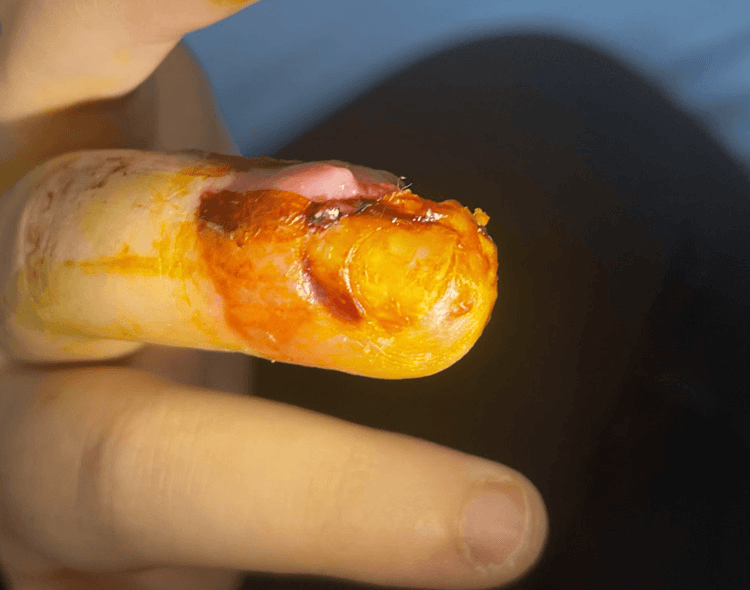
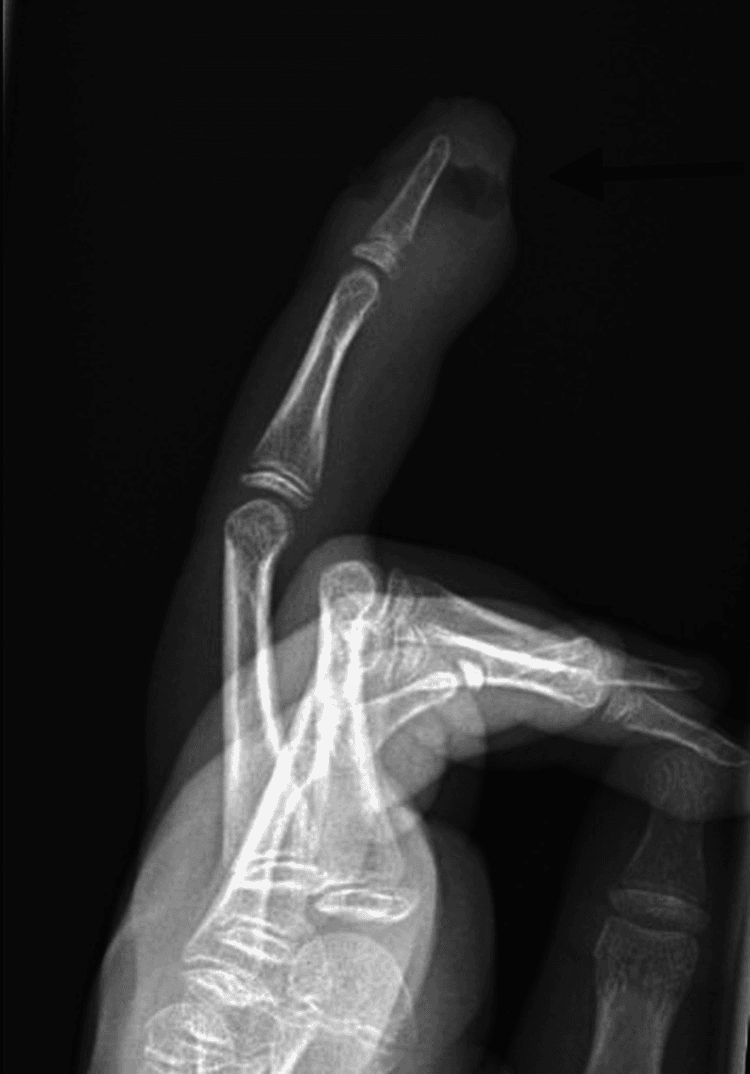
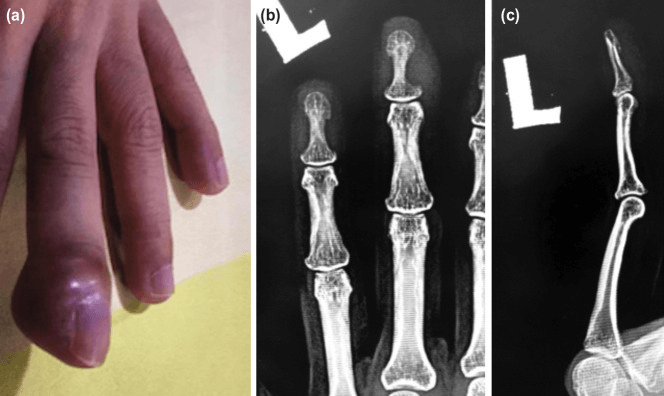
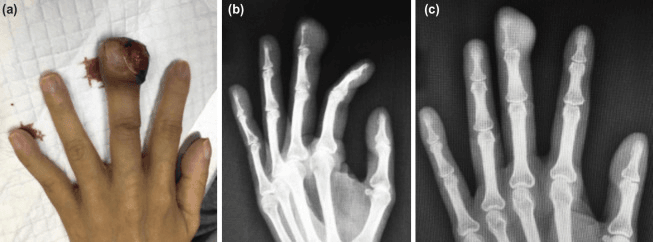
- Gout - do not blindly incise a tophus. An acute gouty attack or an eroding tophus of the DIP/fingertip can present with a red, hot, tender, swollen digit that mimics a felon, sometimes discharging chalky white urate rather than pus. Incising a tophus can create a chronic, non-healing, discharging wound. If the story fits (known gout, other tophi, no clear inoculation), aspirate and send for polarising microscopy (negatively birefringent, needle-shaped urate crystals) and check serum urate before committing to a septic incision-and-drainage - the treatment is medical, not a felon drainage.
- The felon that will not settle - think atypical/indolent infection. A pulp or fingertip infection that fails to resolve, recurs, or forms a chronic sinus despite adequate bacterial drainage should prompt consideration of an atypical organism: Mycobacterium marinum (after aquatic / fish-tank / fishing exposure - an indolent granulomatous infection that grows best at lower temperature, needs special mycobacterial culture at ~30-32°C and biopsy, and prolonged antimycobacterial therapy), fungal infection (immunocompromised, gardeners - sporotrichosis), or unusual bacteria. Ordinary swabs and short antibiotic courses miss these, so send tissue for histology plus prolonged/atypical cultures rather than repeating the same drainage.
- Other named mimics to keep in mind. As emphasised throughout, herpetic whitlow (vesicles - do NOT incise; routed to
herpetic-whitlow) and non-infective lesions (pyogenic granuloma, glomus tumour, metastasis/rarely subungual melanoma presenting as a "chronic infection") sit in the same differential - the unifying rule is that an atypical, non-purulent, or non-resolving "felon" earns imaging, aspiration/biopsy and the correct culture, not another blind incision.
Q: A 'felon' is atypical or won't heal despite drainage - what do you think of? A: Step back from "bacterial felon". Consider gout (red tender digit ± chalky tophus - aspirate for negatively birefringent urate crystals, check urate, do NOT just incise a tophus into a chronic wound); an atypical/indolent infection in the non-resolving case - Mycobacterium marinum (aquatic exposure; needs low-temperature mycobacterial culture + biopsy + prolonged therapy) or fungal (sporotrichosis); and remember herpetic whitlow (vesicles, never incise) and non-infective mimics (pyogenic granuloma, glomus, rarely subungual melanoma). The rule: an atypical or non-resolving "felon" earns biopsy and the right culture, not another blind drainage.
Pathophysiology and Mechanisms
The septa. Fibrous bands run from the periosteum of the distal phalanx to the pulp skin. They stabilise the fingertip and divide its fat into lobules, and in infection they can compartmentalise pus into locules that sit against bone and raise tissue tension.
Why an abscess needs drainage. Pus confined in this way means an established pulp abscess cannot be cured reliably by antibiotics alone. Pressure, vascular compromise and direct contact with the distal phalanx explain the risk of necrosis and osteomyelitis. What matters clinically is compartmentalisation, perfusion and proximity to bone, not an exact septal count or an unvalidated pressure threshold.
How it evolves. The findings change as the infection progresses:
- Early cellulitic pain and erythema may precede an abscess
- Increasing tension, fluctuance or a focal collection indicates pus
- Persistent pain, drainage or bone tenderness raises concern for osteomyelitis
- Proximal tenderness or Kanavel signs raise concern for flexor-sheath spread
Microbiology. Staphylococcus aureus is common, but its susceptibility varies by region and exposure, and streptococcal and polymicrobial infections occur. Bites, water or soil exposure, immunosuppression and healthcare contact change the empiric coverage. Send pus or tissue for culture and adapt treatment to local guidance.
Classification Systems
By location. The site of maximal swelling guides the incision: a lateral incision goes on the side where the swelling is greatest.
- Location
- Central pulp space
- Features
- Most common (70%), symmetric swelling, midline tenderness
- Preferred Incision
- Volar longitudinal or lateral hockey-stick
- Location
- Radial side of the pulp
- Features
- Eccentric swelling, maximal tenderness radial side
- Preferred Incision
- Radial lateral hockey-stick incision
- Location
- Ulnar side of the pulp
- Features
- Eccentric swelling, maximal tenderness ulnar side
- Preferred Incision
- Ulnar lateral hockey-stick incision
By stage. Staging decides treatment. Abscess formation, bone tenderness, systemic illness and proximal spread determine urgency and imaging; elapsed hours alone do not.
- Clinical Features
- Tense pulp without fluctuance or systemic signs; no collection on examination or ultrasound
- Management
- Elevation, analgesia and appropriate antibiotics with close review, or early drainage
- Key Pearl
- Drainage is not required until a collection or necrotic focus is present
- Clinical Features
- Tense, fluctuant, purulent or ultrasound-confirmed collection
- Management
- Prompt incision and drainage with culture; antibiotics according to host and severity
- Key Pearl
- Break locules sufficiently to drain while avoiding indiscriminate tissue injury
- Clinical Features
- Bone tenderness, systemic illness, ischaemia, proximal spread, recurrence or atypical course
- Management
- Radiographs and selective ultrasound/MRI; drainage and sequestrectomy, debridement and prolonged targeted antibiotics
- Key Pearl
- Do not assume osteomyelitis from time alone
Clinical Presentation
History. A penetrating injury 2-7 days earlier, followed by progressive swelling of the pulp and severe throbbing pain from compartment pressure, worse at night and disturbing sleep. Systemic symptoms are uncommon unless the organism is MRSA or the patient is diabetic.
Examination. The pulp is tense and exquisitely tender, and the erythema is limited to the volar fingertip rather than spreading proximally. Fluctuance may be present but is difficult to elicit because of the septa. Check for Kanavel signs, DIP motion, perfusion and sensation: a felon has no Kanavel signs, which distinguishes it from flexor tenosynovitis, and proximal findings change the urgency and scope of treatment.
Felon or paronychia. The site separates them. A felon is a pulp-space infection of the volar distal phalanx, with severe pulp tenderness and no nail involvement. Paronychia is an infection of the nail fold (perionychium), with nail-fold erythema and pus under the cuticle or nail plate, and it often responds to conservative treatment or simple nail elevation. A subungual collection is a periungual mimic of the same kind:
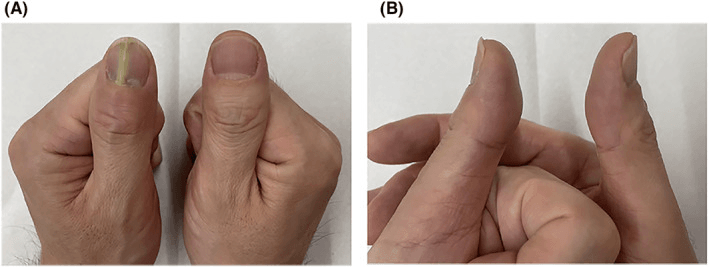
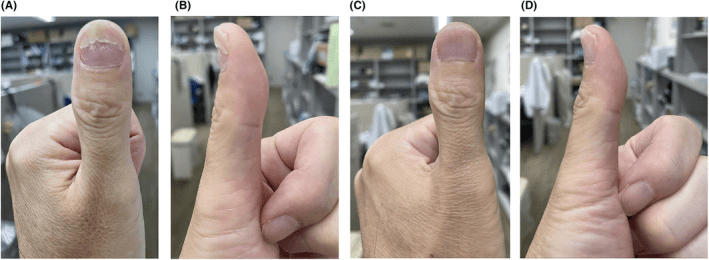
The differential. Four conditions sit closest:
- Key Distinguishing Features
- Nail fold erythema, pus visible under cuticle, no pulp involvement
- Management Difference
- Conservative or simple nail elevation
- Key Distinguishing Features
- Kanavel signs: flexed posture, fusiform swelling, pain on passive extension, tenderness along flexor sheath
- Management Difference
- Urgent flexor sheath irrigation
- Key Distinguishing Features
- Diffuse erythema, no localised abscess, spreads along lymphatics
- Management Difference
- IV antibiotics, no drainage
- Key Distinguishing Features
- Vesicles, burning pain, history of HSV, no pus
- Management Difference
- Conservative - DO NOT INCISE
Investigations
A clinical diagnosis. Felon is diagnosed at the bedside: a penetrating injury, severe pulp pain, a tense tender fingertip and erythema limited to the pulp space. In typical cases no investigation is needed before drainage.
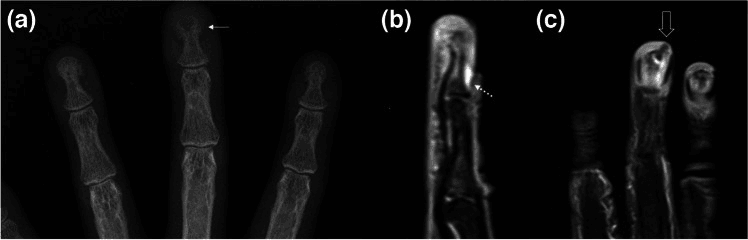
Radiographs. AP and lateral films of the finger if the presentation is over 48 hours or there is bony tenderness, looking for bone erosion, periosteal reaction and sequestrum formation. No source cited on this page quantifies how often delayed felons develop osteomyelitis, so image on these clinical grounds rather than on an assumed rate, and remember that radiographic change lags the infection by one to two weeks.
Ultrasound and MRI. Ultrasound can confirm a collection, and selective ultrasound or MRI belongs to the complicated or non-resolving infection. MRI can localise an atypical or non-resolving process when the clinical compartment is uncertain. In the subungual abscess below, ultrasound places the collection between the nail plate and the distal phalanx rather than within the pulp.
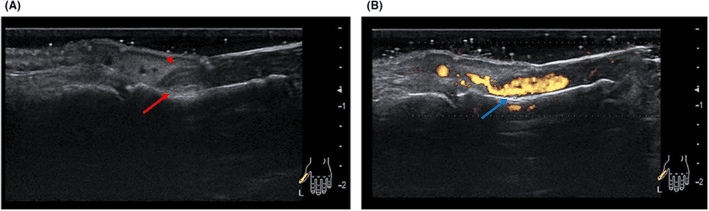
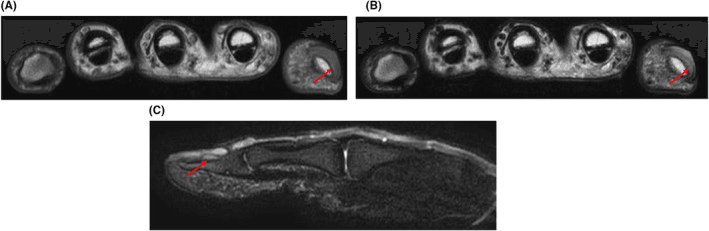
Cultures. Send pus for microscopy, culture and sensitivity at the time of drainage, which allows antibiotics to be tailored, especially for MRSA. Take blood cultures if the patient is systemically unwell or diabetic.
HSV testing. A viral swab for HSV PCR if vesicles are present or the presentation is atypical. Herpetic whitlow mimics a felon but is managed conservatively: incision spreads the virus and worsens the outcome.
Management
Abscess, not the clock. Cellulitis without a collection may be treated non-operatively with close review. Fluctuance, a tense collection, purulence or an ultrasound-confirmed abscess requires prompt drainage. No validated 24- or 48-hour clock replaces examination.
Non-operative treatment. Rarely appropriate, and only for cellulitis without abscess formation or fluctuance, in a cooperative patient who can be observed closely. No trial has quantified how often a non-operative trial succeeds in an established felon; the reviews cited here describe drainage as the treatment once the pulp is tense, so keep the threshold for surgery very low.
Conservative Protocol
Flucloxacillin 500mg QID orally, or 2g QID IV if toxic. With penicillin allergy, clindamycin 450mg TDS. Cover MRSA if risk factors are present (vancomycin 15-20mg/kg IV BD).
Strict elevation above heart level. A volar splint in the safe position: wrist 30 degrees extension, MP 70 degrees flexion, IP joints extended. Ice packs for 20 minutes every 2 hours.
Review at 12-24 hours and proceed immediately to drainage if pain is not improving at 12 hours, swelling increases, fluctuance develops, systemic signs appear (fever, tachycardia) or the patient prefers definitive treatment.
Incision and drainage. This is the standard treatment for an established abscess, and the technique is described in the next section. Beyond the collection itself, it is indicated for:
- A fluctuant felon at any stage
- Failed conservative management
- Radiographic osteomyelitis
Antibiotics with drainage. Select antimicrobial therapy from severity, culture, local resistance, allergy, exposure and host factors.
Surgical Technique - Detailed Approach
Structures at risk. Four structures are at risk during drainage:
- Location
- Radial and ulnar borders of finger
- Risk During Drainage
- Injury during lateral incision if too dorsal/volar
- Protection Strategy
- Keep incision between midlateral line and volar midline
- Location
- Volar to DIP joint
- Risk During Drainage
- Inadvertent entry into flexor sheath
- Protection Strategy
- Do not extend incision proximal to DIP flexion crease
- Location
- Central pulp space
- Risk During Drainage
- Osteomyelitis from pressure necrosis
- Protection Strategy
- Early drainage prevents bone involvement
- Location
- Deep to pulp space
- Risk During Drainage
- Septic arthritis from proximal spread
- Protection Strategy
- Urgent drainage prevents joint extension
Setup. Supine, with the arm abducted 90 degrees on a hand table. Prepare with Betadine from fingertip to mid-forearm and drape with a window exposing the finger. The upper-arm tourniquet is inflated after exsanguination with an Esmarch or by elevation, to 250mmHg for 20-30 minutes at most.
Anaesthesia. A digital block is preferred: 2% lignocaine without adrenaline, 2-3ml each side of the digit base, then wait 5-10 minutes. Adrenaline is avoided because of the risk of ischaemia. Alternatives are a ring block, a wrist block (median, ulnar and radial nerves) or an axillary block; general anaesthesia for a child or an extensive debridement.
Choosing the incision. The lateral hockey-stick is the preferred technique and the volar longitudinal incision the alternative, but position still follows the collection and the surgeon's safe approach, and no single pattern is universal. Use a longitudinal volar or safe lateral approach appropriate to the collection, and protect the digital neurovascular bundles, the nail matrix and the flexor sheath. Never extend proximal to the DIP flexion crease, which risks entering the flexor sheath, and avoid a transverse volar incision, which crosses the digital nerves.
Never a fishmouth. A transverse incision across the fingertip causes pulp necrosis and an unstable, painful tip.
Lateral (hockey-stick) approach: preferred. It stays lateral to the neurovascular bundle, avoids a volar scar, carries a lower neurovascular risk and drains well.
- Identify the DIP flexion crease and the midlateral line. Start 5mm distal to the DIP crease on the radial or ulnar side, choosing the side of maximal swelling or pointing.
- Run the longitudinal limb 15mm parallel to the midlateral line, staying between it and the volar midline.
- Curve a transverse limb across the fingertip (the hockey-stick) to allow drainage and avoid tip necrosis.
- Deepen through the dermis to the pulp space with fine scissors or a #15 blade, neither too dorsal (the neurovascular bundle) nor too deep (the DIP joint).
Volar longitudinal approach: the alternative. A central incision 20mm long, starting 5mm distal to the DIP crease and running to the fingertip in the exact midline, between the neurovascular bundles. It leaves a volar scar that can be tender and painful with pinch, and its neurovascular risk is slightly higher if the incision drifts off the midline. Deepen to the pulp, evacuate the pus and break the septa as for the lateral approach.
Drainage and debridement. The same steps follow either incision:
- Evacuate the pus and send it for MC&S.
- Break down the fibrous septa with a curved mosquito or small haemostat, sweeping through all compartments. Incomplete drainage leads to recurrence; the aim is to open the infected locules while avoiding indiscriminate injury to viable pulp.
- Curette out pus and necrotic tissue and irrigate with 500ml normal saline.
- If bone is exposed, feel it: roughness indicates osteomyelitis. Curette a sequestrum gently, because aggressive curettage weakens the bone.
The wound. Leave it open for drainage and do not close primarily; it needs open drainage for 48-72 hours. Pack lightly with ribbon gauze (iodoform or Vaseline), since tight packing causes pressure necrosis, and insert a 0.25-inch Penrose drain if the cavity is large. A bulky dressing leaves the fingertip exposed for monitoring, and the hand is elevated and protected as needed.
Complications
What to exclude. Persistent or severe disease warrants assessment for distal-phalanx osteomyelitis, DIP septic arthritis, flexor-sheath spread, ischaemia, a foreign body and atypical infection. Proximal spread changes the emergency, and painful DIP motion warrants assessment of the joint.
Osteomyelitis. The pulp infection lies directly against the distal phalanx, which creates a real osteomyelitis risk, but no validated 48-hour percentage exists and the incidence is not established by any universal delay threshold. Drain established pus, review cases that do not resolve, image when bone involvement is suspected, obtain deep cultures, and combine source control with organism- and host-specific therapy.
- Recognition
- Persistent pain after drainage, bone tenderness or recurrence; bone erosion or sequestrum on X-ray
- Risk Factors
- Persistent infection, bone exposure or tenderness, diabetes, immunosuppression
- Management
- Debride dead bone; 4-6 weeks of IV antibiotics (flucloxacillin or vancomycin), culture-directed with hand and infection specialists; serial X-rays
- Recognition
- Kanavel signs develop, pain on passive extension
- Risk Factors
- Inadequate drainage, delayed treatment
- Management
- Urgent flexor sheath irrigation via a Bruner incision, drain the sheath, IV antibiotics; may need multiple washouts
- Recognition
- Joint swelling, pain on DIP motion, effusion on ultrasound
- Risk Factors
- Bone involvement, severe infection
- Management
- Arthrotomy and joint washout, IV antibiotics 4-6 weeks; may need arthrodesis if the cartilage is destroyed
- Recognition
- May follow pressure, ischaemia or a harmful incision
- Risk Factors
- Fishmouth incision, inadequate drainage, vascular compromise
- Management
- Debride necrotic tissue, flap coverage if needed; may need revision amputation
- Recognition
- Persistent drainage beyond 4 weeks, tract on sinogram; suggests a retained focus or bone infection
- Risk Factors
- Retained necrotic tissue, inadequate septal breakdown, osteomyelitis
- Management
- Excise the tract and debride the cavity, antibiotics; close primarily or with flap coverage if the defect is large
- Recognition
- -
- Risk Factors
- Incision too dorsal or volar, poor technique
- Management
- Microsurgical repair if identified, sensory rehabilitation
Postoperative Care
Antibiotics. Empiric antibiotics are given at a dose and route appropriate to severity, exposure, local resistance and host factors, and adjusted once culture results return. The course runs to a total of 7-10 days.
Packing and drain. Both come out when the cavity and drainage permit rather than on a fixed 48-hour rule; the first review is at 48 hours, with drain removal at 48-72 hours. Close follow-up ensures early detection of complications such as osteomyelitis or chronic sinus formation.
Postoperative Timeline
Elevate, monitor perfusion and sensation, and provide analgesia.
Remove the packing when the cavity permits and assess the wound. Check neurovascular status and adjust antibiotics to the culture results. Escalate persistent pus, pain, ischaemia or proximal spread.
Daily dressing changes with dry gauze while the wound granulates and contracts. Gentle range of motion for the DIP and PIP joints to prevent stiffness. At the one-week check, look for osteomyelitis (persistent pain; X-ray if concerned) and complete the antibiotic course.
The wound closes by secondary intention, epithelialising from its edges. Reduce dressings to every 2-3 days, begin scar massage, check range of motion and resume light activities. Discharge at the three-week review if healing well.
Complete healing and full range of motion. Continue scar massage to soften the scar; return to work and normal activities.
Outcomes and Prognosis
Healing. Early drainage (under 24 hours) is quoted at 98% complete resolution, healing in 3 weeks with minimal scarring. After prompt source control of an established abscess, the outcome depends on tissue viability, the organism and the host: review until drainage and inflammation resolve, and image and re-debride when the response is poor. Complicated or delayed infection varies with osteomyelitis, ischaemia and comorbidity; with osteomyelitis, healing takes 8-12 weeks, longer treatment and reconstruction may be required, and amputation may be required. Do not quote unsupported universal percentages for any of these.
Prognostic factors. Complete source control, viable perfused tissue, no bone, joint or sheath involvement, a susceptible organism and an immunocompetent host favour recovery. Ischaemia, diabetes or immunosuppression, osteomyelitis, proximal spread, a retained foreign body, an atypical organism and inadequate source control count against it.
Function and long-term problems. The figures quoted for recovery:
- Return to work at 4-6 weeks for manual labourers
- Full range of motion in 90% at 8 weeks
- Grip strength recovers toward baseline over about 12 weeks; no series measures a figure for felon recovery, so none is quoted
- Normal two-point discrimination in 85%
- Persistent fingertip tenderness in 5%
- Cold intolerance in 10-15% in the first year
- Nail deformity rare (under 2%) if the nail matrix is avoided
- Recurrence under 2% with adequate initial treatment
Guidelines, Registries & Global Practice
- Fingertip is the most common site of hand infection worldwide (thorns, splinters, needlestick)
- Felon and paronychia together account for the majority of hand abscesses presenting acutely
- Predominantly affects manual workers and the immunosuppressed; rising incidence with diabetes prevalence
- Most managed as day-case or emergency-department drainage - inpatient admission reserved for systemic sepsis, osteomyelitis, or comorbidity
- S. aureus dominates globally; community-associated MRSA now a major isolate in many urban regions
- Empiric choice should follow the local antibiogram, not a single national guideline
- Polymicrobial flora in bite injuries, IV drug use and diabetes
- Anti-MRSA empiric cover advised where community MRSA prevalence is high
- Region
- US / international
- Position on Felon Management
- Prompt incision and drainage at point of maximal fluctuance; longitudinal/lateral incision; avoid fishmouth; disrupt septa
- Region
- UK
- Position on Felon Management
- Surgical drainage of established pulp abscess; anti-staphylococcal antibiotics; image and debride if bone involved
- Region
- US / international
- Position on Felon Management
- Drainage is primary therapy for a localised abscess; empiric MRSA cover where community prevalence is high; tailor to culture
digital-block drainage with operating microscope availability for complications, ready MC&S and MRSA testing, hand-therapy referral for scar and stiffness, and early imaging where osteomyelitis is suspected.
clinical diagnosis predominates; bedside incision and drainage under digital block; empiric anti-staphylococcal therapy guided by local resistance patterns rather than routine culture; plain radiography may be the only imaging available, raising the threshold to act early before bone involvement.
drain established pulp abscesses promptly, disrupt all septa, never use a transverse fishmouth incision, exclude herpetic whitlow before incising, document neurovascular status before and after, and arrange review at 48 hours.
Controversies and Areas of Uncertainty
The "best" incision is expert opinion, not trial-based. Lateral/longitudinal volar and high-lateral incisions all feature; the only point of broad agreement is that the transverse fishmouth incision should be abandoned. No randomised data compare incision types for functional outcome.
Whether a very early cellulitic felon can be aborted with antibiotics and elevation without drainage is debated. Most authorities accept a short, closely monitored trial only before fluctuance develops, with a low threshold to drain - established pulp abscess is a drainage diagnosis.
There is no universal empiric regimen. The decision to add anti-MRSA cover at the outset depends on local prevalence and patient risk, with reported community-MRSA rates varying from a minority to the majority of isolates between regions.
Packing versus simple drainage, drain use, and timing of dressing change are based on tradition rather than evidence. Tight packing can cause pressure necrosis; many now favour minimal packing or a small drain with early review.
MCQ Practice Points
Q: What is the clinical significance of the pulp septa? A: Fibrous bands tether the pulp skin to distal-phalanx periosteum and may divide pus into locules close to bone. Effective drainage must open the infected cavity while preserving viable tissue; an exact septal count is not the management target.
Q: How do you distinguish between a felon and herpetic whitlow clinically, and why is this distinction critical? A: Felon presents with severe throbbing pain, tense erythematous pulp, and purulent discharge. Herpetic whitlow presents with burning pain, multiple clear vesicles, and history of HSV exposure. The distinction is CRITICAL because incision of herpetic whitlow spreads virus, worsens infection, and can cause permanent nerve damage. Herpetic whitlow requires conservative management (antiviral medication) while felon requires surgical drainage.
Q: Why is the fishmouth incision contraindicated in felon drainage? A: The fishmouth incision (transverse incision across the fingertip) causes pulp necrosis by devascularizing the central pulp tissue and creates an unstable painful fingertip. Studies show 25% complication rate with fishmouth compared to 3% with lateral hockey-stick incision. The lateral or volar longitudinal approach provides adequate drainage while preserving pulp vascularity and avoiding tender scars.
Q: When should a felon be drained? A: Drain an established pulp abscess promptly when fluctuance, tension, purulence or imaging demonstrates a collection. Cellulitis without a collection may receive antibiotics and close review. No validated 24–48-hour clock or fixed osteomyelitis percentage replaces reassessment.
Q: How should empiric antibiotics be selected? A: Cover likely staphylococci and streptococci according to local guidance, then account for MRSA prevalence, bites, water/soil exposure, allergy, immunosuppression and severity. Culture pus or tissue and narrow therapy; no single flucloxacillin or vancomycin regimen is globally universal.
Q: A patient develops persistent purulent drainage 3 weeks after felon drainage. What is the most likely diagnosis and management? A: Most likely chronic draining sinus (5% incidence) due to retained necrotic tissue, inadequate septa breakdown, or underlying osteomyelitis. Management: First, obtain X-ray to exclude osteomyelitis (sequestrum). Second, sinogram to delineate tract if needed. Third, surgical excision of sinus tract with debridement of cavity and any dead bone. Fourth, prolonged antibiotics if osteomyelitis present. May require flap coverage if large soft tissue defect after excision.
Exam Viva Scenarios
Practise clinical reasoning and management decisions out loud
“A 35-year-old carpenter presents to ED with 48 hours of severe right index fingertip pain. He recalls a splinter injury 5 days ago. On examination, the pulp is tense, erythematous, and exquisitely tender. There is no proximal swelling. How would you assess and manage this patient?”
“Walk me through your surgical technique for drainage of a felon. Compare and contrast the lateral incision versus volar longitudinal incision. What are the anatomical structures at risk?”
“A 55-year-old diabetic presents 5 days after felon drainage with persistent pain, purulent drainage from the wound, and a foul odor. X-ray shows erosion of the distal phalanx with a sequestrum. How do you manage this complication?”
Key Anatomy
- Fibrous bands tether pulp skin to periosteum and may create locules
- Neurovascular bundles run at radial and ulnar borders
- Flexor sheath lies proximally and must not be entered inadvertently
- Compartmentalisation, perfusion and proximity to bone drive risk
Diagnosis
- Felon = pulp space infection (vs paronychia = nail fold)
- Tense tender pulp + erythema + history of penetrating trauma
- No Kanavel signs (distinguishes from flexor tenosynovitis)
- Image with persistent, recurrent or severe infection, foreign-body concern or bone tenderness
Management Algorithm
- Cellulitis without a collection: antibiotics, elevation and close review
- Drain a demonstrated abscess promptly
- Complicated infection requires targeted imaging, debridement and culture-directed therapy
- Antibiotic choice follows organism, exposure, host and local resistance
Surgical Pearls
- Choose a safe longitudinal volar or lateral approach that reaches the collection
- Avoid transverse fishmouth incisions and protect neurovascular bundles and nail matrix
- Open infected locules sufficiently for drainage while preserving viable pulp
- Packing, drain use and removal follow cavity size, tissue and ongoing drainage
Complications
- Distal-phalanx osteomyelitis: source control plus culture-directed treatment
- Flexor tenosynovitis: urgent separate sheath assessment and management
- Septic DIP arthritis: joint source control and targeted therapy
- Fingertip necrosis or painful scar: preserve viable pulp and plan reconstruction deliberately
Evidence Base and Key Studies
Fingertip Infections - Contemporary Review of Anatomy and Management
- Narrative review: fingertip is the most frequent site of hand infection (thorns, needles, splinters)
- Felon defined as a closed-space pulp abscess compartmentalized by fibrous septa from periosteum to dermis
- Early diagnosis and prompt drainage are the key determinants of success; delay risks osteomyelitis
- Emphasises numerous mimics (herpetic whitlow, gout, pyogenic granuloma) requiring careful differential
- Infections are more common and more aggressive in immunosuppressed and diabetic patients
Fingertip Infections - Pathophysiology and Evidence for Management
- Reviews unique anatomy of the volar pulp and perionychium underpinning felon and paronychia
- Felon drainage: incision through point of maximal fluctuance, blunt disruption of septa, irrigation
- Cautions against the classic fishmouth incision because of pulp instability and scar morbidity
- Stresses recognising herpetic whitlow, where incision is contraindicated and worsens outcome
- Choice and duration of antibiotics individualised; MRSA coverage where locally prevalent
Pyogenic Flexor Tenosynovitis - Prognostic Classification (Felon Spread Reference)
- Series of 75 patients with pyogenic flexor tenosynovitis - the feared proximal complication of a neglected felon
- Five poor-prognosis factors: age over 43, diabetes/PVD/renal failure, subcutaneous purulence, digital ischaemia, polymicrobial infection
- Group I (no purulence/ischaemia): no amputations, mean 80% total active motion
- Group II (purulence, no ischaemia): 8% amputation, 72% total active motion
- Group III (purulence plus ischaemia): 59% amputation, 49% total active motion
Epidemiology and Microbiology of Acute Hand Infections
- Review of 2,287 admissions with hand/finger infection; 1,507 incision and drainage procedures over 6 years
- 458 patients (30%) had culture-positive infection across 39 bacterial species
- MRSA was the single commonest isolate (53% of positive cultures), MSSA next (23%)
- Polymicrobial in 19%; IV drug use and diabetes strongly predicted polymicrobial infection
- Volar hand infections had the highest positive-culture rate; paronychia the lowest
Community-Associated MRSA in Hand Infections
- Prospective study of community-acquired hand infections in an urban hospital over 9 months
- After excluding nosocomial infections and fight bites, 52 patients were analysed
- 38 of 52 (73.1%) were MRSA-positive on culture and sensitivity testing
- Community-associated MRSA rate was far higher than previously suspected
- Empiric anti-staphylococcal choice must account for this when treating routine hand infections
Upper Extremity Infections in Patients with Diabetes Mellitus
- Retrospective review of 45 diabetic patients with 46 surgically debrided upper-limb infections
- 27 of 46 infections were deep (fascia, tendon, muscle or bone), 19 superficial
- 23 infections (50%) required more than one operation
- 18 infections (39%) culminated in amputation, with 3 infection-related deaths
- Amputation associated with deep infection, renal failure and gram-negative/anaerobic/polymicrobial cultures (46% polymicrobial)