Pipkin Classification | Associated Hip Dislocation | AVN Risk
- Pipkin I = BELOW fovea (non-weight-bearing) - may excise if small fragment
- Pipkin II = ABOVE fovea (weight-bearing) - MUST fix
- Pipkin III = associated femoral neck fracture - high AVN risk, often arthroplasty
- Reduce dislocation URGENTLY - every hour increases AVN risk
- “Fovea is the KEY landmark - above vs below determines treatment
- “Posterior dislocation = anterior approach for ORIF (avoid posterior blood supply)
- “CT scan ESSENTIAL after reduction - assess fragment size and location
- “Time to reduction is the most important prognostic factor
Overview
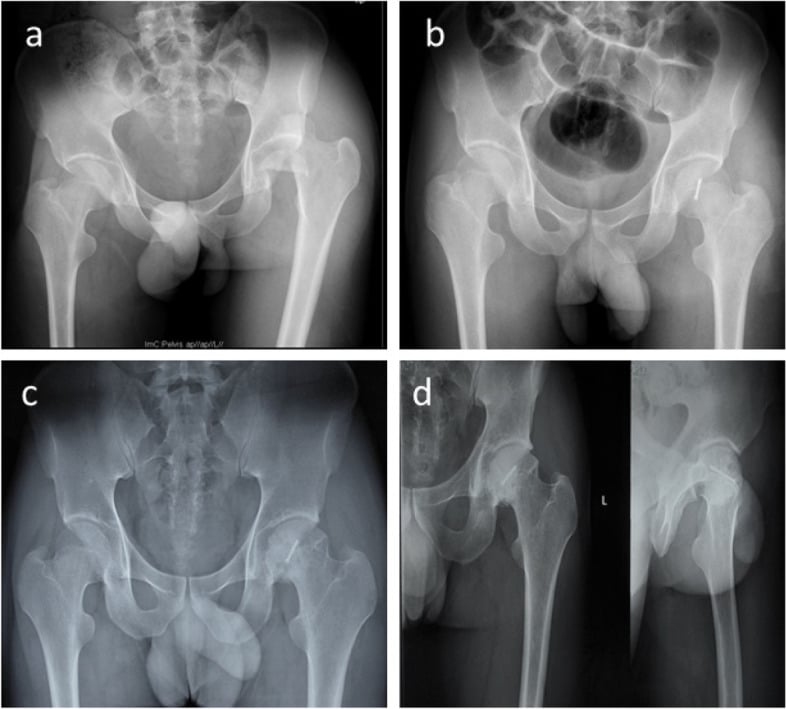
Femoral head fractures are uncommon, and they almost never happen on their own. They occur almost exclusively with a traumatic hip dislocation, most commonly posterior: 75-90% are associated with a posterior dislocation, and the fracture is made when the head is driven against the acetabular rim as it leaves the socket. Pipkin classified them in 1957, and his scheme is still the one used.
Mechanism. High-energy trauma: motor vehicle accidents (the dashboard injury), falls from height, industrial accidents and, rarely, sport. The classic sequence is a seated occupant with the hip flexed and adducted whose knee strikes the dashboard; the force travels up the femur and produces a posterior dislocation with a head fracture.
What decides the outcome. Time from injury to reduction. While the head is out, the medial femoral circumflex artery, its main blood supply, is stretched and occluded, and the rate of avascular necrosis rises dramatically once the hip has been dislocated for more than 6 hours. Everything else in this topic follows from that fact: reduce first, image properly afterwards, and choose an operation that does not injure what blood supply remains.
The classification. Pipkin divides the injuries by where the fragment lies relative to the fovea. A fragment below the fovea (Type I) has come from the non-weight-bearing part of the head; one above it (Type II) has come from the weight-bearing part. Types III and IV are the more complex injuries with an associated femoral neck fracture or acetabular fracture respectively.
Anatomy and Blood Supply
The head. Its superior aspect is the weight-bearing dome, covered by articular cartilage and critical to hip biomechanics; a Pipkin II fragment comes from here. The fovea capitis is the small depression where the ligamentum teres attaches, and it is the landmark on which the classification turns: below the fovea is the non-weight-bearing part of the head.
The blood supply. The medial femoral circumflex artery (MFCA) provides 80% of the head's supply. It arises from the profunda femoris, runs posterior to the femoral neck and gives off the retinacular arteries that enter the head. The lateral femoral circumflex artery supplies the greater trochanter primarily and contributes little to the head. The artery of the ligamentum teres, a branch of the obturator artery, feeds a small area around the fovea; its contribution is variable, significant in 10-20%, and never enough on its own to prevent AVN.
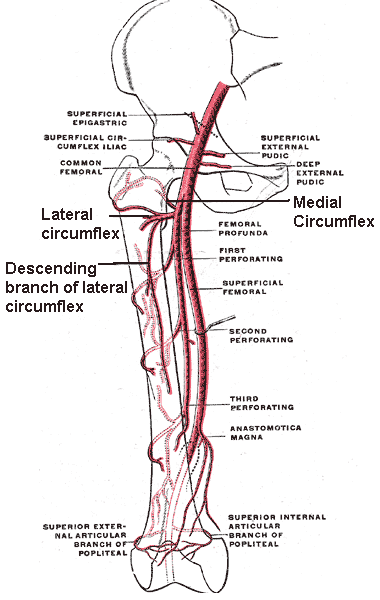
Why a posterior dislocation threatens the head. The MFCA runs behind the neck, so a head that is displaced posteriorly stretches and kinks it. Prolonged dislocation means ischaemia; reduction relieves the stretch, but if reduction is delayed the damage may already be done. The same anatomy governs the surgeon's choice of approach later, since a posterior exposure crosses an artery that the injury has already compromised.
Classification Systems
Pipkin's four types describe the fragment and what came with it. The number tells you two things at once: whether the fragment is from the weight-bearing part of the head, and whether the neck or acetabulum is also broken.
- Fragment Location
- Below fovea
- Associated Fracture
- None
- Key Feature
- Non-weight-bearing zone; best prognosis
- Fragment Location
- Above fovea
- Associated Fracture
- None
- Key Feature
- Weight-bearing zone; moderate prognosis
- Fragment Location
- I or II
- Associated Fracture
- Femoral neck
- Key Feature
- Very high AVN risk
- Fragment Location
- I or II
- Associated Fracture
- Acetabulum
- Key Feature
- Complex polytrauma pattern
Type I. The fragment comes from below the fovea, around the insertion of the ligamentum teres, and is often small. Because it carries no load its size, rather than its position, decides what is done with it.
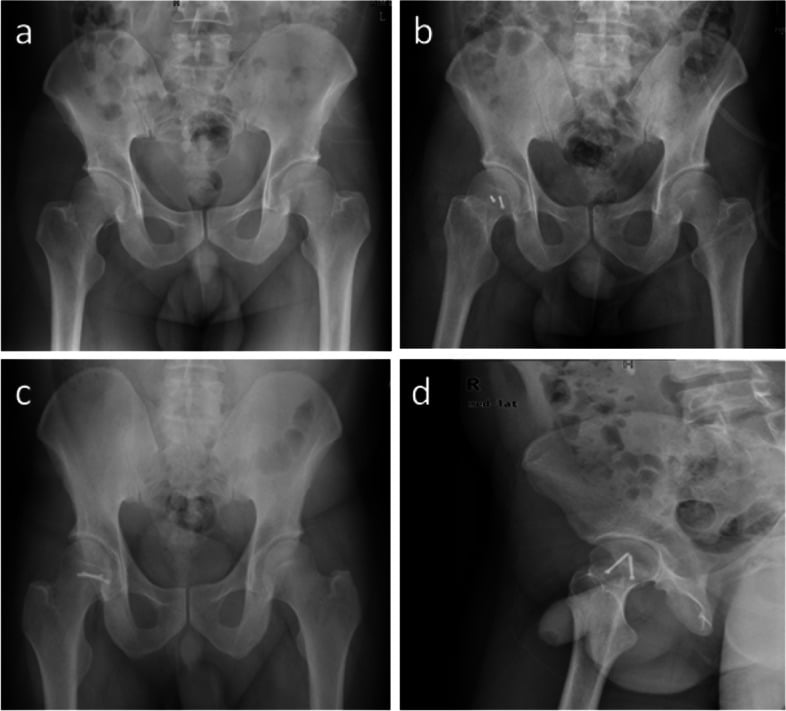
Type II. The fragment comes from the weight-bearing dome, so articular congruity must be restored and the fragment usually needs fixation regardless of size.
Type III. A head fracture of either type with a femoral neck fracture. The neck fracture takes priority, the AVN risk is very high (40-60%), and this is the pattern with the worst prognosis.
Type IV. A head fracture of either type with an acetabular fracture, most often the posterior wall. It is two surgical problems in one hip, and they need a staged approach.
The fovea is the critical landmark. Above fovea = weight-bearing = must fix. Below fovea = non-weight-bearing = may excise if small.
Clinical Presentation and Assessment
History. A high-energy injury, severe hip or groin pain, and a leg the patient cannot move and that looks shortened and internally rotated. In the dashboard mechanism the force arrives through the knee and the femur, so look for the injuries that ride with it:
- Knee injuries (PCL, patella fracture)
- Femoral shaft fracture (the floating hip)
- Other pelvic and acetabular fractures
- Sciatic nerve injury
Examination. The posterior dislocation announces itself: the hip is flexed, adducted and internally rotated, the leg is short, the deformity is obvious and the patient cannot move the hip. The neurovascular examination is mandatory, and the sciatic nerve is the structure at stake.
- Assessment
- Foot dorsiflexion/plantarflexion, sensation
- Injury Rate
- 10-20%
- Assessment
- Toe extension, dorsum sensation
- Injury Rate
- Higher risk
- Assessment
- Toe flexion, plantar sensation
- Injury Rate
- Lower risk
- Assessment
- Femoral, popliteal, DP, PT
- Injury Rate
- Rare injury
Record sciatic nerve function before any reduction attempt. It separates the injury's palsy from an iatrogenic one, and it matters medicolegally.
Differential diagnosis. The deformed, painful hip after trauma has a short list, and the post-reduction CT settles most of it.
- Key Distinguishing Features
- Flexed, adducted, internally rotated shortened limb; smooth concentric head on post-reduction film
- Discriminating Investigation
- Post-reduction CT shows congruent joint, no intra-articular fragment
- Key Distinguishing Features
- As above plus intra-articular bone fragment relative to fovea
- Discriminating Investigation
- CT defines fragment size and supra- vs infra-foveal location
- Key Distinguishing Features
- Shortened, externally rotated limb; pain on axial loading
- Discriminating Investigation
- AP pelvis/CT shows neck lucency; if combined with head fragment it is Pipkin III
- Key Distinguishing Features
- May co-exist; joint instability or incongruity after reduction
- Discriminating Investigation
- CT shows posterior wall defect; combined head injury is Pipkin IV
- Key Distinguishing Features
- Flexed, abducted, externally rotated limb
- Discriminating Investigation
- AP pelvis shows head inferomedial; obturator type lies near foramen
- Key Distinguishing Features
- Atraumatic or low-energy, insidious groin pain, no acute deformity
- Discriminating Investigation
- MRI shows subchondral oedema; not an acute fracture pattern
Investigations
Before reduction. An AP pelvis radiograph is the first-line investigation: it confirms the dislocation and shows associated fractures. A lateral of the hip helps to assess a posterior dislocation but may be difficult to obtain. Neither is a reason to delay the reduction.
After reduction. AP and lateral radiographs confirm a concentric reduction. Joint-space widening is the sign of an interposed fragment, and the films are checked again for associated fractures.
CT is essential after every hip dislocation once it is reduced. It defines the fracture pattern, finds loose bodies and plans the approach, and the report should document six things:
- Fragment size (percentage of the head)
- Fragment location (above or below the fovea)
- Articular step-off
- Loose bodies in the joint
- Associated acetabular fracture
- Femoral neck integrity
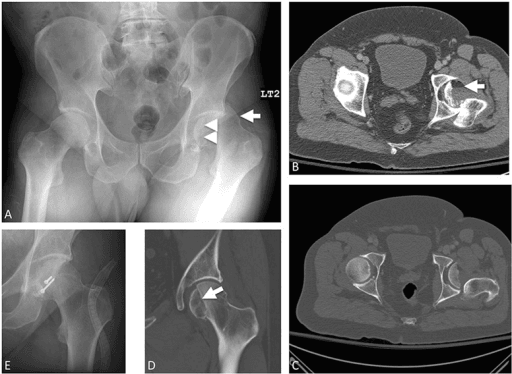
3D reconstruction helps surgical planning: it shows the orientation of the fragment, the sphericity of the head and the trajectory a screw will need.
MRI has no routine place in the acute setting. Its use comes weeks later, to look for early AVN and to assess cartilage damage.
Management
The order of priorities. Everything is done in this sequence, and the first step is the one that decides the outcome:
- Urgent reduction, within 6 hours
- Assess fragment size and location on CT
- Remove incarcerated fragments and loose bodies
- Fix weight-bearing fragments
- Monitor for AVN
The emergency. A dislocated hip is a time emergency. Reduce it in the emergency department if possible, and in theatre if not; do not send the patient for elaborate imaging first. A patient who presents late, beyond 6 hours, is still reduced urgently, accepting that the AVN risk is now higher.
AVN risk by time to reduction: 10-15% under 6 hours, 20-40% at 6-12 hours, over 50% beyond 12 hours. Hougaard and Thomsen's 100 posterior dislocations, the source of the 6-hour convention, found osteonecrosis in 4.8% reduced within 6 hours against 52.9% reduced later; the risk rises continuously with time, so "before 6 hours" is not "safe".
Closed reduction. Under general anaesthesia or deep sedation for muscle relaxation, the Allis manoeuvre:
- Patient supine
- Assistant stabilises the pelvis
- Hip flexed to 90 degrees
- Axial traction in line with the femur
- Gentle internal and external rotation
- Hip adducted initially, then abducted
- Feel or hear the clunk of reduction
The Bigelow manoeuvre, a circumduction technique, is the alternative if Allis fails. Closed reduction fails when a fragment or soft tissue is interposed in the joint, and a hip that will not reduce closed goes to emergent open reduction.
Who needs an operation. Surgery is required for:
- Pipkin II (a weight-bearing fragment)
- A large Pipkin I fragment (over 20%)
- Loose bodies in the joint
- A non-concentric reduction
- An associated acetabular or femoral neck fracture
- An incarcerated fragment
- Fragment Location
- Below fovea (non-weight-bearing)
- Management
- Excise fragment, remove loose bodies
- Fragment Location
- Below fovea but over 20% surface
- Management
- Consider ORIF with countersunk screws
- Fragment Location
- Above fovea (weight-bearing)
- Management
- ORIF REQUIRED - countersunk screws
- Fragment Location
- Any + femoral neck fracture
- Management
- Fix neck urgently + address head
- Fragment Location
- Any + femoral neck fracture
- Management
- Total hip arthroplasty
- Fragment Location
- Any + acetabular fracture
- Management
- Fix acetabulum through posterior + anterior approach for head
- Fragment Location
- Interposed fragment
- Management
- Emergent open reduction
- Fragment Location
- Any type
- Management
- Still reduce urgently, accept higher AVN risk
Pipkin II. The fragment is reduced anatomically and fixed with countersunk screws, restoring articular congruity with every piece of hardware below the cartilage surface. Anatomic reduction is what the outcome depends on.
Pipkin III. The neck fracture takes priority. In the young patient it is fixed urgently and the head fracture is addressed second, often through combined approaches, accepting a high failure and AVN rate. In the elderly patient a total hip arthroplasty gives a better functional outcome and avoids prolonged immobilisation.
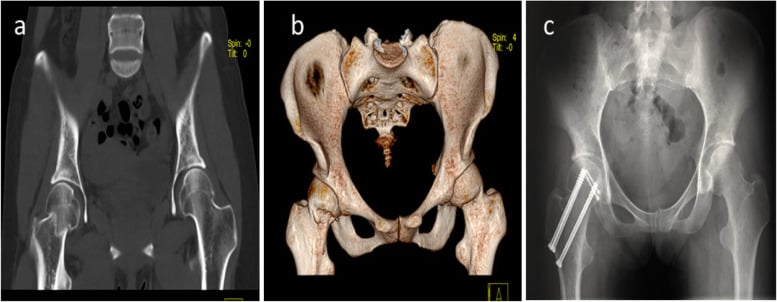
Pipkin IV. Two surgical problems, staged: the acetabular fracture is usually fixed first, through a posterior approach, and the head fragment through an anterior approach. These injuries need careful surgical planning.
Choosing the approach. The classic teaching is an anterior approach after a posterior dislocation, so that the exposure does not cross the posterior blood supply the injury has already compromised; after an anterior dislocation the posterior approach gives direct access.
- Approach
- Anterior (Smith-Petersen)
- Rationale
- Protects posterior blood supply
- Approach
- Posterior (Kocher-Langenbeck)
- Rationale
- Direct access
- Approach
- Posterior + anterior
- Rationale
- Acetabulum posterior, head anterior
The evidence for that rule is thinner than the rule suggests. Stannard's 26-patient series found a 3.2-fold higher osteonecrosis rate with the Kocher-Langenbeck approach than with Smith-Petersen, but the approach was not randomised and the worse injuries went posterior. The Wang meta-analysis of five case-control studies of Pipkin I-II fractures found no difference in osteonecrosis, function or arthritis between approaches, and less heterotopic ossification after the posterior approach. The defensible position is to choose by fracture location and associated injuries, to add heterotopic ossification prophylaxis when the approach is anterior, and not to let a single small series decide.
Surgical Technique
Why. The anterior approach is preferred after a posterior dislocation because it leaves the MFCA alone. It gives excellent visualisation of the femoral head and direct access to its anterior and superior parts, so the fragment can be seen and reduced anatomically.
Set-up. Supine on a radiolucent table, the affected hip slightly externally rotated, with the C-arm available.
Steps.
- Develop the interval between sartorius and tensor fascia lata
- Deepen the interval to expose the hip capsule
- Identify the ascending branch of the lateral femoral circumflex artery
- T-capsulotomy for exposure
Complications
Avascular necrosis. The rate by Pipkin type is in the outcomes table below; Type III carries the highest. Beyond the type, the risk rises with:
- Dislocation time, the most important factor
- Multiple reduction attempts
- Severity of the initial injury
- Age, higher in older patients
Established AVN is managed conservatively at first if asymptomatic, by core decompression in its early stages, and by total hip arthroplasty when advanced; in the young patient joint preservation is considered.
Post-traumatic arthritis. Develops in 20-50% at 10 years, and may progress despite a good initial result. It follows residual articular incongruity, cartilage damage at the moment of injury, AVN and retained loose bodies. Treatment runs from activity modification, NSAIDs and intra-articular injections to total hip arthroplasty at end stage.
Heterotopic ossification. More likely after delayed surgery, extensive soft-tissue trauma, in men and after head injury. Prophylaxis:
- Indometacin 75mg daily for 6 weeks
- Single-dose radiation (700 cGy)
- Low-dose radiation for the high-risk patient
Sciatic nerve injury. Most palsies recover after reduction, the peroneal division doing worse than the tibial. If there is no recovery, EMG at 3-4 weeks.
Recurrent dislocation. Rare, and usually the consequence of a malreduced posterior wall; it may need revision fixation.
Postoperative Care
The first two weeks. On the day of surgery: an abduction pillow or wedge, DVT prophylaxis with enoxaparin, analgesia and hip precautions if needed. Over the first fortnight the wound is checked, weight-bearing is protected at toe-touch, gentle range-of-motion exercises begin and DVT prophylaxis continues. Early mobilisation reduces the DVT risk.
Weight-bearing. The timeline is individualised to the Pipkin type, the stability of the fixation, radiographic healing and the associated injuries:
- Weeks 0-6: toe-touch weight-bearing
- Weeks 6-8: partial weight-bearing (50%)
- Weeks 8-12: progressive to full
- Week 12 onwards: full weight-bearing
Rehabilitation. The early phase (0-6 weeks) is passive range of motion, isometric strengthening and gait training with an aid, avoiding hip flexion beyond 90 degrees. The late phase (6-12 weeks) progresses to active range of motion and strengthening, pool therapy once the wound has healed, and a gradual return to activities. High-impact activity is avoided for a minimum of 6 months.
Follow-up. AVN may appear up to 2 years after the injury, so the follow-up is long: AP and lateral radiographs at 6 weeks, then radiographs at 3, 6 and 12 months, and a final assessment at 2 years. Serial films are read for collapse, MRI is requested if symptoms suggest AVN, and intervention is early if it is found.
Outcomes and Prognosis
- Good/Excellent Result
- 80-90%
- AVN Rate
- 10-15%
- Prognosis
- Best
- Good/Excellent Result
- 70-80%
- AVN Rate
- 15-25%
- Prognosis
- Moderate
- Good/Excellent Result
- 40-50%
- AVN Rate
- 40-60%
- Prognosis
- Poor
- Good/Excellent Result
- 50-60%
- AVN Rate
- 20-30%
- Prognosis
- Variable
What predicts a good result. Reduction within 6 hours, a Pipkin I with a small fragment, an anatomic reduction, a young patient and no associated fractures.
What predicts a poor one. Reduction delayed beyond 12 hours, a Pipkin III pattern or an associated neck fracture, a non-anatomic reduction and multiple reduction attempts.
Return to function. Most patients return to their daily activities. High-impact activity is often limited, athletes may struggle to return to sport, and some patients need their occupation modified.
Guidelines, Registries & Global Practice
Global Epidemiology
Femoral head fractures are rare injuries that occur almost exclusively after high-energy posterior hip dislocation, most often from motor vehicle dashboard injuries or falls from height. The contemporary EFORT narrative review (Menger et al., 2021) confirms they remain uncommon and are still classified worldwide using the 1957 Pipkin system, with osteonecrosis, post-traumatic arthritis and heterotopic ossification as the principal drivers of poorer long-term outcome.
Side-by-Side Guidance and Evidence
- Core Position
- Emergent closed reduction of the dislocation, then CT, then ORIF of weight-bearing fragments; anterior approach favoured after posterior dislocation
- Evidence Basis
- Expert consensus on level III-IV cohorts
- Core Position
- Reduce dislocation as an emergency, document neurovascular status, post-reduction CT mandatory, definitive fixation in a unit with pelvic-acetabular expertise
- Evidence Basis
- Standards for trauma (consensus)
- Core Position
- Classification-led: excise small non-weight-bearing fragments, fix supra-foveal fragments with countersunk headless screws
- Evidence Basis
- Technique consensus
- Core Position
- Approach individualised to fragment location, displacement and loose bodies; no single approach proven superior for osteonecrosis
- Evidence Basis
- Narrative review (Menger 2021)
Registry and Pooled Evidence
Because femoral head fractures are rare, no national joint registry isolates them as a discrete cohort; registry data (AOANJRR in Australia, NJR in England and Wales, AJRR in the United States) inform only the salvage arthroplasty pathway for Pipkin III injuries and post-traumatic arthritis. The highest-level synthesis comes from pooled studies: a meta-analysis of Pipkin I-II fractures found the posterior approach reduced heterotopic ossification without affecting osteonecrosis (Wang et al., 2016), while a systematic review of surgical hip dislocation reported osteonecrosis in 12%, heterotopic ossification in 25% and osteoarthritis in 16% (Khalifa et al., 2021).
Practice Variation
- Approach: North American and many European units favour the anterior (Smith-Petersen) approach after posterior dislocation to protect the medial femoral circumflex artery; others prefer the Ganz surgical hip dislocation for full articular visualisation, accepting trochanteric osteotomy-related risk.
- Heterotopic ossification prophylaxis: more routinely used after anterior and extensile approaches; indometacin or single-dose radiotherapy regimens vary by region.
- Salvage in the elderly: primary total hip arthroplasty for Pipkin III in older patients is widely accepted internationally, reflecting the very high osteonecrosis risk of combined head-and-neck injuries.
- Standard trauma pathway: in major trauma centres internationally, femoral head fractures are managed with emergent reduction within 6 hours under general anaesthesia, universal post-reduction CT, and protocolised rehabilitation according to fracture pattern and fixation.
Viva Scenarios
Viva Scenarios
Clinical Decision Scenarios
Practise clinical reasoning and management decisions out loud
“A 32-year-old male involved in a high-speed MVA presents with his right leg shortened, flexed, and internally rotated. AP pelvis shows posterior hip dislocation. What is your management?”
“After reduction of a posterior hip dislocation, CT shows a femoral head fracture with a fragment involving 35% of the head.”
“A CT after reduction of a posterior hip dislocation shows a Pipkin II fracture - the fragment involves 30% of the femoral head above the fovea. No associated neck or acetabular fracture.”
MCQ Practice Points
Q: What is the key anatomical landmark in the Pipkin classification?
A: The fovea capitis. Type I = below fovea (non-weight-bearing), Type II = above fovea (weight-bearing). The fovea determines whether fixation is mandatory.
Q: What is the target time for reduction of a traumatic hip dislocation?
A: Under 6 hours. AVN risk is 10-15% if reduced within 6 hours, rising to over 50% if delayed beyond 12 hours.
Q: Which surgical approach is preferred for ORIF of a femoral head fracture after posterior hip dislocation?
A: Anterior (Smith-Petersen) approach. This protects the already-compromised posterior blood supply (MFCA) from further damage.
Q: What is the primary blood supply to the femoral head?
A: Medial femoral circumflex artery (MFCA) provides 80% of blood supply via retinacular vessels. It courses posteriorly and is at risk with posterior dislocation.
Q: How should a Pipkin III fracture be managed in an elderly patient?
A: Total hip arthroplasty. The combination of femoral head and neck fracture has very high AVN rates (40-60%). In elderly patients, arthroplasty provides better functional outcomes.
Exam Cheat Sheet
Exam Day Cheat Sheet
Critical Timing
- Reduce dislocation within 6 HOURS
- AVN rate 10-15% if under 6 hours
- AVN rate over 50% if over 12 hours
- Do NOT delay for elaborate imaging
Pipkin Classification
- Type I: Below fovea (non-weight-bearing)
- Type II: Above fovea (weight-bearing)
- Type III: I or II + femoral neck fracture
- Type IV: I or II + acetabular fracture
Management by Type
- Type I small: excise fragment
- Type I large (over 20%): consider ORIF
- Type II: ORIF with countersunk screws
- Type III elderly: THA
Surgical Approach
- Posterior dislocation: use ANTERIOR approach
- Protects remaining MFCA blood supply
- Smith-Petersen interval
- Pipkin IV: combined approaches
Post-Reduction CT
- MANDATORY for all hip dislocations
- Assess fragment size and location
- Identify loose bodies
- Plan surgical approach
Complications
- AVN: 10-60% depending on type
- Post-traumatic arthritis: 20-50%
- Sciatic nerve injury: 10-20%
- Heterotopic ossification: prophylaxis indicated
Quick Reference: Key Numbers
- Value
- Under 6 hours
- Value
- 10-15%
- Value
- Over 50%
- Value
- 10-20%
- Value
- 40-60%
- Value
- Over 20%
- Value
- 6-8 weeks
- Value
- 1-2 years
Pipkin Summary Table
- Fragment
- Below fovea
- Associated Fracture
- None
- Treatment
- Excise (small) or ORIF (large)
- Fragment
- Above fovea
- Associated Fracture
- None
- Treatment
- ORIF
- Fragment
- Any
- Associated Fracture
- Femoral neck
- Treatment
- Arthroplasty (elderly) or fix
- Fragment
- Any
- Associated Fracture
- Acetabulum
- Treatment
- Combined approach
Evidence Base
Time to Reduction and Osteonecrosis (Landmark)
- In 100 adult posterior hip dislocations, avascular necrosis occurred in 4.8% of hips reduced within 6 hours versus 52.9% of hips reduced after 6 hours
- Higher-grade (Stewart-Milford grade III-IV) dislocations had a significantly higher osteonecrosis rate; skeletal traction and non-weight-bearing showed no protective benefit
Long-Term Outcome of Posterior Hip Dislocation
- In 33 patients followed a mean of 49 months, the Pipkin scheme was a useful predictor of outcome: Pipkin 1-2 injuries did significantly better than Pipkin 3-4 (p less than 0.02)
- Overall 67% good, 18% fair and 15% poor results, with outcome dependent on anatomic reduction, restoration of stability and removal of all interposed fragments
Surgical Approach and Osteonecrosis Risk
- The Kocher-Langenbeck posterior approach was associated with a 3.2-fold higher incidence of avascular necrosis compared with the Smith-Petersen anterior approach
- 3 mm cannulated screws with threaded washers gave poor functional outcomes and are contraindicated for femoral head fixation
Anterior vs Posterior Approach (Meta-Analysis)
- Pooled analysis of five case-control studies of Pipkin I-II fractures found the posterior approach significantly reduced heterotopic ossification compared with the anterior approach
- No significant differences were found between approaches for functional outcome, osteonecrosis or post-traumatic arthritis
Surgical Hip Dislocation (Ganz) Outcomes
- Across nine studies (129 fractures), surgical hip dislocation achieved satisfactory clinical outcome in 85% and anatomical reduction in 74% at a mean 38.4 months
- Avascular necrosis occurred in 12%, heterotopic ossification in 25% and osteoarthritis in 16%; trochanteric osteotomy nonunion (3.4%) is a unique risk of this approach
Contemporary Narrative Review
- Femoral head fractures are rare, typically follow posterior hip dislocation and are classified with the 1957 Pipkin system, which remains the most widely used scheme
- Emergency closed reduction followed by approach selection guided by fracture location, displacement, joint congruity and loose fragments is the current standard; osteonecrosis, post-traumatic arthritis and heterotopic ossification drive poorer outcomes